semi合集-English.pdf - 第1525页
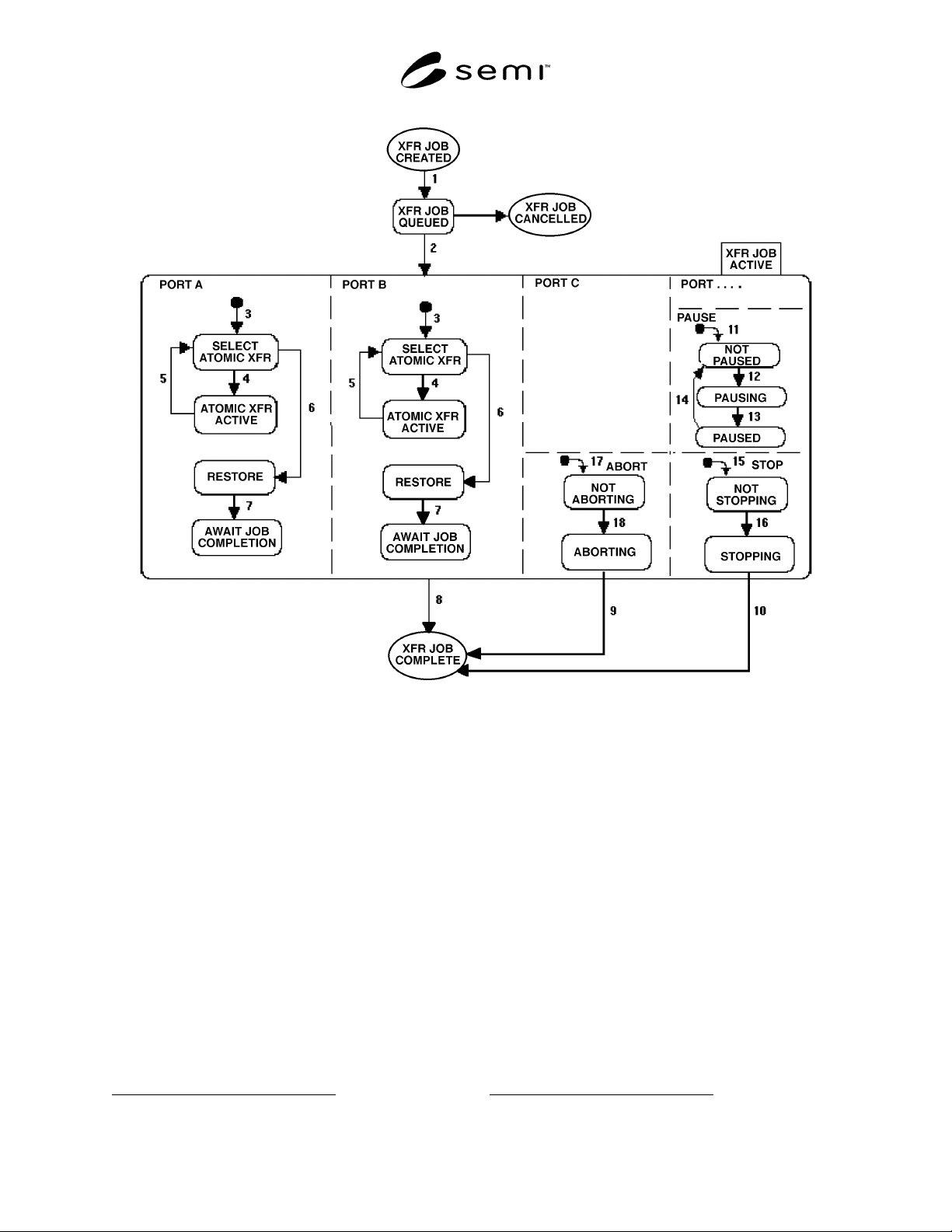
SEMI E32-0997 © SEMI 1994 , 1997 20 PAU SE The PAUSE state is an AND substa te of T RANSFER JOB ACTIVE. That is, the pau se feature is concurren t with the execution of t he transfer job. The PAUSE state has three su b s…
SEMI E32-0997 © SEMI 1994, 199719
Figure 4.7
Extended Transfer Job State Model
ABORT
The ABORT state is an AND substate of TRANSFER
JOB ACTIVE. This state is responsible for coordination
of any activities necessary to abort
10
the active transfer
job. The ABORT state has two substates: NOT
ABORTING and ABORTING.
NOT ABORTING
In this state, the abort process is not in effect. The
transfer job proceeds normally.
ABORTING
In this state the transfer job is causing its active atomic
transfers to abort. This state is active only so long as
any of the transfer job's atomic transfers remains active.
STOP
10 See Section 4.1 for the defintion of abort.
The STOP state is an AND substate of TRANSFER
JOB ACTIVE. This state is responsible for coordination
of any activities necessary to stop
11
the active transfer
job. STOP has two substates: NOT STOPPING and
STOPPING.
NOT STOPPING
In this state, the STOP process is not in effect. The
transfer job proceeds normally.
STOPPING
In this state the process of stopping occurs. When the
STOPPING state is active and the SELECT ATOMIC
TRANSFER state is entered, that atomic transfer shall
transition to the AWAIT JOB COMPLETION state.
When all ports have reached that state, transition 10
from the STOPPING state occurs (see Figure 4.7).
11 See Section 4.1 for the definition of stop.

SEMI E32-0997 © SEMI 1994, 1997 20
PAUSE
The PAUSE state is an AND substate of TRANSFER
JOB ACTIVE. That is, the pause feature is concurrent
with the execution of the transfer job. The PAUSE state
has three substates: NOT PAUSED, PAUSING, and
PAUSED.
NOT PAUSED
A newly activated job is NOT PAUSED by default. In
this state, the transfer job proceeds as normal.
PAUSING
This state is coordinating the movement of the transfer
job from NOT PAUSED to PAUSED. It is responsible
for making sure that the current activity for each port
for the job has ceased at an appropriate point. The
transfer job is PAUSING until all of its active atomic
transfers are paused.
PAUSED
All activity has ceased. The transfer job is awaiting a
Resume command. Note that the PORT A, PORT B,
etc., substates retain their current states, but their
activity ceases when PAUSED.
The following transition table defines the added
transitions between states for the extended transfer job
state model. It applies to Figure 4.7.
Table 4.3 Extended Transfer Job State Transition Table
# Current State Trigger New State Action(s) Comment
9 ABORTING Abort process is complete. (Transfer Job
Complete)
Send “Transfer Job Complete”
message to host indicating
abnormal termination.
Host or equipment
previously issued
abort.
10 STOPPING Stop process is complete. (Transfer Job
Complete)
Send “Transfer Job Complete”
message to host indicating
abnormal termination.
Host or equipment
previously issued
abort.
11 (Undefined) Default entry into PAUSE state. NOT PAUSED None. None.
12 NOT PAUSED Host or equipment issued a
directive to pause.
PAUSING None. None.
13 PAUSING All transfer job activity has
ceased.
PAUSED None. “Transfer Job
Paused” event has
occurred.
14 PAUSED Host issued a directive to resume
the transfer job.
NOT PAUSED None. “Transfer Job
Resumed” event
has occurred.
15 (Undefined) Default entry into STOP state. NOT STOPPING None. None.
16 NOT STOPPING Stop initiated. STOPPING Begin stop activities. None.
17 (Undefined) Default entry into ABORT state. NOT
ABORTING
None. None.
18 NOT ABORTING Abort initiated. ABORTING Begin abort activities. None.
19 TRANSFER JOB
QUEUED
Cancel, Abort, or Stop command
received.
TRANSFER JOB
CANCELLED
Remove the transfer job from
the queue.
None.
SEMI E32-0997 © SEMI 1994, 199721
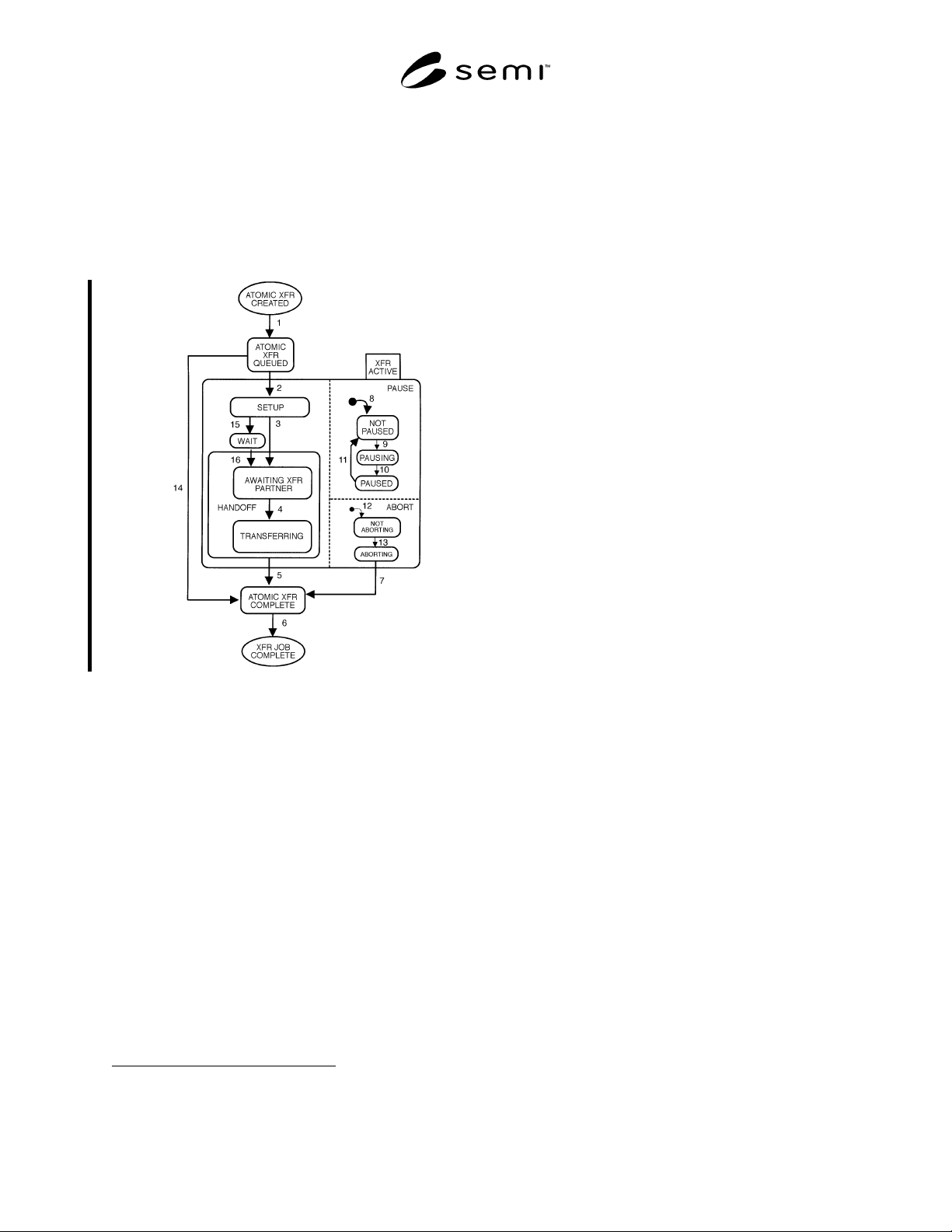
4.3.3 Extended Atomic Transfer State Model — Figure
4.8 presents an extended atomic transfer state model.
This model extends the atomic transfer model in a way
similar to the transfer job extension. It provides for the
capability to pause/resume and to abort
12
. Except for
the extensions, this model is the same as that presented
as Figure 4.6. Therefore, only the extensions are
discussed in this section.
Figure 4.8
Extended Atomic Transfer State Diagram
WAIT
The atomic transfer stops activity and awaits a
StartHandoff command from the host. This capability
allows the host to precisely orchestrate the timing of the
handoff in time critical operations.
ABORT
The ABORT state is an AND substate of TRANSFER
ACTIVE. This state is responsible for coordination of
any activities necessary to abort the active atomic
transfer. The ABORT state has two substates:
ABORTING and NOT ABORTING.
NOT ABORTING
In this state, the abort process is not in effect. The
atomic transfer proceeds normally.
12 Note that “stop” does not apply to atomic transfers, since the
active atomic transfers are allowed to complete when the transfer job
is stopped.
ABORTING
In this state, the process of aborting is performed. It is
the responsibility of the equipment to cease physical
activity as quickly as possible and end the current
atomic transfer. This process is application-specific. It
is the responsibility of the supplier to document this
method.
PAUSE
The PAUSE state is an AND substate of ATOMIC
TRANSFER ACTIVE. That is, the pause states are
concurrent with the execution states of the atomic
transfer. The PAUSE state has three substates: NOT
PAUSED, PAUSING, and PAUSED.
NOT PAUSED
A newly activated atomic transfer is NOT PAUSED by
default. In this state, the atomic transfer proceeds as
normal.
PAUSING
This state is coordinating the movement of the atomic
transfer from NOT PAUSED to PAUSED. It is
responsible for making sure that the current activity for
the atomic transfer has ceased at an appropriate point.
PAUSED
All activity has ceased. The atomic transfer is awaiting
a Resume command. Note that the PORT A, PORT B,
etc., substates retain their current states, but their
activity ceases when PAUSED.
The following transition table defines the added
transitions between states for the extended atomic
transfer state model. It applies to Figure 4.8.