semi合集-English.pdf - 第90页
SEMI E10-0304 E © SEMI 1986, 2004 4 • Process engineering (e.g., process character- ization), • Equipment engineeri ng (e.g., equi pment eval- uation), and • Software engineering (e.g., s oftware qualification). 5.8 SCHE…
SEMI E10-0304
E
© SEMI 1986, 2004 3
4.1.26 training (on-the-job) — the instruction of
personnel in the operation and/or maintenance of
equipment done during the course of normal work
functions. On-the-job training typically does not
interrupt operation or maintenance activities and can
therefore be included in any equipment state (except
standby and non-scheduled) without special
categorization.
4.1.27 unit — any wafer, substrate, die, packaged die,
or piece part thereof.
4.1.28 uptime — the time when the equipment is in a
condition to perform its intended function. It includes
productive, standby, and engineering time, and does not
include any portion of non-scheduled time.
4.1.29 user — any entity interacting with the
equipment, either locally as an operator or remotely via
the host. From the equipment’s view point, both the
operator and the host
represent the user.
4.1.30 utilization — the percent of time the equipment
is performing its intended function during a specified
time period.
4.1.31 verification run — a single cycle of the equip-
ment (using units or no units) used to establish that it is
performing its intended function within specifications.
5 Equipment States
5.1 To clearly measure equipment performance
(RAM), this document defines six basic equipment
states into which all equipment conditions and periods
of time must fall.
5.2 The equipment states are determined by function,
not by organization. Any given maintenance
procedure, for example, is classified the same way no
matter who performs it, an operator, a production
technician, a maintenance technician, or a process
engineer.
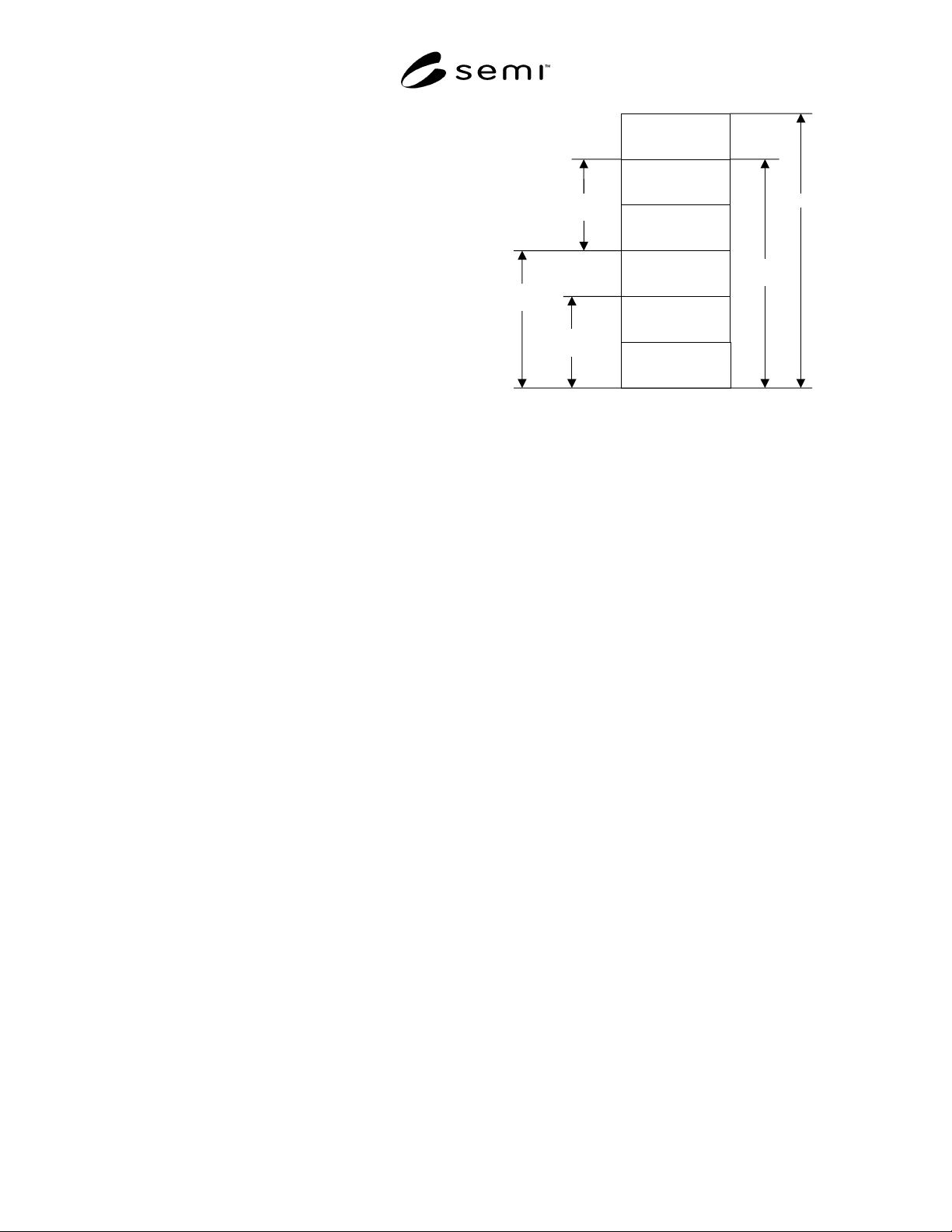
5.3 Figure 1 is a stack chart of the six basic equipment
states. These basic equipment states can be divided into
as many sub-states as are required to achieve the
equipment tracking resolution that a manufacturing
operation desires. SEMI E10 makes no attempt to list
all possible sub-states, but does give some examples for
guidance.
5.4 Key blocks of time associated with the basic states
and example substates are given in Figure 2. These
blocks of time are used in the RAM equations given
later in this document. The blocks of time associated
with the basic states and example substates are
described in the following sections.
SCHEDULED
DOWNTIME
STANDBY
TIME
ENGINEERING
TIME
UNSCHEDULED
DOWNTIME
NON-SCHEDULED
TIME
PRODUCTIVE
TIME
Equipment
Uptime
Operations
Time
Total Time
Manufacturing
Time
Equipment
Downtime
Figure 1
Equipment States Stack Chart
5.5 PRODUCTIVE STATE — The time (productive
time) when the equipment is performing its intended
function. The productive state includes:
• Regular production (including loading and
unloading of units),
• Work for third parties,
• Rework, and
• Engineering runs done in conjunction with
production units (e.g., split lots and new
applications).
5.6 STANDBY STATE — The time (standby time),
other than non-scheduled time, when the equipment is
in a condition to perform its intended function,
chemicals and facilities are available, but it is not
operated. The standby state includes:
• No operator available (including breaks, lunches,
and meetings),
• No units available (including no units due to lack
of available support equipment, such as metrology
tools),
• No support tools (e.g., cassettes, wafer carriers,
probe cards), and
• No input from external automation systems (i.e.,
host).
5.7 ENGINEERING STATE — The time (engineering
time) when the equipment is in a condition to perform
its intended function (no equipment or process
problems exist), but is operated to conduct engineering
experiments. The engineering state includes:

SEMI E10-0304
E
© SEMI 1986, 2004 4
• Process engineering (e.g., process character-
ization),
• Equipment engineering (e.g., equipment eval-
uation), and
• Software engineering (e.g., software qualification).
5.8 SCHEDULED DOWNTIME STATE — The time
(scheduled downtime) when the equipment is not
available to perform its intended function due to
planned downtime events. The scheduled downtime
state includes:
• Maintenance delay (maint-delay),
• Production test,
• Preventive maintenance,
• Change of consumables/chemicals,
• Setup, and
• Facilities related (fac-rel).
5.8.1 Maintenance Delay — The time (maint-delay
downtime) during which the equipment cannot perform
its intended function because it is waiting for either user
or supplier personnel or parts (including
consumables/chemicals) associated with maintenance.
Maintenance delay may also be due to an administrative
decision to leave the equipment down and postpone
maintenance.
5.8.1.1 Maintenance delays may occur at any point in
the maintenance process. These maintenance delay
downtimes must be tracked separately from
maintenance time. Delay downtime is included in time
off-line, but not in time to repair (see Sections 6.3 and
6.4 Equipment Availability and Maintainability).
5.8.2 Production Test — The time (production test
downtime) for the planned interruption of equipment
availability for evaluation of units, as defined in the
specifications of equipment operation, to confirm that
the equipment is performing its intended function
within specifications. It does not include testing that
can be done in parallel with, or transparent to, the
running of production, nor does it include any testing
done following a preventive maintenance, setup, or
repair procedure.
5.8.3 Preventive Maintenance — The sum of the times
(preventive maintenance downtimes) for:
• Preventive action: A predefined maintenance
procedure (including equipment ramp-down and
ramp-up), at scheduled intervals, designed to
reduce the likelihood of equipment failure during
operation. Scheduled intervals may be based upon
time, equipment cycles, or equipment conditions.
• Equipment test: The operation of equipment to
demonstrate equipment functionality; (e.g., system
reaches base pressure, wafers transfer without
problem, gas flow is correct, plasma ignites, source
reaches specified power).
• Verification run: The processing and evaluation of
units after preventive action to establish that the
equipment is performing its intended function
within specifications.
NOTE 2: Equipment suppliers are responsible for specifying
a preventive maintenance program to achieve a predetermined
equipment performance level. Users are obligated to identify
any deviation from the recommended program if they expect
the supplier to meet or improve that performance level.
5.8.4 Change of Consumables/Chemicals — The time
(change of consumables/chemicals downtime) for the
scheduled interruption of operation to replenish the raw
materials of semiconductor processing. It includes
changes of gas bottles, acids, targets, sources, etc., and
any purging, cleaning, or flushing normally associated
with those changes. It does not include delays in
obtaining those consumables/chemicals.
5.8.5 Setup — The sum of the times (setup downtimes)
for:
• Conversion: The time required to complete an
equipment alteration necessary to accommodate a
change in process, unit, package configuration, etc.
(excluding modifications, rebuilds, and upgrades).
• Equipment test: The operation of equipment to
demonstrate equipment functionality; (e.g., system
reaches base pressure, wafers transfer without
problem, gas flow is correct, plasma ignites, source
reaches specified power).
• Verification run: The processing and evaluation of
units after conversion to establish that equipment is
performing its intended function within
specifications.
NOTE 3: Equipment suppliers are responsible for providing
procedures which achieve setup conversion and testing within
predetermined specifications. Users are obligated to identify
any deviation from the procedures if they expect the supplier
to make setups fall within those specifications.
5.8.6 Facilities Related — The time (facilities-related
downtime) when the equipment cannot perform its
intended function solely as a result of out of
specification facilities. Those facilities include:
• Environmental (e.g., temperature, humidity,
vibration, particle count),
• House hookups (e.g., power, cooling water, house
gases, exhaust, LN2), and

SEMI E10-0304
E
© SEMI 1986, 2004 5
• Communications links with other equipment or
host computers.
5.8.6.1 Any downtime created by the items listed
above shall be included in facilities-related downtime.
For example, if, as a result of a scheduled 15-minute
power outage an otherwise unnecessary cryo pump
regeneration is needed, all time required to return the
equipment to a condition where it can perform its
intended function is included in facilities-related
downtime.
5.9 UNSCHEDULED DOWNTIME STATE — The
time (unscheduled downtime) when the equipment is
not in a condition to perform its intended function due
to unplanned downtime events:
• Maintenance delay (maint-delay)
• Repair
• Change of consumables/chemicals
• Out-of-spec input
• Facilities related (fac-rel)
5.9.1 Maintenance Delay — The time (maint-delay
downtime) during which the equipment cannot perform
its intended function because it is waiting for either user
or supplier personnel or parts (including
consumables/chemicals) associated with maintenance.
Maintenance delay may also be due to an administrative
decision to leave the equipment down and postpone
maintenance.
5.9.1.1 Maintenance delays may occur at any point in
the maintenance process. These maintenance delay
downtimes should be tracked separately from
maintenance time. Delay downtime is included in time
off-line, but not in maintenance time (see Sections 6.3
and 6.4 Equipment Availability and Maintainability).
5.9.2 Repair — The sum of the times (repair
downtimes) for:
• Diagnosis: The procedure of identifying the source
of an equipment problem or failure.
• Corrective action: The maintenance procedure
(including equipment ramp-down and ramp-up, re-
booting, resetting, recycling, restarting, reverting to
a previous software version, etc.) employed to
address an equipment failure and return the
equipment to a condition where it can perform its
intended function.
• Equipment test: The operation of equipment to
demonstrate equipment functionality (e.g., system
reaches base pressure, wafers transfer without
problem, gas flow is correct, plasma ignites, source
reaches specified power).
• Verification run: The processing and evaluation of
units after corrective action to establish that the
equipment is performing its intended function
within specifications.
5.9.3 Change of Consumables/Chemicals — The time
(change of consumables/chemicals downtime) for the
unscheduled interruption of operation to replenish the
raw materials of semiconductor processing. It includes
changes of gas bottles, acids, targets, sources, etc., and
any purging, cleaning, or flushing normally associated
with those changes. It does not include delays in
obtaining these consumables/chemicals.
5.9.4 Out-of-Spec Input — The time (out-of-spec input
downtime) when the equipment cannot perform its
intended function solely as a result of problems created
by out-of-specification or faulty inputs. Those inputs
include:
• Support tools (e.g., warped cassettes or wafer
carriers, faulty probe cards, reticles),
• Unit (e.g., upstream process problems, warped
wafers, contaminated wafers, warped lead frames),
• Test data (e.g., metrology tool out of calibration,
misread charts, erroneous data interpre-
tation/entry), and
• Consumables/chemicals (e.g., contaminated acid,
leaky target bond, degraded photo resist, degraded
mold compound).
5.9.4.1 Any downtime created by the items listed
above shall be included in out-of-specification input
downtime. For example, if, as a result of an
intermittent probe card short, a prober/tester system is
put down for repair, all downtime incurred prior to
identifying the problem is re-categorized as out-of-
specification input downtime.
5.9.5 Facilities Related — The time (facilities-related
downtime) when the equipment cannot perform its
intended function solely as a result of out-of-
specification facilities. Those facilities include:
• Environmental (e.g., temperature, humidity,
vibration, particle count),
• House hookups (e.g., power, cooling water, house
gases, exhaust, LN2), and
• Communications links with other equipment or
host computers.
5.9.5.1 Any downtime created by the items listed
above shall be included in facilities-related downtime.
For example, if, as a result of an unscheduled 15-
minute power outage, an otherwise unnecessary cryo
pump regeneration is needed, all time required to return