semi合集-English.pdf - 第3502页
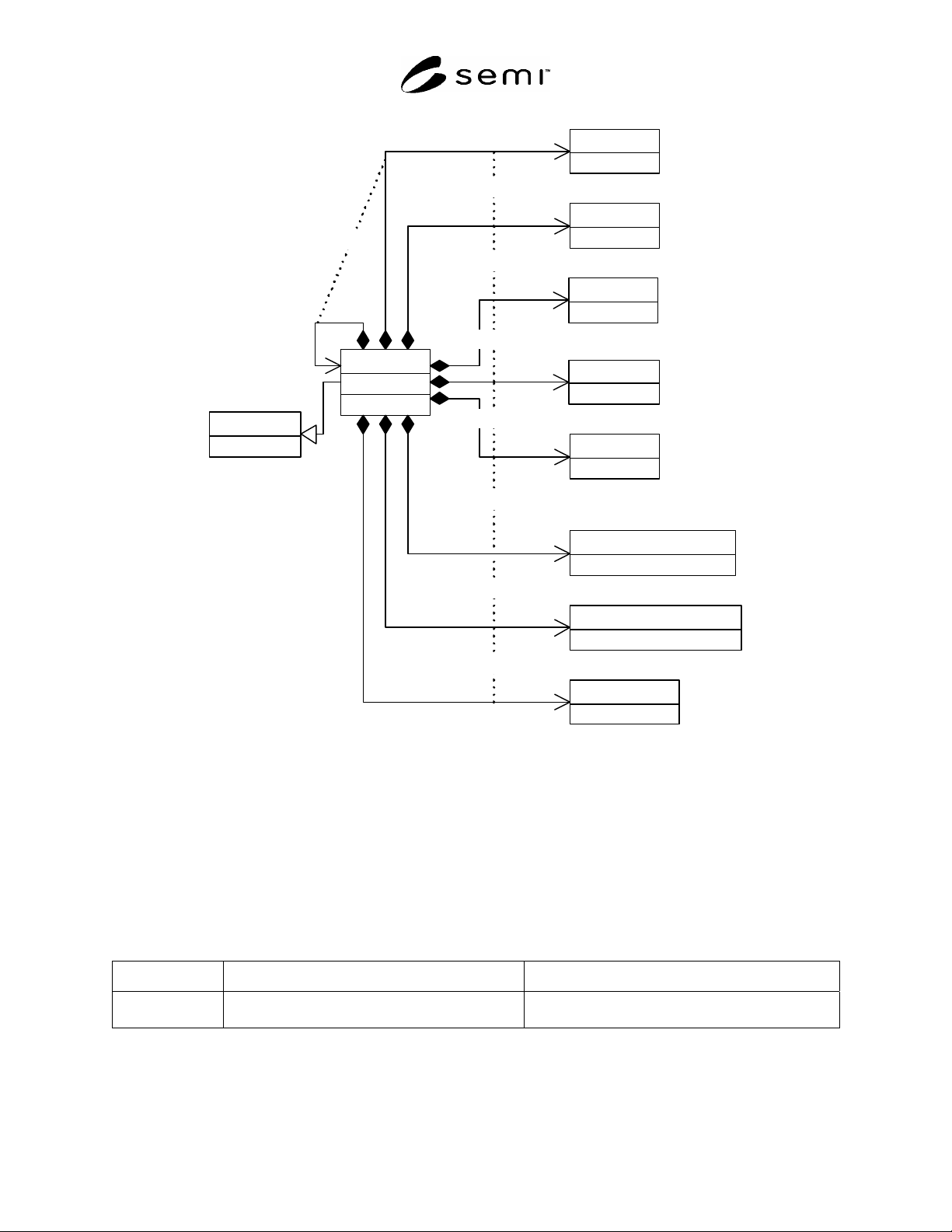
SEMI E134-0305 © SEMI 2004, 2005 55 Str u ct u r eV al u e In t ege r Va l u e St r in g Va l u e Bi na ry Va lu e Bo ol e a nV a lue Re a lV al ue E n u m er at ed I n t eg e r Val u e Arra yV a l u e E n u m er at ed S…
SEMI E134-0305 © SEMI 2004, 2005 54
ArrayValue
Enu merated String Value
Enu merated IntegerValue
IntegerValue
RealValue
BooleanValue
StringValue
BinaryValue
StructureValue
1
values
0..*
1
values
0..*
1
values
0..*
1
values
0..*
1
values
0..*
1
values
0..*
1
values
0..*
1
values
0..*
1
0..*
{XOR}
{XOR}
{XOR}
{XOR}
{XOR}
{XOR}
{XOR}
{XOR}
AbstractValue
{ordered}
{ordered}
{ordered}
{ordered}
{ordered}
{ordered}
{ordered}
{ordered}
{ordered}
Figure 31
Array Values
14.4.3 Figure 31 shows how to represent array values. An array is an ordered collection of zero or more elements,
each element of the same type. In this case the UML {XOR} constraint is used to show that arrays must contain
values of one type only (integers, reals, strings, etc.). Note also that array values can be nested (each element of an
array can be an array).
14.4.3.1 ArrayValue — Represents an array of one or more values of the same type.
14.4.3.2 ArrayValue Attribute Definition Table
Table 75 ArrayValue Attribute Definition
Attribute Name Definition Form
values The values of the array. Ordered list of elements, each of the same specific
primitive, enumerated, structure, or array type.
SEMI E134-0305 © SEMI 2004, 2005 55
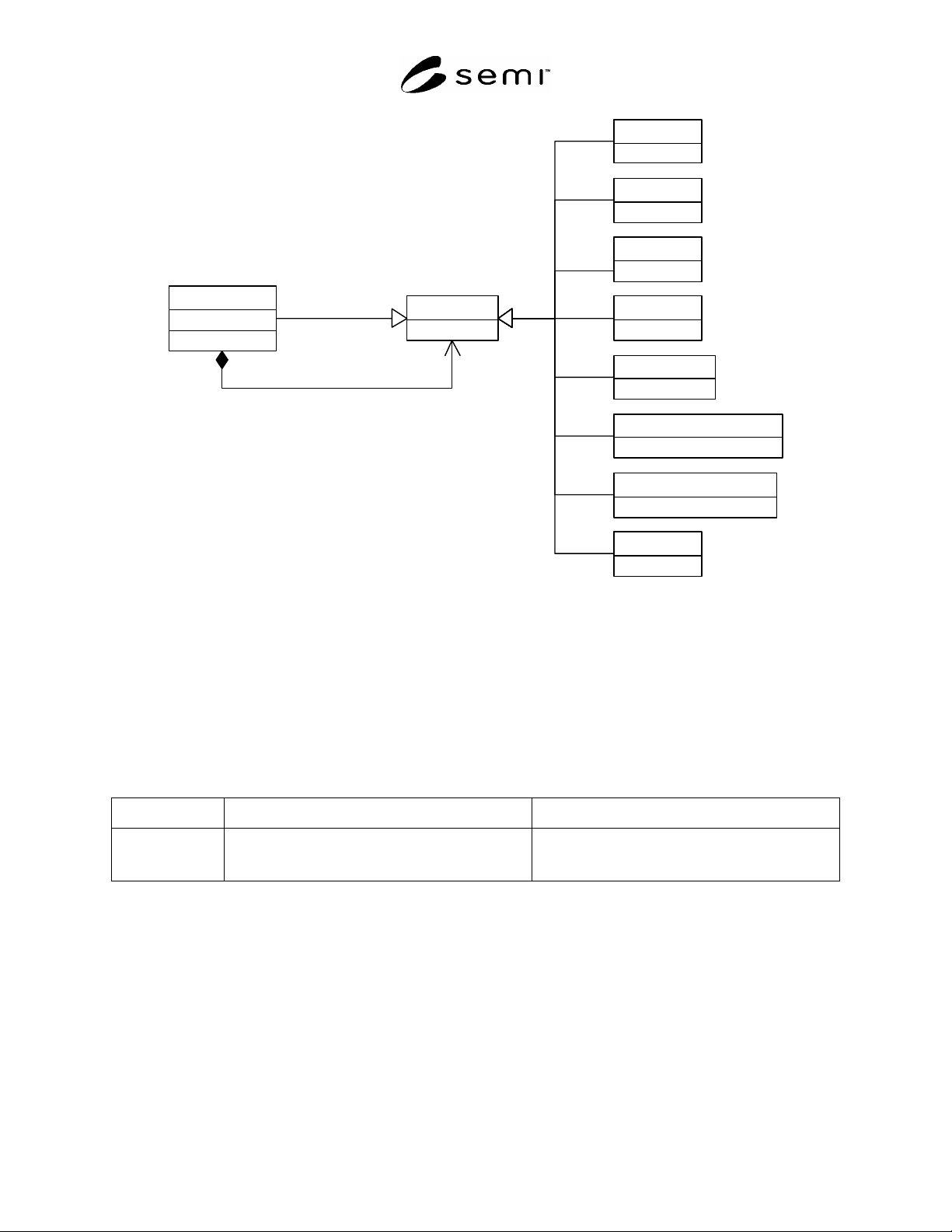
StructureValue
IntegerValue
StringValue
BinaryValue
BooleanValue
RealValue
EnumeratedIntegerValue
ArrayValue
EnumeratedString Valu e
AbstractValue
1
fieldValues 1..*
{ordered}
Figure 32
Structure Values
14.4.4 Figure 32 shows how to represent structure values. A structure is an ordered collection of one or more
elements, each element of a potentially different type. Note also that structure values can be nested (any element of
a structure can be a structure).
14.4.4.1 StructureValue — Represents a structure of one or more values, each of which may be a different type.
14.4.4.2 StructureValue Attribute Definition Table
Table 76 StructureValue Attribute Definition
Attribute Name Definition Form
fieldValues The values of the structure. Ordered list of elements, each of a specific,
potentially different, primitive, enumerated,
structure, or array type.
14.5 Time Format
14.5.1 This specification uses the ISO 8601 format for representing instants in time. ISO 8601 permits a variety of
possible formats for the same time value, so it is necessary to establish a convention for the format used by time
values in this document.
14.5.2 For representing time values, this document restricts the string representation of time to the form CCYY-
MM-DDThh:mm:ss.fff[-+]hh:mm. ‘CC’ is the century (first century starts at ‘00’), ‘YY’ is the year, ‘MM’ is the
month, and ‘DD’ is the day, each represented as a two-digit number with leading zeroes as needed. For years
beyond 9999, additional digits can be added to the ‘CC’ field. ‘T’ separates date information from time information.
‘hh’ is the hour, ‘mm’ are the minutes, ‘ss’ are the seconds, and ‘fff’ are the sub-seconds, supporting up to
millisecond precision in local time. If equipment can’t measure time with millisecond precision, it shall fill in the
sub-second field with zeroes as appropriate up to the measurable precision (for example, if time can be measured
SEMI E134-0305 © SEMI 2004, 2005 56
with centi-second precision, all time values would contain a zero in the third column of the sub-second field). ‘[-
+]hh:mm’ describes the difference from Coordinated Universal Time expressed as either +hh:mm or –hh:mm.
15 DCP Consumer Interface
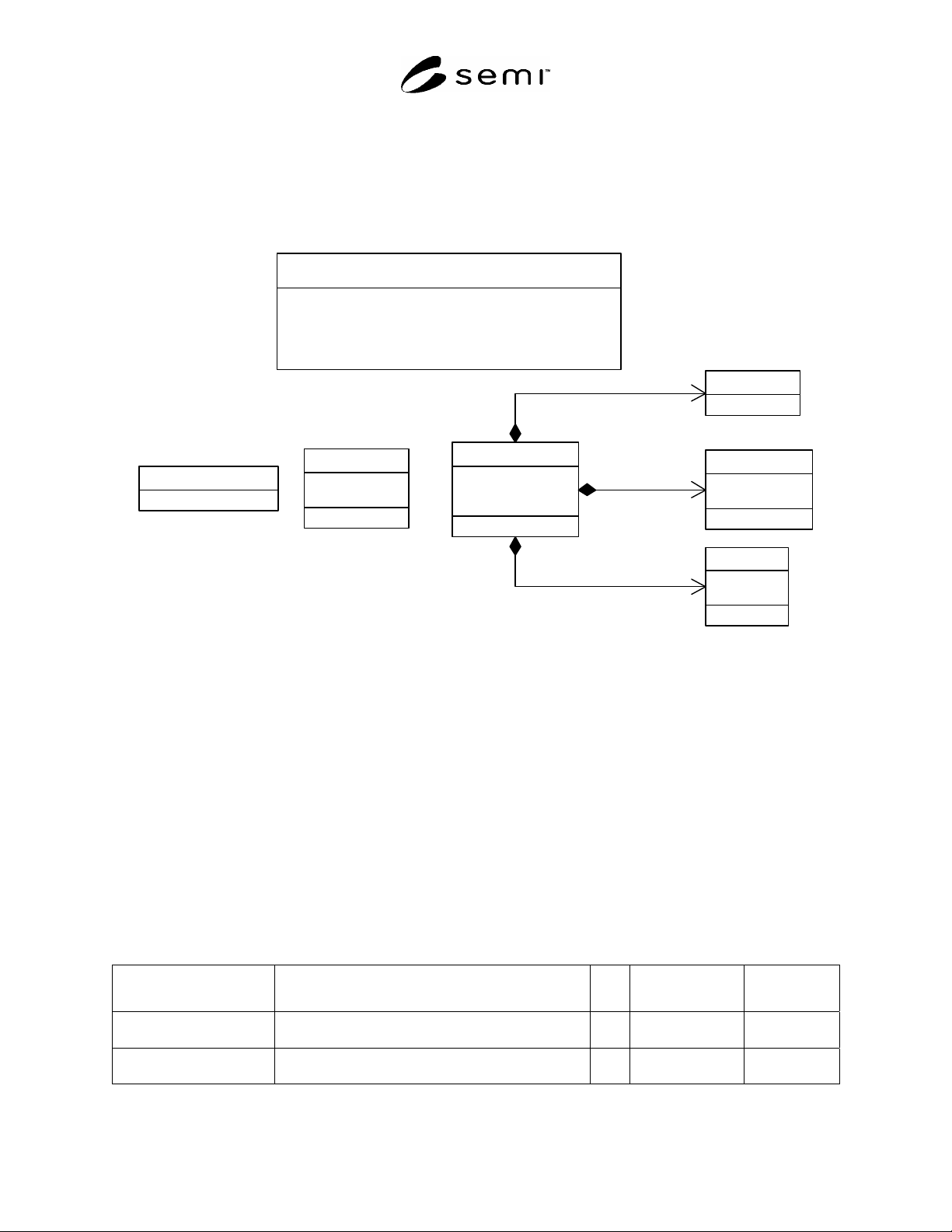
15.1 Figure 33 shows the interface used to communicate data collection results and other notifications to a DCP
consumer, as well as the data types of the arguments provided in each operation.
NewData(in dat a : Dat aCollec tionReport)
Perf ormanceWarning(in problem : PerformanceStatus)
PerformanceRest ored(in c urrent Stat us : Performanc eStat us )
DCPDeact ivation(in termination : DCPDeactivated[])
DCPHibernat ion(in hibernat ingPlans : DCPHibernated[ ])
«int erface»
DCPConsumer
systemName
description
AffectedSystem
timeLast Evaluated
isBelowThres hold
desc ription
PerformanceStatu s
1
affect edSyst ems
0..*
jobI d
jobT ype
ActiveJob
activeJobs1
0..*
DataCollectionReport
act ivePlans 1
0..*
DCPActivated
planId
timeHibernated
DCPHibernated
Figure 33
DCPConsumer Interface and Argument Types
15.2 DCPConsumer
15.2.1 The DCPConsumer interface allows the equipment to provide DCP consumers with data collection results,
operational performance warnings, and DCP deactivation notifications. All DCP consumers must implement this
interface.
15.2.2 The notifications defined for the DCPConsumer interface are Fire-and-Forget messages. No replies from
consumers are specified. The equipment is not required to take action on any protocol-level replies or errors
received from consumers when sending these notifications, unless otherwise required by an implementation
specification. The equipment is not required to retry or buffer notifications if it determines that such notifications
are not being successfully delivered to a consumer. The equipment shall not deactivate any consumer’s DCPs if it
detects an error in the delivery of these notifications.
15.2.3 DCPConsumer Operations
Table 77 DCPConsumer Operation Definition
Operation Description Type Requestor/Sender Responder/
Receiver
NewData Communicates data collection results from an active
DCP to the consumer that activated the DCP.
FF Equipment Consumer
PerformanceWarning Warns the consumer when the equipment has detected
degradation of its performance (see Section 13).
FF Equipment Consumer