semi合集-English.pdf - 第6836页
SEMI S2-0703a E © SEMI 1991, 2004 65 RELATED INFORMATION 6 CONTINUOUS HAZARDOUS GAS DETECTION NOTICE : This rel ated information i s not an of ficial part of SEMI S2 and was de rived from practical application by task fo…

SEMI S2-0703a
E
© SEMI 1991, 2004 64
DESIGN EXAMPLE (continued; refer to Figure R5-1 for illustration of example)
Disclaimer: the calculations below are not a complete seismic analysis. A complete analysis might also include such
things as: stress distribution through a multiple-fastener connection; prying action; bearing stress; simultaneous
combined stresses on the fasteners; and a review of weld geometry. A complete seismic analysis should be done by
a qualified engineer.
R5-4 Calculation of Lateral Force
R5-4.1 Lateral force on each leg is equal to F
P
/# of legs = F
P
/4
R5-4.2 The lateral force acts as shear on the floor anchor fasteners and shear or tensile loading on the equipment
anchor fasteners depending upon orientation. The actual reactions of the fasteners should be calculated by a
qualified engineer.
R5-5 Calculation of Overturning Force
R5-5.1 Sum the moments of the reactions on the system about line through the legs A and B:
(CW =+) M
AB
= 0 = F
P
(h) – 0.85W
P
(L
2
) –2R(L
1
)= 0
F
P
(h) – 0.85W
P
(L
2
)
R = _________________
2L
1
F
P
= 0.94W
P
W
P
(0.94h – 0.85L
2
)
R = _________________
2L
1
If 0.94h
0.85L
2
, then there is a tension reaction, R, at the two anchors, to resist overturning of system.
Example:
L1 = 50 inch
L2 = 20 inch
h= 36
W = 5000 lbs
Lateral force
= Fp/4 = 0.94(5000)/4 = 1175
W
P
(0.94h – 0.85L
2
)
Overturning force
= R =_________________
2L
1
= 5000 (0.94(36) – 0.85(20))
_____________________
2(50)
R = 842 lbs
SEMI S2-0703a
E
© SEMI 1991, 2004 65
RELATED INFORMATION 6
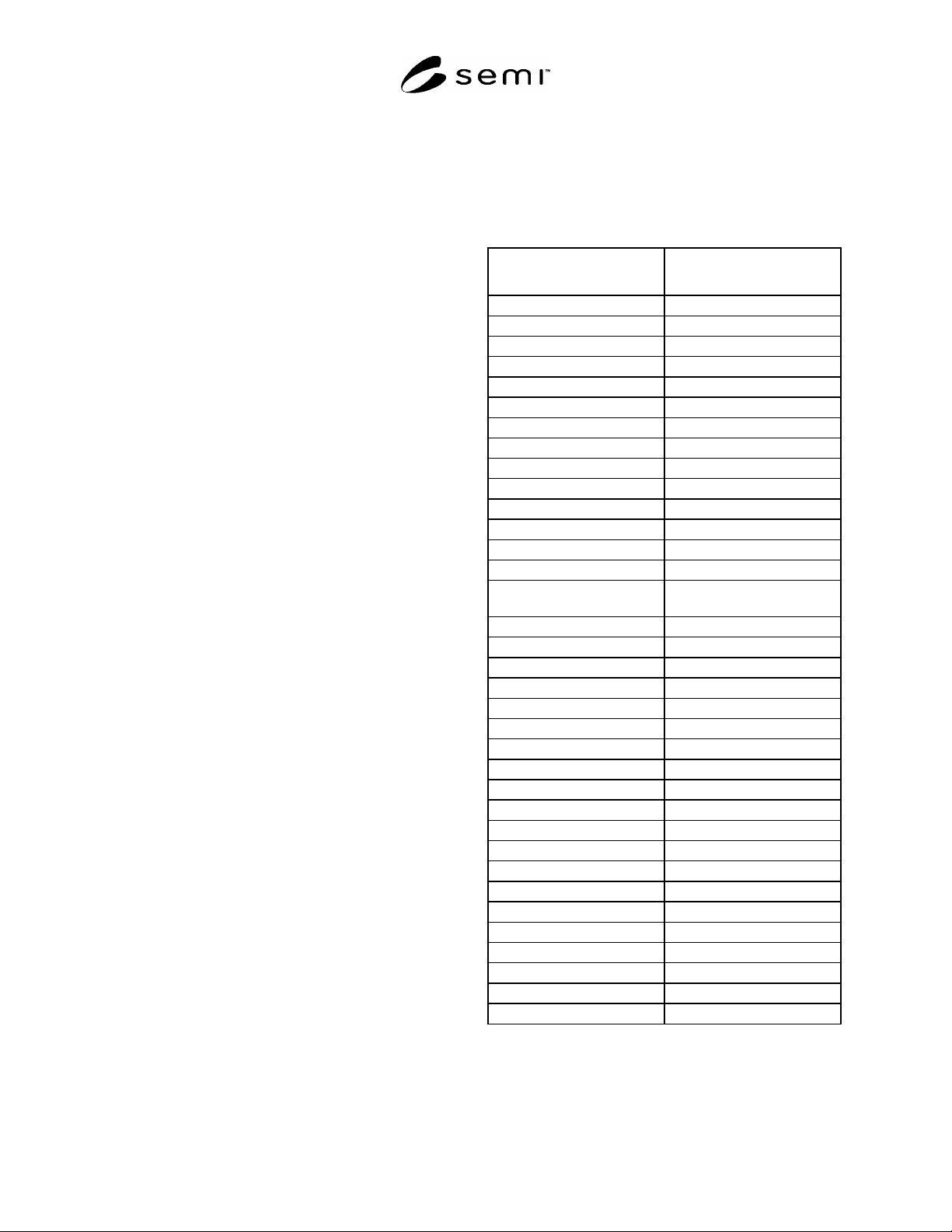
CONTINUOUS HAZARDOUS GAS DETECTION
NOTICE: This related information is not an official part of SEMI S2 and was derived from practical application by
task force members. This related information was approved for publication by vote of the responsible committee on
October 21, 1999.
R6-1 Scope — This related information provides a list
of gases for which continuous monitoring is
recommended, and another list of gases for which
continuous monitoring may be recommended
depending on variables listed below. The list is not
intended to be exhaustive (gases that do not appear on
the list may need to be continuously monitored).
R6-2 Intent — The purpose of this Related Information
is to provide equipment manufacturers with an
indication as to what gases are currently continuously
monitored by device manufacturers, as guidance for
when it may be appropriate to provide an interface (see
also Section 23).
R6-3 The following variables should be taken into
consideration when determining the necessity for
continuous monitoring:
Chemical toxicity,
Warning property/OEL ratio,
Delivery pressure,
LEL,
Flow rate of potential leak,
Engineering controls in place, and
Concentration.
Monitoring Recommended Monitoring May Be
Recommended
ammonia
arsine
boron trifluoride
bromine
carbon dioxide
carbon monoxide
carbon tetrabromide
chlorine
diborane
dichlorosilane
disilane
fluorine
germane
germanium tetrafluoride
flammable mixtures
containing hydrogen
hydrogen bromide
hydrogen chloride
hydrogen fluoride
hydrogen selenide
hydrogen sulfide
Methane
methyl chloride
methyl fluoride
nitric oxide
nitrogen dioxide
nitrous oxide
nitrogen trifluoride
ozone
phosphine
silane
silicon tetrachloride
silicon tetrafluoride
sulfur dioxide
trichlorosilane
tungsten hexafluoride

SEMI S2-0703a
E
© SEMI 1991, 2004 66
RELATED INFORMATION 7
DOCUMENTATION OF IONIZING RADIATION (SECTION 24 AND
APPENDIX 4) INCLUDING RATIONALE FOR CHANGES
NOTICE: This related information is not an official part of SEMI S2 and was derived from practical application by
task force members. This related information was approved for publication by vote of the responsible committee on
October 21, 1999.
R7-1 International Background Information
R7-1.1 The International Atomic Energy Agency
(IAEA)
Mailing address:
P.O. Box 100
Wagramerstrasse 5
A-1400, Vienna, Austria
Telephone: (+43-1) 2060-0; Facsimile: (+43-1) 20607:
E-mail: Official.Mail@iaea.org
R7-1.2 Basic approaches to radiation protection are
consistent all over the world. The International
Commission on Radiation Protection (ICRP)
recommends that any exposure above the natural
background radiation should be kept as low as
reasonably achievable, but below the individual dose
limits. The total individual dose limit for radiation
workers over 5 years is 100 mSv, and for members of
the general public, is 1 mSv per year. These dose limits
have been established based on a prudent approach by
assuming that there is no threshold dose below which
there would be no effect. This hypothesis proposes that
any additional dose will cause a proportional increase in
the chance of a health effect. This relationship has not
yet been established in the low dose range where the
dose limits have been set.
R7-1.3 The ICRP and the IAEA recommend the
individual dose must be kept as low as reasonably
achievable and consideration must be given to the
presence of other sources that may cause simultaneous
radiation exposure to the same group of the public.
Also, allowance for future sources or practices must be
kept in mind so that the total dose received by an
individual member of the public does not exceed the
dose limit.
R7-2 How Does This Apply to the
Semiconductor Industry?
R7-2.1 A person who can potentially be exposed to
ionizing radiation during the normal course of business
in excess of the annual limit for the general public
should be considered a radiation worker. A radiation
worker is trained to recognize and protect him or
herself from the hazards of ionizing radiation. They
may require exposure monitoring to determine
compliance with local radiation regulations. Radiation
workers are covered by a radiation safety program. A
radiation safety program is an administrative control.
Engineering controls minimize the need for spending
resources in a large scale radiation program.
R7-2.2 The exposure limit for the radiation worker is
20 millisievert (2000 millirem) per year. Based on a 40
hour/week, 50 week/working year basis, the allowable
ionizing radiation emissions are 10 microsieverts/hr
(1.0 millirem/hr). This exposure rate should be
evaluated as an emission rate from any accessible
surface of the equipment (the closest approach to the
surface that the radiation is penetrating).
R7-2.3 Maintenance technicians for radiation machines
should be participants in the radiation safety program as
radiation workers. The equipment should be designed to
allow maintenance technicians access to areas that do
not exceed 10 microsieverts/hr.
R7-2.4 Service technicians for radiation machines
should be participants in their employer’s radiation
safety program as radiation workers. The equipment
should be designed to allow service technicians access
to areas that exceed the 10 microsievert per hour level
when operating, but not while the radiation is present.
R7-2.5 The person operating radiation producing
equipment (Operator) should not be considered a
radiation worker. The emission limit for the operator
accessible areas is recommended to be 20% of the
occupational limit. The maximum allowable ionizing
radiation emissions for operator accessible areas is
recommended to be 2 microsieverts/hr (0.2
millirem/hr). This exposure rate should be evaluated as
an emission rate from any surface foreseeably
accessible by an operator of the equipment, and should
be measured as an instantaneous rate.
R7-3 Definitions
R7-3.1 accessible — a significant part of the whole
body, head, or eyes.
R7-3.2 bremsstrahlung — is radiation produced by
slowing of charged particles. The term means “braking
radiation.”