semi合集-English.pdf - 第4006页
SEMI F48-0600 © SEMI 2000 1 SEMI F48-0600 TEST METHOD FOR DETERMINING TR A CE M ET A LS I N POLYME R MA TE RIA LS This test method was tec hnically approved by the G lobal Facilitie s Committee and is the direct responsi…
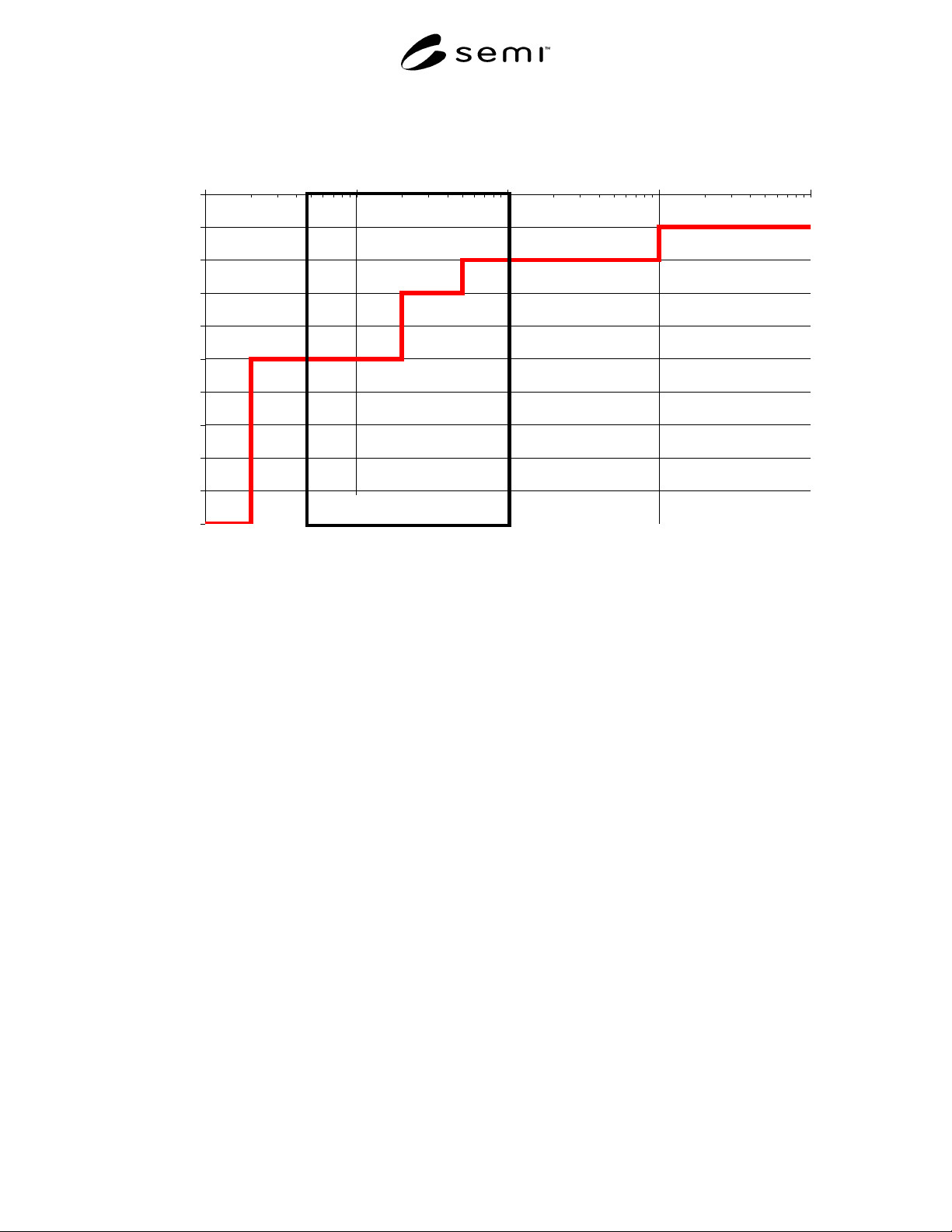
SEMI F47-0200 © SEMI 1999, 2000 6
0
10
20
30
40
50
60
70
80
90
100
0.01 0.1 1 10 100
Duration of Voltage Sag in Seconds
Percent of Equipment Nominal Voltage
Area included in Specification
0.05 to 1 second
0.02
Figure R1-1
Recommended Semiconductor Equipment Voltage Sag Ride-Through Capability Curve
from 0 to 100 Seconds
NOTICE: SEMI makes no warranties or
representations as to the suitability of the standards set
forth herein for any particular application. The
determination of the suitability of the standard is solely
the responsibility of the user. Users are cautioned to
refer to manufacturer’s instructions, product labels,
product data sheets, and other relevant literature
respecting any materials mentioned herein. These
standards are subject to change without notice.
The user’s attention is called to the possibility that
compliance with this standard may require use of
copyrighted material or of an invention covered by
patent rights. By publication of this standard, SEMI
takes no position respecting the validity of any patent
rights or copyrights asserted in connection with any
item mentioned in this standard. Users of this standard
are expressly advised that determination of any such
patent rights or copyrights, and the risk of infringement
of such rights, are entirely their own responsibility.
Copyright by SEMI® (Semiconductor Equipment and Materials
International), 3081 Zanker Road, San Jose, CA 95134. Reproduction o
f
the contents in whole or in part is forbidden without express written
consent of SEMI.
SEMI F48-0600 © SEMI 20001
SEMI F48-0600
TEST METHOD FOR DETERMINING TRACE METALS IN POLYMER
MATERIALS
This test method was technically approved by the Global Facilities Committee and is the direct responsibility
of the North American Facilities Committee. Current edition approved by the North American Regional
Standards Committee on March 2, 2000. Initially available on www.semi.org April 2000; to be published
June 2000.
1 Purpose
1.1 This method provides a procedure for determining
the nonvolatile trace inorganic impurities in bulk
polymeric materials.
2 Scope
2.1 Following digestion by dry ashing (DDA) or
digestion in closed vessel (DCV) preparation
techniques, samples previously obtained and cleaned
according to SEMI F40 are analyzed for trace
inorganics using inductively coupled plasma-mass
spectrometry (ICP–MS), graphite furnace atomic
absorption spectroscopy (GFAAS), and/or inductively
coupled plasma-atomic emission spectroscopy (ICP–
AES).
2.2 Materials for analysis include, but are not limited
to:
• Raw polymer materials (resins), such as pellets of
perfluoroalkoxy (PFA), polyvinylidene fluoride
(PVDF), ethylenechlorotrifluoroethylene (ECTFE),
polyetheretherketone (PEEK), polypropylene (PP),
polyethylene (PE), acetal resin, polyvinyl chloride
(PVC), Perfluoromethylether-based Perfluoro-
alkoxy (MFA) and powders of polytetrafluoro-
ethylene (PTFE).
• Polymer components of tubing, piping, fittings,
valves, regulators, filter housings, filter cartridges,
O–rings and gaskets used in ultrapure water (UPW)
and liquid chemical distribution systems (LCDS).
See Section 3.8 for further information.
• Ion-exchange resins
• Polymer products used in the manufacturing of
semiconductor devices, such as wafer carriers and
wands, as well as accessories internal to wet
equipment (e.g., drums in spin rinse dryers, tanks
in quick dump rinsers). See Section 3.8 for further
information.
2.3 The DDA sections of this document refer to an
ashing technique, whereby the sample is placed into a
platinum or quartz crucible and thermally decomposed.
Thermal decomposition in muffle furnace or microwave
muffle furnace may also be used. Additionally, oxygen
plasma may be used separately or in conjunction with
these techniques.
2.4 The DCV sections of this document refer to closed
vessel microwave acid decomposition at elevated
temperature and pressure. Alternatively closed vessel
thermal conduction heating may also be applied.
2.5 ICP–MS, GFAAS, and ICP–AES are all
appropriate methods for inorganic analysis. ICP–MS is
the preferred method because it is more sensitive and
efficient. Alternate procedures may be used if they
meet the same analytical performance criteria. Each
laboratory is responsible for verifying the validity of
each method within its own operation.
2.6 This method is applicable for the elements found
in Table 1:
Table 1 List of Applicable Elements (See NOTE 1.)
Aluminum Magnesium
Barium Manganese
Calcium Nickel
Chromium Potassium
Cobalt Sodium
Copper Strontium
Iron Tin
Lead Titanium
Lithium Zinc
Molybdenum Zirconium
NOTE 1: See Limitations, Section 3.3.
2.7 This method may be used for other materials, or
other nonvolatile elements, if the end-user wishes and
performance is demonstrated for the analyte of interest,
in the matrices of interest, at the concentration levels of
interest.
2.8 This standard does not purport to address safety
issues, if any, associated with its use. It is the
responsibility of the users of this standard to establish
appropriate safety and health practices and determine
the applicability of regulatory limitations prior to use.
3 Limitations
3.1 The accuracy of the method is limited by the
detection limits of the instruments and by the sample
preparation procedure.

SEMI F48-0600 © SEMI 2000 2
3.2 This procedure anticipates analysis levels in the
ppm (mass/mass) range. Impurities less than 0.1 ppm
may not be detected by this method.
3.3 When extending the method to other elements
recovery should be evaluated during validation. Poor
recovery rates are often found for volatile elements
such as boron (B), arsenic (As), antimony (Sb),
mercury (Hg), gold (Au), and tungsten (W) because of
the relatively high temperature sample preparation
method and poor stability of some elements in aqueous
solution. Elements forming volatile halogenides can be
affected due to the in-situ production of hydrogen
halogenides when halogenated polymers are ashed.
3.4 This is a bulk analysis technique. For leachable
testing or surface analysis refer to the Related
Documents (Section 16) of this method.
3.5 Due to the rapid advances in digestion technology,
consult the manufacturer’s recommended instructions
for guidance when conducting analyses using the DCV
sections of this document.
3.6 DCV techniques can generate gaseous digestion
reaction products, very reactive, or volatile materials at
high pressures. Spontaneous venting which can occur
during sample heating may cause venting of the vessels
with potential loss of sample and analytes. Sample
sizes greater than 0.25 g may accentuate this event.
3.7 In the use of the DCV technique, TiO2, alumina,
and other oxides may not be totally dissolved.
Sequestering of target analyte elements may occur.
3.8 Although this method allows the sampling of small
pieces of polymer that are mechnically removed from a
larger item, obtaining such samples in a clean manner
may be difficult. Multiple sampling, separation and
preparation techniques might be necessary to establish
confidence in the results.
3.9 This document is not intended to supersede
international, national or local codes, regulations, and
laws. Each should be consulted to ensure that the
method meets regulatory requirements in each location.
4 Referenced Standards
4.1 SEMI Standard
SEMI F40 –– Practice for Preparing Liquid Chemical
Distribution Components for Chemical Testing
4.2 ASTM Standard
1
ASTM D4375 –– Standard Practice for Basic
Definitions, Notation, and Symbology for Statistics in
Committee D19 on Water
1 American Society for Testing and Materials, 1916 Race St.,
Philadelphia, PA 19103
NOTE 1: As listed or revised, all documents cited shall be the
latest publications of adopted standards.
5 Terminology
5.1 Acronyms and Abbreviations
5.1.1 AAS/GFAAS — atomic absorption spectroscopy/
graphite furnace atomic absorption spectroscopy
5.1.2 amu — atomic mass unit
5.1.3 DCV digestion in closed vessel
5.1.4 DDA digestion by dry ashing
5.1.5 GFAAS — graphite furnace atomic absorption
spectroscopy
5.1.6 ICP–AES — inductively coupled plasma–atomic
emission spectroscopy
5.1.7 ICP–MS — inductively coupled plasma–mass
spectrometry
5.1.8 ppb — parts per billion by mass (ng/g)
5.1.9 ppm — parts per million by mass (µg/g)
5.1.10 UPW — ultrapure water (see Section 9.4)
6 Summary of Test Method
6.1 Samples previously prepared using SEMI F40 are
ashed or digested under pressure within a digestion
device, and trace inorganics in the residue are dissolved
into acid and UPW. The sample is then analyzed by
ICP–MS, GFAAS, and/or ICP–AES to determine the
inorganic content of the material. This method applies
only to nonvolatile metals (i.e., alkali metals, alkaline
earths, and transition metals).
6.2 Data from different tests can be compared to
determine the inorganic content in different materials
and in the same material from different manufacturers.
7 Significance and Use
7.1 Determining the metallic contamination
concentration in bulk polymer materials used in either
distribution systems for process fluids or products in
direct contact with the wafer is important criterion for
deciding the suitability of a material. For example,
ultrapure water contaminated by distribution system
components may adversely affect microelectronic and
other processes.
7.2 This method measures the total amount of
impurities in the bulk of the material. These impurities
will not necessarily leach into a process fluid stream.