semi合集-English.pdf - 第3498页
SEMI E134-0305 © SEMI 2004, 2005 51 14.2.1.2 ParameterVal ue Associatio n Definition Table Table 65 ParameterValue A ssociation Definition Association Role Name Definition Comments value The v alue of this param eter. An…
SEMI E134-0305 © SEMI 2004, 2005 50
14.1.5.3 CollectedData Association Definition Table
Table 64 CollectedData Association Definition
Association Role Name Definition Comments
parameterValues The parameters requested for this
trace.
Ordered list of elements of type ParameterValue, described in
Section 14.2. ParameterValues appear in the order specified in
the original TraceRequest in the corresponding DCP.
14.2 Parameter Values
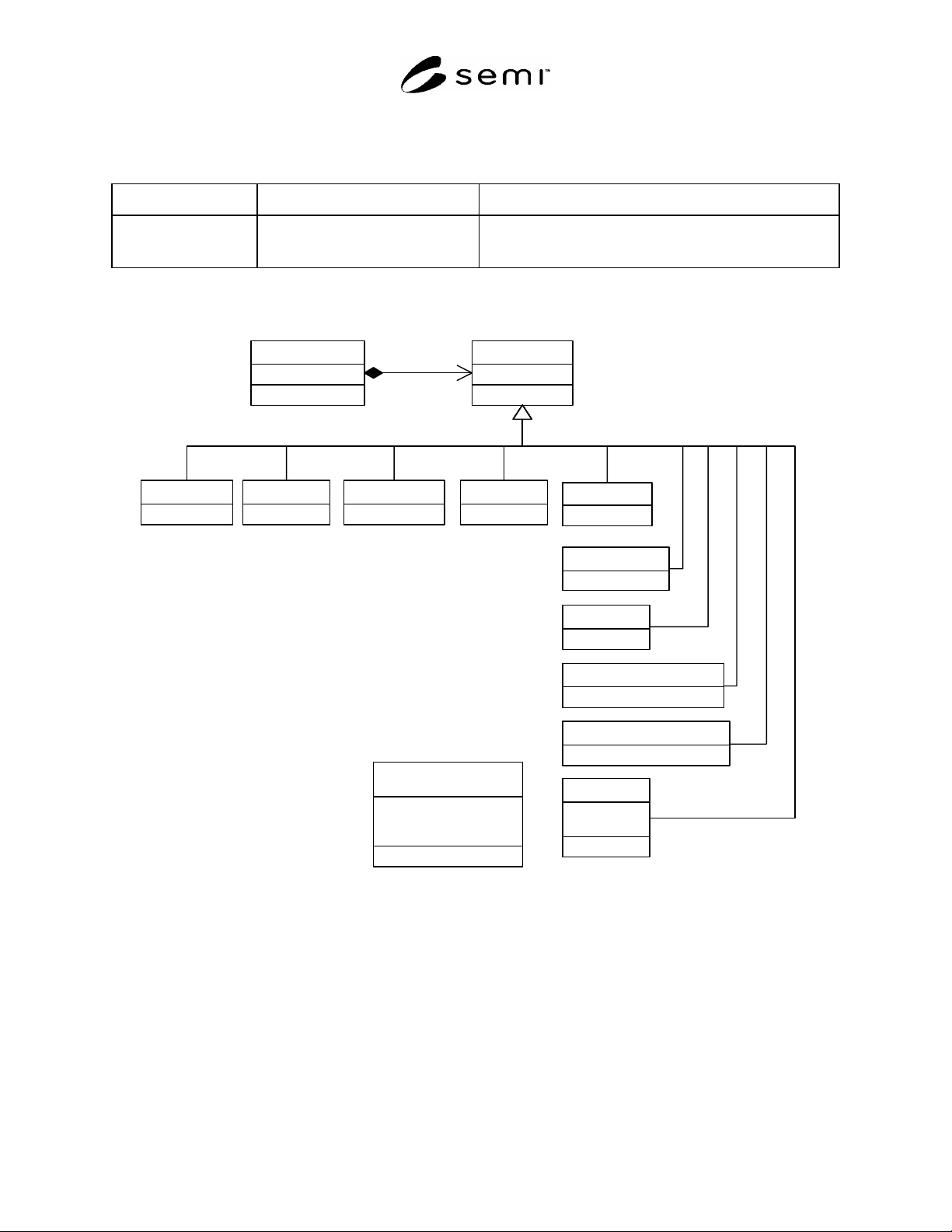
IntegerValue RealValue BooleanValue String Valu e
BinaryValue
EnumeratedIntegerValue
EnumeratedStringValue
ArrayValue
StructureValue
ParameterValue Ab stractValue
1
value
1
reasonCode
desc ript ion
NoValue
ValueNotAvailable
NoSuc hSource
NoSuc hParameter
«enumeration»
NoValu eReasonEnum
Figure 28
Parameter Values
14.2.1 Figure 28 shows how to represent a given data value corresponding to the specific parameters requested for
an event or trace report in a DCP, or as a response to the GetParameterValues operation described in Section 9.1.2.9.
14.2.1.1 ParameterValue — Represents a data value originating from a specific source. For example, the
temperature from a specific processing chamber, a measurement or test result variable, the value of an E39-based
object attribute, etc.

SEMI E134-0305 © SEMI 2004, 2005 51
14.2.1.2 ParameterValue Association Definition Table
Table 65 ParameterValue Association Definition
Association Role Name Definition Comments
value The value of this parameter. Any type derived from the abstract class AbstractValue (see
Sections 14.3 and 14.4).
14.2.1.3 AbstractValue — An abstract class representing any derived primitive, structured, or enumerated value
type. This class has no attributes or associations.
14.2.1.4 NoValue — This class is used to communicate problems in obtaining the values of requested Parameters.
There may be situations where unanticipated conditions arise that prevent the equipment from accessing a data value
due to internal communications failures or other such problems. Less commonly, a DCP that was valid at the time it
was activated may refer to Parameters that are no longer defined due to some on-the-fly reconfiguration of the
equipment.
14.2.1.5 NoValue Attribute Definition Table
Table 66 NoValue Attribute Definition
Attribute Name Definition Form
reasonCode The high-level reason that the value of the
Parameter can’t be provided.
Enumerated, of type NoValueReasonEnum (see Section
14.2.1.6 ).
description Human-readable description of the cause of
the problem, if known.
Text.
14.2.1.6 NoValueReasonEnum — This enumeration classifies the major sources of an error in providing a
Parameter’s value.
14.2.1.7 NoValueReasonEnum Attribute Definition Table
Table 67 NoValueReasonEnum Attribute Definition
Attribute Name Definition Form
ValueNotAvailable The requested Parameter exists, but equipment was unable to obtain its
value.
n/a
NoSuchSource The source of the requested Parameter does not exist. n/a
NoSuchParameter The source of the requested Parameter exists, but no such Parameter is
provided by that source.
n/a
14.3 Primitive Parameter Values
14.3.1 To make the data requested in a DCP available to a consumer, there must be a mechanism for representing
the values of primitive, or single-valued, types such as integers and strings in the type system being used. The
specific simple or primitive types that should be represented are typically determined by the implementation
technology that will be used to communicate values of the declared type (e.g., SECS-II, XML, OMG IDL, etc.).
The primitive types described here should be considered a minimum set that could be refined and extended to work
best with the type system in use. Any specification that translates these types into a specific type system shall define
how it has mapped these primitive types into the technology-specific type system in addition to specifying any
extended primitive types beyond those described here.
SEMI E134-0305 © SEMI 2004, 2005 52
realVal
RealValue
boolVal
BooleanValue
binVal
BinaryValue
stringVal
String Valu e
intVal
IntegerValue
Ab stractValue
Figure 29
Primitive Value Types
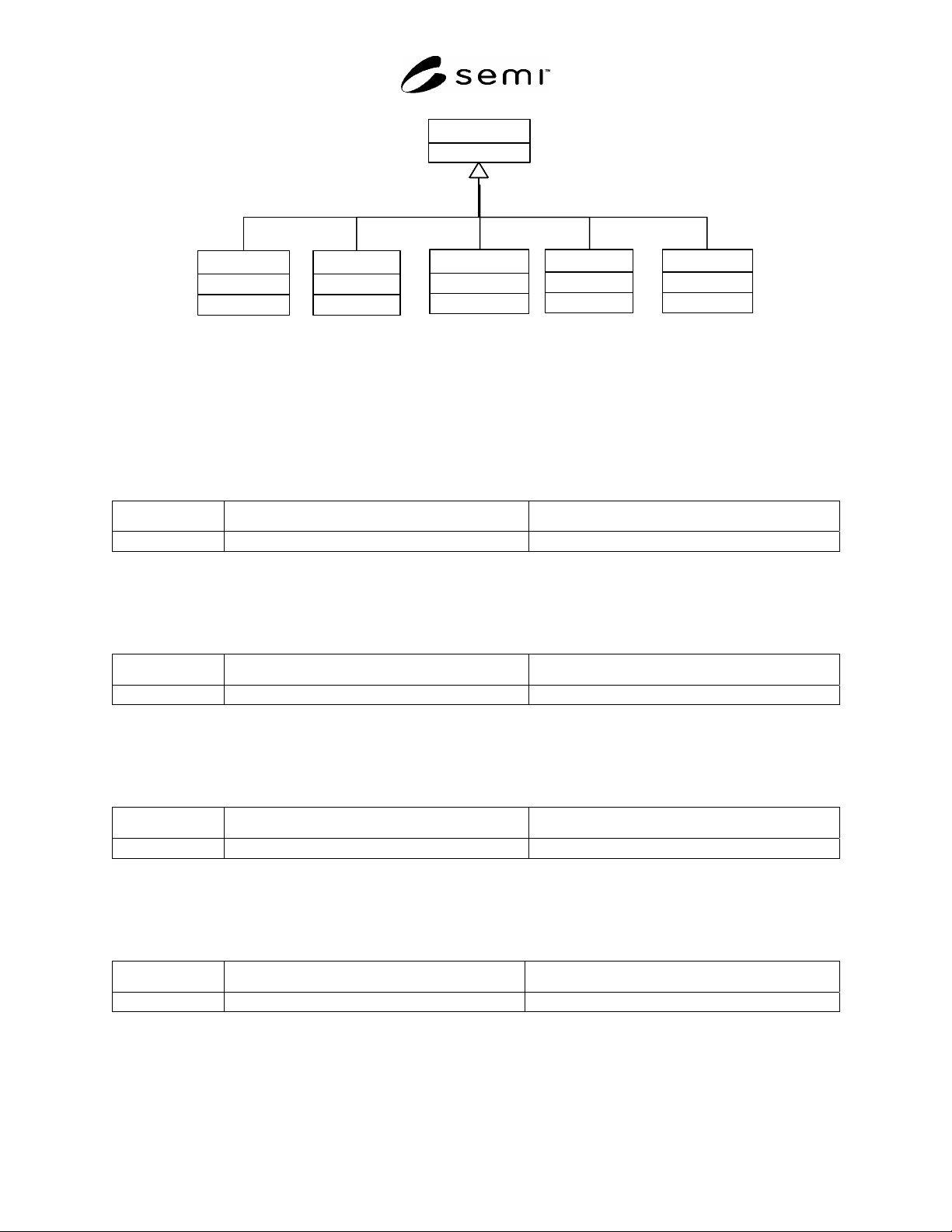
14.3.1.1 Figure 29 shows a basic set of classes that can be used to represent primitive type values.
14.3.1.2 IntegerValue — Represents an integer value.
14.3.1.3 IntegerValue Attribute Definition Table
Table 68 IntegerValue Attribute Definition
Attribute Name Definition Form
intVal The value of the integer item. Integer
14.3.1.4 RealValue — Represents a real (floating point) number value.
14.3.1.5 RealValue Attribute Definition Table
Table 69 RealValue Attribute Definition
Attribute Name Definition Form
realVal The value of the real number item. Real
14.3.1.6 BooleanValue — Represents a boolean value.
14.3.1.7 BooleanValue Attribute Definition Table
Table 70 BooleanValue Attribute Definition
Attribute Name Definition Form
boolVal The value of the Boolean item. Boolean
14.3.1.8 StringValue — Represents a string value.
14.3.1.9 StringValue Attribute Definition Table
Table 71 StringValue Attribute Definition
Attribute Name Definition Form
stringVal The value of the string item. Text