semi合集-English.pdf - 第1776页
SEMI E42-0704 © SEMI 1995, 2004 45 verification , or that have bee n requested to be discarded without storage after verification , may be rem oved from this area more easily when it is separate. A recipe temporarily pla…
SEMI E42-0704 © SEMI 1995, 2004 44
Attribute Name Definition Access Rqmt Form Default Value
UD * Non-standard attribute defined by
supplier or user. Asterisk indicates
the part of the attribute name that is
provided in this definition. Shall be
preserved exactly, except by the
entity that defined it.
RO N Varies with definition.
Text form is limited to
80 characters.
-
6.4 Default Namespace — The default namespace is a dedicated centralized namespace (see Section 4.4) that is
used for all agent-specific recipes. A recipe executor that uses agent-specific recipes, such as thermocouple
calibration tables, shall be provided with a namespace for such recipes. Equipment that may be operated in a stand-
alone mode, and that requires agent-specific recipes, shall also provide a local namespace to be used for this
purpose. A single namespace shall be used to satisfy both requirements.
The recipe executor shall provide a user-settable attribute DefaultNamespace
that contains the name of the default
namespace. The default namespace shall be available on power-up for stand-alone operation. For executing agents
intended to operate only in a supervised configuration, such as cluster process modules, the default namespace may
be provided by the supervisor.
A recipe in a default namespace is referenced within a recipe body by specifying a namespace named “Default”.
This allows controlled specification by namespace role for hardware-specific recipes.
6.5 Recipe Storage — Discussion of types of storage used by the recipe executor is provided to clarify terminology.
Storage is generally assumed to consume space in some form, and the amount of space available for recipes is
assumed to be finite, so that adding recipes reduces the amount of space available and deleting recipes increases the
amount of space available. These assumptions are based on current technologies and are not requirements.
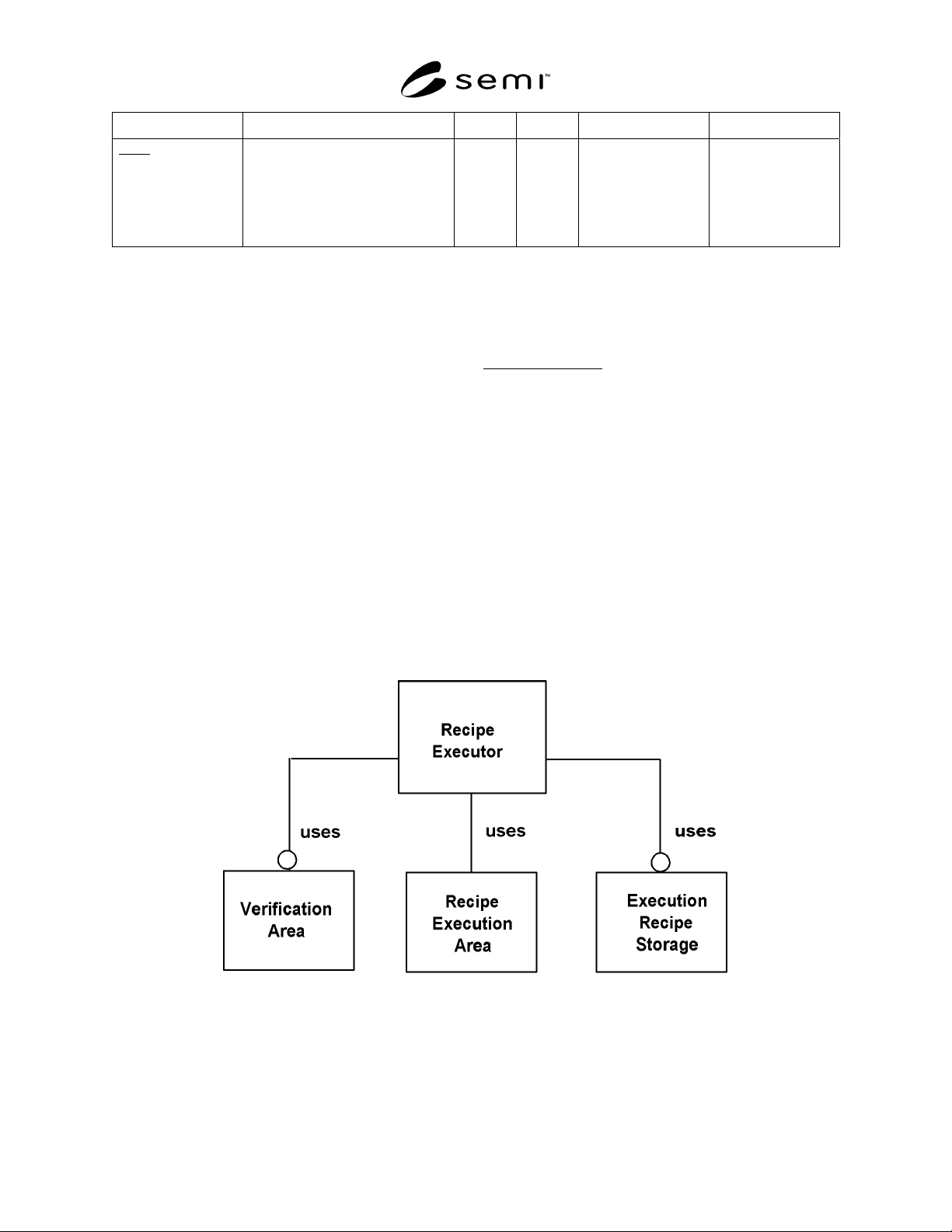
The recipe executor may have one or more types of storage area for recipes, shown in Figure 6.3. The storage area
used for the current process cycle is called the recipe execution area. This is the minimum storage capacity
required. Executable copy recipes in the recipe execution area may or may not be transformed for execution
purposes but shall retain the attributes of the execution recipe. The recipe execution area shall be protected from all
inadvertent and unintentional change, including change resulting from transferring a recipe to or from a recipe
namespace or from editing a recipe.
Figure 6.3
Object Model for Recipe Executor
Extra storage area, for additional recipes that are not
currently selected, when provided, is called the
execution recipe storage.
A separate intermediate area for temporary storage of
unverified downloaded recipes may also be provided.
This area is the verification area. The separation of
this area provides protection for the executable copy
recipes and the execution recipes. Recipes that fail

SEMI E42-0704 © SEMI 1995, 2004 45
verification, or that have been requested to be discarded
without storage after verification, may be removed from
this area more easily when it is separate.
A recipe temporarily placed in a verification area shall
be immediately either discarded or else moved to
execution recipe storage following a successful
verification.
The term stored recipes in this section refers to recipes
in execution recipe storage.
The storage areas of the recipe executor may or may
not be volatile. The verification area, recipe execution
area, and the execution recipe storage are not required
to be physically separate, so long as recipes in each
logical area are protected from change caused by
activities in the other areas.
6.6 Change Control — Storage provided by the recipe
executor is intended as temporary, and only minimum
management capability is required, such as the ability
to rename or delete recipes.
Some recipe executors may choose to provide
additional capabilities, such as the ability to create new
recipes, to edit existing recipes, to build a compressed
derived object form recipe, to modify existing recipes
through the execution process itself, and/or to save the
last value used for variable parameter settings. Certain
restrictions apply to these activities. Each different
capability provided for creating and changing recipes
shall be explicitly documented by the supplier.
In general, change is controlled by the user through the
attribute ExecChgCtrl
. ExecChgCtrl specified four
separate types of control related to change, including
permission to subsequently select or re-select a changed
recipe and a requirement that the originating recipe be
notified of all protected changes to the recipe.
The recipe executor is prohibited from setting the
Linked
attribute of any recipe to TRUE.
The recipe executor is responsible for ensuring the
uniqueness of the identifiers of the recipes that it stores.
Detailed requirements governing the creation of new
recipes and the changes protected by ExecChgCtrl
are
defined in Section 11.
6.6.1 Recipe Creation — Certain recipe executors may
be able to create recipes. This capability is allowed to
cover the hardware-dependent recipes and the provision
of editing services. Mechanisms for creating and
changing recipes are beyond the scope of RMS. Change
notification is required for all newly created recipes.
6.6.2 Recipe Compression — A source form recipe
may be compressed to obtain a derived object form
recipe, described in Section 3.2.2.1.2. This is not
considered as a newly created recipe, as the source form
and derived object form recipes achieve the identical
process results. For this reason, most of the attributes of
the source form recipe, including the Linked
and
ExecChgCtrl
attributes, are passed to the derived object
form. A change notification requirement for the source
form recipe extends to the derived object form as well,
including notification when the derived object form is
built. Requirements for the derived object form recipe
are defined in detail in Section 11.2.2.1.
6.6.3 Changes to Stored Recipes — The recipe
executors may be able to change an existing recipe by
changing its body. Certain hardware-dependent recipes
may sometimes be changed by, or as a result of, the
execution process itself. Recipes also may be changed
through an editing activity, including interactive
“teach” and automated “self-teach” operations provided
by some systems. Except where expressly granted
permission to change an existing recipe through the
ExecChgCtrl
attribute, the bodies of all recipes in
storage shall be protected from change. This is not the
same as the write-protection of the namespace in that
execution recipes may be deleted and renamed by an
authorized user and by the manager of the originating
namespace.
Depending upon the value of the ExecChgCtrl attribute
of the recipe, permission to change the execution recipe
(stored in the execution recipe storage) is granted or
denied in advance and allows case-by-case granularity.
Unless explicitly granted permission, a changed recipe
may not be subsequently selected or re-selected.
Purposeful change during the execution process for
hardware-dependent recipes is included in the
ExecChgCtrl
attribute permission to change the recipe
body. For example, furnaces may be able to update a
“profile recipe” during a normal process cycle. Recipes
changed purposefully by the execution process are
assumed to represent the best, most up-to-date, and
most valid version of a hardware-dependent class of
recipe. Suppliers of recipe executors with this
capability shall provide complete documentation of the
class of recipe changed and the circumstances under
which it is changed.
The ExecChgCtrl
attribute of a recipe may require that
the originating namespace be notified of change.
Change notification consists of a notification message
sent to the originating namespace that alerts the
namespace manager that a recipe has been changed or
originated. Where change notification is required
through ExecChgCtrl, the namespace manager is
responsible for subsequently uploading the recipe,
assigning it a new identifier if necessary, and requesting
the renaming of the execution recipe as necessary to
remain synchronized.

SEMI E42-0704 © SEMI 1995, 2004 46
6.6.4 Last Value — Some recipe executors may also
want to save the last value set by the user for each
variable parameter and use it as the new initial value of
that parameter when the same recipe is rerun.
This is useful when internal conditions drift in a
consistent manner over time, the parameters are
occasionally modified to compensate for such drift, and
the last setting used is, therefore, a better “default” than
the one specified in the recipe itself.
Permission to save the last value may be expressly
granted by the user in the recipe attribute ExecChgCtrl
.
Care should be taken to prevent unintentional
modifications.
6.7 Production — Equipment utilizations states are
defined by SEMI E10 (Standard for Definition and
Measurement of Equipment Reliability, Availability,
and Maintainability (RAM)). These states include the
PRODUCTIVE and STANDBY states used by the
factory for normal production work. The attributes
ProdApprove
and ProdCertify are defined as required
only for equipment supporting states defined in this
document.
To ensure that only recipes authorized for production
are executed while the executing agent is in the
PRODUCTIVE state, or are selected while in the
STANDBY state, the authorized user may set the
values of the attributes ProdApprove
and/or ProdCertify
to non-zero values. Non-zero values in ProdApprove
or
ProdCertify
represent minimums for a recipe's
ApprovalLevel
and Certified attributes, respectively.
The recipe executor is responsible for comparing the
corresponding recipe attributes ApprovalLevel
and
Certified
. When a recipe is selected for execution
(implicitly or explicitly) while either of the
PRODUCTIVE or STANDBY states is active, the
value of ApprovalLevel
is required to be equal to or
greater than the value in ProdApprove
, and the value in
Certified
is required to be equal to or greater than the
value in ProdCertify
. Otherwise, the select shall fail.
6.8 Recipe Executor Attributes — The recipe executor
is owned by the agent that provides a recipe execution
resource. The recipe executor in turn owns the recipes
that it has stored. It shall support Object Services for its
owned object types and for itself.
Table 6.2 defines the attributes of the recipe executor in
alphabetical order.
Table 6.2 Recipe Executor Attribute Definition
Attribute Name Definition Access Rqmt Form
ObjType The object type. RO Y Text = "RcpExec"
ObjID Text. RO Y Text.
DefaultNamespace The name of an executing agent’s namespace
used for all hardware-dependent and other
agent-specific recipes.
RW Y Text.
ProdApprove The minimum value of a recipe’s approval
level accepted during productive and standby
states. Required for SEMI E10 support only.
RW N Unsigned integer.
ProdCertify The minimum value of a recipe’s certification
level accepted during productive and standby
states. Required for SEMI E10 support only.
RW N Unsigned integer.
RunCycleUnit The process unit on which the calculation of the
estimated value of the recipe generic attribute
EstRunTime is based.
RO N Case-sensitive formatted text
composed of a unit of
measure and an optional
numeric suffix. Compliant
with SEMI E5, Section 9.
RecipeSelectID A list of recipe identifiers for the currently
selected recipes.
RO Y List of formatted text.
RecipeSelect-
Parameters
A list of all parameter definitions in effect for
the i
th
recipe identifier in RecipeSelectID. The
maximum value for i is determined by the
equipment supplier as the maximum number of
recipes which may be selected at the same time.
Required if variable parameters are supported.
RO N List of structures composed
of parameter name, parameter
value, parameter restriction.