semi合集-English.pdf - 第6771页
SEMI S1-0701 E © SEMI 1986, 2001 18 RELATED INFORMATION 1 MINIMUM LETTER HEIGHT CALCULATIONS NOTE: This related inform ation is not an official part of SEMI S1 and is not intended to modify or supersede the official guid…
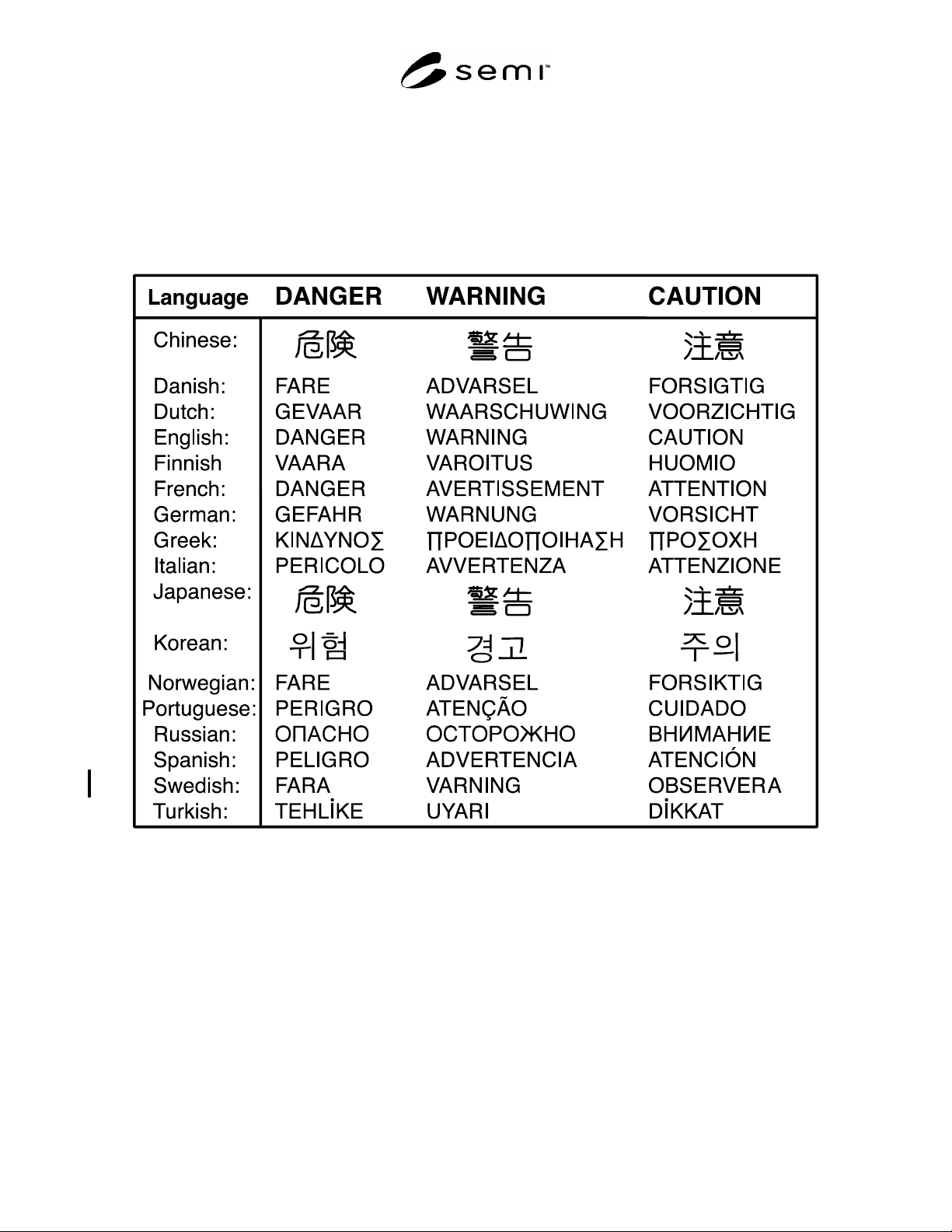
SEMI S1-0701
E
© SEMI 1986, 2001 17
APPENDIX 2
TRANSLATIONS OF SIGNAL WORDS
NOTE: The material in this appendix is an official part of SEMI S1 and was approved by full letter ballot procedures on April 30,
2001 by the North American Regional Standards Committee.
Translation of the signal words and word message are optional considerations. If the signal word of a safety label is
to be translated, the following translations should be used.
NOTICE:
Paragraphs entitled “NOTE” are not an official part of this safety guideline and are not intended to modify or
supersede the official safety guideline. These have been supplied by the committee to enhance the usage of the
safety guideline.
SEMI makes no warranties or representations as to the suitability of the guidelines set forth herein for any particular
application. The determination of the suitability of the guideline is solely the responsibility of the user. Users are
cautioned to refer to manufacturer’s instructions, product labels, product data sheets, and other relevant literature
respecting any materials or equipment mentioned herein. These guidelines are subject to change without notice.
The user’s attention is called to the possibility that compliance with this guideline may require use of copyrighted
material or of an invention covered by patent rights. By publication of this guideline, SEMI takes no position
respecting the validity of any patent rights or copyrights asserted in connection with any item mentioned in this
guideline. Users of this guideline are expressly advised that determination of any such patent rights or copyrights,
and the risk of infringement of such rights, are entirely their own responsibility.
SEMI S1-0701
E
© SEMI 1986, 2001 18
RELATED INFORMATION 1
MINIMUM LETTER HEIGHT CALCULATIONS
NOTE: This related information is not an official part of SEMI S1 and is not intended to modify or supersede the official
guideline. It has been derived from the informative Annex B of ANSI Z535.4-1998. Publication is authorized by vote of the
responsible committee. Determination of the suitability of this material is solely the responsibility of the user.
R1-1 A common concern when designing safety labels is determining the minimum letter height of text. This
Related Information describes one method that may be used to determine a minimum letter height.
Table R1-1 Examples of Word Message Uppercase Letter Heights at Various Viewing Distances
Viewing Distance Minimum Letter Height for
FAVORABLE Reading
Conditions
Recommended Letter Height
for FAVORABLE Reading
Conditions
Recommended Letter
Height for UNFAVORABLE
Reading Conditions
300 mm (12 in.) or less* 2 mm (0.08 in) 2 mm (0.08 in) 2 mm (0.08 in)
600 mm (24 in.) 2.5 mm (0.10 in) 4 mm (0.16 in) 4 mm (0.16 in)
900 mm (35 in.) 3 mm (0.12 in) 4.75 mm (0.19 in) 6 mm (0.24 in)
1.2 m (47 in.) 3.5 mm (0.14 in) 5.5 mm (0.22 in) 8 mm (0.31 in)
1.5 m (59 in.) 4 mm (0.16 in) 6.25 mm (0.25 in) 10 mm (0.39 in)
1.8 m (71 in.) 4.5 mm (0.18 in) 7 mm (0.28 in) 12 mm (0.47 in)
2.1 m (83 in.) 5 mm (0.20 in) 7.75 mm (0.31 in) 14 mm (0.55 in)
2.4 m (94 in.) 5.5 mm (0.22 in) 8.5 mm (0.33 in) 16 mm (0.63 in)
* 2 mm (0.079 in.) is the suggested minimum type size for use on safety labels.
Calculations for Recommended Letter Heights (in mm) for FAVORABLE Reading Conditions:
600 mm or less: (viewing distance in mm) / 150
>600 mm to 6 m: [(viewing distance in mm - 600) x .0025] + 4
Calculation for Recommended Letter Heights for UNFAVORABLE Reading Conditions (all distances):
(viewing distance) / 150
NOTICE:
Paragraphs entitled “NOTE” are not an official part of this safety guideline and are not intended to modify or
supersede the official safety guideline. These have been supplied by the committee to enhance the usage of the
safety guideline.
SEMI makes no warranties or representations as to the suitability of the guidelines set forth herein for any particular
application. The determination of the suitability of the guideline is solely the responsibility of the user. Users are
cautioned to refer to manufacturer’s instructions, product labels, product data sheets, and other relevant literature
respecting any materials or equipment mentioned herein. These guidelines are subject to change without notice.
The user’s attention is called to the possibility that compliance with this guideline may require use of copyrighted
material or of an invention covered by patent rights. By publication of this guideline, SEMI takes no position
respecting the validity of any patent rights or copyrights asserted in connection with any item mentioned in this
guideline. Users of this guideline are expressly advised that determination of any such patent rights or copyrights,
and the risk of infringement of such rights, are entirely their own responsibility.
Copyright by SEMI® (Semiconductor Equipment and Materials
International), 3081 Zanker Road, San Jose, CA 95134. Reproduction of
the contents in whole or in part is forbidden without express written
consent of SEMI.
SEMI S2-0703a
E
© SEMI 1991, 2004 1
SEMI S2-0703a
E
ENVIRONMENTAL, HEALTH, AND SAFETY GUIDELINE FOR
SEMICONDUCTOR MANUFACTURING EQUIPMENT
This safety guideline was technically approved by the Global Environmental, Health, and Safety Committee
and is the direct responsibility of the North American Environmental, Health, and Safety Committee. Current
edition approved by the North American Regional Standards Committee on April 11, 2003. Initially available
on www.semi.org June 2003; to be published July 2003. Originally published in 1991; previously published
in March 2003.
E
This standard was modified in September 2004 to correct editorial errors. Changes were made to Notices
preceding Sections 1 and 11.6.
NOTICE: This document contains material that has
been balloted and approved by the SEMI
Environmental Health and Safety Committee, but is
not immediately effective. This material and the
date on which it becomes effective are included in
Delayed Revisions Sections 1 and 2. The provisions
of this information are not an authoritative part of
the document until their effective dates. The main
body of SEMI S2-0703 remains the authoritative
version. Some or all of the provisions of revisions
not yet in effect may optionally be applied prior to
the effective date, providing they do not conflict with
portions of the authoritative version other than
those that are to be revised or replaced as part of the
deferred change, and are labeled accordingly.
Material that is to be replaced by revisions that are
not yet in effect is preceded by a NOTICE indicating
its status.
1 Purpose
1.1 This safety guideline is intended as a set of
performance-based environmental, health, and safety
(EHS) considerations for semiconductor manufacturing
equipment.
2 Scope
2.1 Applicability — This guideline applies to
equipment used to manufacture, measure, assemble,
and test semiconductor products.
2.2 Contents — This document contains the following
sections:
1. Purpose
2. Scope
3. Limitations
4. Referenced Standards
5. Terminology
6. Safety Philosophy
7. General Provisions
8. Evaluation Process
9. Documents Provided to User
10. Hazard Warning Labels
11. Safety Interlock Systems
12. Emergency Shutdown
13. Electrical Design
14. Fire Protection
15. Heated Chemical Baths
16. Ergonomics and Human Factors
17. Hazardous Energy Isolation
18. Mechanical Design
19. Seismic Protection
20. Automated Material Handlers
21. Environmental Considerations
22. Exhaust Ventilation
23. Chemicals
24. Ionizing Radiation
25. Non-Ionizing Radiation and Fields
26. Lasers
27. Sound Pressure Level
28. Related Documents
Appendix 1 — Enclosure Openings
Appendix 2 — Design Principles and Test Methods for
Evaluating Equipment Exhaust Ventilation
Appendix 3 — Design Guidelines for Equipment Using
Liquid Chemicals
Appendix 4 — Ionizing Radiation Test Validation
Appendix 5 — Non-Ionizing Radiation (Other than
Laser) and Fields Test Validation