semi合集-English.pdf - 第183页
SEMI E23-1104 © SEMI 1991, 2004 1 SEMI E23-1104 SPECIFICATION FOR CASSETTE TRANSFER PARALLEL I/O INTERFACE This specificatio n was technically approved b y the Global Physical Interfac es and Carriers Committee and is th…

SEMI E22.1-1296 © SEMI 1992, 2002 3
RELATED INFORMATION 1
NOTE: This related information is not an official part of SEMI E22.1, and is not meant to modify or supersede it in any way.
Rather, these notes are provided primarily as a source of information to aid in the application of the standard. As such they are to
be considered as reference material only. The standard should be referred to in all cases.
R1-1
R1-1.1 The standard applies to both attached modules and wafer carriers; there is no special subset for carriers. The
extreme end of the exclusion zone should allow adequate stiffness for end effectors and also permit insertion into
carriers (with a 10 mm pitch).
NOTICE: The user’s attention is called to the possibility that compliance with this standard may require use of an
invention covered by patent rights. By publication of this standard, Semiconductor Equipment and Materials
International (SEMI) takes no position respecting the validity of any patent rights asserted in connection with any
item mentioned in this standard. In particular, users of the specification should be aware that Drytek, Inc., A Unit of
General Signal, 16 Jonspin Road, Wilmington, MA 01887-1087, Phone: (508) 657-3933, has neither claimed nor
disclaimed that compliance with this specification would require use of an invention covered by one or more of its
patents. Users of this standard are expressly advised that determination of any such patent rights, and the risk of the
infringement of such rights, are entirely their own responsibility.
NOTICE: SEMI makes no warranties or representations as to the suitability of the standards set forth herein for any
particular application. The determination of the suitability of the standard is solely the responsibility of the user.
Users are cautioned to refer to manufacturer' s instructions, product labels, product data sheets, and other relevant
literature, respecting any materials or equipment mentioned herein. These standards are subject to change without
notice.
By publication of this standard, Semiconductor Equipment and Materials International (SEMI) takes no position
respecting the validity of any patent rights or copyrights asserted in connection with any items mentioned in this
standard. Users of this standard are expressly advised that determination of any such patent rights or copyrights, and
the risk of infringement of such rights are entirely their own responsibility.
Copyright by SEMI® (Semiconductor Equipment and Materials
International), 3081 Zanker Road, San Jose, CA 95134. Reproduction o
f
the contents in whole or in part is forbidden without express written
consent of SEMI.
SEMI E23-1104 © SEMI 1991, 2004 1
SEMI E23-1104
SPECIFICATION FOR CASSETTE TRANSFER PARALLEL I/O
INTERFACE
This specification was technically approved by the Global Physical Interfaces and Carriers Committee and is
the direct responsibility of the North American Physical Interfaces and Carriers Committee. Current edition
approved by the North American Regional Standards Committee on August 16, 2004. Initially available at
www.semi.org September 2004; to be published November 2004. Originally published in 1991; previously
published in 2002.
1 Purpose
1.1 Cassette transfer between process equipment and
transport equipment is performed by means of a
mechanical operation in the interactive area and
requires quick response and reliable interlock signals.
1.2 The purpose of this specification is to provide a
cassette transfer parallel input/output (I/O) interface for
control of the interface mechanism that supplements the
SECS standard for material movement.
2 Scope
2.1 This specification deals with the parallel I/O
interface for the cassette transfer between two pieces of
equipment, such as a piece of process equipment and a
piece of transport equipment.
2.2 This standard defines the wire-connected parallel
I/O interface between two pieces of equipment and the
photo-coupled parallel I/O interface between the
process equipment and the transport equipment.
2.3 The application of the parallel I/O interface to the
cassette transport is as follows.
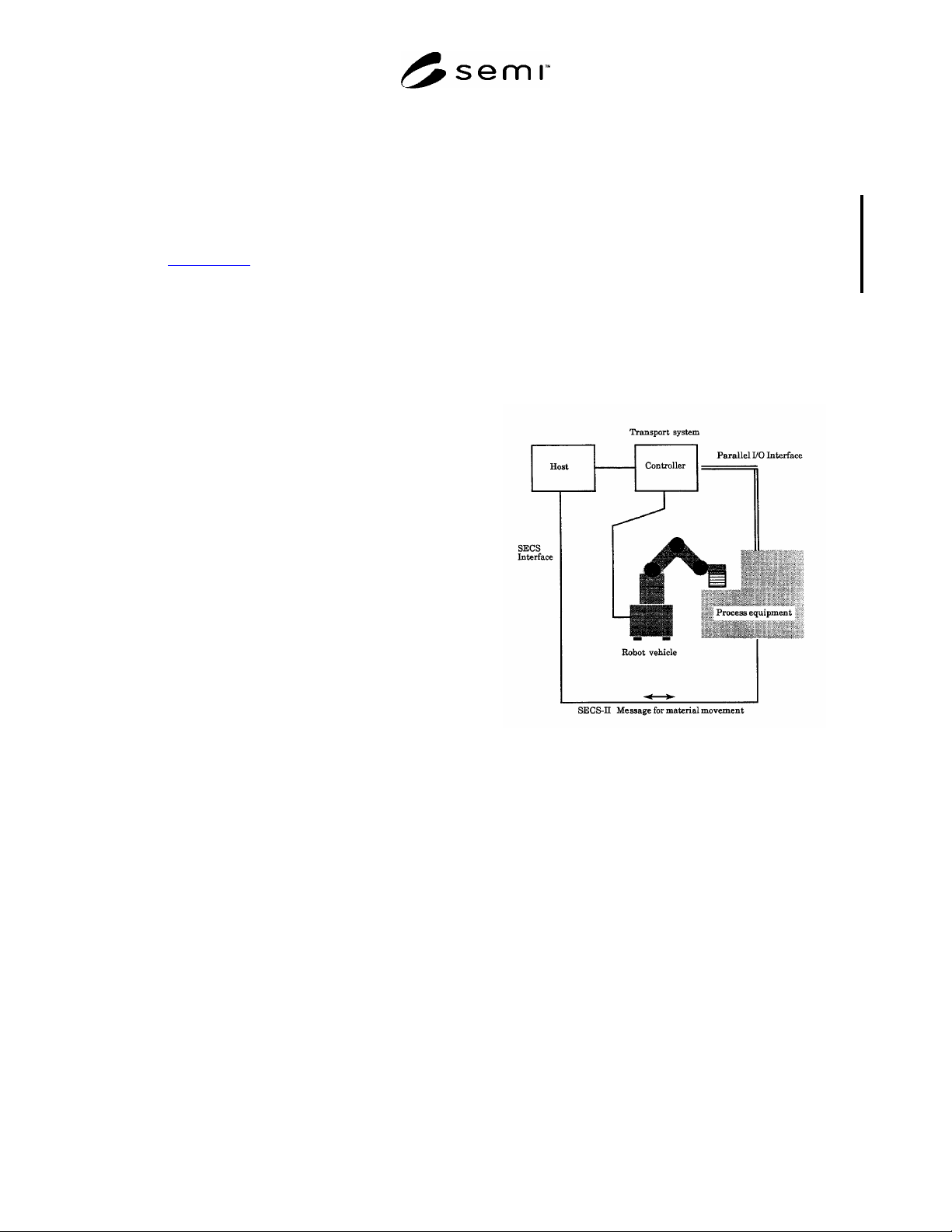
2.4 Each piece of equipment is connected to the HOST
at the SECS interface, and each of the two pieces of
equipment between which the cassette transfer will be
made is connected at the parallel I/O interface as shown
in Figure 1.
2.5 The cassette transfer request, or load/unload
command, is notified by the SECS-II message. The
actual cassette transfer action is executed using the
parallel I/O interface, interlocking each mechanism.
(An example of a cassette transfer transaction using the
parallel I/O interface is shown in Related Information
1.)
NOTICE: This standard does not purport to address
safety issues, if any, associated with its use. It is the
responsibility of the users of this standard to establish
appropriate safety and health practices and determine
the applicability of regulatory or other limitations prior
to use.
Figure 1
Application of Parallel I/O Interface to Cassette
Transport
3 Referenced Standards
3.1 SEMI Standards
SEMI E1 — Specification for 3 inch, 100 mm, 125
mm, and 150 mm Plastic and Metal Wafer Carriers
SEMI E4 — SEMI Equipment Communications
Standard 1 Message Transfer (SECS-I)
SEMI E5 — SEMI Equipment Communications
Standard 2 Message Content (SECS-II)
SEMI E23-1104 © SEMI 1991, 2004 2
3.2 ISO Standards
1
ISO 4902 — Information Technology — Data
Communication — 37-pole DTE/DCE Interface
Connector and Contact Number Assignments
3.3 Japanese Industrial Standards Committees
2
JIS-X-5103 — The Interface Between Data Circuit
Terminating Equipment (DCE) and Data Terminal
Equipment (DTE) (37/9-Pin Interface)
NOTICE: Unless otherwise indicated, all documents
cited shall be the latest published versions.
4 Terminology
4.1 Definitions
4.1.1 active equipment — Equipment that loads a
cassette onto the cassette stage of another piece of
equipment or unloads a cassette from the cassette stage
of another piece of equipment.
4.1.2 cassette — A plastic or metal wafer carrier as
defined in SEMI E1.
4.1.3 cassette stage — A stage on a piece of equipment
on which a cassette is placed or from which it is
removed that allows the cassette transfer.
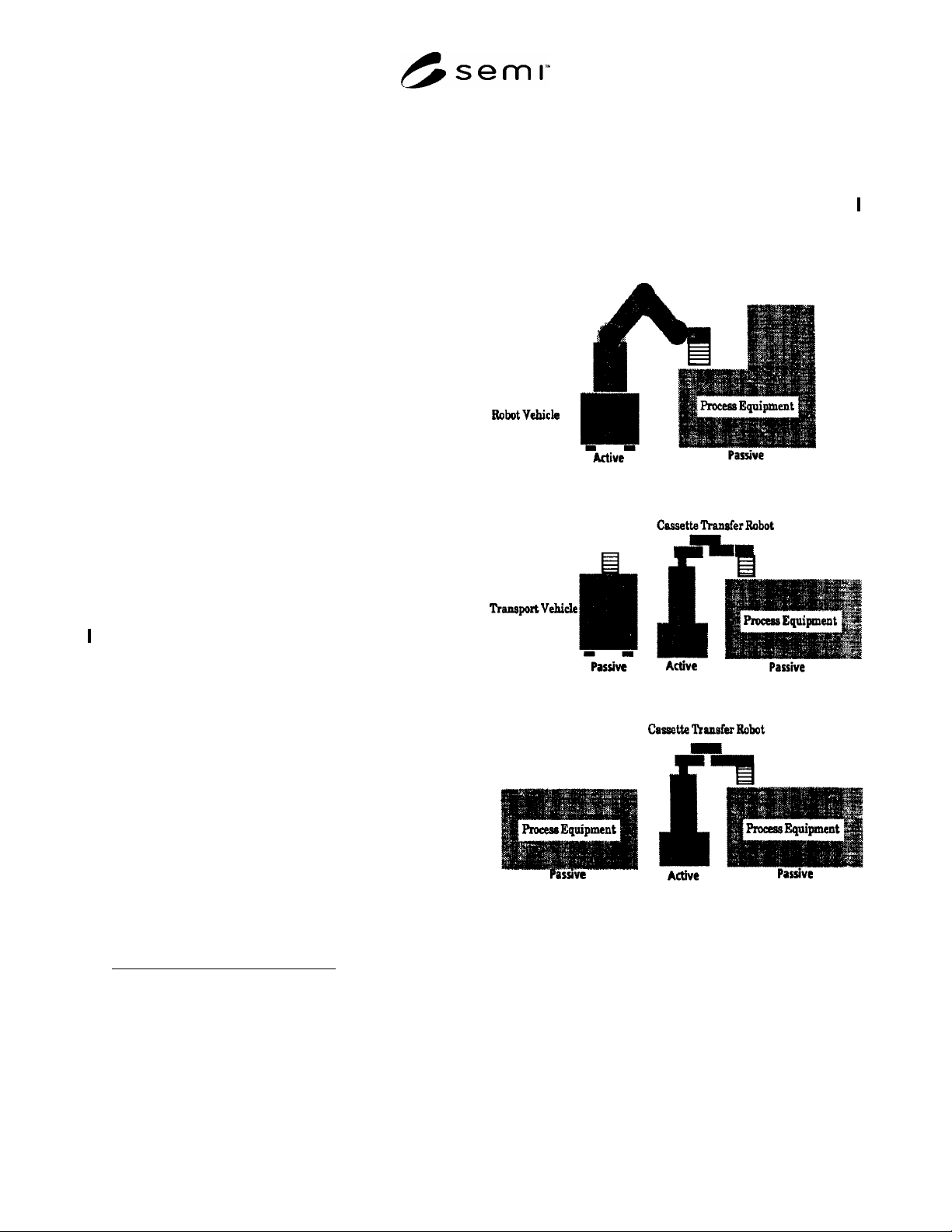
4.1.4 cassette transfer robot — A robot that transfers
cassettes (see Figure 2).
4.1.5 passive equipment — Equipment that is loaded or
unloaded by the active equipment.
4.1.6 photo-coupled interface — A parallel I/O
interface connected without contact by means of a
photo-coupled device.
4.1.7 process equipment — Fabrication equipment,
inspection equipment, and cassette stage equipment
used in semiconductor manufacturing.
4.1.8 robot vehicle — A piece of equipment having a
cassette transfer robot on the vehicle that moves to
another piece of equipment and transfers cassettes (see
Figure 2).
4.1.9 transfer — To either load or unload.
4.1.10 transport equipment — A piece of equipment
(or system) which transports or transfers cassettes. It
1 International Organization for Standardization, ISO Central
Secretariat, 1, rue de Varembé, Case postale 56, CH-1211 Geneva 20,
Switzerland. Telephone: 41.22.749.01.11; Fax: 41.22.733.34.30
Website: www.iso.ch
2 Japanese Industrial Standards, Available through the Japanese
Standards Association, 1-24, Akasaka 4-Chome, Minato-ku, Tokyo
107-8440, Japan. Telephone: 81.3.3583.8005; Fax: 81.3.3586.2014
Website: www.jsa.or.jp
mainly consists of a transport vehicle, a robot vehicle,
and a cassette transfer robot.
4.1.11 transport vehicle (see Figure 2) — A vehicle
which transports cassettes but which has no mechanism
for cassette transfer.
4.1.12 wire-connected interface — A parallel I/O
interface connected by means of wire and a connector.
Figure 2
Cassette Transfer between Active Equipment
and Passive Equipment