semi合集-English.pdf - 第2445页
SEMI E87-0705 © SEMI 1999, 2005 14 10.4 Carrier Location Naming 10.4.1 Carrier locatio ns shall be assigned a unique name. Info rmation about the carrier location can be ob-tai ned by querying the CarrierObject for the L…
SEMI E87-0705 © SEMI 1999, 2005 13
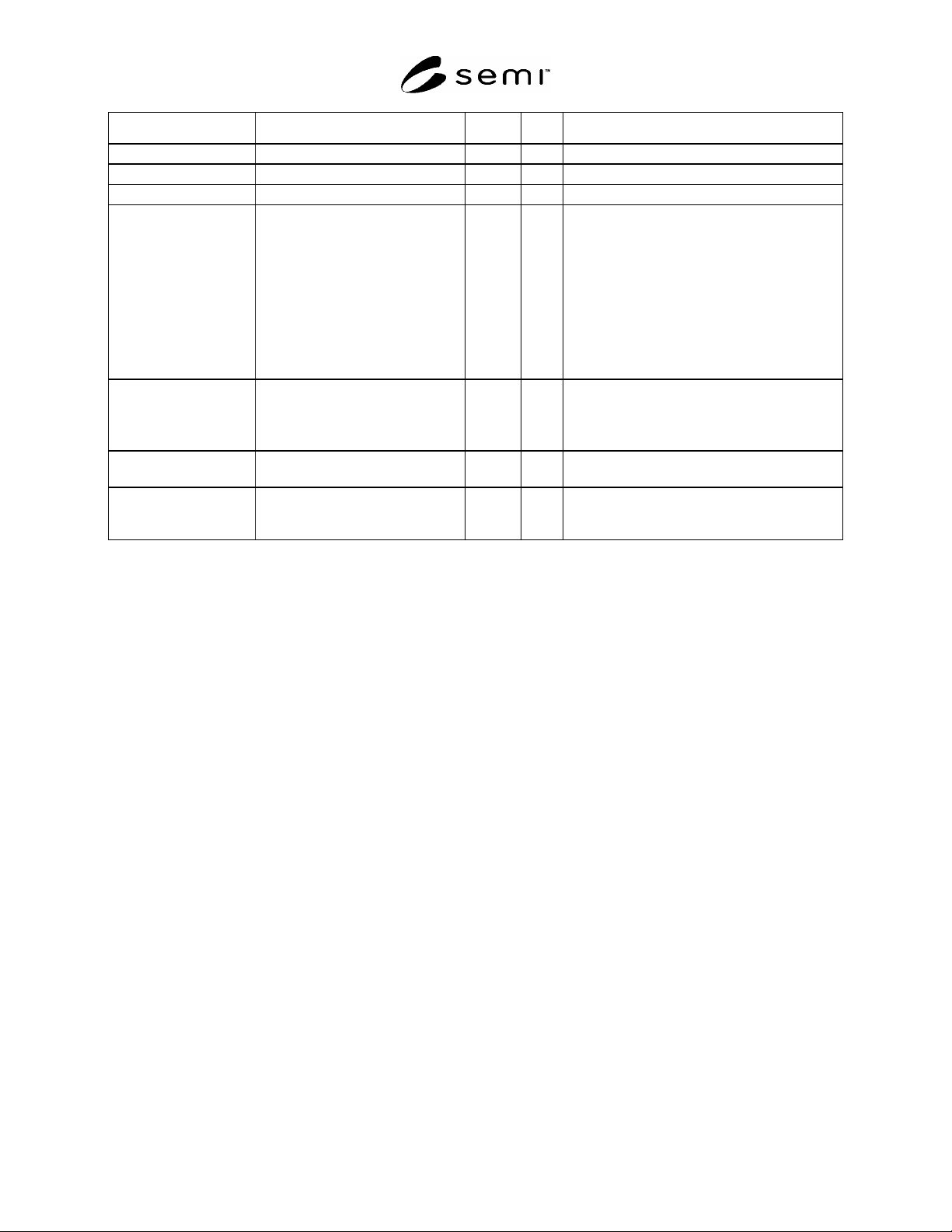
Attribute Name Definition Access Reqd Form
LocationID Identifier of current location. RO Y Text 1 to 80 characters.
ObjType Object type. RO Y Text 1 to 40 characters equal to “Carrier”.
ObjID Object identifier. RO Y Text 1 to 80 characters equal to the CarrierID.
SlotMap Ordered list of slot status as
provided by the host and
corresponding to slot 1,2,3…n until
a successful slot map read, then as
read by the equipment.
RO Y Ordered list of n, where n is equal to the value
of “Capacity” above, each value in the list is
enumerated
Enumerated
Enumerated:
UNDEFINED, EMPTY, NOT EMPTY,
CORRECTLY OCCUPIED, CROSS
SLOTTED, DOUBLESLOTTED. (NOT
EMPTY provided for equipment that cannot
detect incorrectly slotted substrates).
SlotMapStatus Current state of slot map
verification.
RO Y Enumerated:
SLOT MAP NOT READ, [SLOT] WAITING
FOR HOST, SLOT MAP VERIFICATION OK,
SLOT MAP VERIFICATION FAILED.
SubstrateCount The number of substrates currently
in the carrier.
RO Y Non negative integer less than or equal to the
Capacity.
Usage The type of material contained in
the carrier (i.e., TEST, DUMMY,
PRODUCT, FILLER, etc.).
RO Y Text as defined by the Equipment.
#1
NOT EMPTY is included to indicate presence for equipment that is only able to detect substrate presence but not correct positioning of the
substrate slot. For equipment that can detect incorrect positioning such as cross-slotted or double slotted, NOT EMPTY may not be applicable.
10.3.5 Rules for Carrier Attributes
The equipment shall change object attributes, Capacity, ContentMap, SlotMap, Substrate count and Usage,
provided by the host. All other attributes, such as LocationID, shall be set and maintained by the equipment.
The attributes, Capacity, ContentMap, Substrate count and Usage, shall be provided with Bind,
CarrierNotification, or ProceedWithCarrier service before or when SlotMap is provided.
The SlotMap shall be provided with Bind, CarrierNotification, or ProceedWithCarrier to verify CarrierID, when
the SlotMap verification is equipment based. And it shall not be provided when the SlotMap verification is host
based.
Carrier properties may be provided before the carrier arrives as part of the Bind service and should be retained
until either a CancelBind service is received or the carrier is removed.
Carrier properties may also be provided by the ProceedWithCarrier service. The carrier properties that are
provided by the ProceedWithCarrier service may differ based whether or not the object is instantiated by the
service.
Carrier properties that are required shall be actively updated by the equipment.
10.3.6 Carrier Location
10.3.6.1 A carrier location, signified by LocationID, is used for tracking carriers as they move through the
equipment. A carrier location is any physical area that is capable of holding a carrier. It is not intended to represent
entire mechanisms, which may have a variety of other properties of interest, but only that portion where a Carrier
may rest.
10.3.7 Carrier Location Examples
10.3.7.1 Carrier Locations include load port locations, substrate port locations, internal buffer locations, as well as
grippers, conveyors, and elevators that are used internally for moving the carrier from one fixed location to another.

SEMI E87-0705 © SEMI 1999, 2005 14
10.4 Carrier Location Naming
10.4.1 Carrier locations shall be assigned a unique name. Information about the carrier location can be ob-tained by
querying the CarrierObject for the LocationID or by asking the equipment for the CarrierLocation-Matrix. The text
form of the LocationID shall be descriptive of the location. For example, LocationID form for load port load/unload
location might be “LPn”, where “n” equal is equal to the load port number (the load port number is determined
through the numbering rule in ¶9.1). The LocationID form for the FIMS port location might be “FIMSn”. The
LocationID form for a buffer location might be “BUFn”.
10.5 Load Port Carrier Locations
10.5.1 For fixed buffer equipment configured to handle FOUPs, a Load Port has two different Carrier Locations.
One represents the place where a Carrier is delivered and picked up, while the other represents the place where the
Carrier is docked and can be opened.
10.6 Carriers Between Locations
10.6.1 When the carrier is traveling from one location to another, the location attribute remains equal to the source
location until the carrier movement is complete and the carrier is resting at the new carrier location (the destination
location).
10.6.2 Usage
10.6.2.1 The Usage parameter indicates the type of substrate the carrier contains. All Usage values are equipment
specific values. Some internal buffer equipment manages carriers by establishing logical partitions. This type of
equipment shall use the Usage parameter to determine which logical partition where the carrier is held.
10.6.3 SubstrateCount
10.6.3.1 The SubstrateCount parameter can be sent to the equipment by the host in either the Bind service or the
ProceedWithCarrier service. However the equipment shall update this parameter based on the results of the read slot
map operation. Furthermore, the equipment shall update the parameter based on it’s own actions of adding and
removing a substrate to and from a carrier. If the equipment does not know the value of SubstrateCount prior to
instantiation, the equipment shall instantiate the carrier object with the value of null for SubstrateCount.
10.6.4 Lot information for ContentMap
10.6.4.1 Lot is defined in SEMI E90 as a group of one or more substrates of the same type. It is organized external
to the equipment. The Lot ID is the identifier of this group. If the equipment is informed of the Lot ID to which a
substrate belongs, the equipment must maintain this information.
10.6.5 Carrier Accessing Status
10.6.5.1 The CarrierAccessingStatus is used by the host to know whether or not the carrier owned by the equipment
can be moved out. If the carrier is within the internal buffer equipment, this status may be used by the host to issue
CarrierOut service.
10.7 Carrier State Model
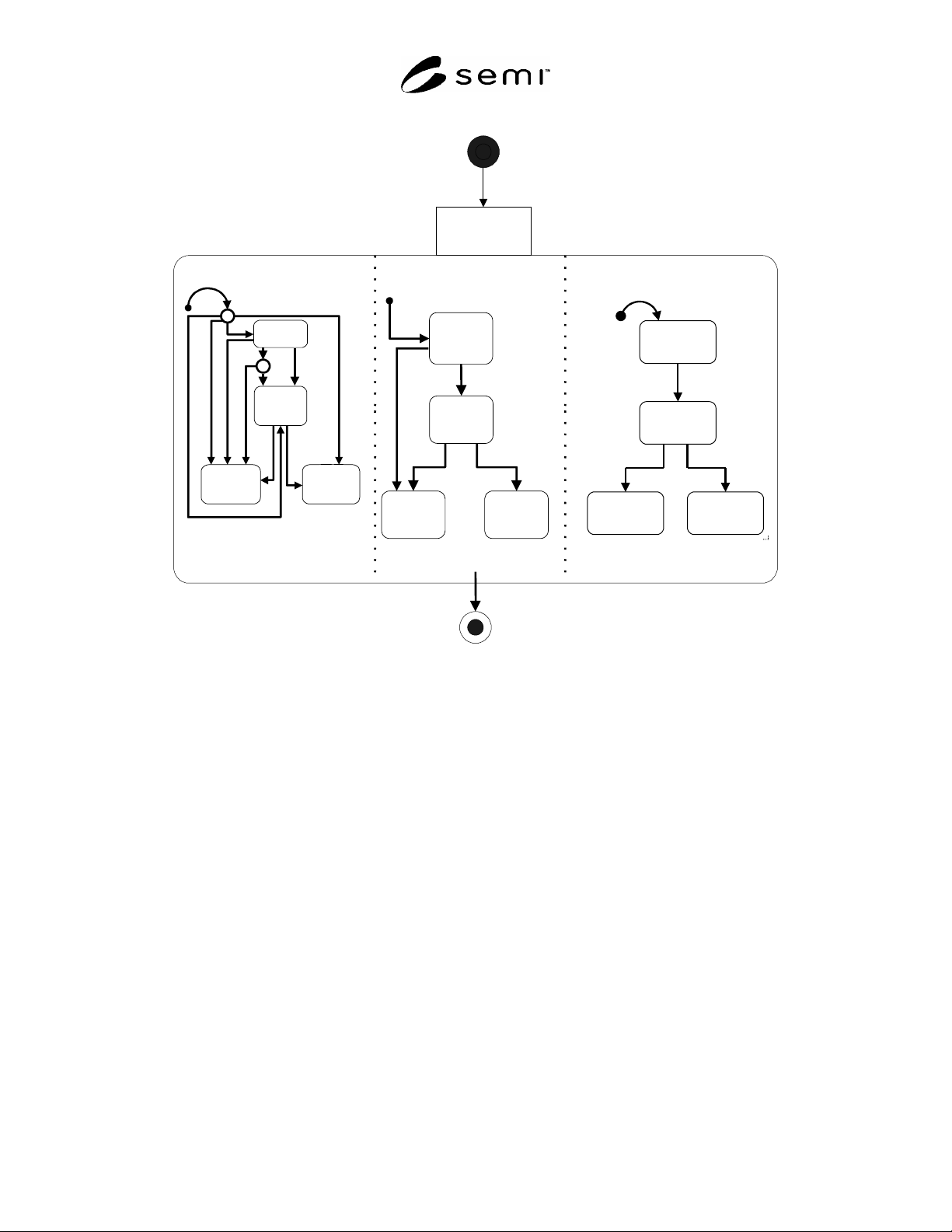
10.7.1 The purpose of the Carrier State Model is to define the host’s view of a carrier. The equipment shall maintain
a separate and independent state model for each carrier in/at the equipment.
SEMI E87-0705 © SEMI 1999, 2005 15
10.7.2 Carrier State Model Diagram
CARRIER
1
21
CARRIER SLOT MAP STATUS
SLOT MAP NOT
READ
WAITING FOR
HOST
SLOT MAP
VERIFICATION
OK
SLOT MAP
VERIFICATION
FAIL
12
13
14
15 16
C
CARRIER ID STATUS
ID NOT READ
WAITING FOR
HOST
ID
V
ERIFICATION
OK
ID
V
ERIFICATION
FAILED
3
4
5
6
7
9
2
8
C
11
10
NOT
ACCESSED
IN
A
CCESS
CARRIER
COMPLETE
18
19
17
CARRIER
STOPPED
20
CARRIER ACCESSING STATUS
Figure 3
Carrier State Model Diagram
10.7.3 Carrier State Definitions
10.7.3.1 CARRIER — The CARRIER state has three ANDed (orthogonal) states: CARRIER ID STATUS,
CARRIER SLOT MAP STATUS and CARRIER ACCESSING STATUS.
10.7.3.2 CARRIER ACCESSING STATUS — This is a substate of CARRIER and indicates the current accessing
status of the carrier. It has four substates, NOT ACCESSED, IN ACCESS, CARRIER COMPLETE, and CARRIER
STOPPED. The initial default entry substate is NOT ACCESSED.
10.7.3.2.1 NOT ACCESSED — This is a substate of CARRIER ACCESSING STATUS and is active when access
by the equipment to the carrier has not been started. The carrier can be moved out.
10.7.3.2.2 IN ACCESS — This is a substate of CARRIER ACCESSING STATUS and is active when access by the
equipment to the carrier has been started but has not been finished, and the carrier should not be moved out.
10.7.3.2.3 CARRIER COMPLETE — This is a substate of CARRIER ACCESSING STATUS and is active when
the access by the equipment to the carrier has been finished, and the carrier should be moved out. This is a final
state.
10.7.3.2.4 CARRIER STOPPED — This is a substate of CARRIER ACCESSING STATUS and is active when the
access by the equipment to the carrier has been stopped abnormally, and the carrier should be moved out. This is a
final state.
10.7.3.3 CARRIER ID STATUS — This is a substate of CARRIER and indicates the current status of the carrier
with respect to its identifier. It has four substates, ID NOT READ, WAITING FOR HOST, ID VERIFICATION
FAILED, ID VERIFICATION OK. The initial substate is conditional based on information the equipment has