semi合集-English.pdf - 第3961页
SEMI F40-0699 © SEMI 1999 5 ASTM D859 — Stan dard Test Method for Silica in Water ASTM D1068 — St andard Test Method for Iron in Water ASTM D1353 — Stan dard T est Method for Nonvolatile Matter in Vo latile Solvents for …

SEMI F40-0699 © SEMI 1999 4
10.6.3 During sample collection for metal analysis, the
components must be acid stabilized to a pH of 2
(approximately 3 drops of concentrated nitric acid per
250 mL of UPW) to stabilize for certain trace metals
(i.e., iron and chromium).
10.6.4 Gaskets and O-rings: A minimum of two grams
of component per 100 mL of test fluid is required to
perform any of the tests. To concentrate a sample and
lower the detection limit of the test method, increase the
amount of component per 100 mL of fluid.
10.6.5 Example of procedure for components that
require a container
10.6.5.1 Clean and prepare 8 covered containers per
Section 10.4.1 and 7.1.1.
10.6.5.2 Place the component into 3 containers per
Section 10.6.
10.6.5.3 Flush all containers (3 with co mponents and 5
as blanks) according to Section 10.4.2 (rinse 10 times
for 2 minutes per Table 1).
10.6.5.4 Fill all containers with the test media of
choice (see Section 2.3 for definition of test media).
10.6.5.5 Soak according to Section 10.4.3 (soak one
week per table 1), agitate all containers once a day for
one minute per Section 10.4.4.
10.6.5.6 At completion of this practice analytical tests
should be performed on test fluid from each container
see test methods noted in Table 3 and related
documents section.
11 Procedure for Preparing Components for
Bulk Polymer Analysis
11.1 Table 2 lists the amount of material required to
achieve the indicated level of detection. Obtaining the
amount may require using 1) an entire component, 2) a
segment of a large component (such as piece of piping
or valve), or 3) an appropriate quantity of smaller
components (such as O-rings).
11.2 No further pretreatment is req uired except for
inorganic analysis. See Section 11.3.
11.3 Additional Pretreatment for Inorganic Bulk
Analysis
11.3.1 If the intent of the inorganic analysis is to
examine the as-received material from a supplier, no
further pretreatment is required.
11.3.2 After the proper amount of the material is
obtained, place it in a clean container and clean it using
the procedure outlined below.
NOTE: This procedure may also be used to pre-clean
containers and caps to meet the criteria specified in
Section 7.1.1. If pre-cleaning performance criteria is
not achieved with this procedure another procedure
should be used or the concentrations, times, and
temperatures noted in this procedure could be varied to
achieve required result.
11.3.3 Agitate the material in ultrapure IPA for 2
minutes. Drain the IPA from the material and replenish
with ultrapure IPA. Allow the material to soak for 30
minutes.
11.3.4 Drain the IPA from the material and replace
with UPW. Agitate the material for 2 minutes.
11.3.5 Soak the material in 1:1 ultrapure nitric acid :
UPW for 2–4 hours.
11.3.6 Drain the nitric acid from the material and
replace with UPW. Agitate the material for 2 minutes.
11.3.7 Soak the material in 1:1 ultrapure HCl : UPW
for 2–4 hours.
11.3.8 Drain the HCl from the material and replace
with the test fluid. Agitate the material for 2 minutes.
Drain the material and replenish with test fluid and
agitate for an additional two minutes.
12 Data Presentation
12.1 See Table 3 for a list of the units to report for
individual component types. Record the following:
a) Report the test fluid used and test temperature.
b) Report if the components were prepared for
testing as received or after the rinse
pretreatment.
c) Report the volume of test fluid used.
d) Report the soak time
e) Report the wetted surface area of the
component. If the precise wetted surface area
is not known please record the assumed or
estimated wetted surface area and note it is
estimated.
f) If multiple components (such as gaskets, or O-
rings) were used, report the total wetted
surface area of the components.
g) Report the manufacturer, model number, and
lot number (if known) for each component
tested.
13 Related Documents
13.1 ASTM Standards
1
1
American Society for Testing and Materials (ASTM). 1916 Race St.
Philadelphia, PA 19103.

SEMI F40-0699 © SEMI 19995
ASTM D859 — Standard Test Method for Silica in
Water
ASTM D1068 — Standard Test Method for Iron in
Water
ASTM D1353 — Standard Test Method for Nonvolatile
Matter in Volatile Solvents for Use in Paint, Varnish,
Lacquer, and Related Products
ASTM D4327 — Standard Test Methods for Anions in
Water by Ion Chromatography
ASTM D4779 — Standard Test Method for Total,
Organic, and Inorganic Carbon in High Purity Water by
Ultraviolet (UV) or Persulfate Oxidation or Both, and
Infrared Detection
13.2 SEMATECH Documents
2
SEMATECH 92010935B–STD — Provisional Test
Method for Electrical Resistivity of UPW
SEMATECH 92010936B–STD — Provisional Test
Method for the Determining Leachable Trace
Inorganics from UPW Distribution System Components
SEMATECH 92010937B–STD — Provisional Test
Method for Evaluating Bulk Polymer Samples of UPW
Distribution System Components (FTIR Method)
SEMATECH 92010938B–STD — Provisional Test
Method for Determining Bulk Trace Metals in Polymer
Materials for UPW Distribution System Components
SEMATECH 92010939B–STD — Provisional Test
Method for Evaluating Bulk Polymer Samples of UPW
Distribution System Components (DSC and TGA
Methods)
SEMATECH 92010940B–STD — Provisional Test
Method for Determining the Water Retention Capacity
of Ion-Exchange Resins Used in UPW Distribution
Systems
2
SEMATECH. 2706 Montopolis Dr. Austin, TX 78741.
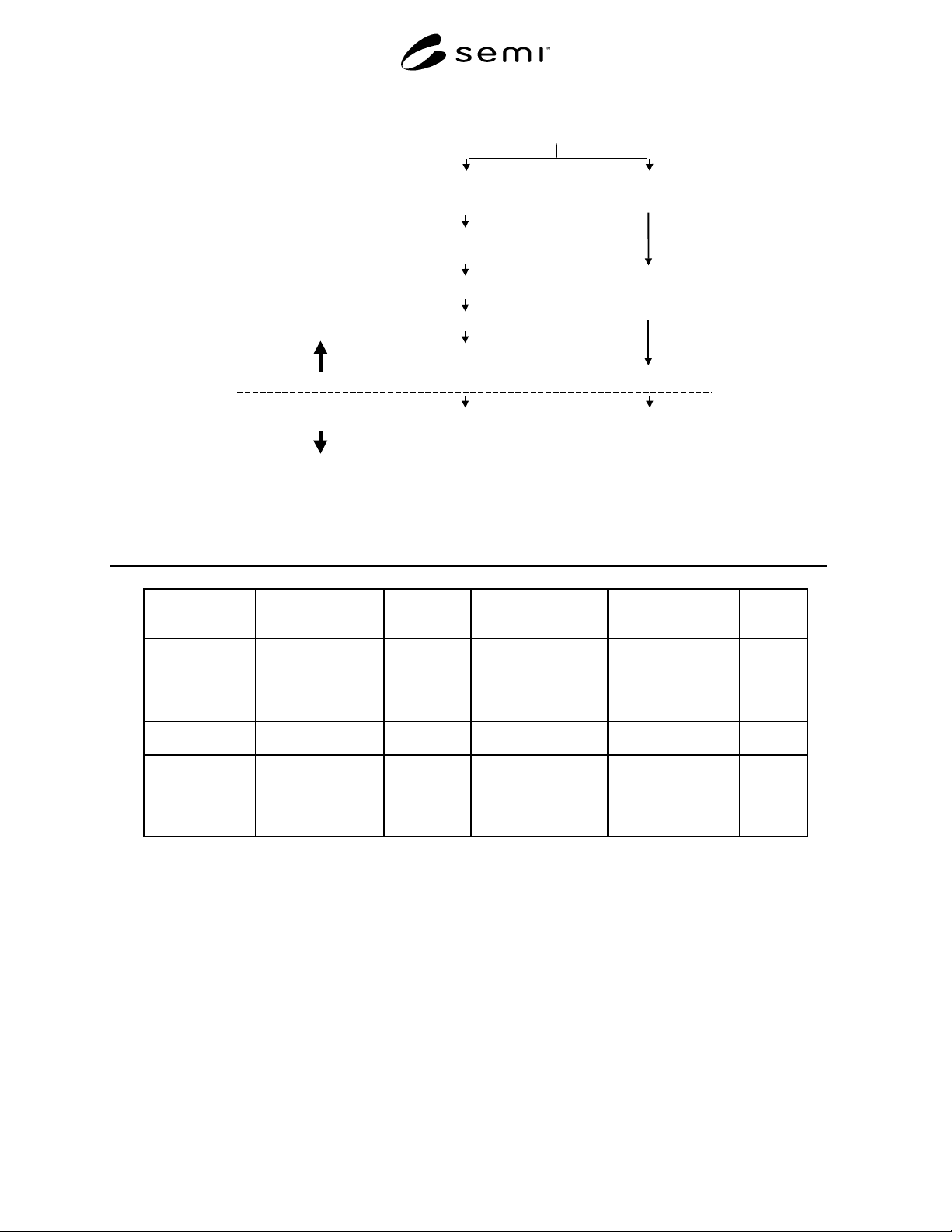
SEMI F40-0699 © SEMI 1999 6
Polymer
material sample
to be tested
Surface Contamination
Extraction Analysis
Component
Bulk Polymer
Analysis
Clean if required
Component and blank
extraction fluid
samples to be tested
Flush
Analytical
test method
Soak
Pre-clean
caps and containers
covered in this practice
covered in test methods
(see Table 3 and Related
Documents)
Analytical
test method
Figure 1
Summary of Practice
Table 1 Component Handling for Extraction Test Preparation
Component No. of Flushes
x
Flush Time (min.)
Soak Time Capped Component
or
Container
Container Material Section
Tubing,
Piping
10 x 2 min. 1 week capped component N/A 9.5.4
Valves,
Regulators,
Fittings
10 x 2 min. 1 week capped component N/A 9.5.5
Filter Housings 10 x 2 min. 1 week capped component N/A 9.5.6
O-rings,
Gaskets
10 x 2 min. 1 week container PFA
FEP
PP
glass
(see NOTE*)
9.6.4
* NOTE: The container and transfer vessel materials used depend on the test to be performed. Use the following
materials for the noted test methods.
Test Method Material
TOC, NVR glass
anions PP, glass
inorganics, resistivity, silica PFA, FEP