semi合集-English.pdf - 第3255页
SEMI E127-0705 © SEMI 2003, 2005 56 R2-1.6 The statements in the above sections are summarized in tab ular format by Table R2-1. It illustrates the fact that BLOCKE D has precedent over BU SY and IDLE, and BUSY has pr ec…

SEMI E127-0705 © SEMI 2003, 2005 55
RELATED INFORMATION 2
USE OF IMMC WITH EPT
NOTICE: This related information is not an official part of SEMI E127 and was derived from work of the
originating committee. This related information was approved for publication by full letter ballot procedures.
R2-1 Association of IMMC State Changes with EPT Module State Changes
R2-1.1 The IMMC defines the IMM as an EPT Module, and the tool connected to the IMM is required to include
the IMM among its EPT Modules.
R2-1.2 The EPT state of the IMM as a whole is based on three components: the state of the STPO, the state of the
portion of the IMM that is independent of the STPO (representing loading and unloading of substrates) and the
combined state of any IMM Data Table Object (representing either current measurement (raw data) or calibration)
or data conversion activities. The IMMC does not require the IMM-only (exclusive of STPO and IMM Data Table
Object states) to have a state model representing any other activities that it may be performing, but to correctly
calculate the EPT state as a whole, its own EPT states must be done.
R2-1.2.1 IMM-Only State — Excluding activities performed by, and subsystems used only by, an STPO or
represented by an IMM Data Table Object state, the IMM-only may contain various subsystems, such as an aligner,
the various sensors used for measuring, and mechanisms for moving a substrate from one Substrate Location to
another, but excludes those mechanisms used solely by an STPO. The IMM-only, then, will be either:
actively performing some task, with or without material, with no faults (EPT-BUSY),
inactive, without material, and with no reason that would prevent it from performing any of its normal tasks
(EPT-IDLE), or
inactive, either with material present or because of a fault in one of its subsystems (EPT-BLOCKED).
R2-1.2.2 The IMM Service state is not related to the IMM EPT State. Whether IN SERVICE or OUT OF
SERVICE, the IMM-Only can be in any of the three EPT states.
R2-1.3 STPO State
R2-1.3.1 The STPO is IDLE only in the READY TO LOAD state. Here it has no material, is performing no
activity, and has nothing to prevent it from performing a load activity.
R2-1.3.2 The STPO is BUSY only in the ASSIGNED state.
R2-1.3.3 The STPO is BLOCKED in the BLOCKED state.
R2-1.3.4 The STPO is BLOCKED in the READY TO UNLOAD state, because, although it is not performing an
activity, it has material.
R2-1.4 IMM Data Table Object State
R2-1.4.1 The combined IMM Data Table Object state, for EPT purposes, is determined by the combination of all
IMM Data Table Objects stored within the IMM.
R2-1.4.2 The combined state is BUSY if at least one IMM Data Table Object is IN PROCESS.
R2-1.4.3 If no IMM Data Table Object is IN PROCESS, then the combined state is IDLE.
R2-1.4.4 There is no state for an IMM Data Table Object that corresponds to BLOCKED.
R2-1.5 The rules for determining the IMM EPT State are as follows:
If any of the above components is BLOCKED, then the IMM EPT State is BLOCKED.
If no component is BLOCKED and at least one is BUSY, then the IMM EPT State is BUSY.
If all three components are IDLE, then the IMM EPT State is IDLE.
SEMI E127-0705 © SEMI 2003, 2005 56
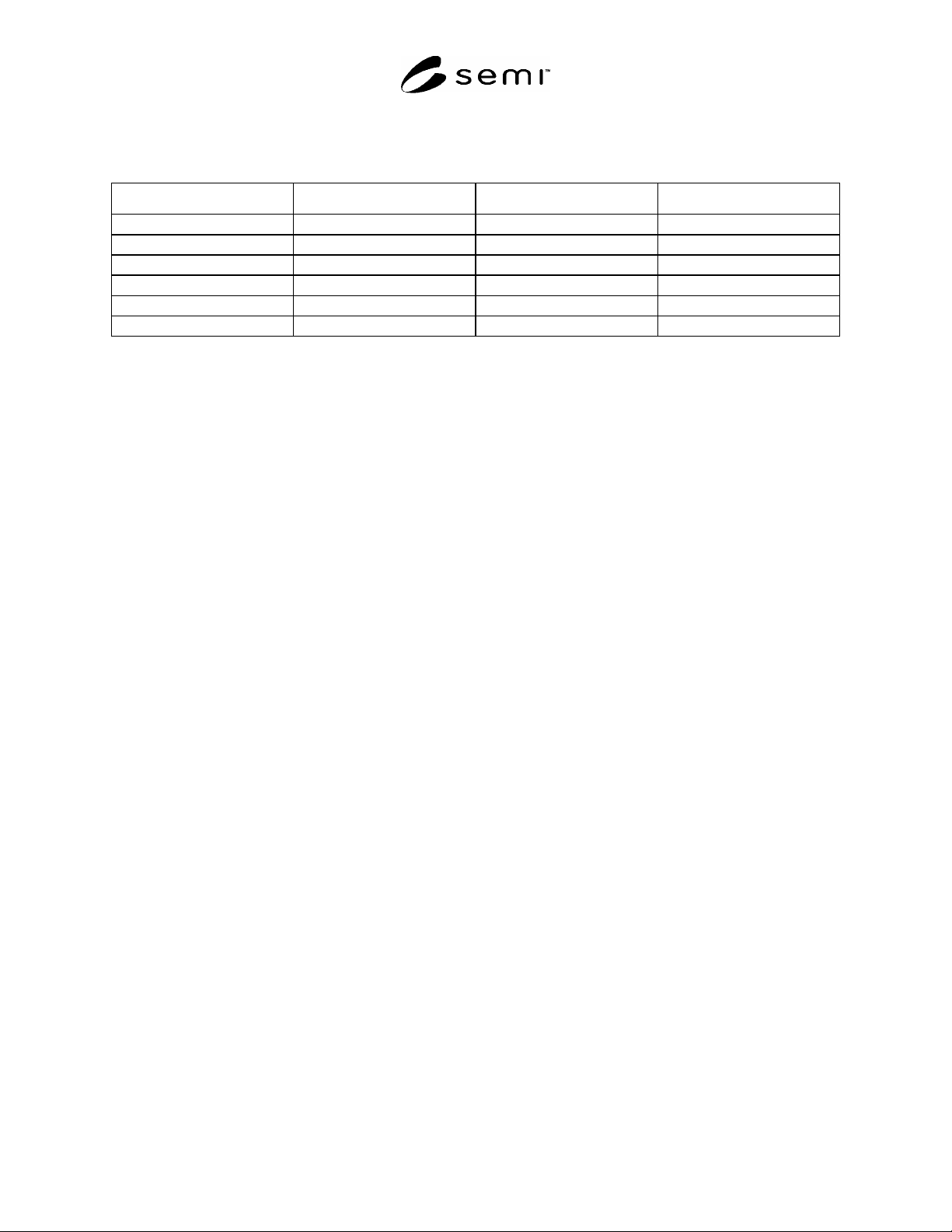
R2-1.6 The statements in the above sections are summarized in tabular format by Table R2-1. It illustrates the fact
that BLOCKED has precedent over BUSY and IDLE, and BUSY has precedence over IDLE.
Table R2-1 Determination of IMM EPT State
IMM ONLY State STPO State IMM Data Table State IMM EPT State
IDLE READY TO LOAD all IN RETENTION IDLE
BLOCKED any any BLOCKED
BUSY any but BLOCKED any BUSY
any BLOCKED any BLOCKED
any but BLOCKED ASSIGNED any BUSY
any but BLOCKED any but BLOCKED one or more IN PROCESS BUSY
NOTICE: SEMI makes no warranties or representations as to the suitability of the standards set forth herein for any
particular application. The determination of the suitability of the standard is solely the responsibility of the user.
Users are cautioned to refer to manufacturer's instructions, product labels, product data sheets, and other relevant
literature, respecting any materials or equipment mentioned herein. These standards are subject to change without
notice.
By publication of this standard, Semiconductor Equipment and Materials International (SEMI) takes no position
respecting the validity of any patent rights or copyrights asserted in connection with any items mentioned in this
standard. Users of this standard are expressly advised that determination of any such patent rights or copyrights, and
the risk of infringement of such rights are entirely their own responsibility.
Copyright by SEMI® (Semiconductor Equipment and Materials
International), 3081 Zanker Road, San Jose, CA 95134. Reproduction of
the contents in whole or in part is forbidden without express written
consent of SEMI.
SEMI E127.1-0705 © SEMI 2004, 2005 1
SEMI E127.1-0705
SPECIFICATION FOR SECS-II PROTOCOL FOR INTEGRATED
MEASUREMENT MODULE COMMUNICATIONS (IMMC)
This specification was technically approved by the global Information & Control Committee. This edition
was approved for publication by the global Audits and Reviews Subcommittee on April 7, 2005. It was
available at www.semi.org in June 2005 and on CD-ROM in July 2005. Originally published March 2004;
previously published November 2004.
1 Purpose
1.1 This document maps the services and data of IMMC to SECS-II streams and functions and data definitions.
2 Scope
2.1 This document applies to all implementations of IMMC that use the SECS-II message protocol (SEMI E5).
NOTICE: This standard does not purport to address safety issues, if any, associated with its use. It is the
responsibility of the users of this standard to establish appropriate safety and health practices and determine the
applicability of regulatory or other limitations prior to use.
3 Referenced Standards and Documents
3.1 SEMI Standards
SEMI E5 — SEMI Equipment Communications Standard 2 Message Content (SECS-II)
SEMI E39 — Object Services Standard: Concepts, Behavior, and Services
SEMI E39.1 — SECS-II Protocol for Object Services Standard (OSS)
SEMI E90.1 — Provisional Specification for SECS-II Protocol Substrate Tracking
SEMI E127 — Specification for Integrated Measurement Module Communications: Concepts, Behavior, and
Services (IMMC)
NOTICE: Unless otherwise indicated, all documents cited shall be the latest published versions.
4 Conventions
4.1 Names of SECS-II data items are in all upper case. Names of SEMI E127 services, parameters, and attributes
are in Title or mixed case.
4.2 SML notation is used for SECS-II format codes. See SEMI E30, Section 8.4.
5 Services Mapping
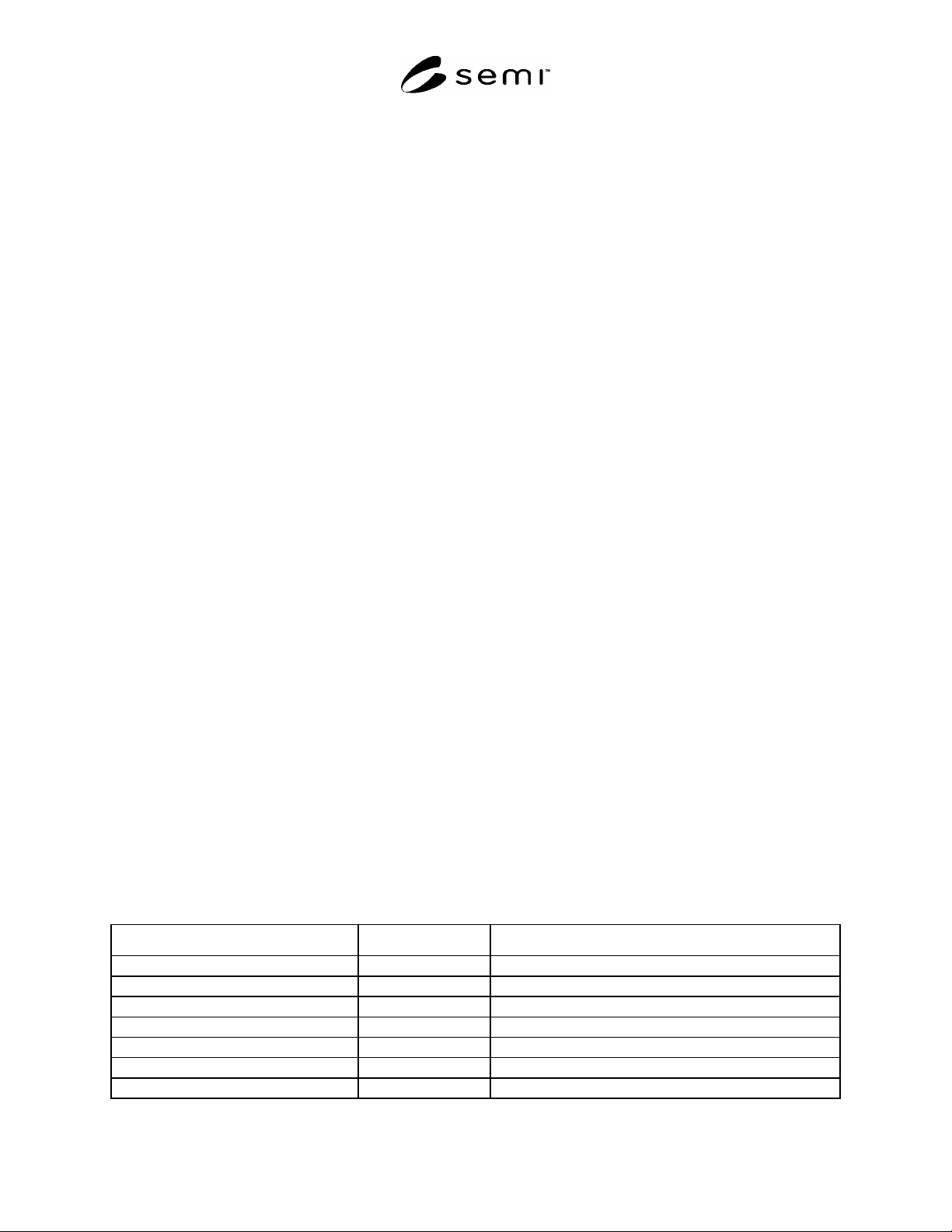
5.1 Table 1 shows the specific SECS-II streams and functions that shall be used for SECS-II implementations of the
services defined in IMMC.
Table 1 Services Mapping Table
Message Name Stream, Function SECS-II Message Name
ChangeService S14, F19/20 Generic Service Request/Acknowledge
ClientConnect S14, F19/20 Generic Service Request/Acknowledge
ClientDisconnect S14, F19/20 Generic Service Request/Acknowledge
RequestRetentionConditions S14, F19/20 Generic Service Request/Acknowledge
SetAutoTableSend S14, F19/20 Generic Service Request/Acknowledge
SetRetentionConditions S14, F19/20 Generic Service Request/Acknowledge
TransferPathCalibration S14, F19/20 Generic Service Request/Acknowledge