semi合集-English.pdf - 第698页
SEMI E92-0302 E © SEMI 1999, 2003 1 SEMI E92-0302 E SPECIFICATION FOR 300 mm LIGH T WEIGHT AND COMPACT BOX OPENER/LOADER TO TOOL-INT EROPERABILITY STANDARD (BOLTS/LIGHT) This provisional specification was technically app…
SEMI E89-1104
E
© SEMI 1999, 2004 24
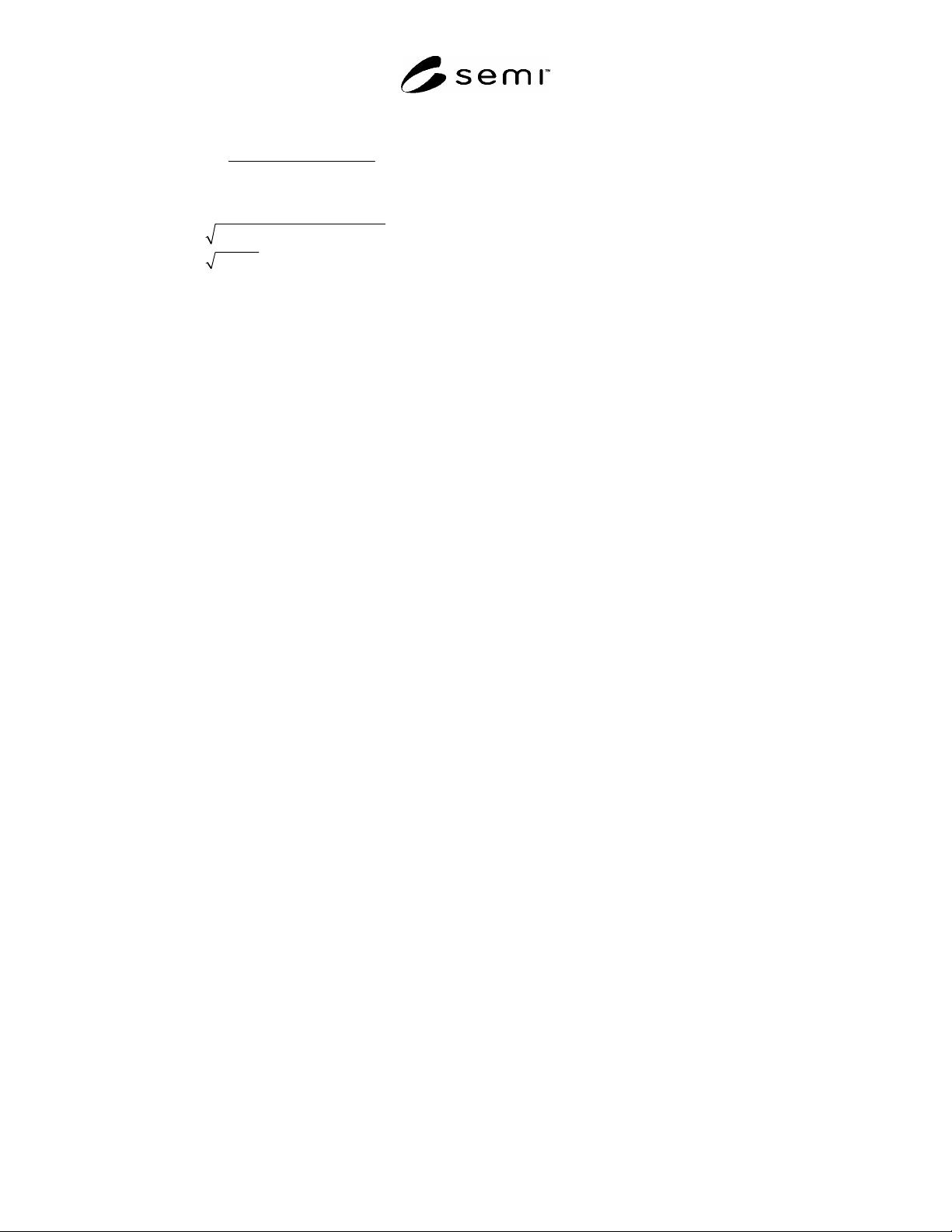
R6-3.11.1 In general, the equation for VC
W
is
xxWLWrW
W
MS nVC VC
VC
nL
(R6-33)
R6-3.12
Reproducibility is
xx
0.4225
0.65
rrLrWLW
VC VC VC VC
(R6-34)
R6-3.12.1 Typically, VC
W
is not included in
reproducibility because it is a function of true
differences on the measurand. If, however, the
measurands are known to be the same value, and
differences are associated with measurement variability,
it should be included in reproducibility.
NOTICE: SEMI makes no warranties or
representations as to the suitability of the standards set
forth herein for any particular application. The
determination of the suitability of the standard is solely
the responsibility of the user. Users are cautioned to
refer to manufacturer's instructions, product labels,
product data sheets, and other relevant literature,
respecting any materials or equipment mentioned
herein. These standards are subject to change without
notice.
By publication of this standard, Semiconductor
Equipment and Materials International (SEMI) takes no
position respecting the validity of any patent rights or
copyrights asserted in connection with any items
mentioned in this standard. Users of this standard are
expressly advised that determination of any such patent
rights or copyrights, and the risk of infringement of
such rights are entirely their own responsibility.
Copyright by SEMI® (Semiconductor Equipment and Materials
International), 3081 Zanker Road, San Jose, CA 95134. Reproduction of
the contents in whole or in part is forbidden without express written
consent of SEMI.

SEMI E92-0302
E
© SEMI 1999, 2003 1
SEMI E92-0302
E
SPECIFICATION FOR 300 mm LIGHT WEIGHT AND COMPACT BOX
OPENER/LOADER TO TOOL-INTEROPERABILITY STANDARD
(BOLTS/LIGHT)
This provisional specification was technically approved by the Global Physical Interfaces & Carriers
Committee and is the direct responsibility of the Japanese Physical Interfaces & Carriers Committee. Current
edition approved by the Japanese Regional Standards Committee on December 3, 2001. Initially available at
www.semi.org January 2002; to be published March 2002. Originally published September 1999.
E
This document was editorially modified in January 2003 to reflect the withdrawal of SEMI E44. Changes
were made to Sections 4.1, 5.2.5, 5.2.9, 5.2.18, and 5.2.19.
1 Purpose
1.1 Provide Standard for Box Opener/Loader
Interoperability — This standard is intended to provide
standard specifications such as interfaces between the
component that opens the boxes and presents the boxes
to the equipment wafer handler for unloading and
loading 300 mm wafers (BOLTS/Light unit) and higher
level part of equipment and its functions to provide:
(see Figure 1)
• High level of interchangeability/ interoperability,
• Quick attachment/detachment capability with high
mechanical repeatability,
• Light weight, and
• Compactness.
1.1.1 In order to provide a high level of
interchangeability and interoperability, this standard
specifies not only interfaces but also some of the box
opener/loader’s functions that affect interoperability.
1.2 Usage of This Standard — Interoperability
specifications defined by this standard are intended to
be used as interfaces and functionality between
BOLTS/Light compliant box opener/loader and:
• A BOLTS/M compliant loadport unit (that would
conform to SEMI E63).
• An integrated loadport such as four box
opener/loader in one chassis.
• High-densely packaged equipment that uses the
space under the box opener/loader.
1.3 SEMI Standards Compatibility — This standard is
compatible with 300 mm SEMI standards including
SEMI E15.1, E47.1, E1.9, E62, E63 and E64.
1.4 Open Cassette Application — The BOLTS/Light
unit might be configured to handle boxes that would
conform to SEMI E47.1 and SEMI E62.
1.5 A similar unit may be compatibly designed which
does not have box opener capability, but facilitates
placement of an open cassette (that would conform to
SEMI E1.9).
1.6 Carrier Capacities — This standard defines one
interface for 13 or 25 carrier capacity box opener/
loaders.
1.7 The interface specified in this standard is designed
for equipment with a sealed mini-environment, but it is
not limited to such.
2 Scope
2.1 Items Specified — This standard is intended to set
an appropriate level of specification that places minimal
limits on innovation while ensuring modularity,
interchange-ability, and interoperability including:
• Box opener/loader functions that affect
interoperability.
• Mechanical interface features between the box
opener/loader and equipment.
2.2 This standard does not purport to address safety
issues, if any, associated with its use. It is the
responsibility of the users of this standard to establish
appropriate safety and health practices and determine
the applicability of regulatory limitations prior to use.
3 Limitations
3.1 This specification does not apply to the following
application:
• Direct insertion of open cassettes into load-lock
chambers.
4 Referenced Standards
4.1 SEMI Standards
SEMI E1.9 — Mechanical Specification for Cassettes
Used to Transport and Store 300 mm Wafers
SEMI E15 — Specification for Tool Load Port

SEMI E92-0302
E
© SEMI 1999, 2003 2
SEMI E15.1 — Specification for 300 mm Tool Load
Port
SEMI E47.1 — Provisional Mechanical Specification
for Boxes and Pods Used to Transport and Store 300
mm Wafers
SEMI E57 — Mechanical Specification for Kinematic
Couplings Used to Align and Support 300 mm Wafer
Carriers
SEMI E62 — Provisional Specification for 300 mm
Front-Opening Interface Mechanical Standard (FIMS)
SEMI E63 — Mechanical Specification for 300 mm
Box Opener/Loader to Tool Standard (BOLTS-M)
Interface
SEMI E64 Specification for 300 mm Cart to SEMI
E15.1 Docking Interface Port
4.2 Other Standard
I300I/J300 GJG I300I/J300 Global Joint Guidance
for 300 mm Semiconductor Factories
NOTE 1: As listed or revised, all documents cited shall be the
latest publications of adopted standards.
5 Terminology
5.1 Abbreviations and Acronyms
5.1.1 AMHS — Automated Material Handling System
5.2 Definitions
5.2.1 bilateral datum plane — a vertical plane that
bisects the wafers and that is perpendicular to both the
horizontal and facial datum planes (as defined in SEMI
E57).
5.2.2 BOLTS/Light exclusion volume — a volume
reserved by equipment or loadport unit to put
BOLTS/Light compliant box opener/loader.
5.2.3 BOLTS/Light plane — a vertical plane that
interfaces BOLTS/Light compliant box opener/loader
and equipment.
5.2.4 bottom interface plane— an interface means
between the equipment and box opener/loader.
5.2.5 box — a protective portable container for a
cassette and/or substrate(s).
5.2.6 box opener/loader — the equipment component
that opens wafer carriers (if needed) and presents the
carriers to the equipment’s wafer handler for unloading
and loading wafers.
5.2.7 carrier — any cassette, box, pod, or boat that
contains wafers (as defined in SEMI E1.9). Also known
as wafer carrier.
5.2.8 carrier capacity — the number of substrates that
a carrier holds (as defined in SEMI E1.9).
5.2.9 cassette — an open structure that holds one or
more substrates.
5.2.10 control connection area — an area to be used
for placement of connectors for electrical signals,
power supplies, and other inlets/outlets.
5.2.11 docked facial datum plane — a vertical plane
that bisects the wafers at the carrier docked position. It
is also parallel to the load face plane specified in SEMI
E15.
5.2.12 docking stroke — the travel distance of the
carrier center between its load position (facial datum
plane) and the position where the door opening/closing
is done.
5.2.13 facial datum plane — a vertical plane that
bisects the wafers and that is parallel to the front side of
the carrier (where wafers are removed or inserted). On
equipment load ports, it is also parallel to the load face
plane specified in SEMI E15 on the side of the
equipment where the carrier is loaded and unloaded (as
defined in SEMI E57).
5.2.14 front-opening unified pod (FOUP) — a box
(that complies with SEMI E47.1) with a nonremovable
cassette (so that its interior complies with SEMI E1.9)
and with a front-opening interface (that mates with a
FIMS port that complies with SEMI E62) (as defined in
SEMI E47.1).
5.2.15 horizontal datum plane — a horizontal plane
from which projects the kinematic-coupling pins on
which the carrier sits. On equipment load ports, it is at
the load height specified in SEMI E15 and might not be
physically realized as a surface (as defined in SEMI
E57).
5.2.16 load face plane — the furthest physical vertical
boundary plane from the cassette centroid or carrier
centroid on the side (or sides) of the equipment where
loading of the equipment is intended (as defined in
SEMI E15).
5.2.17 loading slider area — two flat surfaces on
equipment which may be used by a maintenance
supporting mechanism (not defined in this standard) to
support the box opener/loader during attachment and
detachment.
5.2.18 minienvironment — a localized environment
created by an enclosure to isolate the product from
contamination and people.
5.2.19 pod — a box having a Standard Mechanical
Interface (SMIF) per SEMI E19.