semi合集-English.pdf - 第579页
SEMI E79-0304 © SEMI 1999, 2004 13 APPENDIX 2 SUPPLEMENTAL PRODUCTIVI TY METRICS FOR FOCUSED PRODUCTIVITY STUDIES NOTICE : The material in this appendix is an official part of SEMI E79 and was approved by full letter bal…

SEMI E79-0304 © SEMI 1999, 2004 12
Flexible-Sequence Cluster Tool Operational Efficiency
= (Flexible-Sequence Cluster Tool Production Time)/(Flexible-Sequence Cluster Tool Equipment Uptime)
= (378.00 hours)/(489.00 hours)
= 0.7730
Virtual Machine Rate Efficiency
= (Virtual Machine Theoretical Production Time for Actual Units)/(Virtual Machine Production Time)
Virtual Machine A
Virtual Machine B Virtual Machine C
= (140.00 hours)/(150.00 hours)
= 0.9333
= (145.00 hours)/(148.00 hours)
= 0.9797
= (75.00 hours)/(80.00 hours)
= 0.9375
Flexible-Sequence Cluster Tool Rate Efficiency
= (Flexible-Sequence Cluster Tool Theoretical Production Time for Actual Units)
/(Flexible-Sequence Cluster Tool Production Time)
= (360.00 hours)/(378.00 hours)
= 0.9524
Virtual Machine Quality Efficiency
= (Virtual Machine Theoretical Production Time for Effective Units)
/(Virtual Machine Theoretical Production Time for Actual Units)
Virtual Machine A
Virtual Machine B Virtual Machine C
= (130.50 hours)/(140.00 hours)
= 0.9321
= (139.00 hours)/(145.00 hours)
= 0.9586
= (75.00 hours)/(75.00 hours)
= 1.0000
Flexible-Sequence Cluster Tool Quality Efficiency
=(Flexible-Sequence Cluster Tool Theoretical Production Time for Effective Units)
/(Flexible-Sequence Cluster Tool Theoretical Production Time for Actual Units)
= (344.50 hours)/(360.00 hours)
= 0.9569
Virtual Machine Overall Equipment Efficiency (OEE)
= (Virtual Machine Theoretical Production Time for Effective Units)/(Virtual Machine Total Time)
Virtual Machine A
Virtual Machine B Virtual Machine C
= (130.5 hours)/(168.00 hours)
= 0.7768
= (139.00 hours)/(168.00 hours)
= 0.8274
= (75.00 hours)/(168.00 hours)
= 0.4464
Flexible-Sequence Cluster Tool Overall Equipment Efficiency (OEE)
=(Flexible-Sequence Cluster Tool Theoretical Production Time for Effective Units)
/(Flexible-Sequence Cluster Tool Total Time)
= (344.50 hours)/(504.00 hours)
= 0.6835
SEMI E79-0304 © SEMI 1999, 2004 13
APPENDIX 2
SUPPLEMENTAL PRODUCTIVITY METRICS FOR FOCUSED
PRODUCTIVITY STUDIES
NOTICE: The material in this appendix is an official part of SEMI E79 and was approved by full letter ballot
procedures on December 15, 1999 by the North American Regional Standards Committee.
A2-1 Supplemental Productivity Metrics with
Total Time as the Denominator
A2-1.1 OEE is based on “as-is” assumptions with
respect to process specifications (recipes), equipment
type, and equipment design. In this way, OEE measures
the performance of the organizations of the
manufacturer and the equipment supplier as they
attempt to drive equipment performance to a potential
defined by given process specifications and a given
equipment type and design.
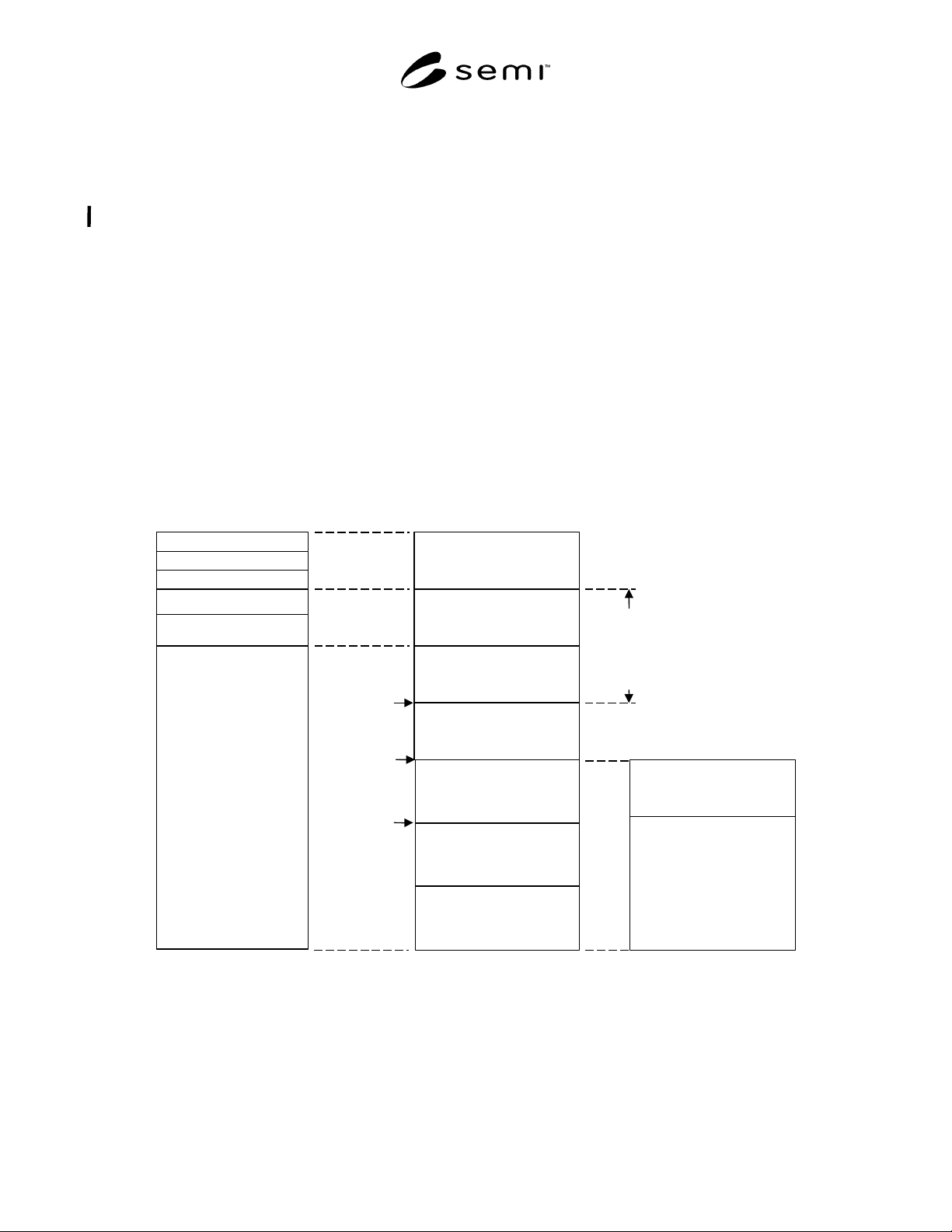
A2-1.2 This section presents three variations on the
OEE calculation that additionally measure the
performance of engineering and design organizations as
they attempt to improve equipment selection, process
specifications and equipment design. These three
variants are each based on more discriminating
definitions of the theoretical production time per unit,
as shown in Figure A2-1. Total time is the denominator
for each metric.
A
vailability Efficiency
L
osses
(Supplier and User Domain)
N
on-Scheduled Time
Scheduled Downtime
Unscheduled Downtime
Engineering
Standby
Production
Time
E
10 States
Theoretical
Production
Time for
Actual Units
Operational
E
fficiency Losses
(User Domain)
R
ate Efficiency
Losses
(Supplier and User Domain)
P
erformance
E
fficienc
y
L
osses
(Supplier and
User Domain)
A
ssignable Quality
E
fficiency Losses
(Supplier and User Domain)
Theoretical
Production
Time for
Effective
Units
E
79 Productivit
y
Losses and
P
rimar
y
Im
p
rovement Domains
Engineering
Theoretical
Production
Time for
Effective
Units
P
rocess Specification Losses
(Process and Product
E
ngineering Domain)
E
quipment Overhead
D
esign Losses
(Supplier Domain)
Value-Added In-Process
Theoretical Production Time
for Effective Units
B
enchmark Equipment
P
roductivity Losses
(Supplier and User Domain)
Reference
Theoretical Production
Time for
Effective Units
Figure A2-1
Incompatibility of R-OEE with E-OEE and VA-OEE
(Data for sample calculations are given on the following page.)

SEMI E79-0304 © SEMI 1999, 2004 14
Operations Time = 168 hours
Theoretical Production Time
for Effective Units = 146 hours
No Product Time = 6 hours
Equipment Unavailable No Product Time = 4 hours
Planned No Product Time = 8 hours
Recipe
Theoretical
Production Time
Per Unit (THT
i
)
Reference
Theoretical
Production Time
Per Unit (RTHT
i
)
Engineering
Theoretical
Production Time
Per Unit (ETHT
i
)
Value-Added In-Process
Theoretical
Production Time
Per Unit (VTHT
i
)
Actual
Units of
Recipe
Effective
Units of
Recipe
A 0.03333 hr/unit 0.03333 hr/unit 0.02500 hr/unit 0.01000 hr/unit 1500 1500
B 0.04000 hr/unit 0.03333 hr/unit 0.02000 hr/unit 0.00500 hr/unit 600 600
C 0.05000 hr/unit 0.03333 hr/unit 0.01500 hr/unit 0.00500 hr/unit 800 800
D 0.06667 hr/unit 0.03333 hr/unit 0.03250 hr/unit 0.01000 hr/unit 500 480
A2-1.3 Reference OEE (R-OEE)
A2-1.3.1 Reference OEE provides a measure of
equipment productivity relative to a benchmark
theoretical production time. The reference theoretical
production time per unit for a given recipe is the time
required by the benchmark equipment (i.e., the fastest
equipment model of similar type), running the
comparable recipe for a benchmark product and process
design. Reference theoretical production time per unit
(RTHT) shall be defined to be less than or equal to
theoretical time per unit (THT) used in calculating
standard OEE. The R-OEE
score may be compared
against the standard OEE score to assess the
productivity loss arising from the application of inferior
equipment.
Reference OEE (R-OEE)
=[∑
i
(Effective Units of Recipe i × RTHT
i
)]
/(Total Time)
where RTHT
i
= reference theoretical production time per unit
of recipe i (based on the benchmark equipment performing a
comparable recipe for a benchmark product and process
design). Reference OEE utilizes an incompatible definition of
theoretical production time for effective units compared to
that utilized in Engineering OEE and Value-Added In-Process
OEE. Productivity losses indicated by R-OEE and by E-OEE
and VA-OEE may overlap. (See Figure A2-1.)
A2-1.3.2 Sample Reference OEE (R-OEE) Calculation
Reference OEE (R-OEE)
= [∑
i
(Effective Units of Recipe i × RTHT
i
)]
/(Total Time)
= [(1500 units × 0.03333 hr/unit)
+ (600 units × 0.03333 hr/unit)
+ (800 units × 0.03333 hr/unit)
+ (480 units × 0.03333 hr/unit)]/(168.00 hours)
= 0.6706
A2-1.4 Engineering OEE (E-OEE)
A2-1.4.1 Engineering OEE provides a measure of
equipment productivity assuming process specifications
are optimized for minimum production time.
Engineering theoretical production time per unit
(ETHT) shall be defined to be less than or equal to
theoretical time per unit (THT) used in calculating
standard OEE. Engineering theoretical production time
per unit may include minimum durations for the
objective processing steps, e.g., implant time for ion
implant systems, and minimum allowances for any
additional supporting process steps, e.g., heating,
cooling, gas stabilization, only if those steps are
deemed absolutely necessary. Time to perform test
wafers, sample wafers, send-aheads, clean cycles,
seasoning cycles, and allowances for non-continuous
cascading of lots through tools are to be specifically
excluded.
Engineering OEE (E-OEE)
=[∑
i
(Effective Units of Recipe i × ETHT
i
)]
/(Total Time)
where ETHT
i
= engineering theoretical production time per
unit of recipe i.
A2-1.4.2 Sample Engineering OEE (E-OEE)
Calculation
Engineering OEE (E-OEE)
= [∑
i
(Effective Units of Recipe i × ETHT
i
)]
/(Total Time)
= [(1500 units × 0.02500 hr/unit)
+ (600 units × 0.02000 hr/unit)
+ (800 units × 0.01500 hr/unit)
+ (480 units × 0.03250 hr/unit)]/(168 hours)
= 0.4589
A2-1.5 Value-added In-Process OEE (VA-OEE)