semi合集-English.pdf - 第3845页
SEMI F20-0305 © SEMI 1995, 2005 9 A2-2.5.2 There appears to be a Cu/S interaction ; the copper eff ect on welding is more pronounced at sulfur levels under 0.01 0%. A2-2.5.3 Commercia lly available t ubing of 2.0 in. dia…

SEMI F20-0305 © SEMI 1995, 2005 8
APPENDIX 2
THE EFFECTS OF COPPER AS A TRACE ELEMENT ON GTA
WELDING OF 316L STAINLESS STEEL
NOTICE: The material in this appendix is an official part of SEMI F20 and was approved by full letter ballot
procedures.
A2-1 Copper in Stainless Steel
A2-1.1 Copper is a residual or unspecified element in AISI 316L. It is not an intentional addition, but is present in
any heat of material as a result of the composition of the furnace charge materials used, which are typically
primarily scrap with elemental and master alloy additions to achieve the composition desired. Levels of unspecified
elements such as Copper are permitted up to 0.50% maximum by AMS 2248E
4
. Copper content can only be
reduced in the melt by dilution. Over time, as more scrap material is recycled, the residual levels of copper in heats
of AISI 316L is anticipated to increase.
A2-1.2 Copper is an austenite phase stabilizer. It also has been shown to improve the resistance of austenitic
stainless steels to stress corrosion cracking in chloride solutions.
A2-2 Effects of Copper on Welding
A2-2.1 In welding, copper is a surface-active element (like S, O, and Se) and has been shown to contribute
significantly to weld bead meander. Like manganese, it will volatilize during welding and redeposit downstream of
the weld, providing a site for the initiation of corrosion in some conditions. Some end users may restrict copper as a
potential source of weld contamination or corrosion.
A2-2.2 A correlation was noted between increased copper content and weld bead meander in a wafer fab project
5
.
Five heats of 0.25 in. tubing were evaluated. Copper was very prominent in the HAZ of one heat (0.47% Cu and
0.011% S) which had a bead meander problem when welded. Another heat with the same sulfur content and a lower
copper content (0.03% Cu) did not exhibit bead meander. Another heat (0.31% Cu and 0.010% S) showed oxidation
after welding. All welds were performed in argon.
A2-2.3 In a study of 28 heats of tubing from 0.25 to 2.0 inch in diameter, copper ranged from 0.05 to 0.41%
6
. Of
the 28 heats tested, 10 had copper contents above 0.25%, and among the nine heats of 2.0 in. diameter tubing, all
had copper levels above 0.22%, with four of the heats above 0.25%. Cosmetically unacceptable welds (slag,
discoloration and/or bead meander) occurred on heats with: 0.26% Cu, 0.005% S; 0.28% Cu, 0.009% S; and 0.41%
Cu, 0.005% S. Conversely, cosmetically acceptable welds were performed on a heat with 0.3% Cu and 0.011% S.
All welds were performed using argon.
A2-2.4 Data was presented at a SEMI Workshop and repeated here concerning the effect of copper content and
shield gas interactions on weldability
7
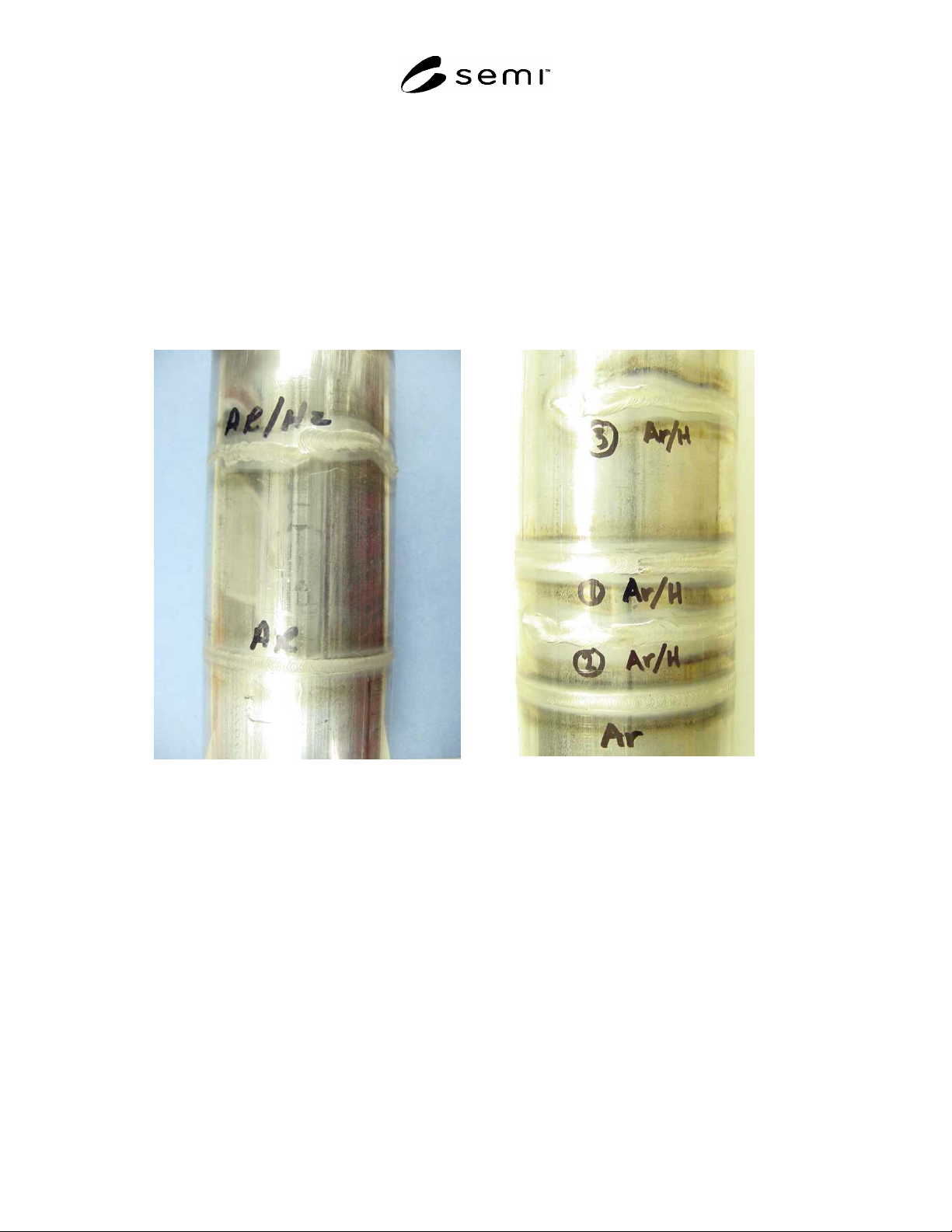
. Two examples of heats of AISI 316L tubing, 2.5 in. in diameter, with copper
contents above 0.3%, demonstrated that adding hydrogen to the argon shield gas adversely affected the weldability
of the tubing (see Figure A2-1). This same effect was not noted in heats of tubing with copper levels below 0.3%. In
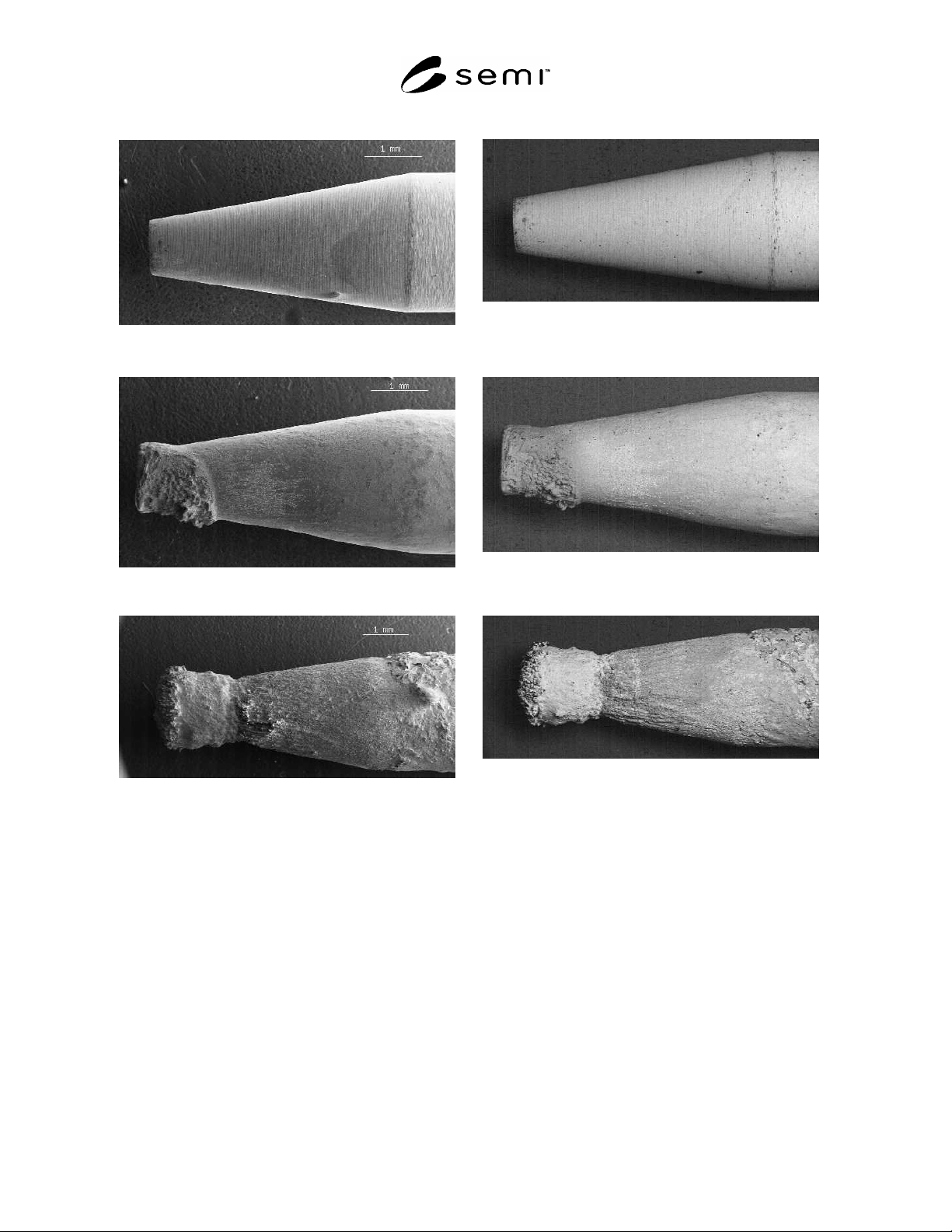
addition, the weld electrodes undergo severe degradation when welding tubing with copper contents above 0.3% and
using Ar/H
2
shield gas (see Figure A2-2).
A2-2.5 Based on the above information, the following conclusions can be made:
A2-2.5.1 The copper restriction in SEMI F20 currently stands at 0.30%. This restriction is due to weldability
effects.
4 Aerospace Materials Specification (AMS) 2248E, "Chemical Check Analysis Limits: Corrosion and Heat Resisting Steels and Alloys,
Maraging and Other Highly Alloyed Steels, and Iron Alloys," SAE International, Warrendale, PA; issued 15 January 1960, Revised 1 October
1993, 6 pp
5 R. M. Cohen, Identifying Trace Elements Affecting the Weldability of 316L Stainless Steel Tubing, Future Fab International 1997, pp. 271-281
6 Sunniva Collins and Pete Williams, Weldability and Corrosion Studies of AISI 316L Electropolished Tubing, Proc. Interphex 2000.
7 Sunniva Collins, The Effect of Copper on GTA Welding of 316L Stainless Steel Tubing, Stainless Steel and Surface Analysis Workshop,
SEMICON West Standards Meeting, July 14, 2003
SEMI F20-0305 © SEMI 1995, 2005 9
A2-2.5.2 There appears to be a Cu/S interaction; the copper effect on welding is more pronounced at sulfur levels
under 0.010%.
A2-2.5.3 Commercially available tubing of 2.0 in. diameter and above is currently being offered with residual
copper levels above 0.2%.
A2-2.5.4 Cohen’s data shows that oxidation after welding will occur at 0.31% Cu, 0.010% S in argon; Collins’ data
shows an acceptable weld at 0.30% Cu, 0.011% S in argon.
A2-2.5.5 A cosmetically unacceptable weld, with bead meander and Cu redeposited in the HAZ, was found at
0.41% and 0.47% Cu.
A2-2.5.6 Heats above 0.30% Cu may be welded successfully in argon, but may exhibit bead meander and electrode
attack in Ar/H
2
.
(a) 2.5 in. tubing, Cu content 0.37%. Bead
meander condition became evident with addition
of H2 to shield gas.
(b) 2.5 in. tubing, Cu content 0.34%. Bead
meander condition became evident with addition
of H
2
to shield gas, worsened with each weld.
Figure A2-1
Weldability: Copper Content and Shield Gas Interactions
A2-2.5.7 Scanning electron micrographs of welding electrodes after welding 2.5 inch tubing with Cu content
0.34%; Shield gas Ar/H
2
.
SEMI F20-0305 © SEMI 1995, 2005 10
Secondar
y
Electron Ima
g
e Mode
Backscatter Electron Image Mode
(
a
)
Electrode 1: 1 weld, 5 misfires.
(
b
)
Electrode 2: 1 weld, arc failed in level 3
(c)Electrode 3: 1 weld, arc failed in level 3; Changed shield gas to Ar, welded acceptably; Changed
back to Ar/H, 2 welds, then misfired.
Figure A2-2
Weldability: Effect of Copper Content and Shield Gas on Weld Electrodes
NOTICE: SEMI makes no warranties or representations as to the suitability of the standards set forth herein for any
particular application. The determination of the suitability of the standard is solely the responsibility of the user.
Users are cautioned to refer to manufacturer's instructions, product labels, product data sheets, and other relevant
literature, respecting any materials or equipment mentioned herein. These standards are subject to change without
notice.
By publication of this standard, Semiconductor Equipment and Materials International (SEMI) takes no position
respecting the validity of any patent rights or copyrights asserted in connection with any items mentioned in this
standard. Users of this standard are expressly advised that determination of any such patent rights or copyrights, and
the risk of infringement of such rights are entirely their own responsibility.
Copyright by SEMI® (Semiconductor Equipment and Materials
International), 3081 Zanker Road, San Jose, CA 95134. Reproduction of
the contents in whole or in part is forbidden without express written
consent of SEMI.