semi合集-English.pdf - 第3144页
SEMI E125-0305 © SEMI 2003, 2005 52 RELATED INFORMATION 8 R8 UML TERMINOLOGY NOTICE : This rel ated infor mation is not an official part of SEMI E125 and was derived from the wo rk of the originating committee. Th is rel…
SEMI E125-0305 © SEMI 2003, 2005 51
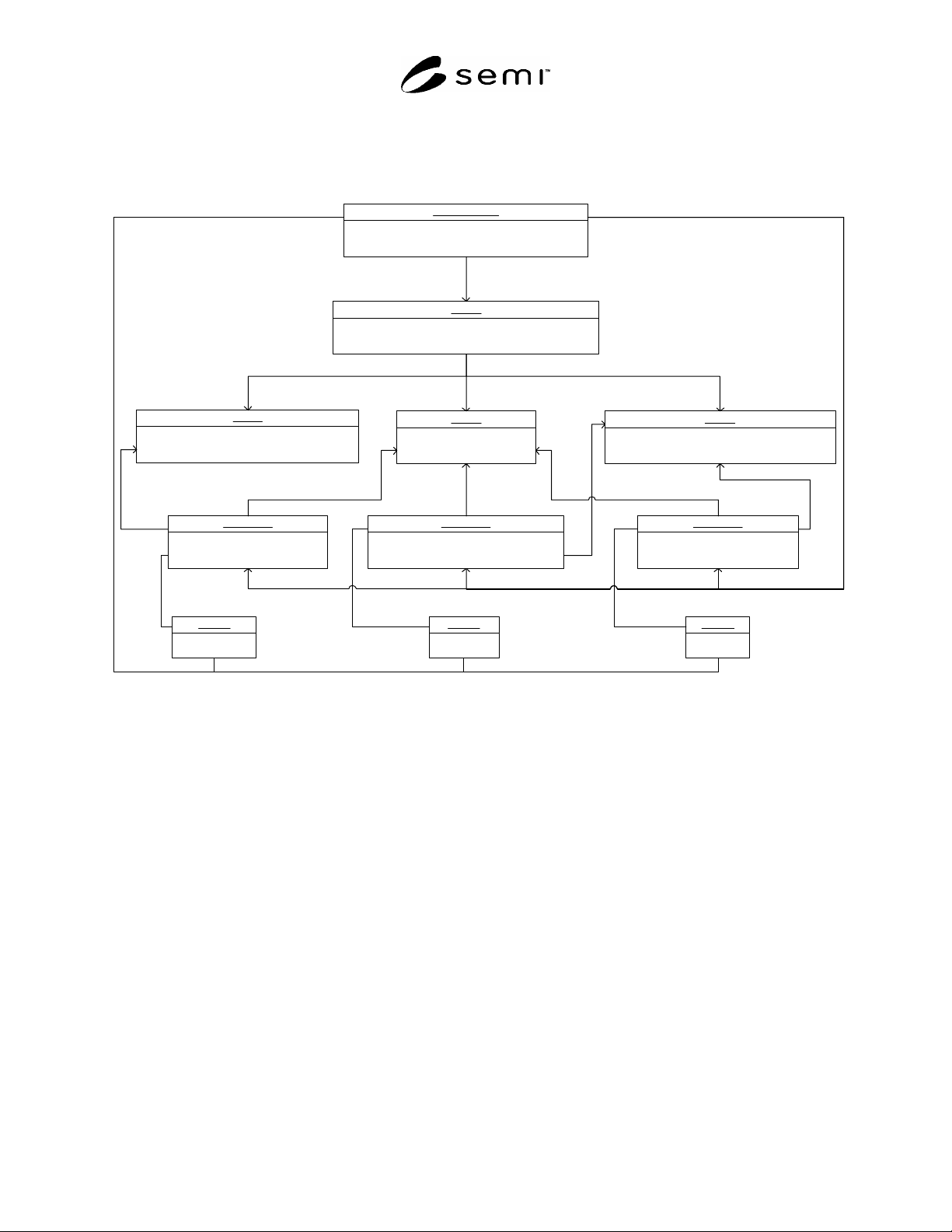
R7-1.1.2 Figure R7-2 shows how the example state machine could be represented using the StateMachine, State,
and Transition classes. The top level state, Pump, is represented as a State that contains two substates corresponding
to Idle and PumpingDown. Three transitions have been defined, corresponding to the three transitions shown in
Figure R7-2.
name = Vacuu m PumpStateMac hine
id = urn: supplier: stat e-m achine:Pump
desc ript ion = Describes t he beh avior of a va cuum pump.
: StateMachine
name = Pump
id = Pump
description = T he t op level s tate for the vac uum pump s ystem
: State
top
name = Idle
id = Pump.Idle
description = The device is idle
: State
name = Pum pingDown
id = Pump. PumpingD ow n
des cription = Th e device is pumping down to vacuum
: State
s ubstates
na m e = In it ialize
id = T1
description = Pump is pow ered up
: T ransition
name = Activate
id = T2
description = T he pump has started pumping
: Transition
name = Sto p
id = T 3
description = The pump has stopped
: Transition
transitions
name = Initial
id = Pump.Initial
description = T he initial stat e for the vacuum pump.
: State
s ource
target
source
target
source
target
na m e = In it ialized
id = pev-01
: Event
name = Active
id = pev-02
: Ev ent
name = Idle
id = pev -03
: Event
trans itions
transitions transitions
events
Figure R7-2
Example Representation of the Vacuum Pump State Machine
SEMI E125-0305 © SEMI 2003, 2005 52
RELATED INFORMATION 8
R8 UML TERMINOLOGY
NOTICE: This related information is not an official part of SEMI E125 and was derived from the work of the
originating committee. This related information was approved for publication by full letter ballot procedures.
R8-1 Glossary
R8-1.1 In order to help with understanding terminology used in conjunction with object technology, this section
shares excerpts from the glossary of the OMG standard for UML — the predominant modeling notation.
R8-1.2 These definitions are taken from B.2 Glossary of Terms of version 1.4 of the OMG UML specification, 01-
09-67, available from http://www.omg.org/technology/documents/modeling_spec_catalog.htm.
R8-1.2.1 abstract class — a class that cannot be directly instantiated. Contrast: concrete class.
R8-1.2.2 aggregate [class] — a class that represents the “whole” in an aggregation (whole-part) relationship. See:
aggregation.
R8-1.2.3 aggregation — a special form of association that specifies a whole-part relationship between the aggregate
(whole) and a component part. See: composition.
R8-1.2.4 association — the semantic relationship between two or more classifiers that specifies connections among
their instances.
R8-1.2.5 attribute — a feature within a classifier that describes a range of values that instances of the classifier may
hold.
R8-1.2.6 cardinality — the number of elements in a set. Contrast: multiplicity.
R8-1.2.7 child — in a generalization relationship, the specialization of another element, the parent. See: subclass,
subtype. Contrast: parent.
R8-1.2.8 class — a description of a set of objects that share the same attributes, operations, methods, relationships,
and semantics. A class may use a set of interfaces to specify collections of operations it provides to its environment.
See: interface.
R8-1.2.9 classifier — a mechanism that describes behavioral and structural features. Classifiers include interfaces,
classes, datatypes, and components.
R8-1.2.10 classification — the assignment of an object to a classifier. See: dynamic classification, multiple
classification, static classification.
R8-1.2.11 class diagram — a diagram that shows a collection of declarative (static) model elements, such as
classes, types, and their contents and relationships.
R8-1.2.12 composition
— a form of aggregation which requires that a part instance be included in at most one
composite at a time, and that the composite object is responsible for the creation and destruction of the parts.
Composition may be recursive. Synonym: composite aggregation.
R8-1.2.13 concrete class — a class that can be directly instantiated. Contrast: abstract class.
R8-1.2.14 constraint — a semantic condition or restriction. Certain constraints are predefined in the UML, others
may be user defined. Constraints are one of three extensibility mechanisms in UML. See: tagged value, stereotype.
R8-1.2.15 dependency — a relationship between two modeling elements, in which a change to one modeling
element (the independent element) will affect the other modeling element (the dependent element).
R8-1.2.16 diagram — a graphical presentation of a collection of model elements, most often rendered as a
connected graph of arcs (relationships) and vertices (other model elements). UML supports the following diagrams:
class diagram, object diagram, use case diagram, sequence diagram, collaboration diagram, state diagram, activity
diagram, component diagram, and deployment diagram.
R8-1.2.17 element — an atomic constituent of a model.
SEMI E125-0305 © SEMI 2003, 2005 53
R8-1.2.18 feature — a property, like operation or attribute, which is encapsulated within a classifier, such as an
interface, a class, or a datatype.
R8-1.2.19 generalization — a taxonomic relationship between a more general element and a more specific element.
The more specific element is fully consistent with the more general element and contains additional information.
An instance of the more specific element may be used where the more general element is allowed. See:
inheritance.
R8-1.2.20 inheritance — the mechanism by which more specific elements incorporate structure and behavior of
more general elements related by behavior. See: generalization.
R8-1.2.21 instance — an entity that has unique identity, a set of operations that can be applied to it, and state that
stores the effects of the operations. See: object.
R8-1.2.22 interface — a named set of operations that characterize the behavior of an element.
R8-1.2.23 interface inheritance — the inheritance of the interface of a more general element. Does not include
inheritance of the implementation. Contrast: implementation inheritance.
R8-1.2.24 message — a specification of the conveyance of information from one instance to another, with the
expectation that activity will ensue. A message may specify the raising of a signal or the call of an operation.
R8-1.2.25 method — the implementation of an operation. It specifies the algorithm or procedure associated with an
operation.
R8-1.2.26 model [MOF] — an abstraction of a physical system with a certain purpose. See: physical system.
Usage note: In the context of the MOF specification, which describes a meta-metamodel, for brevity the
metametamodel is frequently referred to as simply the model.
R8-1.2.27 multiple inheritance — a semantic variation of generalization in which a type may have more than one
supertype. Contrast: single inheritance.
R8-1.2.28 multiplicity — a specification of the range of allowable cardinalities that a set may assume. Multiplicity
specifications may be given for roles within associations, parts within composites, repetitions, and other purposes.
Essentially a multiplicity is a (possibly infinite) subset of the non-negative integers. Contrast: cardinality.
R8-1.2.29 object — an entity with a well-defined boundary and identity that encapsulates state and behavior. State
is represented by attributes and relationships, behavior is represented by operations, methods, and state machines.
An object is an instance of a class. See: class, instance.
R8-1.2.30 object diagram — a diagram that encompasses objects and their relationships at a point in time. An
object diagram may be considered a special case of a class diagram or a collaboration diagram. See:
class diagram,
collaboration diagram.
R8-1.2.31 operation — a service that can be requested from an object to effect behavior. An operation has a
signature, which may restrict the actual parameters that are possible.
R8-1.2.32 parent — in a generalization relationship, the generalization of another element, the child. See:
subclass, subtype. Contrast: child.
R8-1.2.33 package — a general purpose mechanism for organizing elements into groups. Packages may be nested
within other packages.
R8-1.2.34 qualifier — an association attribute or tuple of attributes whose values partition the set of objects related
to an object across an association.
R8-1.2.35 relationship — a semantic connection among model elements. Examples of relationships include
associations and generalizations.
R8-1.2.36 role — the named specific behavior of an entity participating in a particular context. A role may be static
(for example, an association end) or dynamic (for example, a collaboration role).
R8-1.2.37 single inheritance — a semantic variation of generalization in which a type may have only one
supertype. Synonym: multiple inheritance [OMA]. Contrast: multiple inheritance.