semi合集-English.pdf - 第3800页
SEMI F11-0998 © SEMI 1993, 1998 4 NOTICE: These standard s do not purport to address safety issues, if any, associat ed with their use. It is the responsibility of the user of these stand ards to establish appropriate sa…
SEMI F11-0998 © SEMI 1993, 1998 3
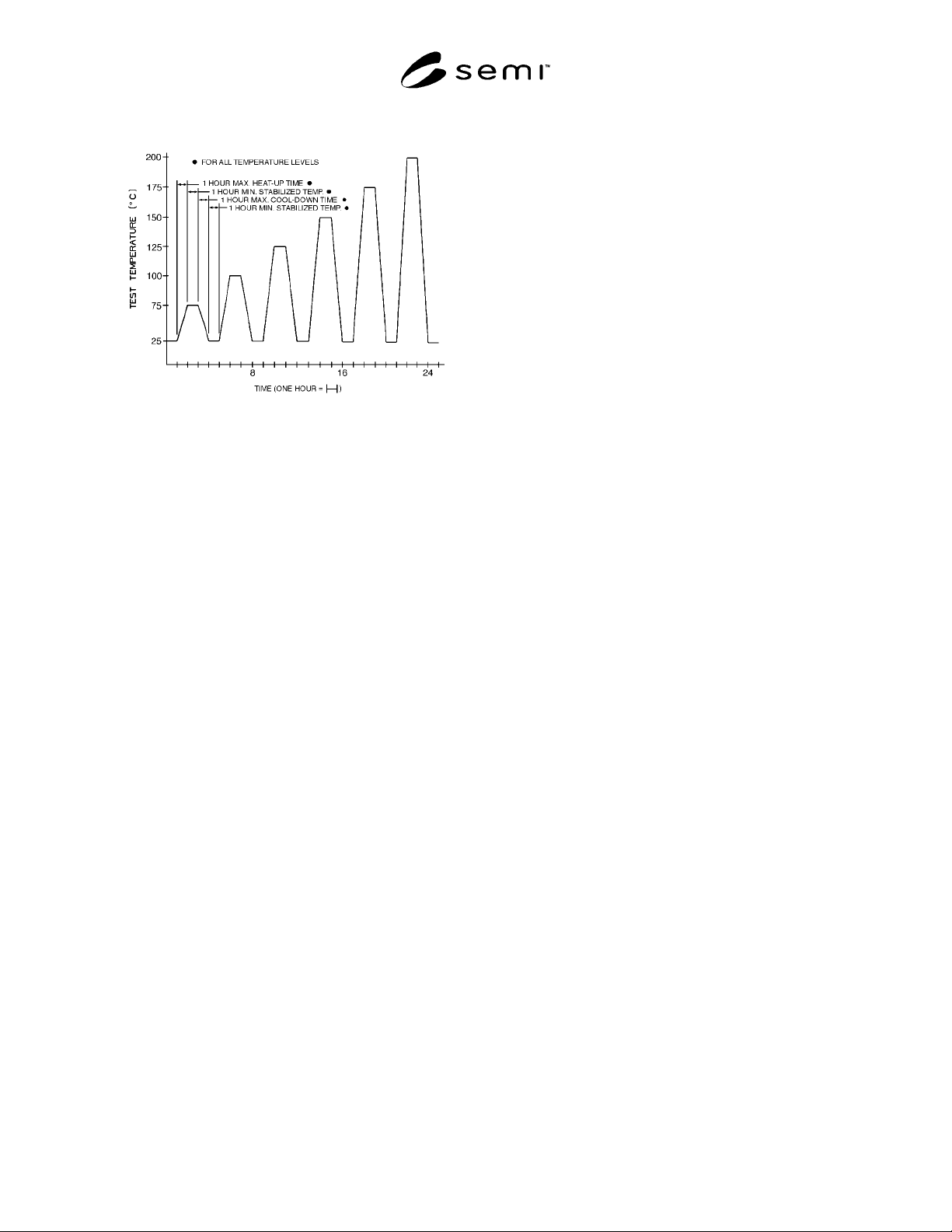
Figure 2
Thermal Transition Chart
9.4 Lower the fluid temperature to 25° C (77° F) for a
total of two hours. The maximum time allowed to
achieve the 25° C (77° F) temperature condition is one
hour.
9.5 Repeat Sections 9.3 and 9.4, substituting, for the
fluid temperature in Section 9.3, the remaining five
temperatures: 100° C (212° F), 125° C (257° F), 150° C
(302° F), 175° C (347° F), and 200° C (392° F).
9.5.1 The test samples should be at 25° C (77° F) prior
to stopping the test at the end of a work shift.
9.5.1.1 The two hours at 25° C (77° F) will be equally
divided between the present day cool-down time and
the next day start-up time.
9.6 Monitor each of the three connections for external
leakage throughout all test parameters.
9.7 Any external leakage at a tube connection will be
recorded as a failure on the test data sheet (see Related
Information 1 for sample test data sheet).
9.7.1 Leakage observed, once an elevated temperature
is reached, will be recorded as a failure at that
temperature.
9.7.2 Leakage at or during the cool-down cycle is to be
recorded as a failure of the previously tested elevated
temperature condition.
9.7.3 Leakage observed while increasing the
temperature to the next condition is to be recorded as a
failure of the previous elevated temperature condition.
9.8 Once a connection shows leakage and its failure
pressure and temperature has been recorded, any
additional leakage is not taken into consideration.
9.8.1 If leakage is not excessive, the connection can
remain in the system until testing at that pressure has
been completed.
9.8.2 If leakage of a connection becomes excessive, the
connection may be retightened or replaced in order to
continue testing of the remaining specimens. Take
precautions not to disturb the remaining test specimens.
WARNING: Due to the extreme danger of high
temperature fluids, take all necessary precautions
when retightening or replacing a connection, to
prevent accidental exposure to the heated fluid.
9.9 After three connection failures are recorded, or the
200° C (392° F) temperature has been achieved, a new
set of fittings is to be installed for the next pressure
condition.
9.10 Repeat Sections 9.2 through 9.9 for the remaining
six pressures: 200 kPa (29 psig), 400 kPa (58 psig), 600
kPa (87 psig), 800 kPa (116 psig), 1000 kPa (145 psig),
and 1200 kPa (174 psig).
10 Data Accuracy
10.1 Fluid Temperature — ± 1° C (± 2° F)
10.2 Pressure — kPa: ± 2%
11 Test Data Sheet
The test data sheet shall include the following
information:
11.1 Date tested.
11.2 Operator and test facility.
11.3 Description of items tested, including:
Tubing — Manufacturer, O.D., wall thickness, part
number, and material type.
Fitting — Manufacturer, type, size, part number, and
material type.
11.4 The actual temperatures and pressures at which
failures occur.
NOTE: A sample test data sheet is provided as Related
Information 1.

SEMI F11-0998 © SEMI 1993, 1998 4
NOTICE: These standards do not purport to address
safety issues, if any, associated with their use. It is the
responsibility of the user of these standards to establish
appropriate safety and health practices and determine
the applicability of regulatory limitations prior to use.
SEMI makes no warranties or representations as to the
suitability of the standards set forth herein for any
particular application. The determination of the
suitability of the standard is solely the responsibility of
the user. Users are cautioned to refer to manufacturer’s
instructions, product labels, product data sheets, and
other relevant literature respecting any materials
mentioned herein. These standards are subject to
change without notice.
The user’s attention is called to the possibility that
compliance with this standard may require use of
copyrighted material or of an invention covered by
patent rights. By publication of this standard, SEMI
takes no position respecting the validity of any patent
rights or copyrights asserted in connection with any
item mentioned in this standard. Users of this standard
are expressly advised that determination of any such
patent rights or copyrights, and the risk of infringement
of such rights, are entirely their own responsibility.
SEMI F11-0998 © SEMI 1993, 1998 5
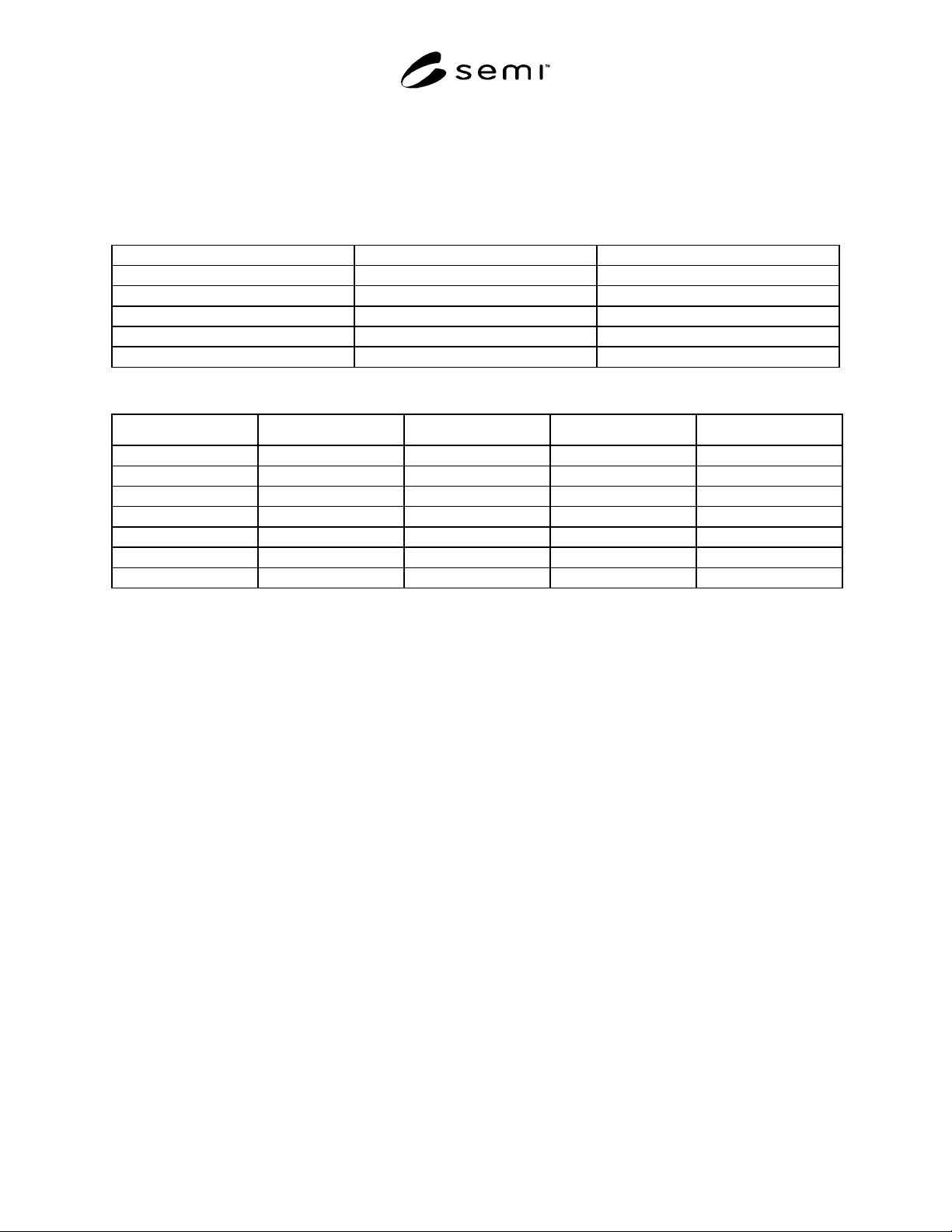
RELATED INFORMATION 1
SAMPLE TEST DATA SHEET
NOTE: This related information is not an official part of SEMI F11 and is not intended to modify or supercede the official guide.
It has been derived from industry specifications. Publication was authorized by full letter ballot procedures. Determination of the
suitability of the material is solely the responsibility of the user.
Test Date: Operator: Test Facility:
Tube Manufacturer: Fitting Manufacturer:
Tube O.D.: Fitting Type:
Tube Wall Thickness: Fitting Size:
Tube P/N: Fitting P/N:
Tube Material: Fitting Material:
Failure Temperatures = 25° , 75° , 100° , 125° , 150° , 175° , or 200° C
kPa Actual kPa Failure #1 Failure #2 Failure #3
100
200
400
600
800
1000
1200
NOTE: Record the pressures and temperatures at which failures occur.
NOTICE: These standards do not purport to address safety issues, if any, associated with their use. It is the
responsibility of the user of these standards to establish appropriate safety and health practices and determine the
applicability of regulatory limitations prior to use. SEMI makes no warranties or representations as to the suitability
of the standards set forth herein for any particular application. The determination of the suitability of the standard is
solely the responsibility of the user. Users are cautioned to refer to manufacturer’s instructions, product labels,
product data sheets, and other relevant literature respecting any materials mentioned herein. These standards are
subject to change without notice.
The user’s attention is called to the possibility that compliance with this standard may require use of copyrighted
material or of an invention covered by patent rights. By publication of this standard, SEMI takes no position
respecting the validity of any patent rights or copyrights asserted in connection with any item mentioned in this
standard. Users of this standard are expressly advised that determination of any such patent rights or copyrights, and
the risk of infringement of such rights, are entirely their own responsibility.
Copyright by SEMI® (Semiconductor Equipment and Materials
International), 3081 Zanker Road, San Jose, CA 95134. Reproduction o
f
the contents in whole or in part is forbidden without express written
consent of SEMI.