semi合集-English.pdf - 第3428页
SEMI E133-0705 © SEMI 2004, 2005 9 Table 5 PCS A n alysis Engine Functi onal Group Capabilities # Description Req’d Comments 3.1 Provide a PCS Analysis Engine capability PCS Analysis Engine shall be capa ble of performin…

SEMI E133-0705 © SEMI 2004, 2005 8
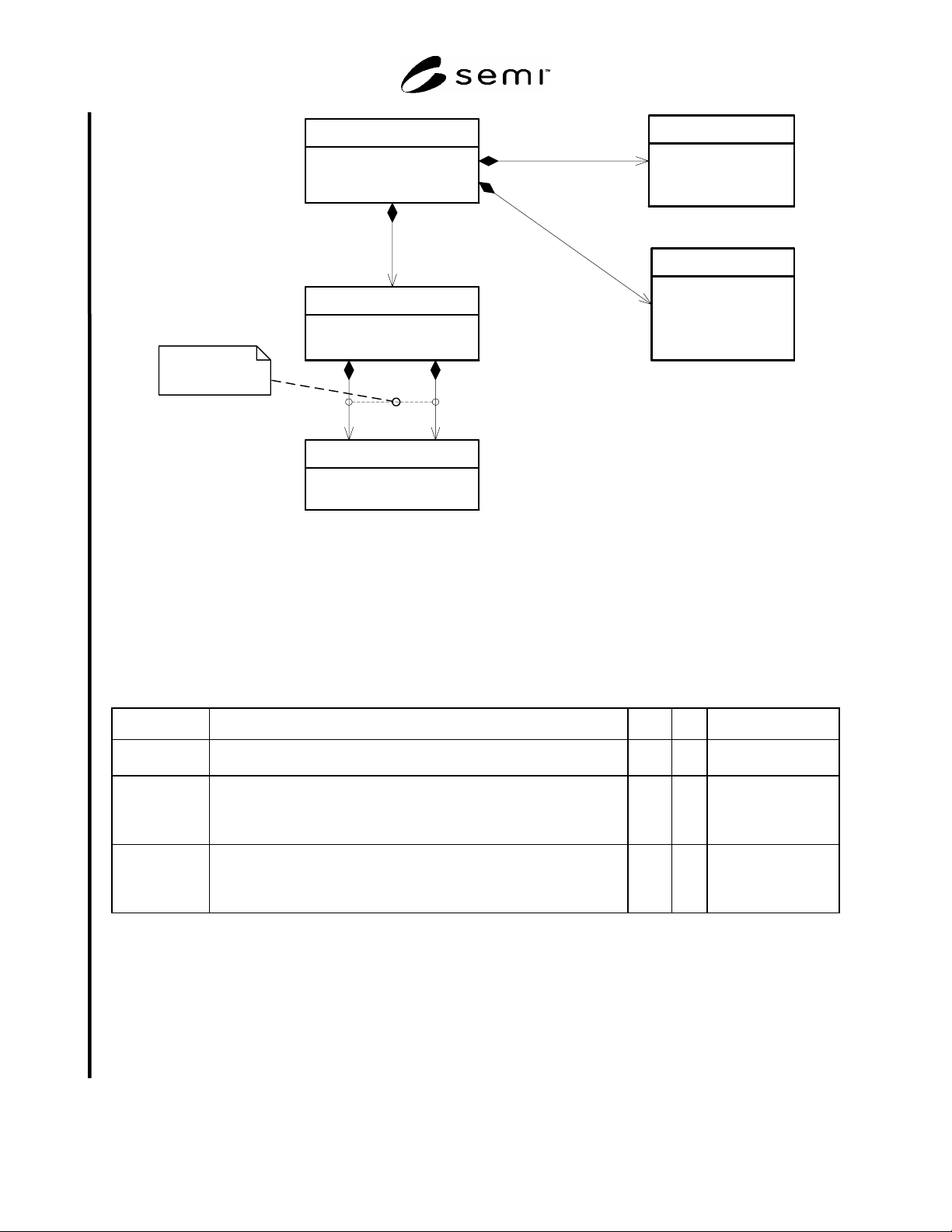
Figure 2
PCS Analysis Engine Common Input/Output Structure
9.2.2.4 Note that based on the simple data model shown in Figure 2, Inputs are available as an Output from an
Analysis Engine. Data provided as input to an Analysis Engine should be accessible as output from the Analysis
Engine for historical purposes.
Table 4 PCS Analysis Engine Inputs and Outputs Collection Type Definitions
Collection Type Definition Comments
Globals
Information that applies globally across an entire job. A lot id, for example could be
specified once as a global so that
it would not have to be specified
with many other data sets.
AnalysisParameters
Information that identifies numeric data used by the Analysis
Engine to perform various calculations.
Equation coefficients,
feedforward data, etc.
CalculatedOutputs
Data representing the results of analysis from an Analysis
Engine.
A calculation derived from
various inputs to the Analysis
Engine indicating wafer state,
process state or model state
information, recommended
machine settings, etc.
LogMessages
Data describing the activity of an Analysis Engine as it
executes its tasks.
Data describing the activities of
the Analysis Engine. Note that
this does not include log
information on the
communication protocol with the
AE. An example that is
acceptable is “Algorithm #3 with
model parameters ‘A’, ‘B’, and
‘C’”.
ModuleData
Information representing the current or last known physical
state of a process module that will be used by an Analysis
Engine to process material.
Machine, or module E10 state,
RF hours, number of wafers
processed, etc.
ProcessData
Information representing the process itself, such as the name
and type of the process and the current or last known process
state based on measurements from sensors of the processing
environment.
Name of the process (CMP), in-
situ process measurements, trace
data, and summary statistics etc.
SubstrateData
Information about the substrate being associated with the
Analysis Engine. This could include data representing a
single wafer, multiple wafers, or one or more lots, as well as
attributes of the material.
Profile or topology data, and
other characteristics measured
physically or electrically.
PCS AE
Inputs
Globals
AnalysisParameters
CalculatedOutputs
Outputs
Globals
AnalysisParameters
CalculatedOutputs
PCS AE
Inputs
Globals
AnalysisParameters
LogMessages
ModuleData
ProcessData
SubstrateData
Outputs
Globals
AnalysisParameters
LogMessages
ModuleData
ProcessData
SubstrateData

SEMI E133-0705 © SEMI 2004, 2005 9
Table 5 PCS Analysis Engine Functional Group Capabilities
# Description Req’d Comments
3.1
Provide a PCS Analysis Engine capability
PCS Analysis Engine shall be capable of performing one or more of
R2R control, FD, FC, FP, SPC, or any future functionality defined in
this standard as a PCS functional group.
Y
3.2
Provide the required PCS Analysis Engine methods
The PCS analysis engine shall provide the required interface methods
as defined in this standard. See ¶10.4.1.
Y These include Execute and Update.
3.3
Provide the required PCS Analysis Engine method capabilities
The PCS analysis engine shall provide the required interface method
capabilities as defined in this standard. See ¶10.4.1.
Y These include Log Data, Exception
Handling, Get Topic List, Subscribe to
Topic, Get Topic Data.
3.4
Maintain models of selected process control system environment
The PCS Analysis Engine shall maintain explicit or implicit models
of the selected process control environment. These models shall be
utilized to provide the analysis or control capability of the Analysis
Engine.
Y The specific form and behavior of these
models is beyond the scope of this
standard.
3.5
Provide a mechanism to uniquely instruct the Analysis Engine to
perform an action
The PCS Analysis Engine shall support an input mechanism whereby
the analysis engine can be instructed to take a specific unique action.
Y The mechanism could be a single key
variable, e.g., model name or a
complex set of context data utilized
internally to perform context matching,
etc. The action could include application
of a specific model and generation of a
PCS result, update of a model, or
communication of model parameters.
3.6
Interface with multiple external systems
The PCS Analysis Engine shall be capable of accepting inputs from,
or generating outputs to multiple external systems.
Y The definition of these systems will be a
function of the application environment;
these could include process tool or
metrology systems, or user interfaces.
3.7
Edit configuration of models
The PCS Analysis Engine shall provide the capability to create/add,
edit configuration, and delete models.
Y This capability will be supported through
the Analysis Engine interface.
3.8
Interface with other Analysis Engines
The PCS Analysis Engine shall be capable of either accepting outputs
from other Analysis Engines as inputs, or producing outputs that are
utilized by other Analysis Engines.
N May be a requirement of Analysis
Engines belonging to a specific
functional group.
3.9
Advanced Model Management
The PCS Analysis Engine may provide advanced model management
capabilities including but not limited to: secure access to models, and
automatic updating of models based on process control environment
changes.
N
3.10
Provide the optional PCS Analysis Engine method capabilities
The PCS Analysis Engine shall provide all or a subset of the optional
interface method capabilities as defined in this standard. See ¶10.4.1.
N
9.2.3 Common Interface Data Structures
9.2.3.1 Common Data Model Overview — The common interface data structures from which all PCS functional
groups may inherit are shown in Figure 3. This figure shows the basic types of information (“classes” in object
terminology) that can be supported by the interface. This model applies to the structure of inputs as well as outputs
of a PCS analysis engine as shown in Figure 2. This model applies to a complete message associated with a PCS
Job. That is it applies to the complete set of information communicated to or from a PCS AE for a PCS job. Note
that a complete message into or out of a PCS AE may be broken into multiple application-to-application
communications as defined in ¶9.2.3.5.
SEMI E133-0705 © SEMI 2004, 2005 10
PCSJobID: text
AnalysisEngineDataSet
Name: text
Value: any
DataItem
Data Context
0..* 0..*
At least one of
Data or Context
DataCollections
0..*
PCSAETarget
AEType: Enumeration
AEInstance: Integer
Instructions: text
Extension: any
PCSAETargets
0..
BinCategory: Enumeration
DataCollection
{ordered}
StatusElement
Source: text
Code: Integer
Description: text
Extension: any
Status
0..*
Figure 3
Analysis Engine Data Structure Model for a Complete Message Associated with a PCS Job
9.2.3.2 Class Definitions — Class definitions consist of a brief description of each class, a table defining any
attributes belonging to that class, and further text as necessary to fully define the class.
9.2.3.2.1 AnalysisEngineDataSet — A composite data structure that represents the data associated with a single
input or output message of an AE.
Table 6 Attributes of AnalysisEngineDataSet
Attribute Name Description Access Reqd Form
PCSJobID A unique identifier of a Process Control System Job. NA C ObjID—reference
SEMI E39
PCSAETargets An attribute that indicates a list of AE types targeted by the
A
nalysisEngineDataSet
NA Y An ordered list of
structured data of
type PCSAETarget;
see below.
Status An attribute formatted as an extensible data structure that relates
p
roperties of the success or failure of a PCS AE, identified in
P
CSAETargets, to execute a PCSJob
NA C An unordered list of
structured data of
type StatusElement;
see below.
9.2.3.2.1.1 PCSJobID — The specification that PCSJobID is a required attribute of AnalysisEngineDataSet along
with the specification that it is a unique identifier of a PCS Job means that a unique PCSJobID shall be associated
with each PCS Job. The management of the uniqueness of the PCSJobID can be performed by an AE or by an
application that wishes to utilize the capabilities of an AE. The application communicating with the AE is assumed
to generate and manage PCSJobIDs for all PCS jobs, however the AE is required to provide this functionality in the
event that the application does not wish to provide it. The existence of the PCSJobID attribute is conditional upon
the following: