semi合集-English.pdf - 第6756页
SEMI S1-0701 E © SEMI 1986, 2001 3 Figure 1 Safety Alert Symbols for Signal Word Pa nel Use 5.5 safety label — a sign, label, or decal that provides safety information. 5.6 signal word — th e word that calls attention to…

SEMI S1-0701
E
© SEMI 1986, 2001 2
14. Translation
15. Related Documents
Appendix 1 — Safety Symbols
Appendix 2 — Translations of Signal Words
2.3 This safety guideline does not purport to address all of the safety issues associated with its use. It is the
responsibility of the users of this guideline to establish appropriate safety and health practices and determine the
applicability of regulatory limitations prior to use.
3 Limitations
3.1 Various components or assemblies used in semiconductor manufacturing equipment may carry safety labels that
are designed and affixed in accordance with other international standards. It is not the intent of this guideline to
replace or supersede such labeling requirements.
3.2 Some safety label formats and content are dictated by other applicable standards and guidelines or
by law (e.g.,
laser labeling and chemical hazard communication labeling in certain countries of use). It is not the intent of this
guideline to replace or supersede such labeling requirements.
3.3 New safety labels and safety labels that are significantly redesigned should conform to the latest version of
SEMI S1. This guideline is not intended to be applied retroactively.
4 Referenced Standards
NOTE 5: Unless otherwise indicated, all documents cited shall be the latest published versions.
4.1 SEMI Standards
SEMI S10 — Safety Guideline for Risk Assessment
4.2 ANSI Standards
1
ANSI Z535.1 — Safety Color Code
ANSI Z535.3 — Criteria for Safety Symbols
ANSI Z535.4 — Product Safety Signs and Labels
4.3 ISO Standards
2
ISO 3864 — Safety Colours and Safety Signs
4.4 IEC Standards
3
IEC 61310-1 — Safety of Machinery - Indication, Marking and Actuation - Part 1: Requirements for Visual,
Auditory and Tactile Signals
5 Terminology
5.1 hazard — a condition that is a prerequisite to a mishap.
5.2 mishap — an unplanned event or series of events that results in death, injury, occupational illness, damage to or
loss of equipment or property, or environmental damage.
5.3 panel — area of a safety label having a distinctive background color which is different from other areas, or
which is delineated by a line, border, or margin. See Figures 3 and 4 for examples of panel placement.
5.4 safety alert symbol — a specific symbol (see Figure 1) that indicates a potential personal injury hazard.
1 American National Standards Institute, 11 West 42nd Street, New York, New York 10036, USA, http://www.ansi.org
2 International Organization for Standardization, C.P.56, CH-1211 Geneva 20, Switzerland, http://www.iso.ch
3 International Electrotechnical Commission, 1 rue de Varembe, Geneva, Switzerland, http://www.iec.ch

SEMI S1-0701
E
© SEMI 1986, 2001 3
Figure 1
Safety Alert Symbols for Signal Word Panel Use
5.5 safety label — a sign, label, or decal that provides safety information.
5.6 signal word — the word that calls attention to the safety label and designates a degree or level of hazard
seriousness.
5.7 surround shape — a geometric configuration that is placed around a symbol and which conveys additional
safety information.
5.8 symbol — a graphical representation, either abstract or representational, of a hazard, a consequence of engaging
a hazard, or a method to avoid a hazard, or some combination of these ideas.
NOTE 6: Some label design standards use the term “pictorial” in the same sense as this guideline uses the term “symbol.”
5.9 target audience — the audience to be advised of the hazard.
6 General Provisions
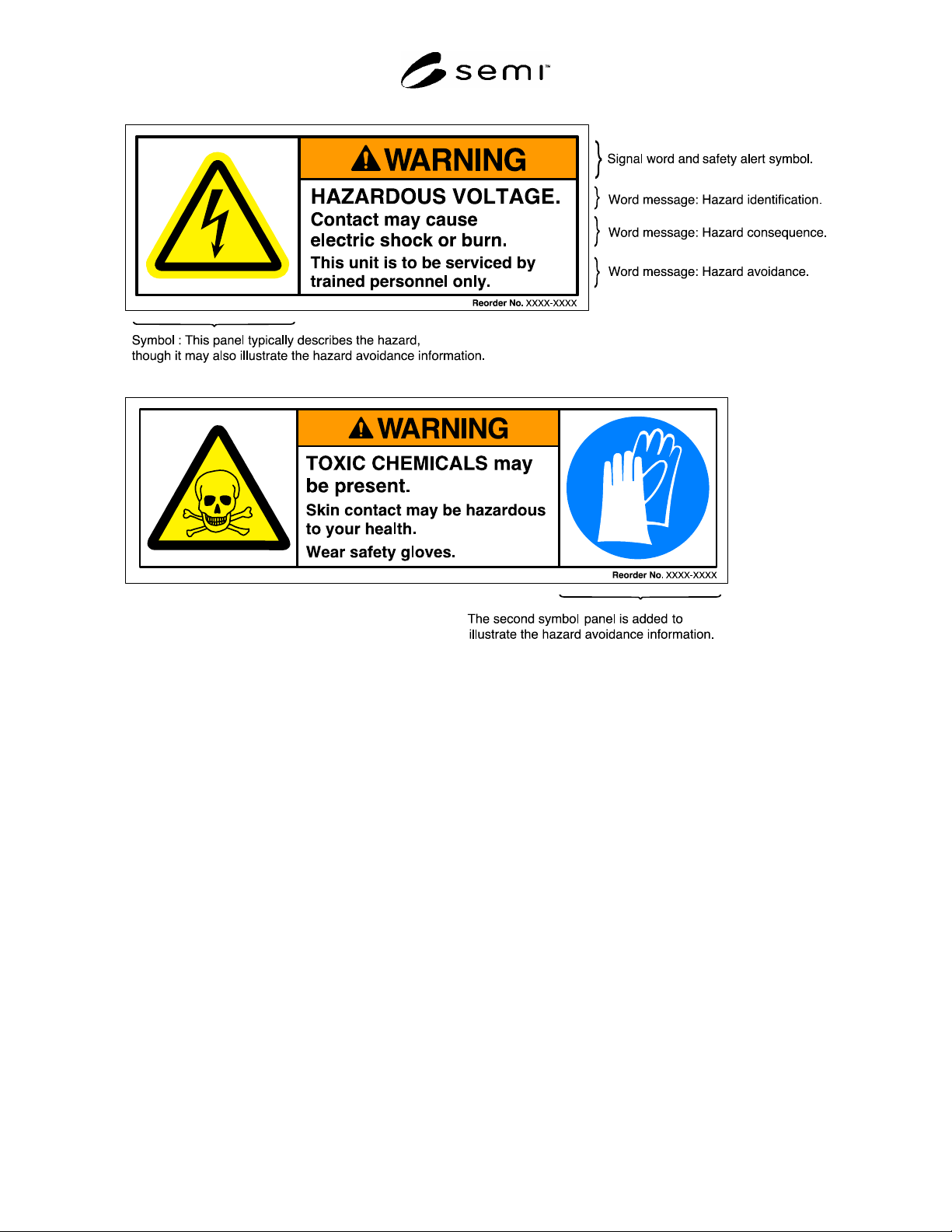
6.1 Safety labels should communicate information about specific hazards. Safety labels should be simple, direct,
and understandable by the target audience.
6.2 Content — Safety labels should communicate:
6.2.1 the seriousness of the hazard (indicated by the signal word);
6.2.2 the nature of the hazard (e.g., type of hazard) or the probable consequence of engaging the hazard; and
6.2.3 how the hazard can be avoided.
6.3 See Figure 2 for examples of how this information can be communicated on a safety label.
SEMI S1-0701
E
© SEMI 1986, 2001 4
Figure 2
Examples of How Product Safety Labels Communicate Content
(Note that the order and content of the word message is flexible).
6.4 Identifier — Safety labels should have a unique identifier (e.g., a part number) printed on the label, to facilitate
ordering replacement labels from the equipment manufacturer.
NOTE 7: If a safety label becomes illegible, the user may want to replace it.
6.5 Durability — Safety labels should have a reasonable useful life. Determination of reasonable useful life should
take into consideration the expected life of the product and the intended environment of use.
NOTE 8: Two factors that may be used for judging useful life are color stability and legibility when viewed at a safe viewing
distance. Legibility is affected by letter height.
7 Formats
7.1 Safety labels should consist of at least three panels: signal word panel, word message panel, and symbol panel.
Figure 3 provides examples of some possible horizontal and vertical formats incorporating these panels.
EXCEPTION 1: A symbol panel is not necessary for labels that indicate only potential property damage hazards.
EXCEPTION 2: When space limitations exist, such as under guards or on small parts, for safety labels whose target
audience is maintenance or service personnel, symbol-only formats with surround shapes (i.e., no signal word, word
message, or symbol panels; see Figures 7, 8, and 9) may be used. In this case, borders around the surround shapes
should be used. Alternatively, for the same situations, a safety label may be used that has a signal word panel and a
word message panel but does not have a symbol panel.