semi合集-English.pdf - 第4676页
SEMI C3.34-1102 © SEMI 1989, 1102 5 8.6.4.9 Titrate wi th a solution of 5 g. m ercuric nitrate Hg(NO 3 ) 2, (diluted to 1000 mL in de ionized water; then 50 mL diluted t o 500 mL in d eionized water ) which has been prev…
SEMI C3.34-1102 © SEMI 1989, 2002 4
Sample Peak Area
Standard Peak Area
×
C
oncentrat
i
on
of Standard
=
C
oncentrat
i
on
of Sample
8.5 Water — This procedure is for the determination of
moisture in disilane using a continuous flow
electrolysis of water in a phosphorus pentoxide (P
2
O
5
)
cell.
NOTE 5: Direct gases for moisture measurement to the
analyzer with stainless steel lines which have been purged.
8.5.1 Detection Limit — 1 ppmv
8.5.2 Flow Requirement — Set the sample flow rate
and pressure in accordance with manufacturer's
instructions.
8.5.3 Operating Procedure
8.5.3.1 Direct samples of three standards,
independently verified with a dewpoint/frostpoint
hygrometer, spanning the range of moisture content of
interest to the analyzer. After a stable reading is
obtained, record the instrument's response to each
standard.
8.5.3.2 Obtain a representative sample of the gas to be
analyzed and direct it to the unit as with the standards.
After a stable reading is obtained, record the
instrument’s response.
8.5.3.3 Construct calibration curve from the standard
data and determine the moisture content in sample gas.
The result may not exceed the specification in Section 7
of this standard.
8.6 Total Chlorides — This procedure is for the
determination of total hydrolyzable chlorides in disilane
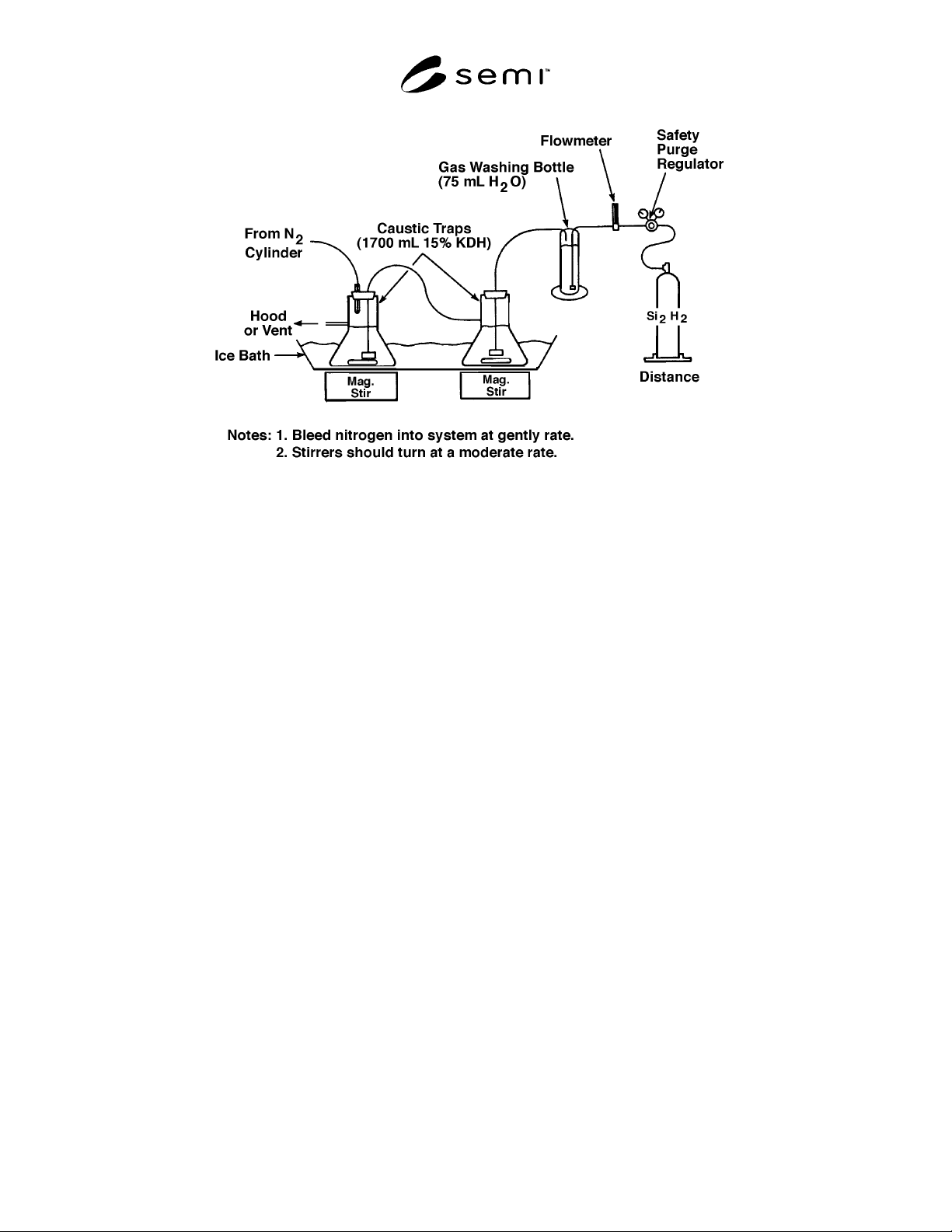
by titration of a hydrolyzed sample of disilane. (See
Figure 2.)
8.6.1 Detection Limit — 0.5 ppm.
8.6.2 Instrument Parameters
8.6.2.1 Equipment
1. Safety purge regulator with proper fittings.
2. Flow meter capable of measuring 0.25 standard
liters per minute (0.5 SCF/hour) (Brooks or
equivalent).
3. One cylinder of nitrogen with regulator.
4. One ice bath.
5. Three magnetic stirring bars.
6. Two 2000 mL heavy-duty sidearm flasks (Fisher
Cat. No. 10-181G or equivalent).
7. One #9 one-hole rubber stopper.
8. One #9 two-hole rubber stopper.
9. Two borosilicate glass tubes with fritted cylinders
(Fisher Cat. No. 11.138B or equivalent).
10. One gas washing bottle with fritted cylinder, 125
mL cap. (Fisher Cat. No. 03-040A or equivalent).
11. One buret, 50 mL capacity with PTFE stopcock
(Fisher Cat. No. 03-700-22C or equivalent).
12. One buret stand (Fisher Cat. No. 14-688 or
equivalent).
13. Miscellaneous clamps, support stands, and rubber
hose.
14. Two 250 mL Erlenmeyer flasks.
8.6.3 Reagents
1. Potassium hydroxide flakes, technical (Fisher Cat.
No. P-246 or equivalent).
2. Mercuric nitrate crystal (Fisher Cat. No. M-168 or
equivalent).
3. Sodium chloride crystal (Fisher Cat. No. S-271 or
equivalent).
4. Diphenyl carbazone (Fisher Cat. No. D-86 or
equivalent).
5. Bromophenol blue (Fisher Cat. No. B-392 or
equivalent).
6. Nitric acid (Fisher Cat. No. AA-200 or equivalent).
7. Ethanol, denatured (Fisher Cat. No. AA-407 or
equivalent).
8.6.4 Operating Procedure
8.6.4.1 Fill each 2000 mL sidearm flask with about
1700 mL of 15% potassium hydroxide solution (15 g
KOH per each 100 mL water).
8.6.4.2 Fill the gas washing bottle with about 75 mL of
deionized water that has been degassed.
8.6.4.3 Assemble apparatus as shown in Diagram A
and purge entire system with nitrogen for 30 minutes.
8.6.4.4 Pass 30 liters (approximately one cubic foot) of
disilane through the system at a rate of 0.25 liters per
minute. Record the volume of the disilane sample.
8.6.4.5 Stop disilane flow and purge system for 30
minutes.
8.6.4.6 Remove gas washing bottle from system and
transfer contents quantitatively and with the aid of three
25 mL deionized water washings, to a 250 mL
Erlenmeyer flask.
8.6.4.7 Add a few drops of indicator solution (5 g
diphenyl carbazone plus 0.5 g bromophenol blue
dissolved in 750 mL ethanol, plus 250 mL deionized
water).
8.6.4.8 Add, in a drop-wise fashion, sufficient 0.2N
HNO
3
(13 mL conc. HNO
3
, diluted to 1 L in deionized
water) in order to just turn the solution to yellow from
purple.
SEMI C3.34-1102 © SEMI 1989, 1102 5
8.6.4.9 Titrate with a solution of 5 g. mercuric nitrate
Hg(NO
3
)
2,
(diluted to 1000 mL in deionized water; then
50 mL diluted to 500 mL in deionized water) which has
been previously standardized to 5.0 mL of a sodium
chloride solution (approximately 165 ng NaCl,
accurately weighed, dissolved in 100 mL deionized
water).
8.6.5 Calibration
8.6.5.1 Run titration blank consisting of 150 mL
deionized water.
8.6.5.2 Calculate the concentration of chloride, using
the formula below. The result may not exceed the
specification in Section 8 of this standard.
mL sample - mL blank
mL standard - mL blank
×
wt. of NaCl g
()
100.0 mL
×
60.66% Cl
-
100% NaCl
×
1000 mL
1 L
×
.005 L
35.453 g/mole
×
0.082 atm L/mole
o
K
1 atm
×
294.26
o
K
volume of gas samples
×
1
×
10
6
ppm = ppm Cl
-
8.6.6 Final Calculation — Convert the results from
ppm to ppm-wt using the formula below. The result
may not exceed the specification in Section 7 of this
standard.
ppm- wt = ppm mole/mole()×
35.45
62.22
FIP
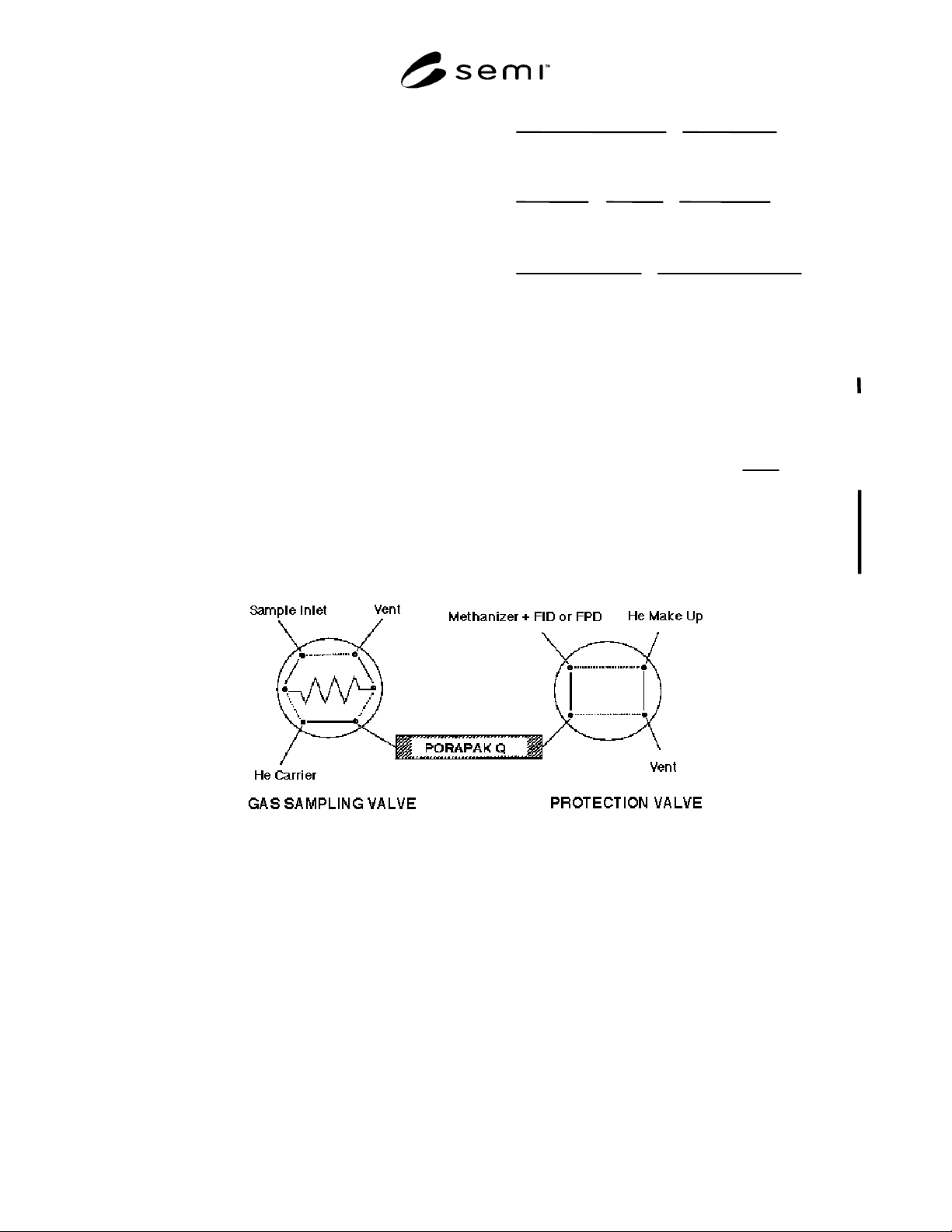
Figure 1
G.C. Configuration
SEMI C3.34-1102 © SEMI 1989, 2002 6
Figure 2
Chloride Scrubbing Apparatus
NOTICE: SEMI makes no warranties or representations as to the suitability of the standards set forth herein for
any particular application. The determination of the suitability of the standard is solely the responsibility of the user.
Users are cautioned to refer to manufacturer’s instructions, product labels, product data sheets, and other relevant
literature respecting any materials mentioned herein. These standards are subject to change without notice.
The user’s attention is called to the possibility that compliance with this standard may require use of copyrighted
material or of an invention covered by patent rights. By publication of this standard, SEMI takes no position
respecting the validity of any patent rights or copyrights asserted in connection with any item mentioned in this
standard. Users of this standard are expressly advised that determination of any such patent rights or copyrights and
the risk of infringement of such rights, are entirely their own responsibility.
Copyright by SEMI® (Semiconductor Equipment and Materials
International), 3081 Zanker Road, San Jose, CA 95134. Reproduction o
f
the contents in whole or in part is forbidden without express written
consent of SEMI.