semi合集-English.pdf - 第6338页
SEMI G66-96 © SEMI 1996, 2004 4 APPENDIX 1 APPLICATION NOTES — METH OD OF CALCULATI ON FOR DIFFUSION AND SOLUBI LITY COEFFICIENT NOTICE : The material in this appendix is an o fficial part of SEMI G66 and was approved by…

3 SEMI G66-96 © SEMI 1996, 2004
13.1.5 Date of test
14 Related Documents
14.1 ASTM Specification
1
ASTM D 570 — Standard Test Method for Water
Absorption of Plastic
1 American Society for Testing and Materials, 100 Barr Harbor
Drive, West Conshohocken, Pennsylvania 19428-2959, USA.
Telephone: 610.832.9585, Fax: 610.832.9555, Website:
www.astm.org
SEMI G66-96 © SEMI 1996, 2004 4
APPENDIX 1
APPLICATION NOTES — METHOD OF CALCULATION FOR
DIFFUSION AND SOLUBILITY COEFFICIENT
NOTICE: The material in this appendix is an official part of SEMI G66 and was approved by full letter ballot
procedures.
A1-1 Purpose
A1-1.1 This application note describes a method for
calculating diffusion and solubility coefficients.
A1-2 Solubility Coefficient, S
A1-1.2 The solubility coefficient is given from the data
of saturated area as follows:
A1-1.2.1 S= M
s
d / P 1000 (2)
Where:
S = Solubility coefficient ((mg/cm
3
/ (kg/mm
2
))
M Saturated moisture absorption rate (wt%) (data
from saturated area test)
D = Density of specimen (g/cm
3
)
P = Partial pressure of moisture in environment (Pa)
(value at 85 C in this test)
A1-3 Diffusion Coefficient, D
A1-1.3 The moisture absorption rate in resin exposed
for relatively short term is calculated using the
following equation based on Fick’s formula:
M
t
/ M
s
4{ (D t) / (1
) }
1/2
(3)
Then:
D = 1
2
M
t
2
/ (t 4
2
M
s
2
) (4)
Where:
D = Diffusion coefficient (cm
2
/ h)
t = Time of moisture absorption (h) (data from diffusion
area test — 24 hours)
M
t
= Moisture absorption rate at the time "t" (wt%)
(data from diffusion area test)
1 = Thickness of the specimen (cm) (data from
diffusion area test = 0.3 cm)
M
5
Saturated moisture absorption rate (wt%) (data of
saturated area test)
NOTICE: SEMI makes no warranties or
representations as to the suitability of the standard set
forth herein for any particular application. The
determination of the suitability of the standard is solely
the responsibility of the user. Users are cautioned to
refer to manufacturer’s instructions, product labels,
product data sheets, and other relevant literature
respecting any materials or equipment mentioned
herein. These standards are subject to change without
notice.
By publication of this standard, SEMI takes no position
respecting the validity of any patent rights or copyrights
asserted in connection with any item mentioned in this
standard. Users of this standard are expressly advised
that determination of any such patent rights or
copyrights, and the risk of infringement of such rights,
are entirely their own responsibility.
Copyright by SEMI® (Semiconductor Equipment and Materials
International), 3081 Zanker Road, San Jose, CA 95134. Reproduction of
the contents in whole or in part is forbidden without express written
consent of SEMI.
SEMI G67-0996 © SEMI 1996, 2004 1
SEMI G67-0996 (Reapproved 1104)
TEST METHOD FOR THE MEASUREMENT OF PARTICLE
GENERATION FROM SHEET MATERIALS
This test method was technically reapproved by the Global Assembly & Packaging Committee and is the
direct responsibility of the Japanese Packaging Committee. Current edition approved by the Japanese
Regional Standards Committee on July 23, 2004. Initially available at www.semi.org September 2004; to be
published November 2004. Originally published September 1996.
1 Purpose
1.1 This test method describes a procedure to measure
particles on sheet materials.
2 Scope
2.1 The method described may be used for the
measurement of particles on items such as:
• Leadframe Interleaves,
• Cleanroom Paper, and
• Packing Material.
2.2 The procedures may be used by the material
manufacturer for quality control or by a customer at
incoming inspection.
NOTICE: This standard does not purport to address
safety issues, if any, associated with its use. It is the
responsibility of the users of this standard to establish
appropriate safety and health practices and determine
the applicability of regulatory or other limitations prior
to use.
3 Referenced Standards
3.1 None.
NOTICE: Unless otherwise indicated, all documents
cited shall be the latest published versions.
4 Terminology
4.1 None.
5 Summary of Method
5.1 The method is based on measuring a background
particle count in a clean enclosure and then measuring
the increased particle count when items under test are
submitted to handling operations likely to generate
particles.
6 Interference
6.1 Care must be taken to avoid contaminating the
clean bench when sheet materials are placed inside. All
external packaging material shall be removed and the
internal packaging shall be cleaned by appropriate
means prior to placing inside the bench.
6.2 A method of cutting the specimens to size, if
performed, must not add to, or detract from, the
contamination levels on the sheet materials.
6.3 Care must be taken to avoid contaminating the
specimens from the human body and clothes when the
sheet materials are prepared for the test method.
7 Equipment
7.1 Particle Counter and Recorder
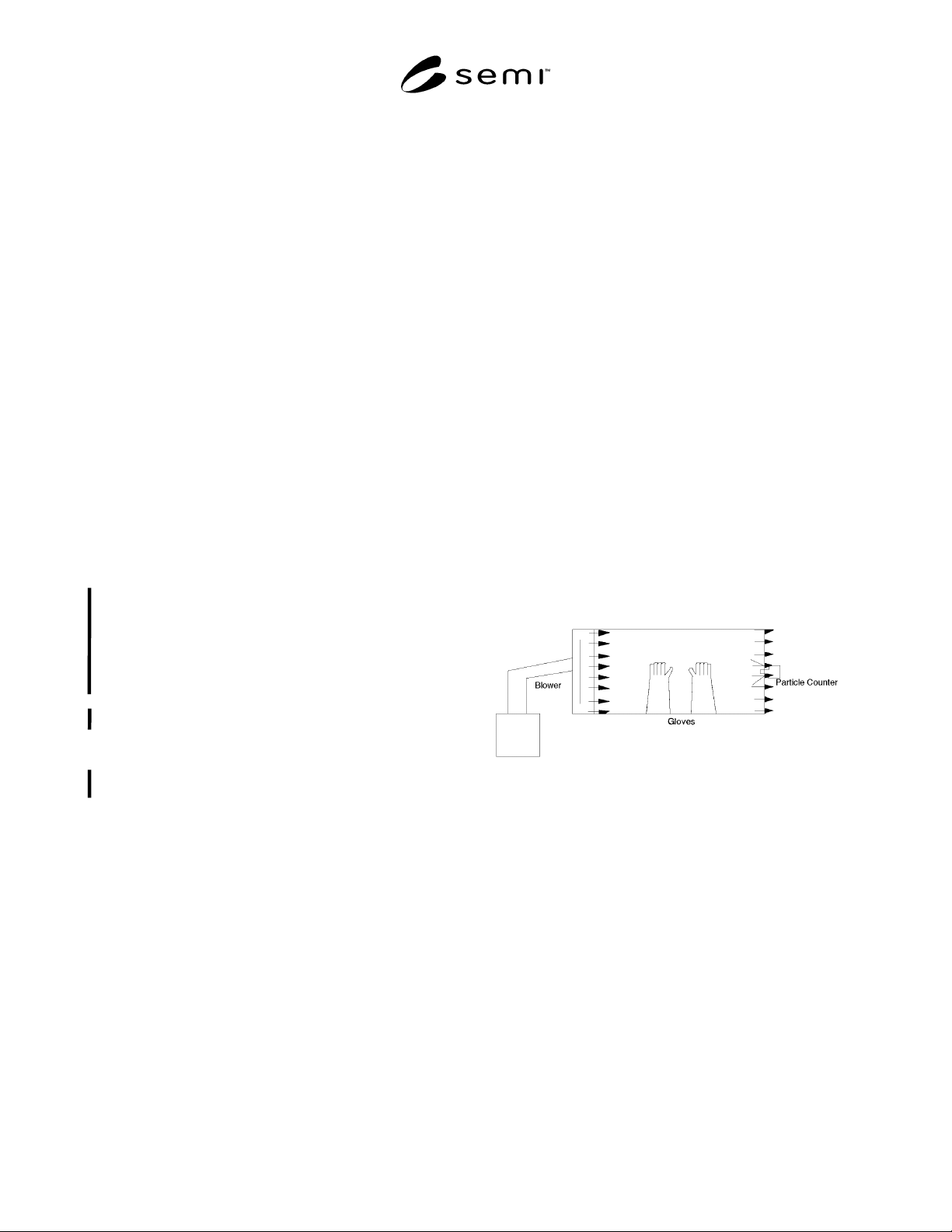
7.2 Clean Bench with Full Gloves and a Dust Particle
Measurement Port — See Figure 1.
7.2.1 Air flow speed in the clean bench should be 0.6
m/sec.
Figure 1
Clean Bench Configuration
8 Sampling
8.1 Sampling plans shall be agreed between user and
supplier.
9 Test Specimen
9.1 Specimen size shall be agreed between user and
supplier. It is recommended that a 152.4 mm × 203.2
mm (6 × 8 inches) test piece be used.
10 Equipment Set-Up
10.1 The particle counter shall be set up with the probe
in the clean bench. Calibrate the counter in accordance
with the equipment manufacturer's instructions.