semi合集-English.pdf - 第2860页
SEMI E105-0701 © SEMI 2000, 2001 11 RELATED INFORM A TI ON 1 IMPLEMENTATION GUIDA NCE FOR INPUT OF FA CTORY STA TE INFORM A TI ON TO THE SCHEDULING COMPONENT NOTE: T his related inf o rmation is n ot an offic ial part of…

SEMI E105-0701 © SEMI 2000, 2001 10
#endif // _CIMFW_SCHEDULING_
}; // mdoule CIMFW
NOTICE: SEMI makes no warranties or representations as to the suitability of the standard set forth herein for any
particular application. The determination of the suitability of the standard is solely the responsibility of the user.
Users are cautioned to refer to manufacturer’s instructions, product labels, product data sheets, and other relevant
literature respecting any materials mentioned herein. These standards are subject to change without notice.
The user’s attention is called to the possibility that compliance with this standard may require use of copyrighted
material or of an invention covered by patent rights. By publication of this standard, SEMI takes no position
respecting the validity of any patent rights or copyrights asserted in connection with any item mentioned in this
standard. Users of this standard are expressly advised that determination of any such patent rights or copyrights, and
the risk of infringement of such rights, are entirely their own responsibility.

SEMI E105-0701 © SEMI 2000, 200111
RELATED INFORMATION 1
IMPLEMENTATION GUIDANCE FOR INPUT OF FACTORY STATE
INFORMATION TO THE SCHEDULING COMPONENT
NOTE: This related information is not an official part of SEMI E105. This related information was approved for publication by
full letter ballot procedures on August 28, 2000.
NOTE: This related information is included with the Scheduling Component specification to aid the readers in understanding the
intent and use of the standard.
R1-1 The Scheduling Component has two types of interfaces:
A. Scheduling and Dispatching Service Interface - this is the interface for services provided by the Scheduling
Component in response to requests from the Factory Operations Component or some other client. It also
includes interfaces to support asynchronous actions for an active scheduler or dispatcher which provides the
same information content on an event driven basis rather than requiring a client request.
This is included within the scope of the current standard.
B. Scheduling and Dispatching Factory Input Interface - this is the interface used by other components to provide
updated information on factory state used by the Scheduling Component in making scheduling and dispatching
decisions. The updates are typically provided by other CIM Framework components to the Scheduling
Component asynchronously.
This is NOT included within the scope of the current standard.
R1-2 The goal for CIM Framework standards is to eventually standardize both of these types of interface. However,
at this time there are two major issues that prevent inclusion of the Factory Input Interface to the Scheduling
Component.
1. There is inadequate consensus on the technical maturity of the currently available asynchronous input
mechanisms. While the CIM Framework specifies events for delivery via an Event Broker mechanism, it is not
assumed that the quality of service for events will include guaranteed delivery and performance adequate for
keeping a Scheduling Component current with real-time factory state changes. For a more complete discussion
of the CIM Framework technical architecture issues, see SEMI E96.
2. Some key components of the CIM Framework needed to provide factory state to the Scheduling Component
have not yet been approved as SEMI standards.
R1-3 The following approach is suggested as a possible way to address Scheduling Component Input in the future:
1. Identify the most important inputs required by the Scheduling Component in a follow-on ballot for the
Scheduling Component to be used during the interim period until the full component specifications containing
those events are approved as SEMI standards.
2. Suppliers who implement the Scheduling Component should take advantage of existing standard interfaces
defined in adopted CIM framework standards and use this experience as expert input on future updates to this
standard.
3. Encourage technical studies to provide added understanding of the tradeoffs and limitations that impact
standardization of this interface in the future.
SEMI E105-0701 © SEMI 2000, 2001 12
RELATED INFORMATION 2
SCENARIOS FOR SCHEDULING AND DISPATCHING.
NOTE: This related information is not an official part of SEMI E105. This related information was approved for publication by
full letter ballot procedures on August 28, 2000.
These scenarios show possible implementations of the SEMI Scheduling Component. The information shown here is
intended to be a guide rather than describe prescriptive implementation rules. Some of the message sequences and
implied functionality included in these scenarios will vary across different implementations.
This section focuses primarily on the interface between the Scheduling Component and factory operations
component. The messaging between the lower level components is for informational purposes, and may not actually
reflect what is developed in the future when standards for those components have been completed.
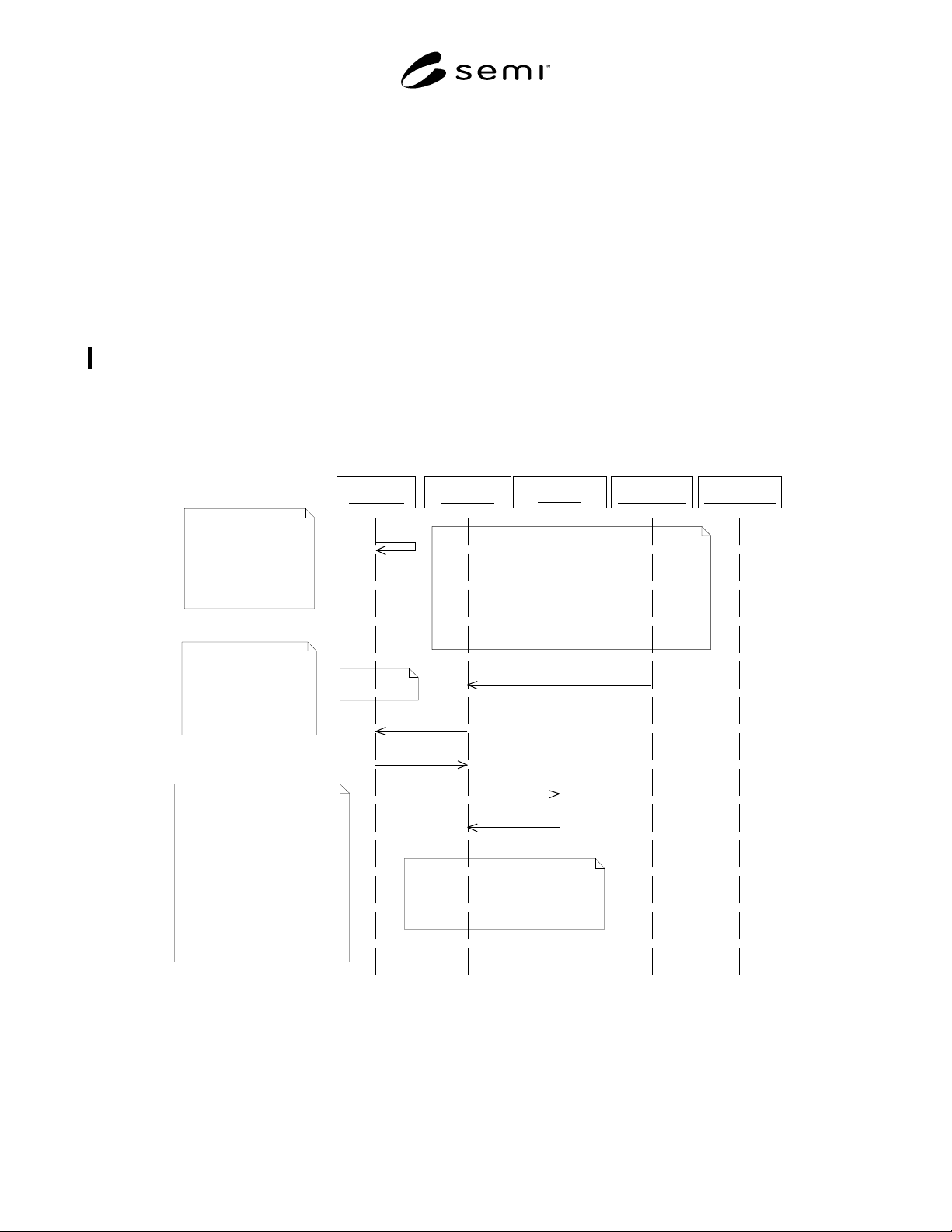
R2-1 Scenario 1 — Simulator Based Scheduler/Dispatcher, Stocker is Not Managed by Scheduling Component
R2-1.1 Lot 1 is scheduled for equipment 2 at 10:00. Lot is held in stocker until ready to start on equipment 2.
Factory operations makes the carrier delivery decisions.
STK1 STK2
Operation 10 -----------> Operation 20
EQ1 EQ2
Lot-1 processing on EQ1 is finished at 09:30
<Scheduling Result>
10:00 11:00 12:00 13:00
14:00
EQ2 <-------------> <---------------------> <----------->
S/D provides the next EQ
information for Lot-1.
S/D sends dispatch list.
Lot-1 / EQ2 / Start at
10:00 / Receipe-A
FO checks the condition to issue
transport request to MTSC
(1) Next Lot for EQ2 (Lot-1) has
arrived at Operation 20
(Assumption)
(2) It is 9:30 (Before 09:45)
(3) Next EQ2 is ready to load.
FO decides to transfer Lot-1 to
STK-2 and issues the Macro
Command.
(1) Source : Port-1 of EQ1
(2) Destination : STK2
At 9:30
1:
4: ActivityForecast(Lot 1, Equipment 2, Start 10:00)
3: forecastForMaterialGroupByTime(Lot 1)
2: Ready to Unload (Lot-1)
FO checks the forecast list and judges
(1) Keep this Lot-1 on EQ1 Port
or
(2) Return Lot-1 to STK2
5: Estimated transport time inquiry from EQ1 to EQ2
6: Estimated Time (15min)
S/D - Scheduling
Component
FO - Factory Operations
Component
MTSC - Material
Transport & Storage
Component
Factory
Operations
Scheduling
Component
Material Transport
& Storage
Production
Machine (EQ2)
Production
Machine(EQ1)
Figure R2-1
Scenario Case 1