semi合集-English.pdf - 第7699页
SEMI T8-0698 E © SEMI 1998, 2004 8 NOTICE: SEMI makes no warranties or represen tations as to the suitability o f the standards set forth herein for any particular application. The determination of the suitability of the…
SEMI T8-0698
E
© SEMI 1998, 2004 7
APPENDIX 1
PLACEMENT OF DATA MATRIX CODES ON DISPLAY SECTIONS OF
FLAT PANEL DISPLAY SUBSTRATES
NOTICE: This appendix was approved as an official part of SEMI T8, but the recommendations in this appendix
are optional and are not required to conform to this standard.
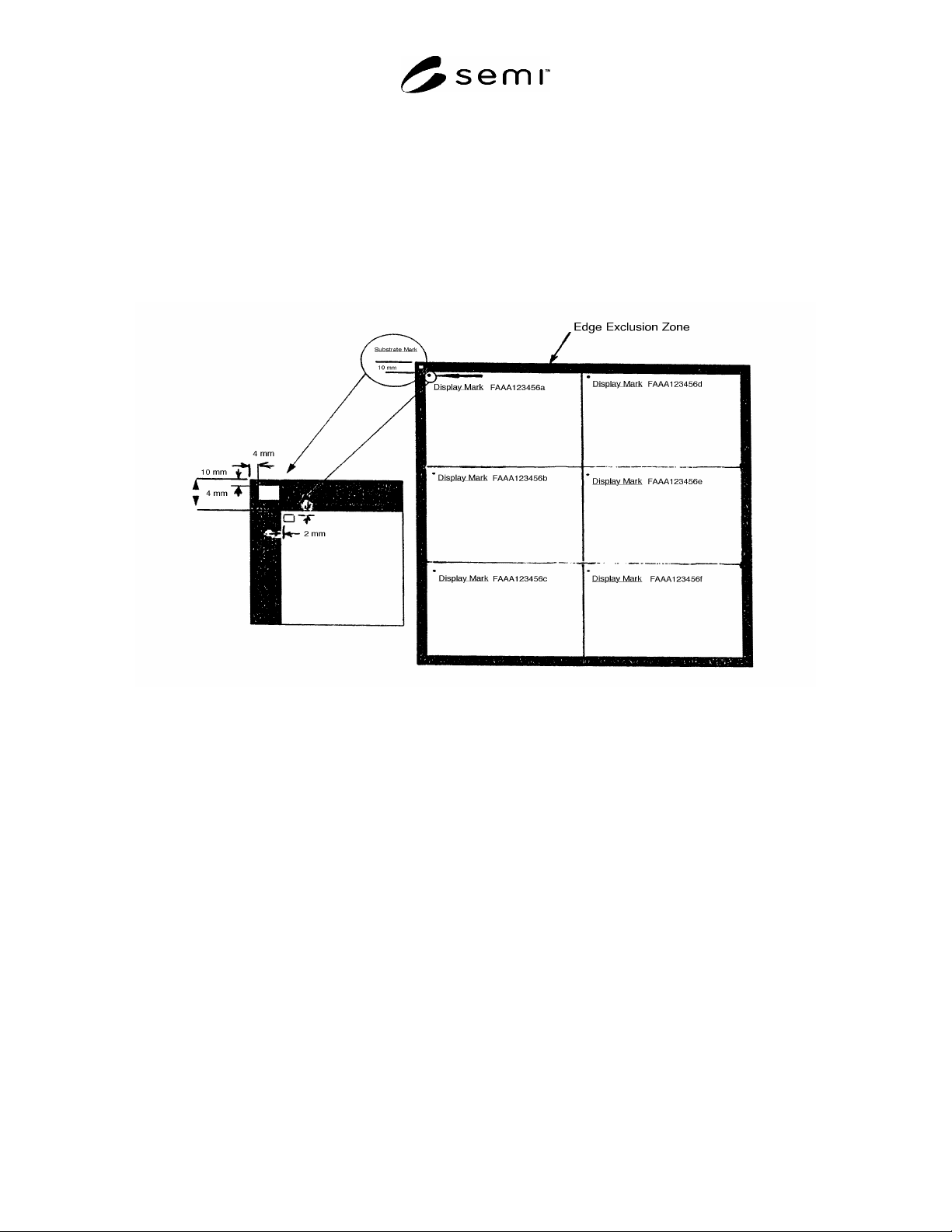
A1-1 The following suggests one way in which individual display sections could be marked while still a part of the
motherglass substrate. Figure A1-1 illustrates a six-up display layout on a 550 × 650 mm substrate
Figure A1-1
An Example of Mark Field Locations in Individual Display
Sections within a “Motherglass” Substrate
A1-2 The Substrate ID location falls within the edge exclusion area as detailed in Figure 4. In this example, all ID
fields are located on the back (non-pattern) surface. Placing them on the same surface as the substrate mark can
simplify ID reading during fabrication. Their location on the non-pattern surface could allow ID reading of the
outside surface of a display after assembly.
A1-3 The axes of the individual display IDs are parallel to the substrate ID axes. Each display ID is located adjacent
to a display corner. The locations of each ID field are given.
NOTE A1-1: This example does not constitute a recommended usage, but is intended to assist users in developing ID locations
suitable for their operations.

SEMI T8-0698
E
© SEMI 1998, 2004 8
NOTICE: SEMI makes no warranties or representations as to the suitability of the standards set forth herein for any
particular application. The determination of the suitability of the standard is solely the responsibility of the user.
Users are cautioned to refer to manufacturer's instructions, product labels, product data sheets, and other relevant
literature, respecting any materials or equipment mentioned herein. These standards are subject to change without
notice.
By publication of this standard, Semiconductor Equipment and Materials International (SEMI) takes no position
respecting the validity of any patent rights or copyrights asserted in connection with any items mentioned in this
standard. Users of this standard are expressly advised that determination of any such patent rights or copyrights, and
the risk of infringement of such rights are entirely their own responsibility.
Copyright by SEMI® (Semiconductor Equipment and Materials
International), 3081 Zanker Road, San Jose, CA 95134. Reproduction of
the contents in whole or in part is forbidden without express written
consent of SEMI.

SEMI T9-0200 © SEMI 1998, 2004 1
SEMI T9-0200 (Reapproved 1104)
SPECIFICATION FOR MARKING OF METAL LEAD-FRAME STRIPS
WITH A TWO-DIMENSIONAL DATA MATRIX CODE SYMBOL
This specification was technically approved by the Global Traceability Committee and is the direct
responsibility of the North American Traceability Committee. Current edition approved by the North
American Regional Standards Committee on July 11, 2004. Initially available at www.semi.org September
2004; to be published November 2004. Originally published in 1998; previously published April 2000.
1 Purpose
1.1 This specification provides a marking symbology
that can be used to mark metal lead-frame strips.
2 Scope
2.1 This specification defines the geometric and spatial
relationships and content (including the error checking
and correcting code) of rectangular two-dimensional (2-
D), machine-readable, binary Data Matrix symbology
for front-surface marking of metal lead-frame strips
(also called “strips”). It may be used in conjunction
with the alphanumeric marking codes specified in
SEMI M12 and SEMI M13 or the bar code specified in
SEMI T1.
2.2 This specification defines a 22-character default
message that is included in all marks, and option for up
to 50 additional characters, for a total of 72 message
characters. An optional shorter message contains 12 to
16 message characters; the resulting square field is
narrower but taller than the 22-character rectangular
one.
2.3 This specification provides a suggested location for
the code symbol. It also provides guidelines for
specifying other code locations when the suggested
location is not suitable for an application.
2.4 Although this specification does not specify the
marking techniques that may be employed when
complying with its requirements, it is assumed that the
symbol will be obtained by laser scribing individual
dots.
NOTE 1: A mark survivability experiment is being
conducted by the SEMI North American Traceability
committee. A report is available from SEMI: request
“Leadframe Mark Survivability Report” dated February,
1999.
2.5 Data Matrix symbology is applicable to a broad
range of lead-frame materials including copper and
Alloy 42 in both bare and plated conditions. The format
and algorithms of this code are based on two-
dimensional symbology specified in AIM International
Symbology Specification - Data Matrix.
2.6 This specification supports EIA Package Marking
Specification by enabling individual die tracking in the
manufacturing steps between die attach and device
packaging marking.
NOTE 2: Marking of each die, while in wafer form, prior to
dicing, could also accomplish this end.
NOTICE: This standard does not purport to address
safety issues, if any, associated with its use. It is the
responsibility of the users of this standard to establish
appropriate safety and health practices and determine
the applicability of regulatory or other limitations prior
to use.
3 Referenced Standards
3.1 SEMI Standards
SEMI M12 — Specification for Serial Alphanumeric
Marking of the Front Surface of Wafers
SEMI M13 — Specification for Alphanumeric Marking
of Silicon Wafers
SEMI T1 — Specification for Back Surface Bar Code
Marking of Silicon Wafers
3.2 AIM International Technical Specifications
1
AIM International Symbology Specification — Data
Matrix
3.3 ANSI Standards
2
ANSI/FACT-1 — Data Application Identifier Standard
ANSI X3.4 — American Standard Code for
Information Interchange (ASCII)
NOTE 3: This standard is equivalent to ISO 646, Information
Processing - ISO 7-bit Coded Character Set for Information
Exchange
3
.
1 AIM International, Inc., 125 Warrendale-Bayne Road , Warrendale,
PA 15086, Phone: 1 724 934 4470, Fax: 1 724 934 4495,
http://www.aimglobal.org/
2 American National Standards Institute, Headquarters: 1819 L
Street, NW, Washington, DC 20036, USA. Telephone: 202.293.8020;
Fax: 202.293.9287, New York Office: 11 West 42nd Street, New
York, NY 10036, USA. Telephone: 212.642.4900; Fax:
212.398.0023, Website: www.ansi.org