semi合集-English.pdf - 第3843页
SEMI F20-0305 © SEMI 1995, 2005 7 A1-2.1.6 These effects lead to the following recommend ations to ensure optimum weld quality when welding stainless steel: A1-2.1.6.3 Check compositions of pieces to be we lded. Match Su…
SEMI F20-0305 © SEMI 1995, 2005 6
As Sulfur increases from zero to the 0.030% maximum permitted:
Solidification temperature range increases.
– Increased segregation in weld.
– Rougher weld bead surface.
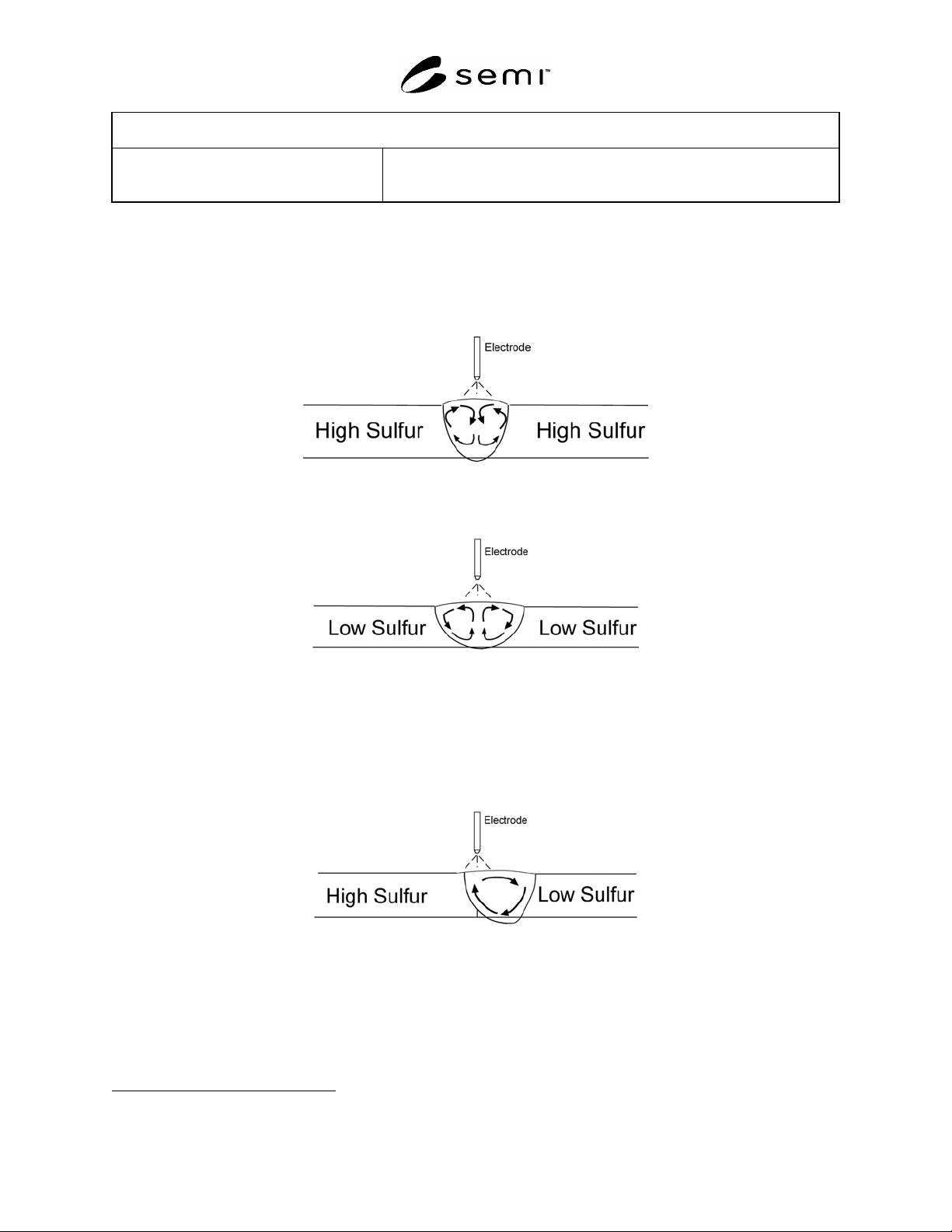
A1-2.1.3 The latter effect is due to a reversal of the convection currents in the weld pool at approximately 0.005
percent Sulfur. At Sulfur levels significantly above 0.005 percent the convective currents flow downward from the
arc, causing deep penetration as illustrated in Figure A1-1, whereas at Sulfur levels well below about 0.005 percent
the convective currents flow outward from the arc, causing a wider weld pool and shallower penetration as
illustrated in Figure A1-2
3
.
Figure A1-1
Convection Currents in the Weld Pool During Welding of Stainless Steel with >>0.005% Sulfur Levels
Figure A1-2
Convection Currents in the Weld Pool During Welding of Stainless Steel with <<0.005% Sulfur Levels
A1-2.1.4 Serious problems can occur when attempting to weld two pieces of stainless steel with substantially
different Sulfur contents. The weld pool can become asymmetric, favoring the low Sulfur side, and cause the root of
the weld to shift away from the joint, as illustrated in Figure A1-3.
Figure A1-3
The Weld Pool is Asymmetric When Welding Stainless Steel Pieces with Significantly Different Sulfur Levels
A1-2.1.5 In order to minimize this effect it is desirable to match Sulfur contents in components to be welded to
within ± 0.007 percentage points. Greater differences in Sulfur contents require very careful weld set-up to ensure
full penetration to the root of the joint.
3 Pollard, B., The Effects of Minor Elements on the Welding Characteristics of Stainless Steel, Welding Research Supplement, 202 (Sept 1988).

SEMI F20-0305 © SEMI 1995, 2005 7
A1-2.1.6 These effects lead to the following recommendations to ensure optimum weld quality when welding
stainless steel:
A1-2.1.6.3 Check compositions of pieces to be welded. Match Sulfur contents to within ± 0.007 percentage points.
A1-2.1.6.3 Welding of pieces with very low Sulfur (< 0.003 % approximately) may require additional attention to
the establishment of appropriate weld settings to achieve full, uniform penetration. It is recommended that product
with wall thickness > 0.100 inch approximately be restricted to > 0.003 % Sulfur.
A1-2.1.6.3 Establish weld settings for piece lots to be welded; recheck whenever changing lots.

SEMI F20-0305 © SEMI 1995, 2005 8
APPENDIX 2
THE EFFECTS OF COPPER AS A TRACE ELEMENT ON GTA
WELDING OF 316L STAINLESS STEEL
NOTICE: The material in this appendix is an official part of SEMI F20 and was approved by full letter ballot
procedures.
A2-1 Copper in Stainless Steel
A2-1.1 Copper is a residual or unspecified element in AISI 316L. It is not an intentional addition, but is present in
any heat of material as a result of the composition of the furnace charge materials used, which are typically
primarily scrap with elemental and master alloy additions to achieve the composition desired. Levels of unspecified
elements such as Copper are permitted up to 0.50% maximum by AMS 2248E
4
. Copper content can only be
reduced in the melt by dilution. Over time, as more scrap material is recycled, the residual levels of copper in heats
of AISI 316L is anticipated to increase.
A2-1.2 Copper is an austenite phase stabilizer. It also has been shown to improve the resistance of austenitic
stainless steels to stress corrosion cracking in chloride solutions.
A2-2 Effects of Copper on Welding
A2-2.1 In welding, copper is a surface-active element (like S, O, and Se) and has been shown to contribute
significantly to weld bead meander. Like manganese, it will volatilize during welding and redeposit downstream of
the weld, providing a site for the initiation of corrosion in some conditions. Some end users may restrict copper as a
potential source of weld contamination or corrosion.
A2-2.2 A correlation was noted between increased copper content and weld bead meander in a wafer fab project
5
.
Five heats of 0.25 in. tubing were evaluated. Copper was very prominent in the HAZ of one heat (0.47% Cu and
0.011% S) which had a bead meander problem when welded. Another heat with the same sulfur content and a lower
copper content (0.03% Cu) did not exhibit bead meander. Another heat (0.31% Cu and 0.010% S) showed oxidation
after welding. All welds were performed in argon.
A2-2.3 In a study of 28 heats of tubing from 0.25 to 2.0 inch in diameter, copper ranged from 0.05 to 0.41%
6
. Of
the 28 heats tested, 10 had copper contents above 0.25%, and among the nine heats of 2.0 in. diameter tubing, all
had copper levels above 0.22%, with four of the heats above 0.25%. Cosmetically unacceptable welds (slag,
discoloration and/or bead meander) occurred on heats with: 0.26% Cu, 0.005% S; 0.28% Cu, 0.009% S; and 0.41%
Cu, 0.005% S. Conversely, cosmetically acceptable welds were performed on a heat with 0.3% Cu and 0.011% S.
All welds were performed using argon.
A2-2.4 Data was presented at a SEMI Workshop and repeated here concerning the effect of copper content and
shield gas interactions on weldability
7
. Two examples of heats of AISI 316L tubing, 2.5 in. in diameter, with copper
contents above 0.3%, demonstrated that adding hydrogen to the argon shield gas adversely affected the weldability
of the tubing (see Figure A2-1). This same effect was not noted in heats of tubing with copper levels below 0.3%. In
addition, the weld electrodes undergo severe degradation when welding tubing with copper contents above 0.3% and
using Ar/H
2
shield gas (see Figure A2-2).
A2-2.5 Based on the above information, the following conclusions can be made:
A2-2.5.1 The copper restriction in SEMI F20 currently stands at 0.30%. This restriction is due to weldability
effects.
4 Aerospace Materials Specification (AMS) 2248E, "Chemical Check Analysis Limits: Corrosion and Heat Resisting Steels and Alloys,
Maraging and Other Highly Alloyed Steels, and Iron Alloys," SAE International, Warrendale, PA; issued 15 January 1960, Revised 1 October
1993, 6 pp
5 R. M. Cohen, Identifying Trace Elements Affecting the Weldability of 316L Stainless Steel Tubing, Future Fab International 1997, pp. 271-281
6 Sunniva Collins and Pete Williams, Weldability and Corrosion Studies of AISI 316L Electropolished Tubing, Proc. Interphex 2000.
7 Sunniva Collins, The Effect of Copper on GTA Welding of 316L Stainless Steel Tubing, Stainless Steel and Surface Analysis Workshop,
SEMICON West Standards Meeting, July 14, 2003