semi合集-English.pdf - 第3472页
SEMI E134-0305 © SEMI 2004, 2005 25 9.1.2.10 .6 ObjTypeRequ est — This class represents a re quest for th e instance id’s of one or more ObjTypes. 9.1.2.10 .6.1 ObjTypeRequ est Attribute Definition Table Table 34 ObjType…

SEMI E134-0305 © SEMI 2004, 2005 24
interested in the attributes of specific E39 objects can only make requests from a specific object instance if the
unique instance identification information for such objects is known. This operation allows consumers to learn from
the equipment how many E39-compliant objects of a given ObjType are instantiated on the equipment at the time of
the request, and what their unique instance identification information is. The consumer may then use that instance
information to request E39-compliant object attribute values using either the GetParameterValues operation (see
Section 9.1.2.9), or by including this information in a DCP. E39-compliant object attribute values are returned as
ParameterValues (see Section 14.2).
9.1.2.10.1 This specification does not define the format of an E39-compliant object instance identifier; this format
shall be fully specified by any implementation mapping of this specification.
9.1.2.10.2 Upon receiving this request, the equipment shall return a list of the instance identifiers of all SEMI E39-
compliant objects that exist at the time of the request, and are of the requested ObjType, and that are provided by the
requested source. If the request includes unrecognized ObjTypes or sources, the equipment shall indicate so by
returning ObjTypeRequestError (see Section 9.1.2.10.11) for each such request. Consumers can request the list of
all instances, all instances of a specific type, all instances from a specific source, or all instances of a specific type
from a specific source.
9.1.2.10.3 If the consumer does not have sufficient privilege (see Section 10) to request ObjType instance id’s, the
equipment shall return an UnauthorizedOperation error.
9.1.2.10.4 GetObjTypeInstanceIds Operation Arguments
Table 33 GetObjTypeInstanceIds Argument Definitions
Argument Description Kind Form
request The ObjTypes whose instance id’s are
being requested.
in List of elements of type ObjTypeRequest,
described in Section 9.1.2.10.6.
objTypeInstances The instance id’s of the requested
ObjTypes.
out List of elements of type ObjTypeResult, described
in Section 9.1.2.10.9 . See Section 9.1.2.10.5 for
further description.
error The consumer does not have sufficient
privilege to request ObjType instance
id’s.
error Structured data, of type UnauthorizedOperation,
described in Section 9.1.2.2.5.
9.1.2.10.5 objTypeInstances — The equipment shall return one and only one element of type ObjTypeResult for
each unique ObjType-source combination resulting from the original request. For example, if the consumer
requested all “Carrier” ObjType instance id’s, regardless of the source, and the equipment has only one source of
that ObjType, then only one ObjTypeResult will be returned. That result will contain all instance id’s for that
ObjType provided by that source. If there were two or more sources of that ObjType, the equipment would return as
many ObjTypeResult elements as there were sources, each element containing all instance id’s of that ObjType
provided by that source.
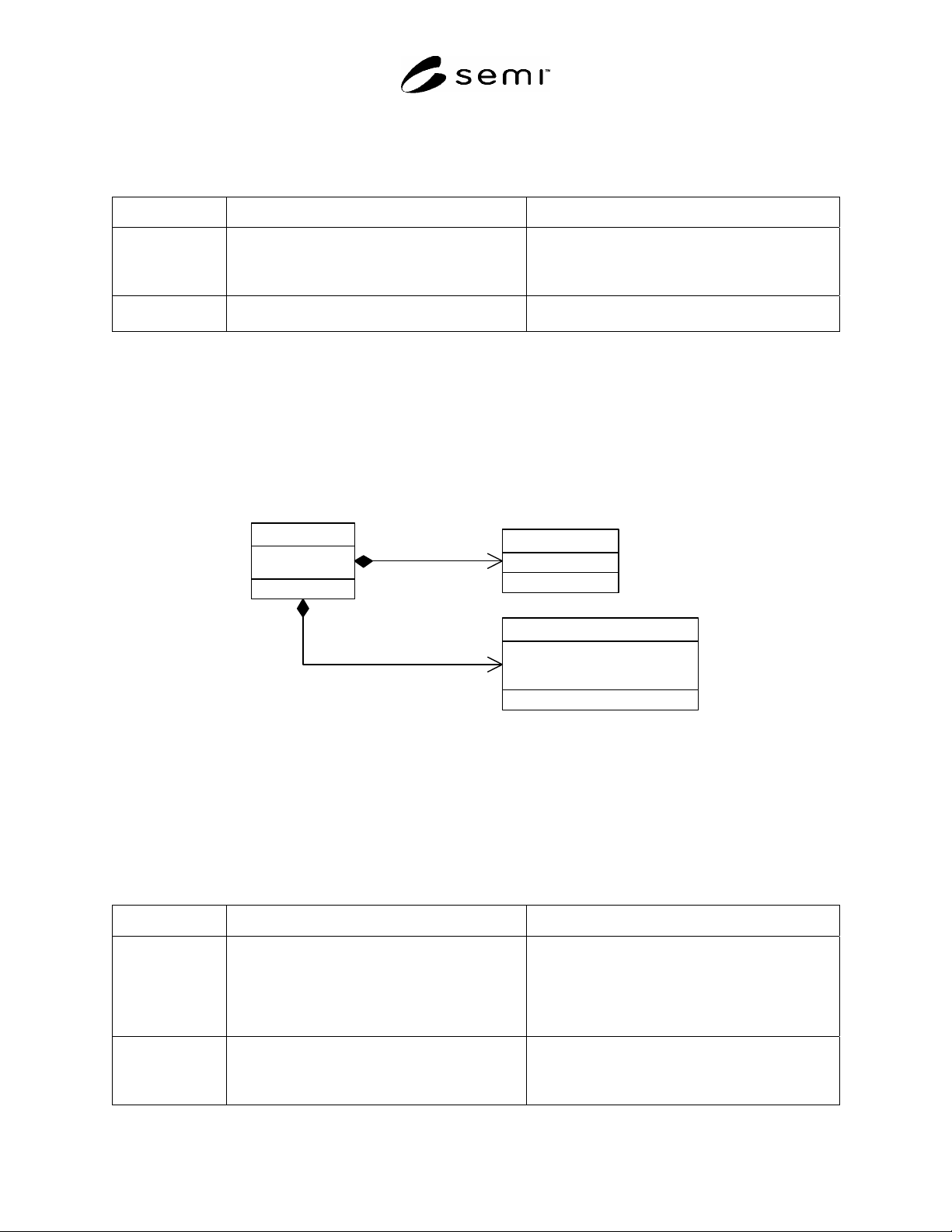
sourceId
objTy peId
ObjTypeRequest
Figure 16
ObjTypeRequest Class
SEMI E134-0305 © SEMI 2004, 2005 25
9.1.2.10.6 ObjTypeRequest — This class represents a request for the instance id’s of one or more ObjTypes.
9.1.2.10.6.1 ObjTypeRequest Attribute Definition Table
Table 34 ObjTypeRequestError Attribute Definition
Attribute Name Definition Form
sourceId Identifies the requested source of the requested
ObjType.
Text, formatted according to the convention used to
identify the source of an ObjType. See limitations,
Section 3.1.1. See Sections 9.1.2.10.7 and 9.1.2.10.8
for further description.
objTypeId Identifies the ObjType whose instance id’s are
being requested.
Text. See Sections 9.1.2.10.7 and 9.1.2.10.8 for
further description.
9.1.2.10.7 If the ‘sourceId’ attribute is non-empty, the equipment shall return all instance id’s of the ObjType
specified in the ‘objTypeId’ attribute that are available from the specified source. If the ‘objTypeId’ attribute is
empty, the equipment shall return the id’s of all E39-compliant ObjType instances available from the specified
source, regardless of their ObjType.
9.1.2.10.8 If the ‘sourceId’ attribute is empty, the equipment shall return all instance id’s of the ObjType specified
in the objTypeId attribute, regardless of their source. If the objTypeId attribute is also empty, the equipment shall
return all instances of all E39-compliant ObjTypes, regardless of their source.
sourceId
objTy peI d
ObjTypeResult
instanceId
ObjTypeInstance
objTypeI nstanc es
10..*
invalidSource
invalidObjTy pe
sourc eDoesN otProduceObjType
ObjT ypeRequestErrorobjT ypeReques tError1
0..1
Figure 17
ObjTypeResult and Related Classes
9.1.2.10.9 ObjTypeResult — This class provides a list of requested ObjType instance id’s. If the original request
included unrecognized sources or ObjTypes, or ObjTypes that are not provided by the requested sources, the
equipment shall return an ObjTypeRequestError (see Section 9.1.2.10.11) for each such request.
9.1.2.10.9.1 ObjTypeResult Attribute Definition Table
Table 35 ObjTypeResult Attribute Definition
Attribute Name Definition Form
sourceId Identifies the source of the ObjType instance. Text, formatted according to the convention used to
identify the source of an E39-compliant ObjType.
See limitations, Section 3.1.1. If the original request
contained an invalid source or ObjType, this field
must be equal to the sourceId provided with the
corresponding original ObjTypeRequest.
objTypeId The ObjType whose instances are provided with
this result.
Text, equal to the ObjType name. If the original
request contained an invalid source or ObjType, this
field must be equal to the objTypeId provided with the
original corresponding ObjTypeRequest.

SEMI E134-0305 © SEMI 2004, 2005 26
9.1.2.10.9.2 ObjTypeResult Association Definition Table
Table 36 ObjTypeResult Association Definition
Association Role Name Definition Comments
objTypeInstances The list of ObjType instance id’s for the
corresponding ObjTypeResult.
List of zero or more elements of type
ObjTypeInstance, described in Section 9.1.2.10.10.
objTypeError A description of a problem detected in the
original ObjTypeRequest.
Zero or one element of type ObjTypeRequestError,
described in Section 9.1.2.10.11.
9.1.2.10.10 ObjTypeInstance — This class, shown in Figure 23, provides the instance id of a requested ObjType
from its requested source.
9.1.2.10.10.1 ObjTypeInstance Attribute Definition Table
Table 37 ObjTypeInstance Attribute Definition
Attribute Name Definition Form
instanceId The instance id of an E39-compliant object that has
the source and objTypeId of the ObjTypeResult to
which this ObjTypeInstance belongs.
Text, format to be specified in implementation
mappings.
9.1.2.10.11 ObjTypeRequestError — This class, shown in Figure 23, describes an error detected in a specific
ObjTypeRequest provided as input to the GetObjTypeInstanceIds operation.
9.1.2.10.11.1 ObjTypeRequestError Attribute Definition Table
Table 38 ObjTypeRequest Attribute Definition
Attribute Name Definition Form
invalidSource Whether or not the corresponding
ObjTypeRequest specified an unrecognized
source.
Boolean
invalidObjType Whether or not the corresponding
ObjTypeRequest specified an unrecognized
ObjType.
Boolean
sourceDoesNotProduceObjType Whether or not the corresponding
ObjTypeRequest specified a source that
does not provide the requested ObjType.
Boolean
9.1.2.11 GetCurrentPerformanceStatus — Upon receiving this request, the equipment shall return the most recently
evaluated equipment performance status (see Section 15.1.6.1.1).
9.1.2.11.1 If the consumer does not have sufficient privilege (see Section 10) to request the current performance
status, the equipment shall return an UnauthorizedOperation error.
9.1.2.11.2 GetCurrentPerformanceStatus Operation Arguments
Table 39 GetCurrentPerformanceStatus Argument Definitions
Argument Description Kind Form
status The most recent operational performance
status.
out One and only one element of type
PerformanceStatus, described in Section
15.1.6.1.1.