semi合集-English.pdf - 第2161页
SEMI E54.16-0705 © SEMI 2005 6 types match. A list of all available SNVTs and details of their definitions is p rovided in the SNVT Master List and Programmer’s Guide . 6 Communication Protocol High Level Struc ture 6.1 …
SEMI E54.16-0705 © SEMI 2005 5
5.4.8 state diagram — In a LONWORKS device, state is represented by the collection of values of local and network
variables of the application program. Transitions between states are the result of external events (such as the receipt
of a network variable update, or other I/O event), or internal events (such as the expiration of a timer).
5.5 LONWORKS-Specific Definitions — In addition to the standard data type definitions for bit, nibble, byte, and
character, the ANSI/EIA/CEA-709.1 (LONWORKS) protocol defines a set of standard data representations for use as
attribute values.
5.5.1 binding — Network variables on the same or different devices may be associated together by means of a
network management service known as binding. Binding is permitted only if all the network variables in the set are
of the same data type. The values of network variables that are bound together are propagated over the network by
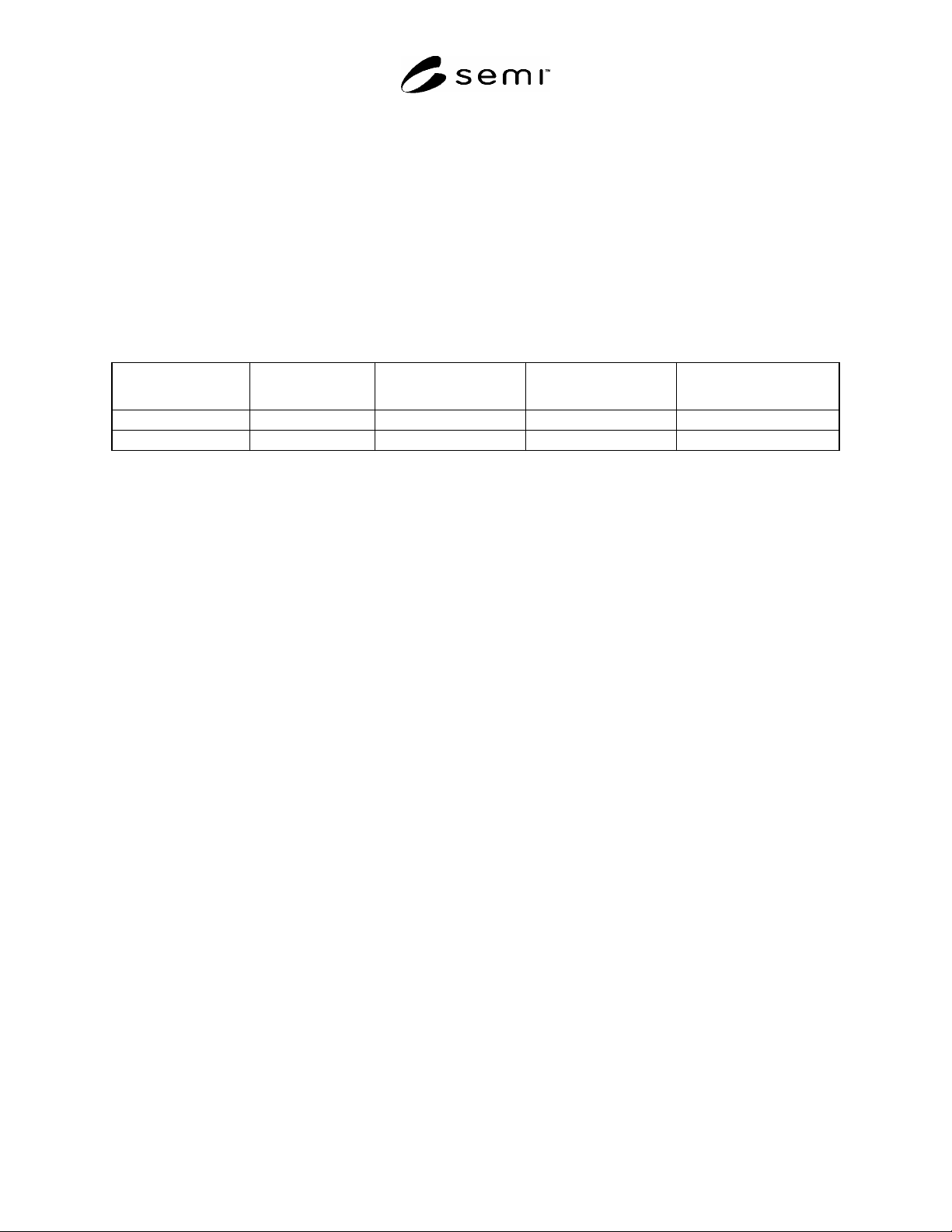
the ANSI/EIA/CEA-709.1 (LONWORKS) protocol. Table 2 shows the permitted combinations for updating and
polling of network variables.
Table 2 Updating and Polling of Network Variables
Network Variable
Class
Update from
Network
Update from Device Poll from Network Poll from Device
Input Yes Yes Yes Yes
#2
Output No Yes
#1
Yes No
#1
When the device updates one of its own output network variables, input network variables that are bound to this output network variable
receive an update from the network.
#2
When the device polls one of its own input or configuration network variables, output network variables that are bound to this input or
configuration network variable receive a poll from the network.
5.5.2 configuration properties — These are attributes of a functional block that are used to configure the
application-specific behavior of the functional block, such as sensor gain and offset, linearization table, and sample
rate. These attributes are typically updated when the device is installed, configured, or calibrated, and are stored in
non-volatile memory.
5.5.3 device interface — A device interface is a specification of one or more functional blocks, together with
semantic definitions relating the behavior of the functional block(s) to the network variable values. The collection of
functional blocks in a device corresponds to the SEMI SAN device-specific model for that device. Each type of
device interface is identified by a standard program ID (SPID).
5.5.4 network variable — This is a network-visible data attribute of a device, with a well-defined data type.
Network variables are either input variables, output variables, or configuration network variables. The value of a
network variable may be updated either by the device itself, or over the network by some other device. This
corresponds to the SEMI specific service SetAttribute operation. The value of a network variable may be polled over
the network by some other device, or retrieved by the device itself. This corresponds to the SEMI specific service
GetAttribute operation.
5.5.5 functional block — A device’s external interface documentation specifies the type identifiers of the functional
blocks contained within the device. This documentation may be uploaded from the device, and completely specifies
the functional profiles implemented by the device, as well as the network variables and configuration properties
contained within each of the functional blocks.
5.5.6 functional profile — A functional profile is the definition of the attributes and behaviors of an abstract entity.
Each type of functional block is identified by a functional profile number. A specific device type consists of
instantiations of one or more of these functional profiles. A functional block is implemented as a collection of
network variables and configuration properties.
5.5.7 standard configuration property types — These data types, also known as SCPTs, provide a data type
definition and a semantic behavior for the configuration properties of functional blocks. A list of all available SCPTs
and details of their definitions is provided in the SCPT Master List and Programmer’s Guide.
5.5.8 standard network variable types — These data types, also known as SNVTs, facilitate interoperability by
providing a well-defined interface for communication between devices made by different manufacturers. A device
may be installed in a network, and logically connected to other devices via network variables, as long as the data
SEMI E54.16-0705 © SEMI 2005 6
types match. A list of all available SNVTs and details of their definitions is provided in the SNVT Master List and
Programmer’s Guide.
6 Communication Protocol High Level Structure
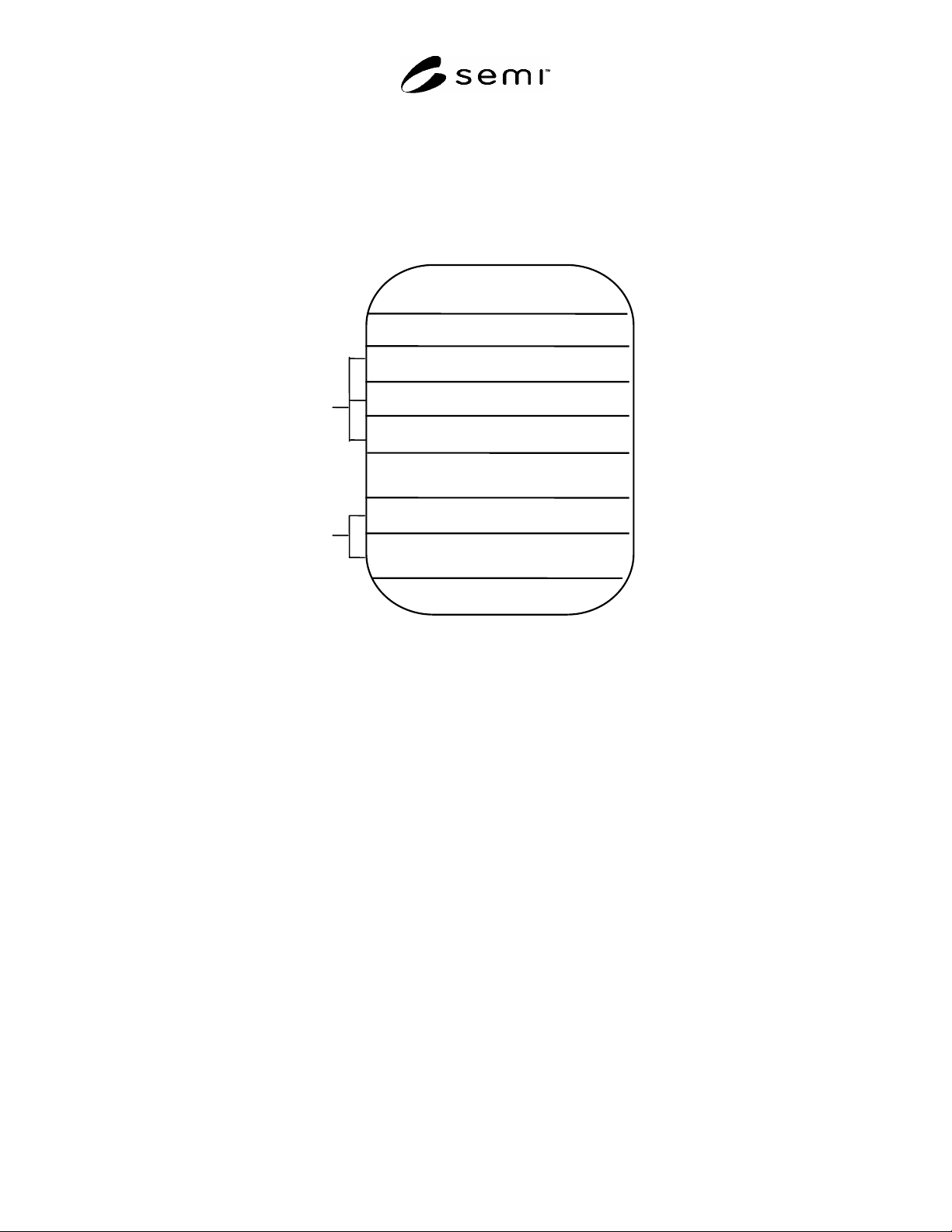
6.1 The ANSI/EIA/CEA-709.1 (LONWORKS) protocol is based on a seven-layer architecture. At each layer, there is
a description of the services provided within that layer. The high level protocol architecture is shown in Figure 1.
Application and Presentation La
y
ers
Application:
network variable exchan
g
e,
application-specific RPC, etc.
Network Mana
g
ement:
network mana
g
ement RPC,
dia
g
nostics
Session La
y
er
request-response service
Transport La
y
er
acknowled
g
ed and unacknowled
g
ed unicast and multicast
Authentication
server
Transaction Control Sublayer
common orderin
g
and duplicate detection
Network La
y
er
connection-less, domain-wide broadcast, no se
g
mentation,
loop-free topolo
gy
, learnin
g
routers
Link La
y
er
framin
g
, data encodin
g
, CRC error checkin
g
MAC Subla
y
er
predictive p-persistent CSMA: collision avoidance;
optional priorit
y
and collision detection
Ph
y
sical La
y
er
mulitple-media, medium specific protocols
LAYERS 6,7
LAYER 5
LAYER 4
LAYER 3
LAYER 2
LAYER 1
Figure 1
Layered View of the ANSI/EIA/CEA-709.1 (LONWORKS) Protocol
6.1.1 Figure 1 represents a conceptual view of the device architecture. Implementations typically use the Neuron
Chip and its associated firmware, which provide a conforming implementation of layers 2 through 6. The LonMark
Interoperability Guidelines specify the protocol options to be used, most specifically at the physical layer (network
transceivers) and at the application layer (object model).
6.2 Physical Layer — The device shall employ one of the L
ONMARK-approved physical channels as specified in the
LONMARK Layers 1–6 Interoperability Guidelines. LONWORKS-based SEMI SAN-compliant devices shall use, by
default, a two-pin screw-terminal open pluggable connector (Weidmüller-Klippon SL2, Phoenix Combicon, or
equivalent) for the network connection. The default connector specification may be overridden for specific device
types if special requirements apply; any such overrides shall be noted in §9, Specific Device Type Information, of
this document. This connection is polarity-insensitive. The requirements of semiconductor equipment may be met
by one of the twisted pair channel specifications listed below.
6.2.1 TP/XF-1250 Twisted Pair — This twisted-pair channel operates at a bit rate of 1,250kbps and supports a bus
topology using transformer-coupled transceivers.
6.2.2 TP/FT-10 Twisted Pair — This twisted-pair channel operates at a bit rate of 78kbps and supports both free
topology and bus topology wiring, as well as optional link power.
6.2.3 The L
ONMARK Layers 1-6 Interoperability Guidelines provide specific details of the characteristics of these
transceivers. This document also provides specifications of wiring types and interconnection topologies to be used
for guaranteed device interoperability. Note that the ANSI/EIA/CEA-709.1 (LONWORKS) protocol supports
heterogeneous networks. Devices with dissimilar transceivers may be interconnected and communicate via routers
or repeaters. Similarly, routers and repeaters may be used to extend a physical channel beyond the device count,
wire length, or other physical limitations imposed by the chosen transceiver.

SEMI E54.16-0705 © SEMI 2005 7
6.2.4 Multiple physical layer protocols and data encoding methods are used in the ANSI/EIA/CEA-709.1
(LONWORKS) protocol. Differential Manchester encoding is used on twisted pair physical layers.
6.3 Link Layer — The device shall comply with the ANSI/EIA/CEA-709.1 (LONWORKS) protocol link layer
specification. This layer includes the media access control sublayer. For a number of reasons, including simplicity
and compatibility with the multicast protocol, the ANSI/EIA/CEA-709.1 (LONWORKS) protocol supports a simple
connectionless service. Its functions are limited to framing, frame encoding, and error detection.
6.3.1 Media Access Control Sub-layer — In order to deal with a variety of media in the potential absence of
collision detection, the MAC (Media Access Control) sub-layer employs a collision avoidance algorithm called
Predictive p-persistent CSMA (Carrier Sense, Multiple Access).
6.4 Network Layer — The device shall comply with the ANSI/EIA/CEA-709.1 (LONWORKS) protocol network
layer specification. This layer handles packet delivery within a single domain, with no provisions for inter-domain
communication. The network service is connection-less, unacknowledged, and supports neither segmentation nor re-
assembly of messages. The routing algorithms employed by the network layer to learn the topology assume a tree-
like network topology; routers with configured tables may operate on topologies with physical loops, as long as the
communication paths are logically tree-like. In this configuration, a packet may never appear more than once at the
router on the side on which the packet originated. The unicast routing algorithm uses learning for minimal overhead
and no additional routing traffic. Use of configured routing tables is supported for both unicast and multicast
addresses.
6.5 Transport Layer — The device shall comply with the ANSI/EIA/CEA-709.1 (LONWORKS) protocol transport
layer specification. The heart of the protocol hierarchy is the Transport and Session layers. A common Transaction
Control sub-layer handles transaction ordering and duplicate detection for both layers. The transport layer is
connectionless and provides reliable message delivery to both single and multiple destinations. Authentication of the
message sender’s identity is provided as an optional feature. The authentication server requires only the Transaction
Control sub-layer to accomplish its function. The transport and session layer messages may be authenticated using
all of the ANSI/EIA/CEA-709.1addressing modes other than broadcast. The transport layer supports end-to-end
acknowledged service and an unacknowledged/ repeated service.
6.6 Session Layer — The device shall comply with the ANSI/EIA/CEA-709.1 (L
ONWORKS) protocol session layer
specification. This layer implements a simple Request-Response mechanism for access to remote servers. This
mechanism provides a platform upon which application-specific remote procedure calls can be built. The
ANSI/EIA/CEA-709.1 (LONWORKS) network management protocol, for example, is dependent on the Request-
Response mechanism in the Session layer, even though it accesses the protocol via the application layer interface.
6.7 Presentation Layer — The device shall comply with the ANSI/EIA/CEA-709.1 (LONWORKS) protocol
presentation layer specification. The Presentation layer and the Application layer taken together form the foundation
of interoperability for LONWORKS devices. The application layer provides all the usual services for sending and
receiving messages, but it also contains the concept of network variables. The presentation layer provides
information in the Application Protocol Data Unit (APDU) header for how the APDU is to be interpreted for
network variable updates. This application-independent interpretation of the data allows data to be shared among
devices without prior arrangement. With agreement on which network variables are to be used for sensors, actuators,
etc., intelligent components from different manufacturers may work together without prior knowledge of each
other's characteristics.
6.8 Application Layer — At the application layer, interoperability between LONWORKS-based devices is facilitated
through the use of functional blocks and Standard Network Variable Types (SNVTs). Functional blocks build upon
network variables and provide a concise application layer interface that incorporates semantic meaning for specific
device functions. Functional blocks not only define which SNVTs to use to convey data, but also provide semantic
meaning about the information being communicated. To aid in the specification of specific device models with well-
defined functional behavior, functional block interfaces and semantics are defined by functional profiles. The
Application Layer also includes the LONWORKS file transfer protocol, which provides segmentation and reassembly
of arbitrary length files of data. This service may be used to get and set object attributes that exceed the network
variable size limit of 31 bytes.
6.8.1 Object Models — The ANSI/EIA/CEA-709.1 (LONWORKS) protocol provides an object-oriented specification
for defining and addressing network variables and configuration properties, which are the representation of object
attributes and events. The device shall comply with the object model specifications defined in §7 of this document.