semi合集-English.pdf - 第251页
SEMI E35.1-95 © SEMI 1995, 2004 1 SEMI E35.1-95 (Withdrawn 0304) GUIDE FOR COST OF EQUIPM ENT OWNERSHIP COMPARI SON METRIC NOTICE: This document was balloted and app roved for withdrawal in 2004. 1 Purpose 1.1 The pur po…
SEMI E35-0305 © SEMI 1995, 2005 19
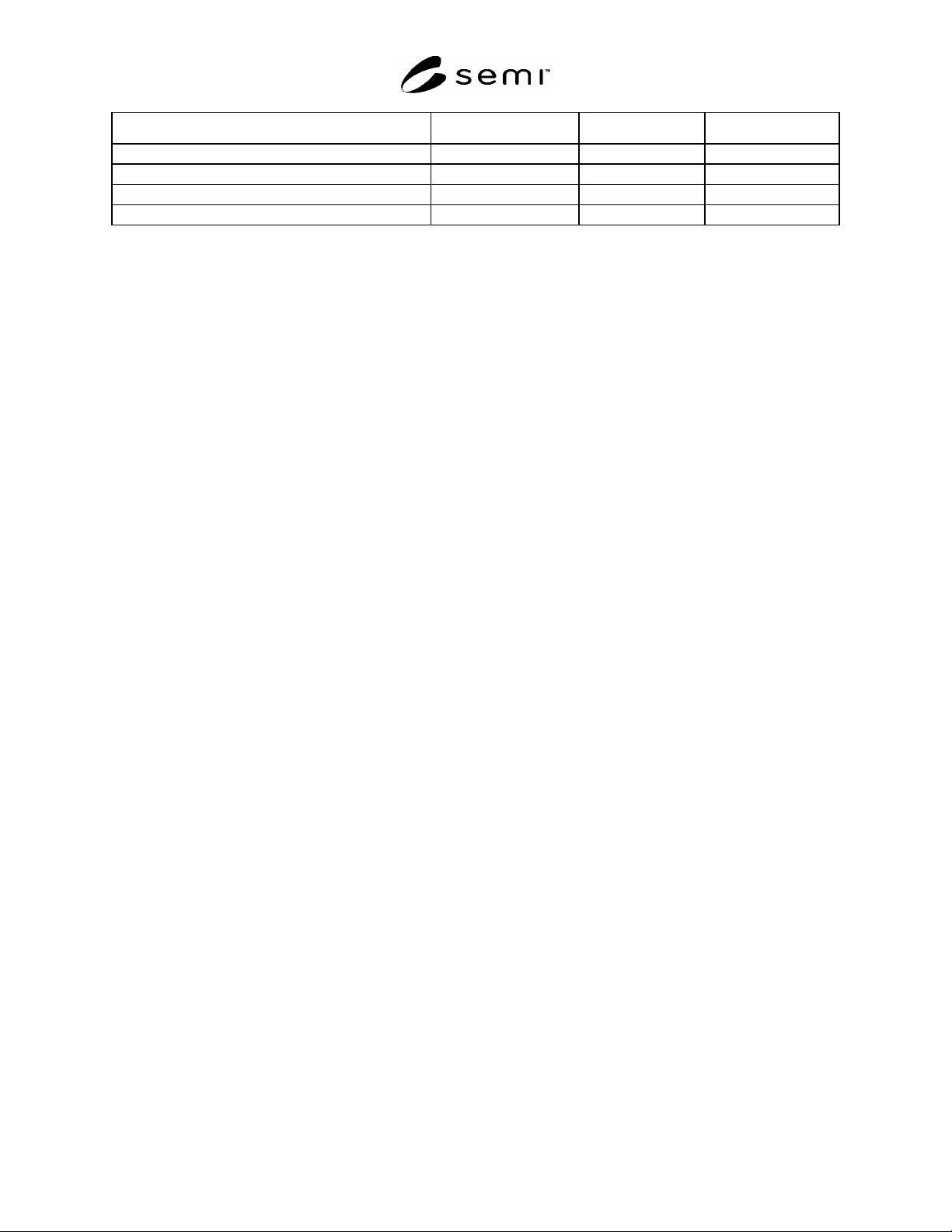
Example Values Description 150 mm Example
#1
200 mm Example
#2
300 mm Example
#3
8. Installation Cost as Percent of Equipment Cost
Lithography NA NA 8%
Metrology NA NA 5%
Other NA NA 12%
#1
Derived from SEMATECH Cost of Ownership Rev. B December 1990.
#2
Approved, Metrics Committee, July 11, 1995.
#3
Derived from joint Selete and International 300mm Initiative (I300I) inputs, 1997.
NOTICE: SEMI makes no warranties or representations as to the suitability of the standards set forth herein for any
particular application. The determination of the suitability of the standard is solely the responsibility of the user.
Users are cautioned to refer to manufacturer's instructions, product labels, product data sheets, and other relevant
literature, respecting any materials or equipment mentioned herein. These standards are subject to change without
notice.
By publication of this standard, Semiconductor Equipment and Materials International (SEMI) takes no position
respecting the validity of any patent rights or copyrights asserted in connection with any items mentioned in this
standard. Users of this standard are expressly advised that determination of any such patent rights or copyrights, and
the risk of infringement of such rights are entirely their own responsibility.
Copyright by SEMI® (Semiconductor Equipment and Materials
International), 3081 Zanker Road, San Jose, CA 95134. Reproduction of
the contents in whole or in part is forbidden without express written
consent of SEMI.
SEMI E35.1-95 © SEMI 1995, 2004 1
SEMI E35.1-95 (Withdrawn 0304)
GUIDE FOR COST OF EQUIPMENT OWNERSHIP COMPARISON
METRIC
NOTICE: This document was balloted and approved for withdrawal in 2004.
1 Purpose
1.1 The purpose of this guide is to provide a standard
constrained version of the Cost of Ownership for
Semiconductor Manufacturing Equipment Metrics
Guide to provide a baseline metric for comparing cost
effectiveness of competitive factory equipment
subsystems in the semiconductor industry. The major
constraints are the inclusion of only Equipment Yield
and the exclusion of the Cost of Yield Loss consisting
of defect limited yield and parametric yield.
1.2 The guide establishes well-defined practice to
facilitate cost comparisons of equipment by using
definitions, classifications and methods necessary to
build a useful cost of equipment ownership comparator
as a constraint version of SEMI E35. The guide should
facilitate communication about cost of ownership.
2 Scope
2.1 This guide is a subset of a full COO calculator as
presented in SEMI E35 and constitutes a fully
conforming standard constraint version. The baseline
metric is meant to reflect those equipment aspects over
which an equipment supplier has responsibility and
seeks to minimize aspects which couple costs for
individual equipment to the entire factory system. The
use of the metric is for competitive evaluation of
equipment sets to be used for a specific process step.
2.2 Effective use of the metric to build a COO model
requires identification of the constraints, parameter
values within the adopted category classification. The
primary calculators should, where possible, use direct
values for inputs rather than deriving them from
secondary models or using the default values provided
in Related Information 1 and 2 in SEMI E35. A COO
model requires data for many parameters. Default data
for the COO is provided within this document and may
be updated periodically through support documents.
3 Referenced Documents
3.1 SEMI Documents
SEMI E10 — Guideline for Definition and
Measurement of Equipment Reliability, Availability,
and Maintainability
SEMI E35 — Guideline for Cost of Ownership for
Semiconductor Manufacturing Equipment Metrics
SEMI Compilation of Terms
4 Terminology
All terminology in this guideline is defined in SEMI
E35.
5 Cost of Equipment Ownership Comparator
The Cost of Equipment Ownership Comparator
(CEOC) metric is the incremental cost added to a good
wafer or IC device flowing through a volume sized
process system embedded in a factory environment for
a specified lifetime. The metric is expressed as Cost per
Good Wafer Equivalent for one pass through the
system. CEOC should reflect the full cost of embedding
and operating in a factory environment a process
system needed to accommodate a specified number of
wafers but does not include defect yield or parametric
yield loss.
5.1 CEOC: Fixed and Recurring Costs — Determining
the Cost of Ownership requires enumerating all of the
Fixed and Recurring costs. Fixed costs are those
incurred once and are usually associated with the
acquisition and incorporation of equipment into the
factory. Recurring costs are those which arise on an
annual basis from the operation and maintenance of the
equipment.
5.2 Yield
5.2.1 Production yield (PY) is often tied to a large
number of factors which are principally the
responsibility of the IC manufacturer and equipment
comparisons for production yield should be done
directly in the context of the production flow. Yield is a
metric of the percentage of the wafer volume that
results in good wafers and enters the picture in a
number of ways which can complicate comparisons.
Yield-related comparisons of equipment should be dealt
with directly rather than lumping them into the CEO.
COST of
Embedding + Operating
CEO =
annualized
Fixed Costs
per system
annualized
Recurring Costs
per system
+
(
)
*
Volume Required
# Systems
Good Units
Per Year
5.2.2 Particles additions for example are often used as
a predictor of yield loss. Equipment should be
SEMI E35.1-95 © SEMI 1995, 2004 2
compared directly on the basis of particles or other
direct metrics such as uniformity.
5.2.3 The Cost of Equipment Ownership should only
reflect Equipment Yield. The percentage of wafers
which can be passed to the next step can be based on
any criteria, such as broken wafers or wafers
determined to be defective by inspection or test.
5.3 Life — Time over which the fixed and recurring
costs are spread for the annualized basis. Tax Life is
customarily used in COO based upon standard
accounting practice.
COO Lifetimes
1. Tax Lifetime - Depreciation
2. Equipment Production Lifetime
5.4 System Throughput — Wafers per hour capability
for the process system.
5.5 Volume Requirement
5.5.1 The volume requirement is the wafer or IC (unit)
flow to be processed. The volume requirement can be
derived from specification of the product wafers or IC
devices needed corrected for yield and the required
number of other wafers which might be designated as
test, dummy, or monitor wafers. One complication in
accurately dealing with the volume requirement is that
the volume of wafers actually reaching the equipment
will depend on the volume loss from equipment yield
for all the prior steps.
5.5.2 For CEOC, volume should be dealt with
parametrically based upon factory wafer starts. For
multi-chamber equipment, the impact of added
chambers to increase capacity should be included as
well as the impact of adding whole systems.
5.6 Good Wafer Equivalents (GWE) — GWE is
derived from the number of good product die at wafer
probe and is expressed as completely good wafers.
5.7 Systems Required — See SEMI E35.
6 Reporting Results
Conform to SEMI E35.
7 Limitations
7.1 Certain factors are more difficult than others to
accurately determine. Thus, the accuracy of a COO
calculation may be prone to a variety of errors or
omissions. In addition, line balance considerations are
not included in cost of ownership calculation.
7.2 A COO calculation may have more detail than
presented explicitly in this guide. The structure of the
guide however allows for the proper handling of these
situations.
8 Procedures
8.1 The CEOC algorithm requires the specification of
the volume level and the enumeration of appropriate
fixed and recurring costs associated with processing
that volume. The CEOC metric is a function expressed
as the sum of a number of categories which constitute a
classification system as given in SEMI E35. Each item
in the classification system should be defined, a method
for evaluating its expression given, and default values
or handling specified. The cost of equipment ownership
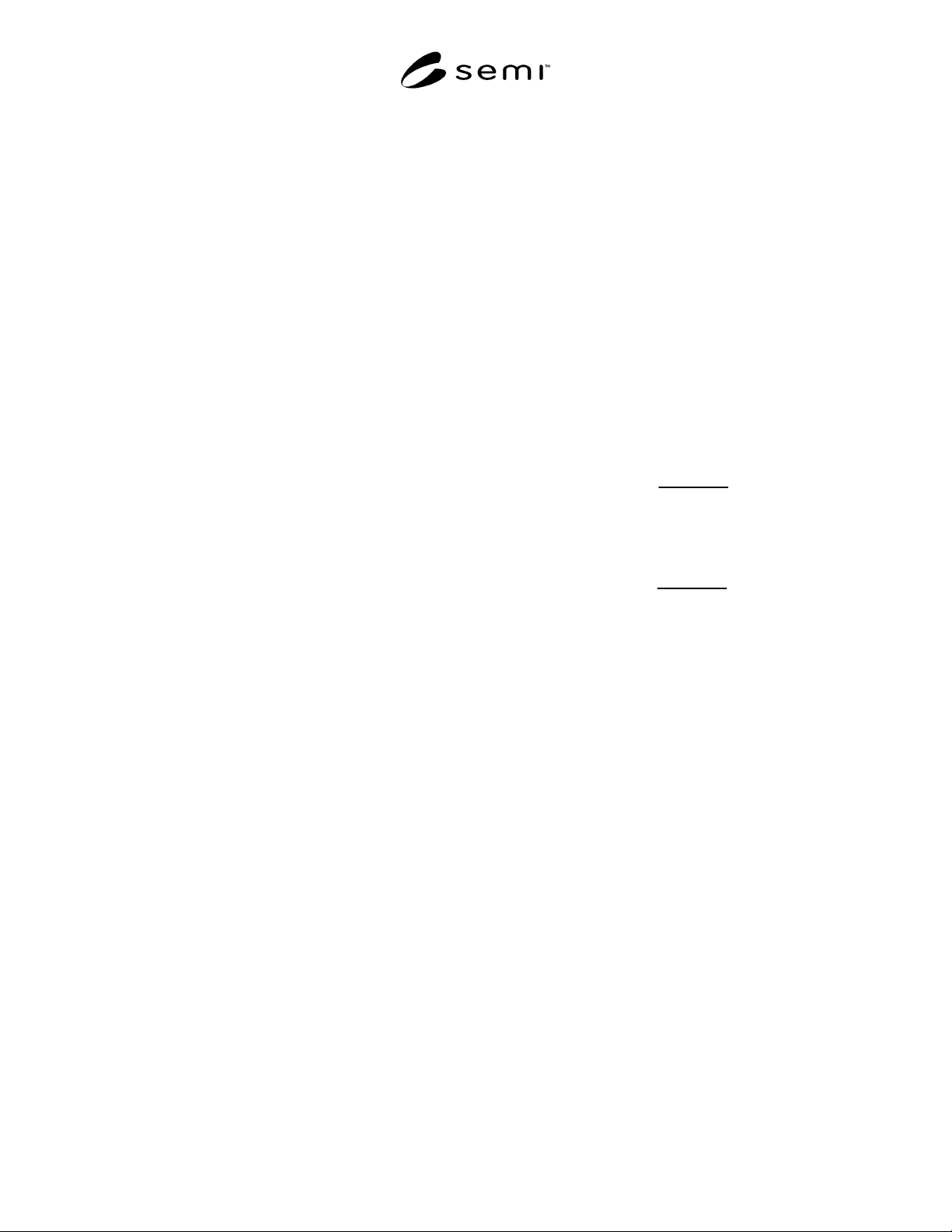
is a sum over the elements in the Category Table as
expressed in Equation 2 and defined in SEMI E35.
8.2 Each item in the classification system is defined, a
method for evaluating its expression given, and default
values or handling specified. All costs must be assigned
through the classification system and calculated per
system for the number of production hours.
CEOC
=
F
0j
j
∑
+
R
0k
k
∑
*
Volume
Required
# Systems
# Good Units
p
er year
=
F
ij
ij
∑
+
R
kl
kl
∑
*
Volume
Required
# Systems
# Good Units
p
er yea
r
(2)
NOTICE: These standards do not purport to address
safety issues, if any, associated with their use. It is the
responsibility of the user of these standards to establish
appropriate safety and health practices and determine
the applicability of regulatory limitations prior to use.
SEMI makes no warranties or representations as to the
suitability of the standards set forth herein for any
particular application. The determination of the
suitability of the standard is solely the responsibility of
the user. Users are cautioned to refer to manufacturer’s
instructions, product labels, product data sheets, and
other relevant literature respecting any materials
mentioned herein. These standards are subject to
change without notice.
The user’s attention is called to the possibility that
compliance with this standard may require use of
copyrighted material or of an invention covered by
patent rights. By publication of this standard, SEMI
takes no position respecting the validity of any patent
rights or copyrights asserted in connection with any
item mentioned in this standard. Users of this standard
are expressly advised that determination of any such
patent rights or copyrights, and the risk of infringement
of such rights, are entirely their own responsibility.
Copyright by SEMI® (Semiconductor Equipment and Materials
International), 3081 Zanker Road, San Jose, CA 95134. Reproduction o
f
the contents in whole or in part is forbidden without express written
consent of SEMI.