semi合集-English.pdf - 第1788页
SEMI E42-0704 © SEMI 1995, 2004 57 value greater than approval level . RecipeReadOnlyLevel . 16 (default entry to APPROVAL) Recipe is created. UNAPPROVED Reset ApprovalLevel . Newly created recip e is unapproved . 17 UNA…
SEMI E42-0704 © SEMI 1995, 2004 56
PROTECTION: the interaction of ApprovalLevel and the namespace attribute RecipeReadOnlyLevel,
LINKAGE: Linked
, and
CERTIFICATION: Certified
.
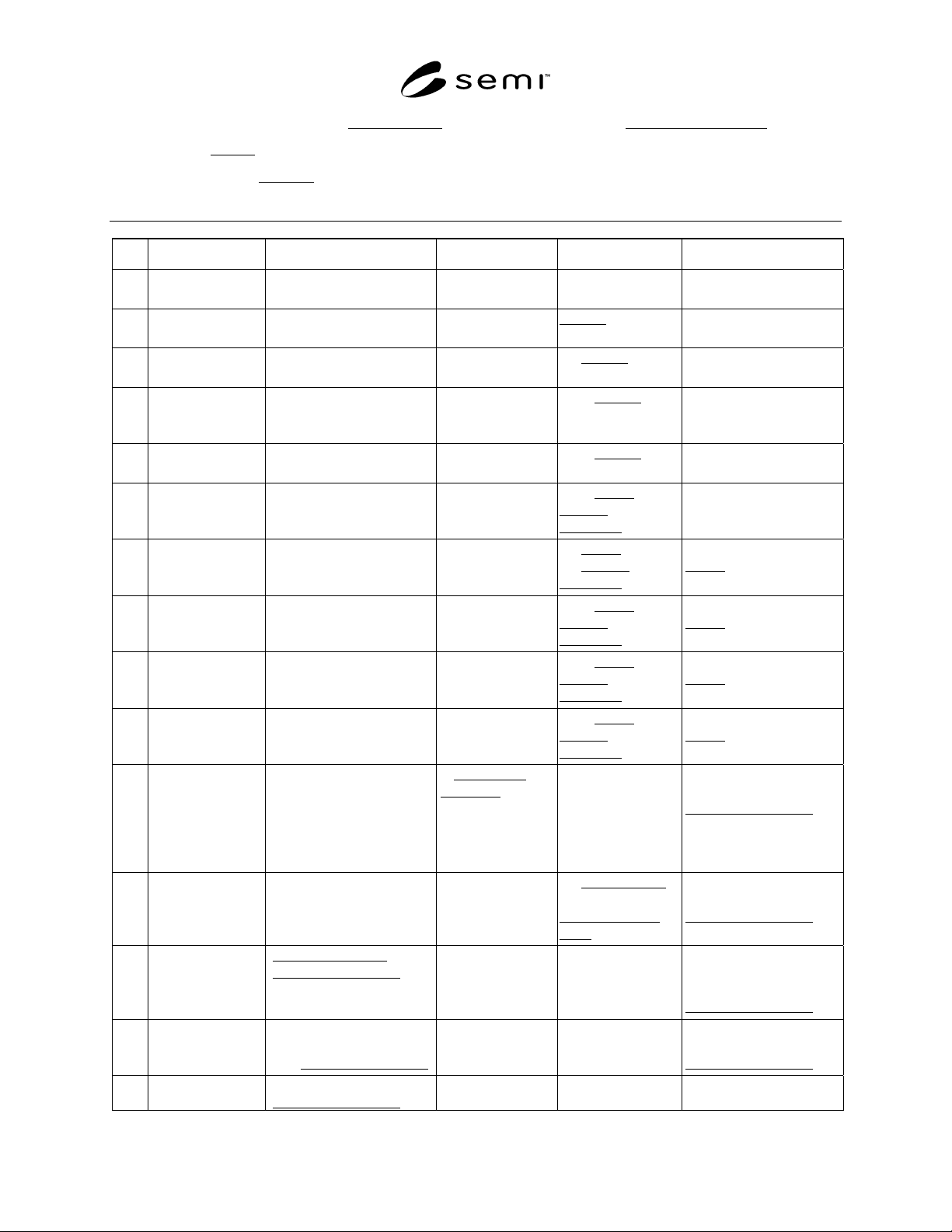
The table of transitions is given in Table 8.1.
Table 8.1 Table of Transitions
# Current State Trigger New State Action Comment
1 (entry to Recipe
Available)
Recipe is created. Recipe Available. Initialize generic
attributes.
None.
2 (default entry to
VERIFICATION)
Recipe is created. UNVERIFIED Verified reset. Newly created recipe is
unverified.
3 UNVERIFIED Requested verification
operation is successful.
VERIFIED Set Verified to
TRUE.
Verification is performed
by the recipe executor.
4 VERIFIED Requested verification
operation, on previously
verified recipe, fails.
UNVERIFIED Reset Verified. Verification is performed
by the recipe executor.
5 VERIFIED Recipe is updated. UNVERIFIED Reset Verified. Updated recipe must be re-
verified.
6 (default entry to
LINKAGE)
Recipe is created. UNLINKED Reset Linked,
LinkList
, and
LinkParam
.
Newly created recipe is
unlinked.
7 UNLINKED Authorized user requested
link operation is successful.
LINKED Set Linked to TRUE.
Set LinkList
and
LinkParam
.
Single-part recipes set
Linked
only.
8 LINKED Recipe is updated. UNLINKED Reset Linked,
LinkList
, and
LinkParam
.
Single-part recipes set
Linked
only.
9 LINKED Recipe is re-verified. UNLINKED Reset Linked,
LinkList
, and
LinkParam
.
Single-part recipes set
Linked
only.
10 LINKED Authorized user requests the
unlink operation.
UNLINKED Reset Linked,
LinkList
, and
LinkParam
.
Single-part recipes set
Linked
only.
11 (default entry to
PROTECTION)
Recipe is created. If RecipeRead-
OnlyLevel
is zero,
new state is
PROTECTED.
Otherwise, it is
UNPROTECTED.
None. All recipes are read only
when
RecipeReadOnlyLevel
is
zero.
12 UNPROTECTED Authorized user request to
protect the recipe.
PROTECTED Set ApprovalLevel to
the value in
RecipeReadOnly-
Level.
Recipe is protected when
approval level =
RecipeReadOnlyLevel
.
13 UNPROTECTED Authorized user sets
RecipeReadOnlyLevel to
value greater than or equal
to approval level.
PROTECTED None. Recipe is protected when
approval level greater than
or equal to
RecipeReadOnlyLevel
.
14 PROTECTED Authorized user sets
approval level to a value less
than RecipeReadOnlyLevel
.
UNPROTECTED None. Recipe is unprotected when
approval level less than
RecipeReadOnlyLevel.
15 PROTECTED Authorized user sets
RecipeReadOnlyLevel to a
UNPROTECTED None. Recipe is unprotected when
approval level less than
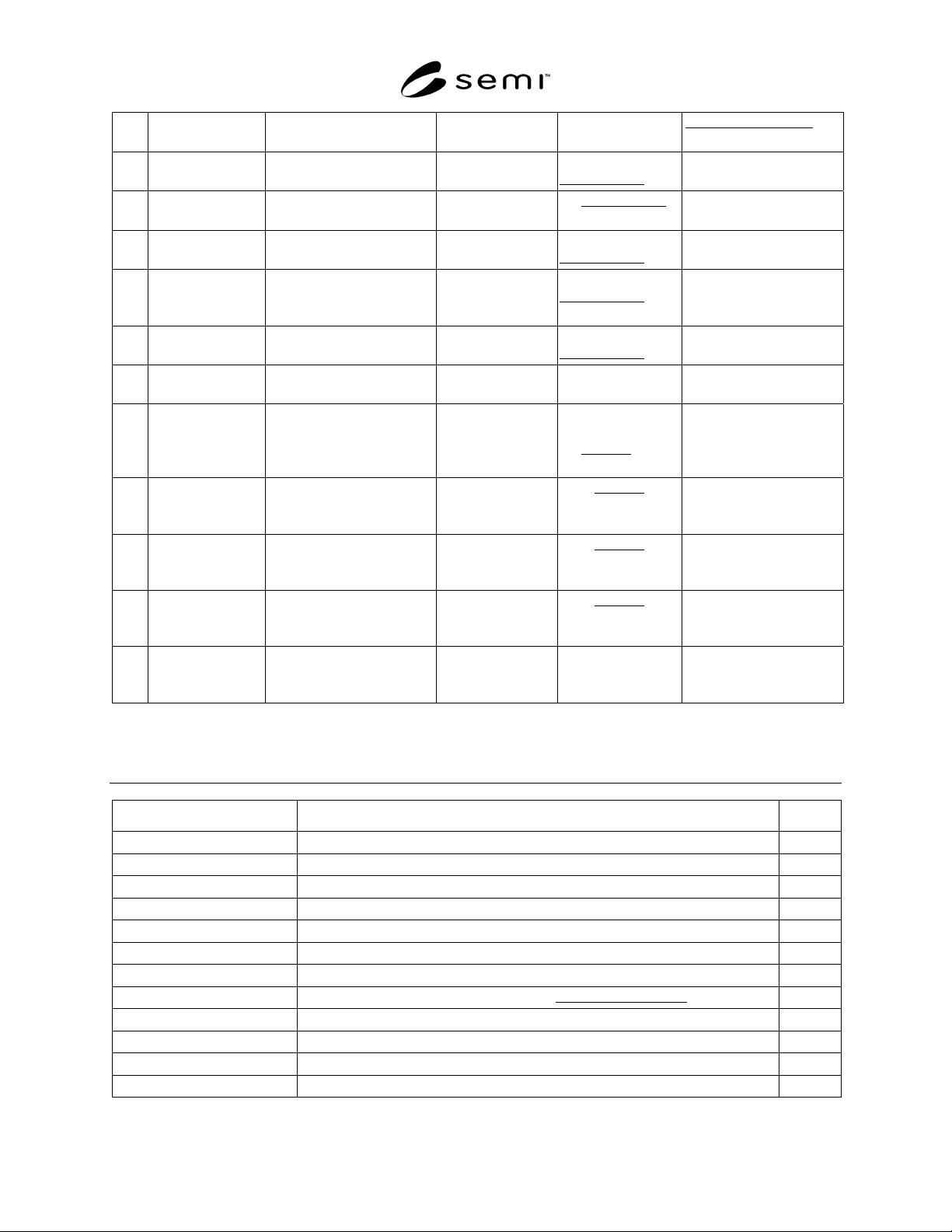
SEMI E42-0704 © SEMI 1995, 2004 57
value greater than approval
level.
RecipeReadOnlyLevel.
16 (default entry to
APPROVAL)
Recipe is created. UNAPPROVED Reset
ApprovalLevel
.
Newly created recipe is
unapproved.
17 UNAPPROVED Authorized user sets non-
zero approval level.
APPROVED Set ApprovalLevel as
specified by the user.
User assigns approval level
to a specific value.
18 APPROVED Authorized user sets
approval level to zero.
UNAPPROVED Reset
ApprovalLevel
.
User assigns a zero value as
approval level.
19 APPROVED Recipe is linked. UNAPPROVED Reset
ApprovalLevel
.
User is required to
specifically approve a
newly linked recipe set.
20 APPROVED Recipe is updated. UNAPPROVED Reset
ApprovalLevel
.
A modified recipe is
unapproved.
21 (default entry to
CERTIFICATION)
Recipe is created. UNCERTIFIED None. Newly created recipe has
no agent-specific attributes.
22 UNCERTIFIED Authorized user assigned
non-zero certification level.
CERTIFIED Create agent-
s
pecific
dataset if necessary.
Set Certified
to
specified value.
User assigns certification
level.
23 CERTIFIED Authorized user assigned
zero certification level.
UNCERTIFIED Reset Certified. Agent-specific dataset not
required if there are no
agent-specific attributes.
24 CERTIFIED Authorized user changes
agent-specific variable
parameter restrictions.
UNCERTIFIED Reset Certified. A change in restrictions
affects performance of
recipe.
25 CERTIFIED Recipe is unlinked. UNCERTIFIED Reset Certified
attribute.
Agent-specific dataset not
required if there are no
agent-specific attributes.
26 RECIPE
AVAILABLE
Authorized user deletes
unprotected recipe.
(Undefined recipe
no longer exists.)
Storage occupied by
recipe becomes
available.
None.
8.4 Table of Operations — Table 8.2 lists the recipe management operations in the order presented in this section.
The column labelled “Rqmt” is used to indicate those operations that are required for fundamental compliance to
RMS.
Table 8.2 Recipe Management Operations
Operation Description Rqmt
create recipe
*
A new recipe body is entered into the namespace. Y
update recipe
*
The body of an existing recipe is replaced. Y
verify recipe Check the syntax or format of a recipe body for correctness. Y
link recipe A main recipe is linked. Y
unlink recipe An unprotected linked recipe is unlinked. N
modify variable parameters A linked recipe's parameter definitions are modified within an agent-specific dataset.N
approve recipe Set the recipe's approval level to a non-zero value. N
protect recipe Set the recipe's approval level to the value in RecipeReadOnlyLevel. N
unprotect recipe Set the recipe's approval level to zero. N
certify recipe A linked recipe's certification level is set to a non-zero value. N
decertify recipe A linked recipe's certification level is set to zero. N
get recipe descriptor A recipe's descriptor is requested. Y
*This operation is also covered under Namespace Management Operations.

SEMI E42-0704 © SEMI 1995, 2004 58
9 Namespace Management Operations
Namespace management operations include
operations that affect the namespace itself in some way
and those operations that provide information about the
namespace or its manager, or that require knowledge
about more than one recipe.
Namespace operations defined in RMS are presented in
groups of similar functionality:
• operations on the namespace (create, delete, and
rename namespace),
• operations that provide information about the
namespace or its recipes (get available storage,
check recipe status, and get best version), and
• operations on recipes that affect the set of recipe
identifiers within the namespace and/or moving a
recipe as a whole (create, delete, store, retrieve,
copy, and rename recipe),
• operations that always require interactions with a
recipe executor (verify, download, and upload
recipe).
Namespace management operations may be invoked
through namespace services defined in Section 12. In
most cases, service scenarios consist of a single
message request from the service user and a
corresponding response from the namespace manager.
This case is illustrated in Section 12.1.
Scenarios are shown only for operations that require
additional messages. These operations are one of two
types: operations that may be performed on more than
one recipe (such as delete recipe) and operations that
require interactions with a recipe executor to complete.
Operations such as these may require more time to
complete. The initial response to the message service
request only indicates the intent to perform the
operation. The namespace manager informs the service
user of the completion of each individual operation by
sending the notification message RMNComplete. (See
Section 12.1 for more detail.)
9.1 Applications of Object Services — A manager shall
comply with SEMI E39 (Object Services Standard
(OSS): Concepts, Behavior, and Services)
specifications for fundamental requirements and with
the requirements for Filters and Owner Objects.
9.1.1 Object Specifiers — The “owns/owned by”
relationship is used by OSS to define the object
specifier used for scope. Recipes within a namespace
are owned by the namespace in which they reside. The
namespace in turn is owned by its manager. The agent
that provides the storage and services for a centralized
namespace owns both the manager and the namespace.
An object specifier has the form of:
“type
1
: id
1
>…type
n
: id
n
>”
where “type
i
” and “id
i
” represent the object type and
object identifier, respectively, of the ith object instance
in the sequence, and where each object is owned by the
preceding object in the sequence and is the owner of the
succeeding object.
A namespace specifier is an object specifier applied to
namespaces. A recipe specifier is an object specifier
applied to recipes.
Object types in the object specifier may be omitted
where they may be otherwise determined. For the
recipe specifier, when omitted, they are determined by
their relative positions, with the recipe identifier in the
final position, preceded by a namespace identifier.
Additional identifiers preceding that of the namespace
are those of agents.
An example of a namespace specifier for a namespace
“NS-MOM” owned by an agent “Etch01” would be
“Agent:Etch01>RNS:NS-MOM>” or (where object
types can be otherwise determined) “Etch01>NS-
MOM”. A recipe specifier for recipe “/PROCESS/
ABC;5” stored in NS-MOM would be “Agent:
Etch01>RNS:NS-MOM>/PROCESS/ABC;
5>”.
Where the manager is to be used instead of the
namespace, the object type of the manager must be
included.
A recipe in a namespace also owns its components. An
agent-specific attribute is accessed through the recipe
owner.
9.1.2 Required Object Services — A manager shall
support operations for Get Attributes and Set Attributes
for the attributes of the namespace, the recipes within
the namespace, and the manager itself. For a shared
namespace, access to different agent-specific datasets
shall be supported.
When a recipe’s attributes are changed through the Set
Attributes operation, the appropriate attribute timestamp
and length attributes shall be updated as well.
A manager shall support the Get Type and Get
Attribute Name operations for the object types of
namespace, recipe, recipe components, and manager.
9.2 Namespace Operations — This section describes
operations that are performed on a namespace.
9.2.1 Create Namespace — The create namespace
operation is used to define a namespace and assign a
name to be used as its identifier ObjID
. The name is
assigned only by an authorized user, except that a name