semi合集-English.pdf - 第7086页
SEMI S19-1102 © SEMI 2002 1 SEMI S19-1102 SAFETY GUIDELINE FOR TRAI NING OF SEMICONDUCTOR MANUFACTURING EQUIPMENT INST ALLATION, MAINTENANCE AND SERVICE PERSONNEL This safety guideline was technicall y approved by th e G…
SEMI S18-1102 © SEMI 2002 23
RELATED INFORMATION 3
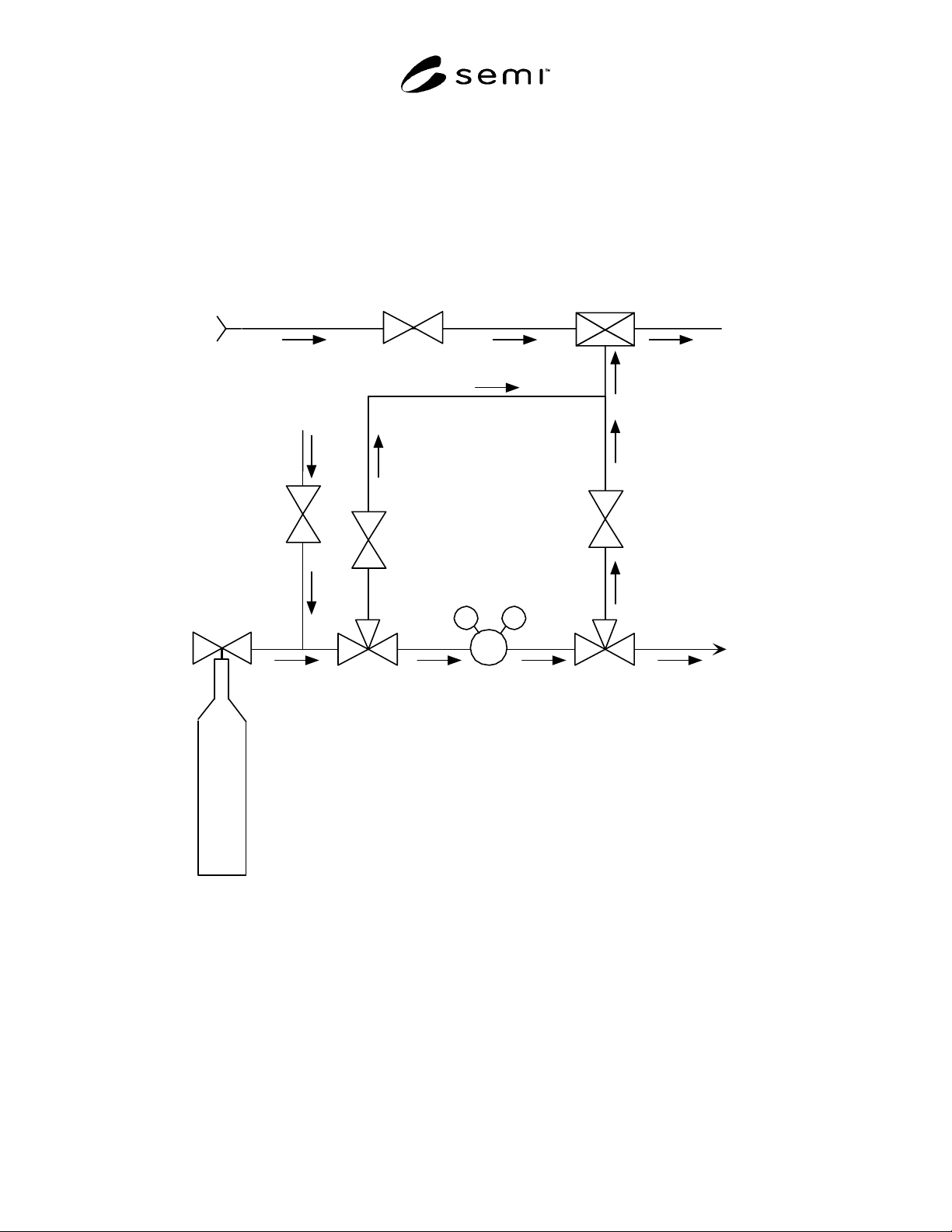
EXAMPLES OF SIMPLIFIED VALVE AND PIPING DIAGRAM FOR GAS
SUPPLY
NOTICE: This Related Information is not an official balloted part of SEMI S18. It is included to assist the user of
the document in understanding effective control systems. Publication is authorized by vote of the responsible
committee.
P
r
o
c
e
s
s
G
a
s
C
y
l
i
n
d
e
r
Vacuum
Generator
Supply
Vacuum
Generator
Valve
Vacuum
Generator
To Vent
Low Pressure
Vent Valve
To Process
Low Pressure
Gas Valve
2 Stage
Regulator
High Pressure
Gas Valve
P
r
o
c
e
s
s
G
a
s
C
y
l
i
n
d
e
r
Purge
Gas
Purge Gas
Valve
Automatic
Cylinder Valve
High Pressure
Vent Valve
Figure R3-1
Gas Supply System
NOTICE: SEMI makes no warranties or representations as to the suitability of the guideline set forth herein for any
particular application. The determination of the suitability of the guideline is solely the responsibility of the user.
Users are cautioned to refer to manufacturer’s instructions, product labels, product data sheets, and other relevant
literature respecting any materials mentioned herein. This guideline is subject to change without notice.
The user’s attention is called to the possibility that compliance with this guideline may require use of copyrighted
material or of an invention covered by patent rights. By publication of this guideline, SEMI takes no position
respecting the validity of any patent rights or copyrights asserted in connection with any item mentioned in this
guideline. Users of this guideline are expressly advised that determination of any such patent rights or copyrights,
and the risk of infringement of such rights, are entirely their own responsibility.
Copyright by SEMI® (Semiconductor Equipment and Materials
International), 3081 Zanker Road, San Jose, CA 95134. Reproduction o
f
the contents in whole or in part is forbidden without express written
consent of SEMI.

SEMI S19-1102 © SEMI 2002 1
SEMI S19-1102
SAFETY GUIDELINE FOR TRAINING OF SEMICONDUCTOR
MANUFACTURING EQUIPMENT INSTALLATION, MAINTENANCE AND
SERVICE PERSONNEL
This safety guideline was technically approved by the Global Environmental, Health, and Safety Committee
and is the direct responsibility of the North American Environmental, Health, and Safety Committee. Current
edition approved by the North American Regional Standards Committee on August 29, 2002. Initially
available at www.semi.org September 2002; to be published November 2002.
1 Purpose
1.1 Provide guidance to the employer for
environmental, health and safety proficiencies.
NOTE 1: The “employer” is determined by regulation or by
contact.
1.2 Establish specific learning objectives which, when
fulfilled, demonstrate a baseline level of environmental,
health and safety (EHS) proficiency.
1.3 Identify quality control, documentation and record
keeping criteria for the management of EHS training
programs.
2 Scope
2.1 This document applies to the EHS training of
personnel servicing, maintaining, installing or
otherwise providing semiconductor equipment support.
2.2 All elements of this guideline are necessary for
declaring conformance to the guideline.
2.3 This safety guideline does not purport to address all
of the safety issues associated with its use. It is the
responsibility of the users of this standard to establish
appropriate safety and health practices and determine
the applicability of regulatory limitations prior to use.
3 Limitations
3.1 This guideline is not intended to apply to trades
used in the facility construction and remodeling, or
provision of building or facility services to
semiconductor equipment.
3.2 The guideline provided herein is not intended to
represent an all inclusive or exhaustive identification of
the EHS training required for personnel within the
scope of this guideline.
3.3 Depending on the hazards, additional training or
certifications, specific to the task or the area hazards,
may be required.
4 Referenced Standards
4.1 ANSI Documents
1
ANSI Z490.1 — Criteria for Accepted Practices in
Safety, Health and Environmental Training
NOTE 2: As listed or revised, all documents cited shall be the
latest publications of adopted standards.
5 Terminology
5.1 Definitions
5.1.1 authorized employee(s) — persons trained and
proficient in performing a hazardous energy isolation
(lockout/tagout) procedure on an energy source
ensuring that the energy isolating device and the
equipment being controlled cannot be operated until the
locking device is removed.
5.1.2 instructor or facilitator — an individual with
appropriate technical expertise and experience,
authorized by the employer to deliver, or facilitate the
delivery of, a course module or set of modules and
capable of addressing student questions in a timely
manner.
5.1.3 learning objective — written statement of the
desired knowledge, skill, or ability to be demonstrated.
5.1.4 qualified employee(s) — persons trained and
proficient in the equipment and operation to be
performed, including recognition of the hazards and
necessary protective measures.
5.1.5 training — an activity which assists an individual
in fulfilling the learning objectives.
6 Core Curriculum
6.1 The employer is responsible for ensuring that the
employee’s EHS training is based on a needs
assessment or the results of hazards analyses. The
subject matter in this section is considered the
minimum basic curriculum for training personnel
within the limitations of this guideline.
1 American National Standards Institute, New York Office: 11 West
42nd Street, New York, NY 10036, USA. Telephone: 212.642.4900;
Fax: 212.398.0023 Website: www.ansi.org

SEMI S19-1102 © SEMI 2002 2
6.2 Housekeeping — General principles and concepts
of hazard recognition and various techniques,
procedures or practices for reducing or eliminating risks
such as:
• Appropriate use of passageways, storerooms, and
service rooms,
• Maintaining walking and working surfaces in a
safe, clean, orderly and sanitary condition, and
• Establishing and maintaining aisle width and
means of egress.
6.3 Ergonomics — General principles and concepts of
Ergonomic and Musculoskeletal Disorders (MSD) as
they relate to service activities, with special emphasis
in the following areas:
• Repetitive motion injuries,
• Video display terminal usage,
• Material handling techniques,
• Recognition of MSD signs and symptoms,
• How to report MSD signs and symptoms and the
importance of early reporting,
• Personal MSD risk factors including factors that
contribute to MSD of the upper extremities, and
back,
• MSD hazards in their jobs and measures for
protection against MSD hazards,
• Proper selection and use of tools and equipment,
and
• Job-specific controls implemented.
6.4 Hand and Portable Power Tools
• Recognition of the hazards associated with the use
of hand and portable power tools, and
• Requirements for tool–specific training in the safe
use of the tools to be used.
6.5 Material Handling Equipment
• Recognition of the hazards associated with
operating or working around material handling
equipment and mechanical lifting devices such as
hoists, pallet jacks, forklifts, and overhead cranes,
and
• Restrictions, including additional training and
certification requirements, associated with their
operation.
6.6 Robotics
• Recognition of the hazards associated with
working near robots and associated components,
• Restrictions and requirements for robot service or
repair, including additional training and
certification of service personnel,
• An understanding of the operating envelope and
the risks associated with entry, and
• Review of appropriate safe work practices.
6.7 Confined Space
• Ability to recognize a confined space,
• Recognition of the hazards associated with
confined spaces, and
• Requirements and restrictions for confined space
entry including sampling or additional training and
certification of service personnel.
6.8 Elevated Work
6.8.1 Fall Protection
• Recognition of the hazards, both to the worker and
other personnel, when performing work in an
elevated position, and
• Identification of when additional fall protection
measures including training are required.
6.8.2 Portable Ladders
• Recognition of the hazards associated with the use
of portable ladders, and
• Proper selection, inspection, set–up and use of
portable ladders and working platforms in the work
area.
6.9 Walking and Working Surfaces — General
principles and concepts of hazard recognition and
various techniques, procedures or practices for reducing
or eliminating risks involving:
• Walking and working surfaces, gratings, raised
platforms, floor and wall openings,
• Guarding floor and wall openings and holes using
covers, guardrails and warning barriers,
• Floor loading and protection, and
• Protection of open-sided floors, platforms,
runways, and stairway railings and guards.