semi合集-English.pdf - 第2252页
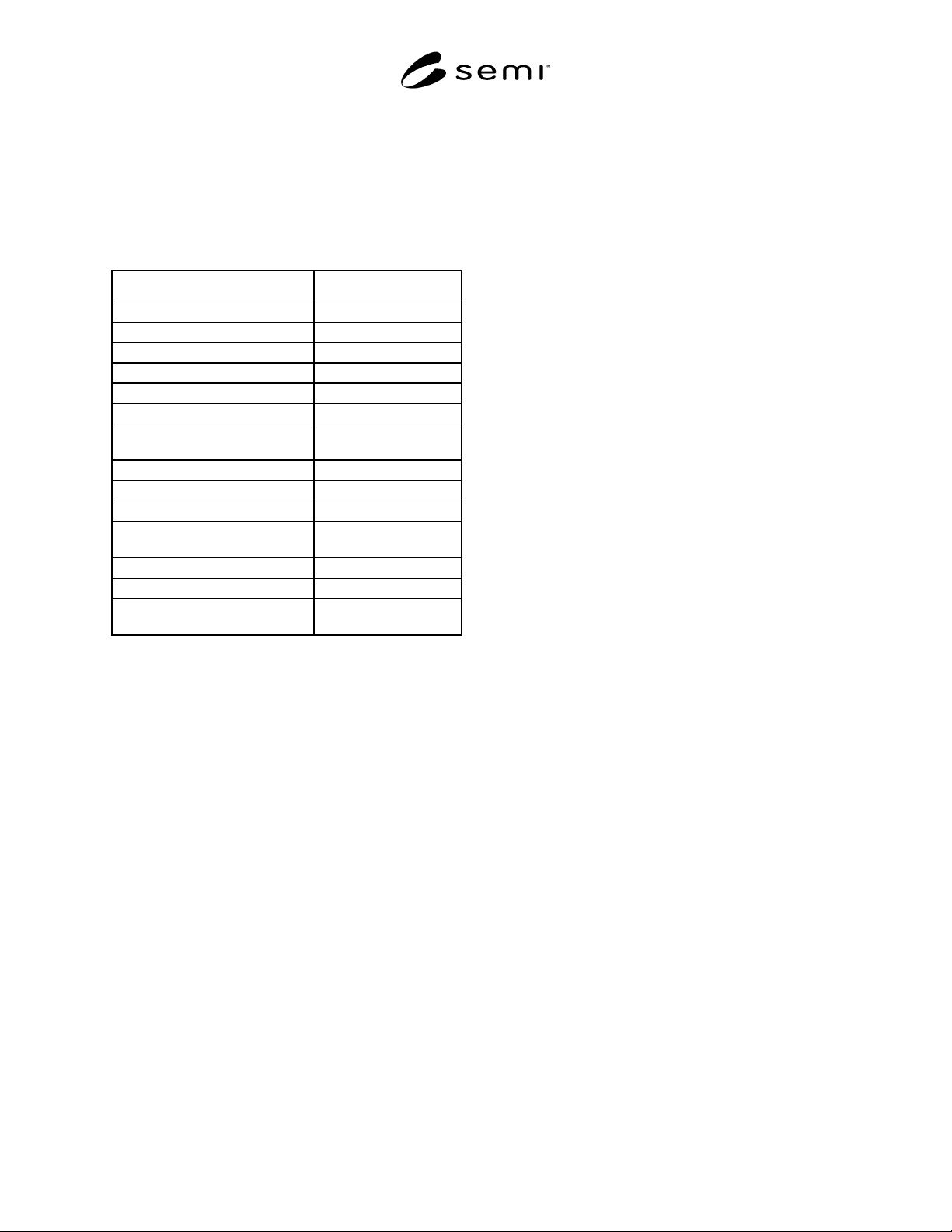
SEMI E58-0703 © SEMI 1997, 2003 33 Table 15 Table 15 Section References for A dditional ARAMS Capabilit ies Capability Section Reference User-Configurable Powerup State ARAMS 11.4.4, 16.3.2 User-Configurable Fault Recov …
SEMI E58-0703 © SEMI 1997, 2003
32
4.1.32.4 Table 14 lists the requirements for
fundamental compliance to ARAMS and the section
references to ARAMS or (where applicable) the
standards where these capabilities are defined. These
requirements shall all be satisfied for equipment to be
termed ARAMS-compliant.
Table 14 Table 14 Fundamental ARAMS
Requirements
Requirement Reference
Event Notification GEM 4.2.1.1 or ERS
Clock Services GEM 4.10 or CTMC 8.7
Read-Only Data Access GEM 4.2.2 or OSS 12.1
User-Configurable Data Access GEM 4.5 or OSS 12.1
Alarm/Exception Management GEM 4.3 or EMS
ARAMS State Model ARAMS 8.3
ARAMS State
TransitionNotification
ARAMS 12, 16.1
ARAMS Substate Codes ARAMS 9
ARAMS Status Data ARAMS 11.2
ARAMS Constant Data ARAMS 11.3, 11.4
ARAMS Event Report Data ARAMS 12, GEM
4.2.1.1, GEM 4.2.1.2.
Host State Change Request ARAMS 15.1, 15.2, 15.5
Estimation of Powerdown Time ARAMS 16.2
ARAMS Behavioral Requirements ARAMS 16 (all except
16.3.2, 16.7.4, 16.8.2)
4.2 Additional Capabilities — The following
capabilities are not required for fundamental
compliance to ARAMS. They are recommended for
equipment that provide a local operator interface and
are not expected from equipment such as individual
process modules of a cluster tool.
14.1.15 User-Configurable Powerup State —
Provision of the user-programmable variable
PowerupState, which allows the user to select either
STANDBY or UNSCHEDULED DOWNTIME as the
powerup state following powerdowns that occurred
during STANDBY. (See Section 16.3.2.)
14.1.16 User-Configurable Fault Recovery to
Manufacturing — Provision of user-programmable
variables, PrdRecovery and SbyRecovery, that allows
the user to enable or disable automatic equipment-
initiated recovery from faults that clear without user
intervention. (See Section 16.7.4.)
14.1.17 Accumulator Data — Support for the variables
defined in Section 11.5, together with access to this
data by the operator (Section 14.1) and the host, with
support for the ResetAccumulators service. (See
Sections 11.5 and 15.6.)
14.1.18 User-Generated ARAMS Substate Table(s) —
The ability to accept one or more sets of user-generated
ARAMS Substate Codes, as defined in ARAMS
Substate Tables, that may be selected by the user in a
request to change to a new state or substate. This
includes support of the TableSend and TableRequest
services and methods for operator access. (See Sections
10.3, 14.2, and 15.3.)
14.1.19 Equipment-Generated ARAMS Substate
Table(s) — Provision of a set of equipment-defined
ARAMS Substate Codes that can be selected by the
user in a request to change to a new ARAMS state or
substate. This includes support of the TableRequest
service. (See Sections 10.3 and 15.4.)
14.1.20 User-Generated Symptom Table(s) — The
ability to accept one or more user-defined ARAMS
Symptom Table, allows the operator to select a
symptom when requesting a transition to a new
ARAMS state, and the associated data. This includes
support for the TableRequest service and methods for
operator access. (See Sections 10.4, 14.3, and 15.3.)
14.1.21 Human Interface Requirements — Operator
access to ARAMS tables as defined in Sections 14.2
through 14.4. Where color is used, conformance to
color code in Section 14.5.
14.1.22 Equipment-Selected Substates — Support for
the user-configurable variable SubstateSelect (Section
11.4.5) allowing the user to enable and disable the
capability to select substates of PRODUCTIVE and
STANDBY. Documentation of the prioritization of
substate selection. (See Section 16.6).
14.1.23 User-Configurable Fault Detection in
ENGINEERING — Support for Transitions 12 and 13
(Section 16.7.4) and the user-configurable variable
EngInterrupt (Section 11.4.1) allowing the user to
enable and disable Transitions 12 and 13.
14.1.24 User-Configurable Fault Recovery to
ENGINEERING — Support for automatic recovery
(Transition 13, Sections 16.8.1 and 16.8.2) and the
user-configurable variable EngRecovery (Section
11.4.2) allowing the user to enable and disable
automatic recovery in Transition 13.
4.2.1.1 Table 15 provides the section references for
additional ARAMS capabilities.
SEMI E58-0703 © SEMI 1997, 2003 33
Table 15 Table 15 Section References for Additional ARAMS Capabilities
Capability Section Reference
User-Configurable Powerup State ARAMS 11.4.4, 16.3.2
User-Configurable Fault Recovery ARAMS 11.4.2, 11.4.5, 11.4.6, 16.8.2
Accumulator Data ARAMS 11.5, 15.5
User-Generated ARAMS Substate Table(s) ARAMS 10.1, 10.2, 10.3, 14.3, 15.3
Equipment-Generated ARAMS Substate Table(s) ARAMS 10.1, 10.2, 10.3, 15.4
User-Generated ARAMS Symptom Table(s) ARAMS 10.1, 10.2, 10.4, 14.3, 14.4, 15.3
Human Interface Requirements ARAMS 14.2, 14.3, 14.4, 14.5
Equipment-Selected Substates ARAMS 11.4.7, 16.6
User-Configurable Fault Detection in ENGINEERING ARAMS 11.4.1, 16.7, 16.7.4
User-Configurable Fault Recovery to ENGINEERING ARAMS 11.4.2, 16.8
Human Interface Requirements ARAMS 14, 14.1, 14.2.
14.1.25 Human Interface Requirements — Operator access to ARAMS data and state change, defined in Sections
14, 14.1, and 14.2.
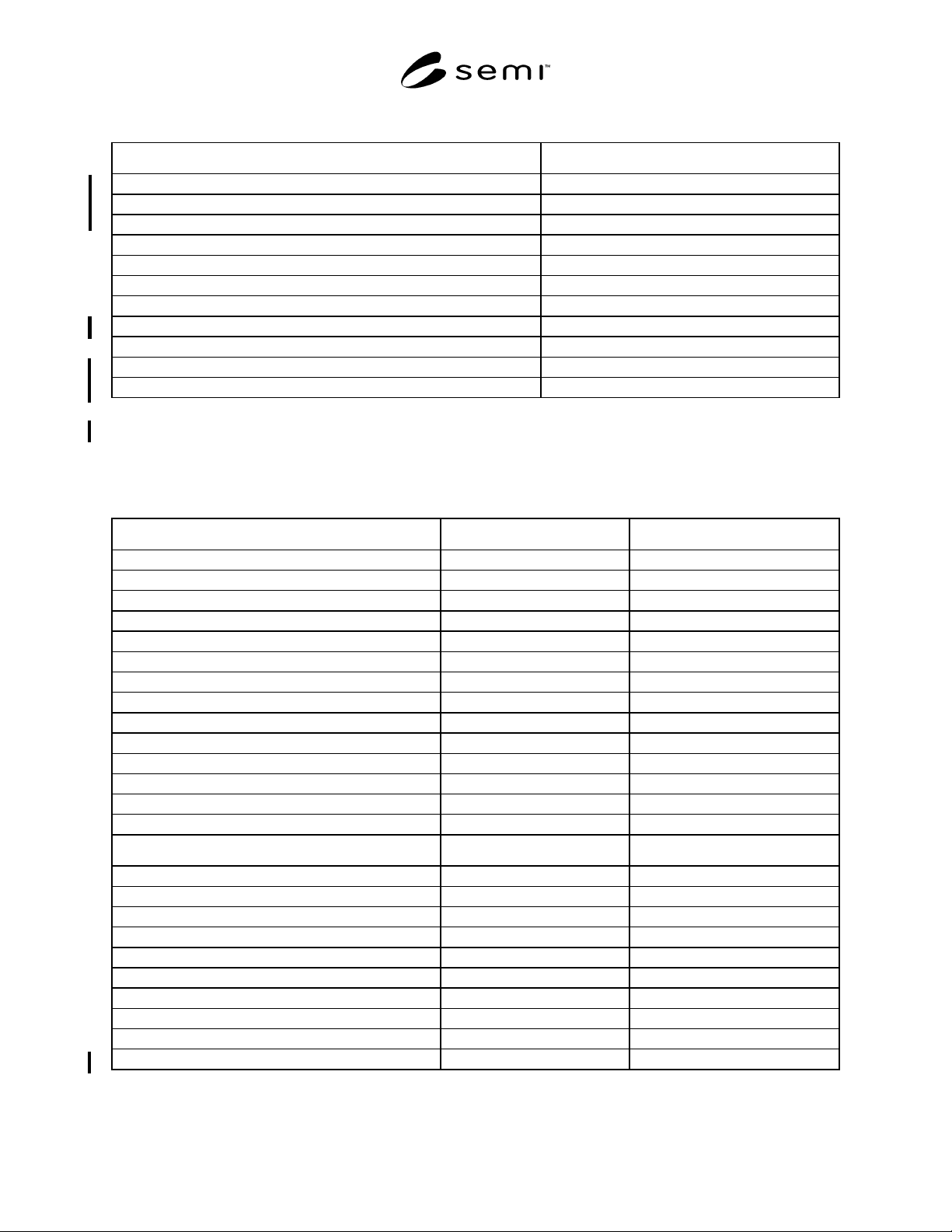
14.2 Requirements for Compliance — Table 16 provides a checklist for ARAMS compliance.
Table 16 Table 16 ARAMS Compliance Statement
Fundamental ARAMS Requirements Implemented ARAMS Compliant (See NOTE 1.)
Event Notification ❏ Yes ❏ No ❏ Yes ❏ No
Clock Services ❏ Yes ❏ No ❏ Yes ❏ No
Read-Only Data Access ❏ Yes ❏ No ❏ Yes ❏ No
User-Configurable Data Access ❏ Yes ❏ No ❏ Yes ❏ No
Alarm/Exception Management ❏ Yes ❏ No ❏ Yes ❏ No
ARAMS State Model ❏ Yes ❏ No ❏ Yes ❏ No
ARAMS State Transition Notification ❏ Yes ❏ No ❏ Yes ❏ No
ARAMS Substate Codes ❏ Yes ❏ No ❏ Yes ❏ No
ARAMS Status Data ❏ Yes ❏ No ❏ Yes ❏ No
ARAMS Constant Data ❏ Yes ❏ No ❏ Yes ❏ No
ARAMS Event Report Data ❏ Yes ❏ No ❏ Yes ❏ No
Host State Change Request ❏ Yes ❏ No ❏ Yes ❏ No
Estimation of Powerdown Time ❏ Yes ❏ No ❏ Yes ❏ No
ARAMS Behavioral Requirements ❏ Yes ❏ No ❏ Yes ❏ No
Additional Capabilities Implemented ARAMS Compliant (See NOTE 2.)
User-Configurable Powerup State ❏ Yes ❏ No ❏ Yes ❏ No
User-Configurable Fault Recovery to Manufacturing ❏ Yes ❏ No ❏ Yes ❏ No
Accumulator Data ❏ Yes ❏ No ❏ Yes ❏ No
User-Generated ARAMS Substate Table(s) ❏ Yes ❏ No ❏ Yes ❏ No
Equipment-Generated ARAMS Substate Table(s) ❏ Yes ❏ No ❏ Yes ❏ No
User-Generated ARAMS Symptom Table(s) ❏ Yes ❏ No ❏ Yes ❏ No
Equipment-Selected Substates ❏ Yes ❏ No ❏ Yes ❏ No
User-Configurable Fault Detection in ENGINEERING ❏ Yes ❏ No ❏ Yes ❏ No
User-Configurable Fault Recovery to ENGINEERING ❏ Yes ❏ No ❏ Yes ❏ No
Human Interface Requirements ❏ Yes ❏ No ❏ Yes ❏ No
NOTE 1: Do not mark YES unless all fundamental ARAMS requirements are implemented.
NOTE 2: Additional capabilities may not be marked ARAMS-compliant unless all fundamental ARAMS requirements are implemented.

SEMI E58-0703 © SEMI 1997, 2003
34
15 ARAMS States for Multi-Module Equipment
4.3 The preceding sections define how ARAMS is to
be supported by simple equipment. Simple equipment
includes equipment with at most one process chamber,
and a single process capability, where individual
modules are not treated separately from the equipment.
NOTE 22: Process capability, in this context, refers to the
factory’s manufacturing process. Equipment with more than
one process capability may be used in different ways at
different steps, typically through different process recipes.
Such equipment may be “available” for one process but not
for another. This type of complexity is neither addressed nor
affected by SEMI E10 or by ARAMS.
4.4 This section addresses the application of ARAMS
to complex equipment, including modular equipment
where individual modules may be in different ARAMS
states/substates. Complex equipment includes cluster
tools and any other type of equipment that is organized
into separate subsystems that can be addressed
individually. In this case, it is advantageous for each
module or subsystem to be given its own ARAMS state
model. In addition, the overall equipment system itself
has an ARAMS state model. This situation is illustrated
in Figure 6.
4.5 The complexities of possible interactions between
ARAMS states of the individual modules and the
ARAMS state of the cluster tool as a whole are beyond
the scope of this document. The following approach is
recommended:
• Each module complies to fundamental
requirements for the ARAMS state model, data
variables, and message services.
• The integrated cluster tool complies to
requirements for the ARAMS state model, data
variables, and message services.
• The set of all the ARAMS models above are
simultaneously active, as represented in Figure 6.
• The relationships between the ARAMS state for
the cluster tool and the ARAMS states for the
individual modules are user-configurable wherever
possible. (Certain relationships between the cluster
and critical modules, such as central wafer handler
or central load lock, may not be configurable: e.g.,
if the critical module is down, the cluster is down.)