semi合集-English.pdf - 第6701页
PHOSPHORIC ETCHANTS SEM I C37-0699 © SEMI 1981, 1999 1 SEMI C37-0699 SPECIFICA TION FOR PHOSPHORIC ETCHA NTS This spe cifica tion was te chnically approve d by the G lobal Process Che micals Com mittee and is the dire ct…
SEMI C36-0705 © SEMI 1981, 2005 8
Previous SEMI Reference # C1.13-96, C1.27-96 C7.24-0697
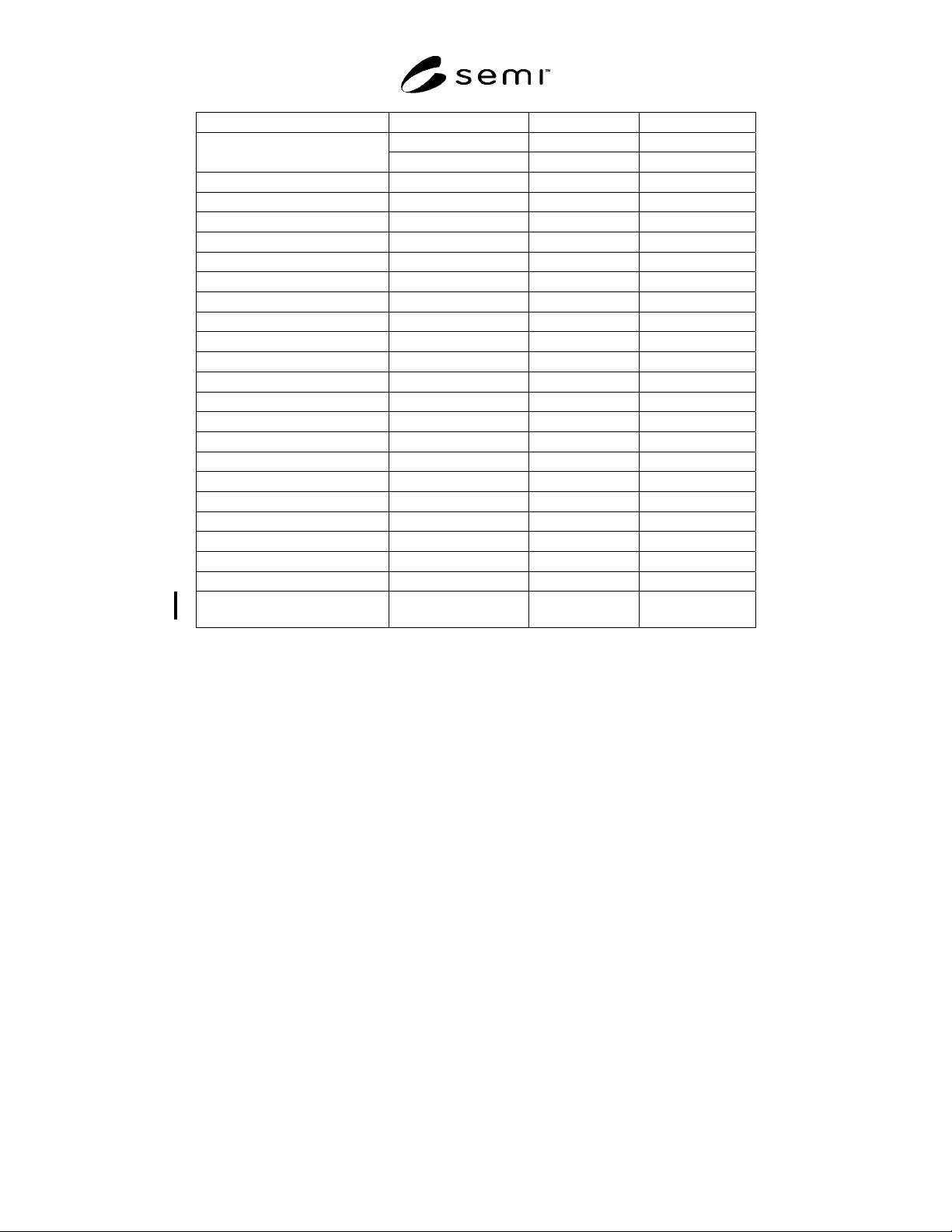
Grade 1 Grade 2 Grade 3
(Specification) (Specification) (Specification)
Arsenic (As) 0.05 ppm max 50 ppb max 50 ppb max
Barium (Ba) -- -- 50 ppb max
Boron (B) -- -- 50 ppb max
Cadmium (Cd) -- 450 ppb max 50 ppb max
Calcium (Ca) 1.5 ppm max 1100 ppb max 150 ppb max
Chromium (Cr) 0.2 ppm max 200 ppb max 50 ppb max
Cobalt (Co) 0.05 ppm max 50 ppb max 50 ppb max
Copper (Cu) 0.05 ppm max 50 ppb max 50 ppb max
Gold (Au) 0.3 ppm max 150 ppb max 50 ppb max
Iron (Fe) 2.0 ppm max 700 ppb max 100 ppb max
Lead (Pb) 0.3 ppm max 300 ppb max 50 ppb max
Lithium (Li) 0.1 ppm max 100 ppb max 10 ppb max
Magnesium (Mg) 0.2 ppm max 200 ppb max 50 ppb max
Manganese (Mn) 0.1 ppm max 100 ppb max 50 ppb max
Nickel (Ni) 0.2 ppm max 200 ppb max 50 ppb max
Potassium (K) 1.5 ppm max 450 ppb max 150 ppb max
Silicon (Si) -- -- 50 ppb max
Sodium (Na) 2.5 ppm max 500 ppb max 250 ppb max
Strontium (Sr) 0.1 ppm max 100 ppb max 10 ppb max
Titanium (Ti) 0.3 ppm max 300 ppb max 50 ppb max
Zinc (Zn) 2.0 ppm max 400 ppb max 50 ppb max
Particles in bottles:
size, #/mL
(See
#1
) (See
#1
) (See
#1
)
#1
Due to the limitations of current particle counters, particle size and number areto be agreed upon between supplier and user.
See SEMI C1, ‘Calibration and Measurement Method for Particles in Liquids’.
NOTICE: SEMI makes no warranties or representations as to the suitability of the standards set forth herein for any
particular application. The determination of the suitability of the standard is solely the responsibility of the user.
Users are cautioned to refer to manufacturer's instructions, product labels, product data sheets, and other relevant
literature, respecting any materials or equipment mentioned herein. These standards are subject to change without
notice.
By publication of this standard, Semiconductor Equipment and Materials International (SEMI) takes no position
respecting the validity of any patent rights or copyrights asserted in connection with any items mentioned in this
standard. Users of this standard are expressly advised that determination of any such patent rights or copyrights, and
the risk of infringement of such rights are entirely their own responsibility.
Copyright by SEMI® (Semiconductor Equipment and Materials
International), 3081 Zanker Road, San Jose, CA 95134. Reproduction of
the contents in whole or in part is forbidden without express written
consent of SEMI.
PHOSPHORIC ETCHANTS SEMI C37-0699 © SEMI 1981, 19991
SEMI C37-0699
SPECIFICATION FOR PHOSPHORIC ETCHANTS
This specification was technically approved by the Global Process Chemicals Committee and is the direct
responsibility of the North American Process Chemicals Committee. Current edition approved by the North
American Regional Standards Committee on April 23, 1999. Initially available on SEMI OnLine May 1999;
to be published June 1999. This document replaces SEMI C2.3 in its entirety. Originally published in 1981.
1 Purpose
1.1 The purpose of this document is to standardize
requirements for phosphoric etchants used in the
semiconductor industry and testing procedures to
support those standards. Test methods have been shown
to give statistically valid results. This document also
provides guidelines for grades of phosphoric etchants
for which a need has been identified. In the case of the
guidelines, the test methods may not have been
statistically validated yet.
2 Scope
2.1 The scope of this document is all grades of
phosphoric etchants used in the semiconductor industry.
3 Limitations
3.1 None.
4 Referenced Documents
SEMI C1 — Specifications for Reagents
SEMI C2 — Specifications for Etchants
5 Terminology
5.1 phosphoric etchant — any combination of phos-
phoric, nitric, and acetic acids with the relative compo-
sition expressed in terms of 85% phosphoric acid, 70%
nitric acid, and glacial acetic acid, respectively. In the
expression, all the relative volumes shall be reduced to
a ratio of the smallest whole numbers. For example, a
16:1:2 phosphoric etchant would imply a mixture of 16
volumes of 85% phosphoric acid, 1 volume of 70%
nitric acid, and 2 volumes of glacial acetic acid. If a
component is absent, its relative volume shall be taken
as zero. For example, a 16:1:0 phosphoric etchant
implies that no acetic acid is present.
6 Composition
6.1 The content of each of the components of a
phosphoric etchant shall be expressed on a weight/
weight basis of the 100 percent acid in the total mix-
ture. For the volume-to-weight conversion, the densities
shall be taken as 1.695, 1.415, and 1.050 g/mL for 85%
phosphoric acid, 70% nitric acid, and glacial acetic
acid, respectively.
7 Tolerances
7.1 The tolerances allowed for the absolute percentage
of each of the components of a phosphoric etchant shall
be:
Phosphoric Acid: ± 1.0% (± 0.20 meq/g)
Nitric Acid: ± 0.5% (± 0.08 meq/g)
Acetic Acid: ± 0.5% (± 0.08 meq/g)
8 Requirements
8.1 The requirements for phosphoric etchants for
Grade 1 are listed in Table 1.
9 Grade 1 Procedures
9.1 Total Acidity — Weigh accurately 2.5 to 3.0 g of
sample in a tared weighing bottle. Transfer with water
to a 25 mL beaker and dilute to approximately 100 mL.
Add 10 drops of thymolphthalein indicator solution and
titrate with standardized 1 N sodium hydroxide solution
to the blue endpoint. Calculate the total acidity (A):
Total Acidit
y
meq
g
()=
mL
×
N
of NaOH
Weight of sample g
()
=
A
9.2 Phosphoric Acid — Weigh accurately 2.5 to 3.0 g
of sample in a tared weighing bottle. Quantitatively
transfer the sample with 40 to 60 mL of water into a
platinum or polyfluorocarbon dish. Evaporate the
solution on a steam bath in a hood (1 to 2 hours). Rinse
down the inner sides of the dish with 10 to 15 mL of
water and re-evaporate for 1 hour. Cool and dilute with
50 mL of water. Add 10 drops of thymolphthalein
indicator solution and titrate with standardized 1 N
sodium hydroxide solution to the blue endpoint.
% Phosphoric Acid
=
mL
×
N
of NaOH
×
4.900
Weight of sample g
()
9.3 Nitric Acid — Weigh accurately a sample
containing 0.9 to 1.1 g of nitric acid in a tared 100 mL
volumetric flask. Dilute to volume with water and mix
thoroughly. Following the manufacturer's directions,
ready a spectrophotometer and set the wavelengh to 302
nm. Transfer the sample solution to a 1 cm fused silica
cell and measure the absorbance versus water. Read
from a previously established calibration curve the
grams of nitric acid present in the sample solulion (see

SEMI C37-0699 © SEMI 1981, 1999 PHOSPHORIC ETCHANTS2
SEMI C2, Section 3.2, Determination of Nitric Acid by
Ultraviolet Absorption Spectrophotometry).
%
Nitric Aci
d
=
grams of HNO
3
calibration curve
×
100
Weight of sample g
()
9.4 Acetic Acid — The acetic acid content is calcu-
lated by deducting the acidity found for each of the
other components from the value for the total acidity.
% Acetic Acid
=
A
−
%H
3
PO
4
4.900
−
%HNO
3
6.302
[
]
×
6.005
9.5 Heavy Metals (as Pb) — Dilute 6 g of sample to
30 mL with water. For the standard, add 0.02 mg of
lead ion (Pb) to a 5 mL aliquot of this solution and
dilute to 25 mL with water. For the sample, use the
remaining 25 mL portion. Adjust the pH to between 3
and 4 (using a pH meter) with 1 N acetic acid or dilute
ammonium hydroxide (10% NH
3
), dilute to 40 mL with
water, and mix. Add 10 mL of freshly prepared hydro-
gen sulfide water to each and mix. Any color in the
solution of the sample should not exceed that in the
standard.
9.6 Antimony — Dilute 20 mL (20 g) of stock solution
to volume with water in a 100 mL volumetric flask and
mix. For the standard, dilute 0.4 mg of antimony ion
(Sb) to volume with water in a second 100 mL
volumetric flask and mix. Following the manufacturer's
directions, ready an atomic absorption spectrometer,
use an air-acetylene flame, position the antimony
hollow cathode lamp, and set the monochromator to the
antimony resonance line of 217.6 nm. Employ
deuterium lamp correction. Aspirate water and set to
zero absorbance. Then aspirate, in succession, the
standard, water, and sample. The absorbance of the
sample should not exceed that of the standard. (see
SEMI C1, Section 3.6, Guidelines for Determination of
Trace Elements by Atomic Absorption Spectrometry.)
9.6.1 Stock Solution for Sections 9.6 through 9.9 —
To 200 g of sample in a 400 mL beaker, add 100 mL of
water. Heat to boiling on a hot plate in a hood, and boil
off approximately 100 mL. Cool slightly, add 100 mL
of water, and again boil off about 100 mL. Cool,
transfer to a 200 mL volumetric flask, and dilute to
volume with water. One mL contains 1 gram of sample.
9.7 Arsenic — To 10 mL (10 g) of stock solution in a
125 mL arsine generator flask, add 30 mL of water 10
mL of ferric ammonium sulfate reagent solution, and
then 2% potassium permanganate reagent solution
dropwise to a permanent pink color. Add 1.5 g of
sodium chloride and mix to dissolve. Heat nearly to
boiling, remove from heat, and add 1 mL of stannous
chloride reagent solution. Dilute to 60 mL and cool to
25°C ± 3°C. For the standard, add 20 mL of dilute
sulfuric acid (1 + 4) to 0.005 mg of arsenic ion (As) in a
second arsine generator flask and treat as above.
Assemble the arsenic test apparatus (see SEMI C1,
Section 3.4.2). Pack each scrubber tube with two
pledgets of lead acetate-impregnated glass wool
previously moistened with lead acetate solution, freed
from excess solution by squeezing, and dried in a
vacuum. Allow a small space between the two pledgets.
Place 3.0 mL of silver diethyldithiocarbamate solution
in each absorber tube and 10 g of zinc (granular) in
each generator flask. Immediately connect the scrubber
absorber assemblies to the sample and standard
generator flasks. Place the flasks in a water bath
maintained at 25°C ± 3°C. Swirl each flask
occasionally. After 30 minutes disconnect the tubing
from the generator flasks and transfer the silver
diethyldithiocarbamate solutions to separate 1 cm
photometer cells. Measure both sample and standard
absorbances at 540 nm using the silver diethyldithio-
carbamate solution as a blank. The absorbance of the
sample should not exceed that of the standard.
9.8 Manganese — Add 25 mL (25 g) of stock solution
to 100 mL of dilute sulfuric acid (1 + 9). For the
standard, add 5 mL (5 g) of stock solution and 0.01 mg
of manganese ion (Mn) to 100 mL of dilute sulfuric
acid (1 + 9). To each solution, add 20 mL of nitric acid,
heat to boiling, and continue boiling gently for 5 min-
utes. Cool slightly, add 0.25 g of potassium periodate,
and again boil for 5 minutes. Any pink color in the
sample solution should not exceed that in the standard.
9.9 Copper, Iron, and Nickel — Dilute 1 mL (1 g) of
stock solution with 50 mL of water in a 100 mL beaker.
Add 0.5 mL of ammonium hydroxide and cool. For the
three-element standard, add 0.002 mg of copper ion
(Cu), 0.01 mg of iron ion (Fe), and 0.003 mg of nickel
ion (Ni) to 50 mL of water in a second 100 mL beaker.
9.9.1 Treat each solution as follows: Adjust the pH to
2.5 (using a pH meter) with dilute ammonium hy-
droxide (10% NH
3
) or 10% hydrochloric acid. Transfer
to a polyfluorocarbon-stoppered 250 mL separatory
funnel. Rinse the beaker with water adjusted to pH 2.5
and add the rinsings to the funnel (the final volume
should not exceed 100 mL). Add 10 mL of freshly
prepared 1% ammonium 1-pyrrolidinecarbodithiolate
solution and mix thoroughly. Add 10.0 mL of water-
saturated methyl isobutyl ketone (that is, 4-methyl-2-
pentanone), stopper, and shake vigorously for 3
minutes. Allow the layers to separate. Drain and discard
the lower, aqueous layer; save the upper, organic layer.
9.9.2 Following the manufacturer's directions, ready
the atomic absorption spectrometer for measurements in
the absorbance mode and with the air-acetylene flame
adjusted for aspiration of an organic solvent. For
copper, align the copper hollow cathode lamp, set the
wavelength to 324.7 nm, and zero the absorbance while