semi合集-English.pdf - 第3004页
SEMI E120.1-0705 © SEMI 2004, 2005 18 NOTICE: SEMI makes no warranties or represen tations as to the suitability o f the standards set forth herein for any particular application. The determination of the suitability of …
SEMI E120.1-0705 © SEMI 2004, 2005 17
6.4.4 Equipment Element
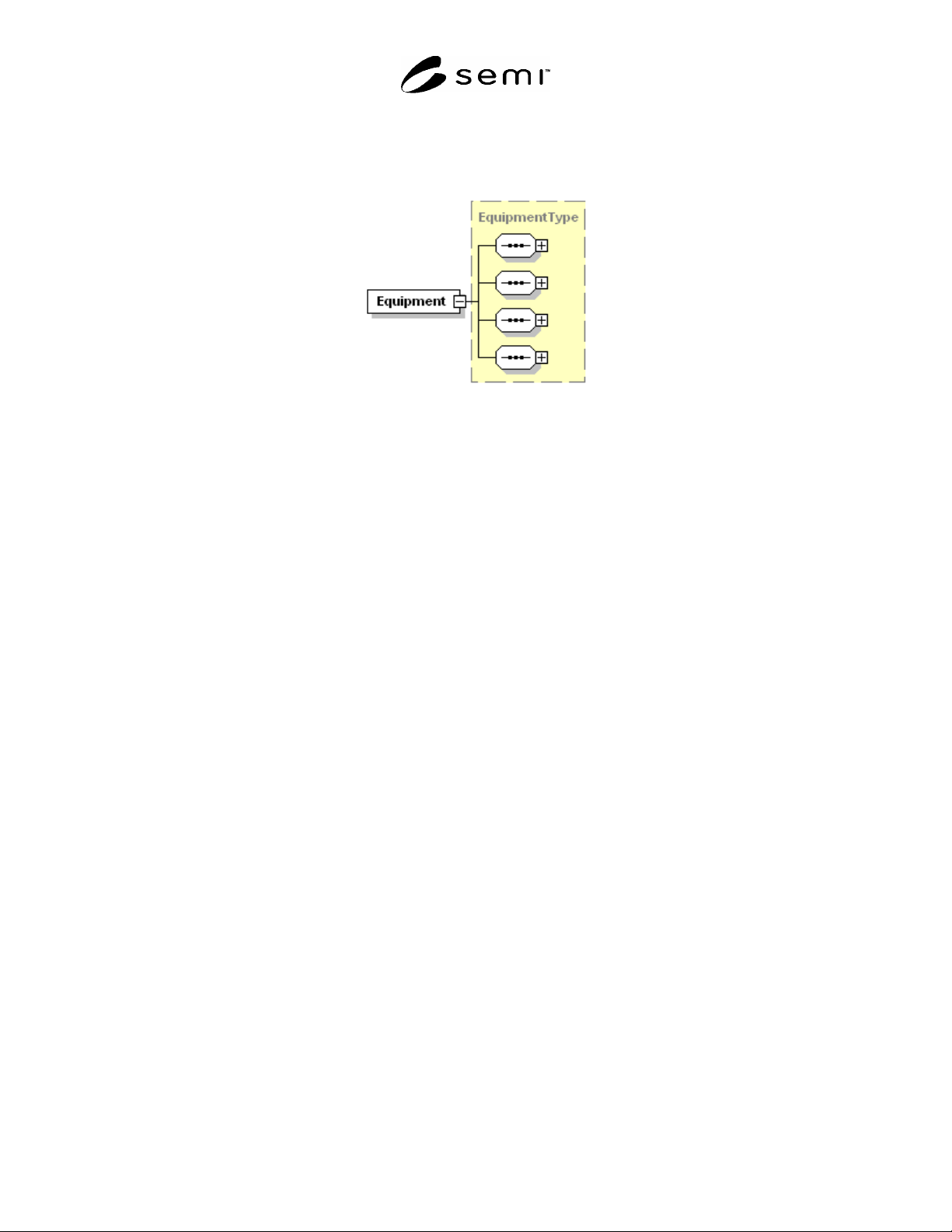
6.4.4.1 Equipment is an element of type EquipmentType (see Figure 14). The Equipment element is included in the
schema to provide for better type checking through the use of Keys and Keyrefs.
Figure 14
Equipment Element
6.4.4.2 The key and keyref constructs in the schema allow the enforcement the structure of the document. A key
defines an element that may be used to uniquely identify a structure in the document. To uniquely identify the
structure in the document, the key element must remain unique within the document. A document will fail
validation if an instance of the element is found that is not unique.
6.4.4.3 The keyref construct allows a reference to a specific key to be created. The keyref requires an instance of
the element exist with the same value as the reference. The key and keyref constructs allow the enforcement of the
Uid elements in the CEM schema. A key exists for all Uid elements in the document forcing each Uid defined in the
document to be unique and creates a table of them. This key is then used to enforce references to all objects base on
Nameable in the document. Additional keys and keyref fields are defined to enforce a reference to an IODevice,
Subsystem, or Module.
6.4.4.4 The unique construct is also used to enforce the structure of the document. The unique construct defines an
element that must be unique within a portion of the document. For the CEM schema, the unique construct enforces
the uniqueness of object names within an aggregation. The enforcement of names is limited to Nameable objects
defined directly within the aggregation. It does not enforce names of objects in references.
7 XML Schema
7.1 The XML schema defined by this specification is contained in a separate document named:
E120-1.V0704.CommonEquipmentModel.xsd
7.2 That schema document is a part of this specification and it should accompany this document.
7.3 The contents of the schema document constitute the core part of this specification. The information above
serves only to explain and describe the schema.
8 Related Documents
8.1 None

SEMI E120.1-0705 © SEMI 2004, 2005 18
NOTICE: SEMI makes no warranties or representations as to the suitability of the standards set forth herein for any
particular application. The determination of the suitability of the standard is solely the responsibility of the user.
Users are cautioned to refer to manufacturer's instructions, product labels, product data sheets, and other relevant
literature, respecting any materials or equipment mentioned herein. These standards are subject to change without
notice.
By publication of this standard, Semiconductor Equipment and Materials International (SEMI) takes no position
respecting the validity of any patent rights or copyrights asserted in connection with any items mentioned in this
standard. Users of this standard are expressly advised that determination of any such patent rights or copyrights, and
the risk of infringement of such rights are entirely their own responsibility.
Copyright by SEMI® (Semiconductor Equipment and Materials
International), 3081 Zanker Road, San Jose, CA 95134. Reproduction of
the contents in whole or in part is forbidden without express written
consent of SEMI.

SEMI E121-0305 © SEMI 2003, 2005 1
SEMI E121-0305
GUIDE FOR STYLE & USAGE OF XML FOR SEMICONDUCTOR
MANUFACTURING APPLICATIONS
This guide was technically approved by the Global Information and Control Committee and is the direct
responsibility of the North American Information and Control Committee. Current edition approved by the
North American Regional Standards Committee on November 4, 2004 and December 10, 2004. Initially
available at www.semi.org February 2005; to be published March 2005. Originally published March 2003;
last published March 2004.
1 Purpose
1.1 The inclusion of XML (Extensible Markup Language) notation within current SEMI standards reflects the
industry’s growing interest in XML technology. This guide is the first step to prepare for XML protocols in SEMI
standards and to establish consistency in XML style and usage. Recommendations given in this document are
intended for the definition and conformance of XML based standards. This document also attempts to highlight
those areas where standardization and further work may be required.
2 Scope
2.1 This guide is intended to promote interoperable application of XML in a variety of semiconductor
manufacturing usage contexts. It addresses an approach for the usage and definition of XML specifications within
the semiconductor industry with the focus on the use of XML in future SEMI standards. These guidelines should be
applied to any XML document or schema generated as part of a SEMI standard for communication between
software entities. This guide includes the following:
2.1.1 Overview of XML Resources, Organizations, and Standards,
2.1.2 XML Three Tier Model Architecture, and
2.1.3 General and specific recommendations of XML style and usage.
NOTICE: This standard does not purport to address safety issues, if any, associated with its use. It is the
responsibility of the users of this standard to establish appropriate safety and health practices and determine the
applicability of regulatory or other limitations prior to use.
3 Limitations
3.1 Because of the rapid development of new standards in the XML arena at the time of the writing of this
document, it was found that there are areas in XML where standards are still in the development stage. Some
examples of emerging XML technologies are: XMI (XML Metadata Interchange), SOAP (Simple Object Access
Protocol), and Web Services Routing. Therefore, this guide does not include recommendations in those areas until
the governing bodies approve these specifications. A list of some of the areas where guidance may be necessary is
provided below:
3.1.1 (UML) (Unified Modeling Language) models with derived schema definition
3.1.2 XMI (XML Metadata Interchange) usage and recommendations
3.1.3 XML Namespace definitions
3.1.4 XSLT (Extensible Stylesheet Language Transformations) usage and conversion rules
3.1.5 WSDL (Web Service Definition Language) usage and recommendations
3.1.6 SOAP (Simple Object Access Protocol) and transport recommendations