semi合集-English.pdf - 第4611页
SEMI D41-0305 © SEMI 2005 2 5.3 Definitions 5.3.1 Dynamic Range — the div ided ability from a minimum detecting lev el to a maximum detection level of a CCD equipm ent. 5.3.2 Gray Scale — gray scale on a n image display.…

SEMI D41-0305 © SEMI 2005 1
SEMI D41-0305
MEASUREMENT METHOD OF SEMI MURA IN FPD IMAGE QUALITY
INSPECTION
This standard was technically approved by the Global Flat Panel Display - Factory Committee and is the
direct responsibility of Japanese Flat Panel Display Factory Automation Committee. Current edition
approved by the Japan Regional Standards Committee on November 24, 2004. Initially available at
www.semi.org January 2005; to be published March 2005.
1 Purpose
1.1 This standard will define the application of the formula derived in SEMI D31 to various test conditions closed
to visual inspection for MURA in FPD image quality inspection.
1.2 SEMI D31 has derived a formula to detect defects and blemishes in FPD in comparison with human eyes and
CCD based instruments.
1.3 In general the difficulty of implementing instruments to replace human inspector lays on human factor variation
with its origin and location.
2 Scope
2.1 This standard is applicable to FPDs. This standard mainly deals with both the measurement method of Semu
and the revised definition of Semu. The target display size is typically from 8”(20.3cm) to 30”(76.2cm) diagonal.
NOTICE: This standard does not purport to address safety issues, if any, associated with its use. It is the
responsibility of the users of this standard to establish appropriate safety and health practices and determine the
applicability of regulatory or other limitations prior to use.
3 Limitations
3.1 In this standard, the target of measurement, Mura, is limited as below.
3.2 Line defects narrower than a pixel and pixel dot defects are not the subject of this standard. In this issue, this
standard follows SEMI D31.
3.3 In this standard, it is dealt with monochrome displays like gray scale patterns in color patterns. In this issue, this
standard follows SEMI D31.
4 Reference Standards
4.1 SEMI Standards
SEMI D31 —Definition of Measurement Index (Semu) for Luminance Mura in FPD Image Quality Inspection
4.2 Other Documents
Flat Panel Display Measurement Standard, VESA FPDM 2.0, June 2001, IEC 61747-6.
NOTICE: Unless otherwise indicated, all documents cited shall be the latest published versions.
5 Terminology
5.1 This standard follows SEMI D31 in terminology.
5.2 Abbreviations and Acronyms
5.2.1 JND — abbreviation for Just Noticeable Difference used in the field of Psychophysics; for a certain stimulus,
the smallest change in stimulus (luminance, for example) where a difference can be perceived. Specifically, it is
often used to indicate a statistical value where the probability of the difference being “perceptible” is 50% and the
probability of the difference “not being perceptible” is 50%. Also expressed using lower case letters, jnd.

SEMI D41-0305 © SEMI 2005 2
5.3 Definitions
5.3.1 Dynamic Range — the divided ability from a minimum detecting level to a maximum detection level of a
CCD equipment.
5.3.2 Gray Scale — gray scale on an image display. This standard indicates level 32 out of 64 level gray scale.
5.3.3 L0 Display — gradation 0 out of 64. (Pitch Black)
5.3.4 L63 Display — gradation 63 out of 64 (Completely white)
5.3.5 Luminance Accuracy — the error ratio of the luminance.
5.3.6 Measuring points — the number of CCD sensors.
5.3.7 Semu — Semi Mura, Measurement index for Mura, defined in this standard. Please refer toSEMI D31.
5.3.8 Viewing direction — the angle between the CCD equipment and the test sample.
6 Related Definitions for Mura Measurement
6.1 Mura is a Japanese term meaning blemish and has been adopted in English to provide a name for imperfections
of the display pixel matrix surfaces that are visible when the display is in operation. Inspect the display surface
while displaying a white full screen, a black full screen, and a dark gray full screen (VESA FPDM 2.0). In many
case, the Mura phenomena is detected by human eyes. But this is very confusing in the quality aspect. And it is very
difficult to quantify the level.
6.2 The definition in SEMI D31 shows mainly that Luminance Mura is related with the size of Mura. Therefore this
standard will follow the Cjnd concept.
6.3 Semu Definition
6.3.1 Under specific conditions, the below regression function can explain the level of Mura between the area and
contrast for Human Mura JND. (Refer to SEMI D31.)
Cjnd = F (Sjnd) = 1.97/Sjnd
0.33
+ 0.72
Cjnd: Contrast of Mura at JND
(Unit: % relative to background = 100%)
Sjnd: The area of Mura at above contrast (Units: mm
2
)
6.3.2 In the above equation, contrast at JND is inversely proportional to the area raised to the 0.33 powers. In short,
it indicates that as Mura the area gets smaller, only darker Mura can be sensed.
6.3.2.1 For the subject Mura, the Mura level, Semu, can be calculated using the below formula.
Semu = |Cx| / Cjnd
= |Cx| / F (Sx)
= |Cx| /(1.97/Sx
0.33
+ 0.72)
Cx: Average contrast of Mura being measured (Unit: % relative to background = 100%)
Sx: The surface area of Mura being measured (mm
2
)
7 Measurement Method
7.1 Environment Conditions:
Temperature: 25 ± 2°C
Humidity: 65 ± 20% RH
Illumination of surrounding: in a dark room below 10 lux
Air flow: no wind
SEMI D41-0305 © SEMI 2005 3
7.2 Measurement Method
7.2.1 Warm-Up Time
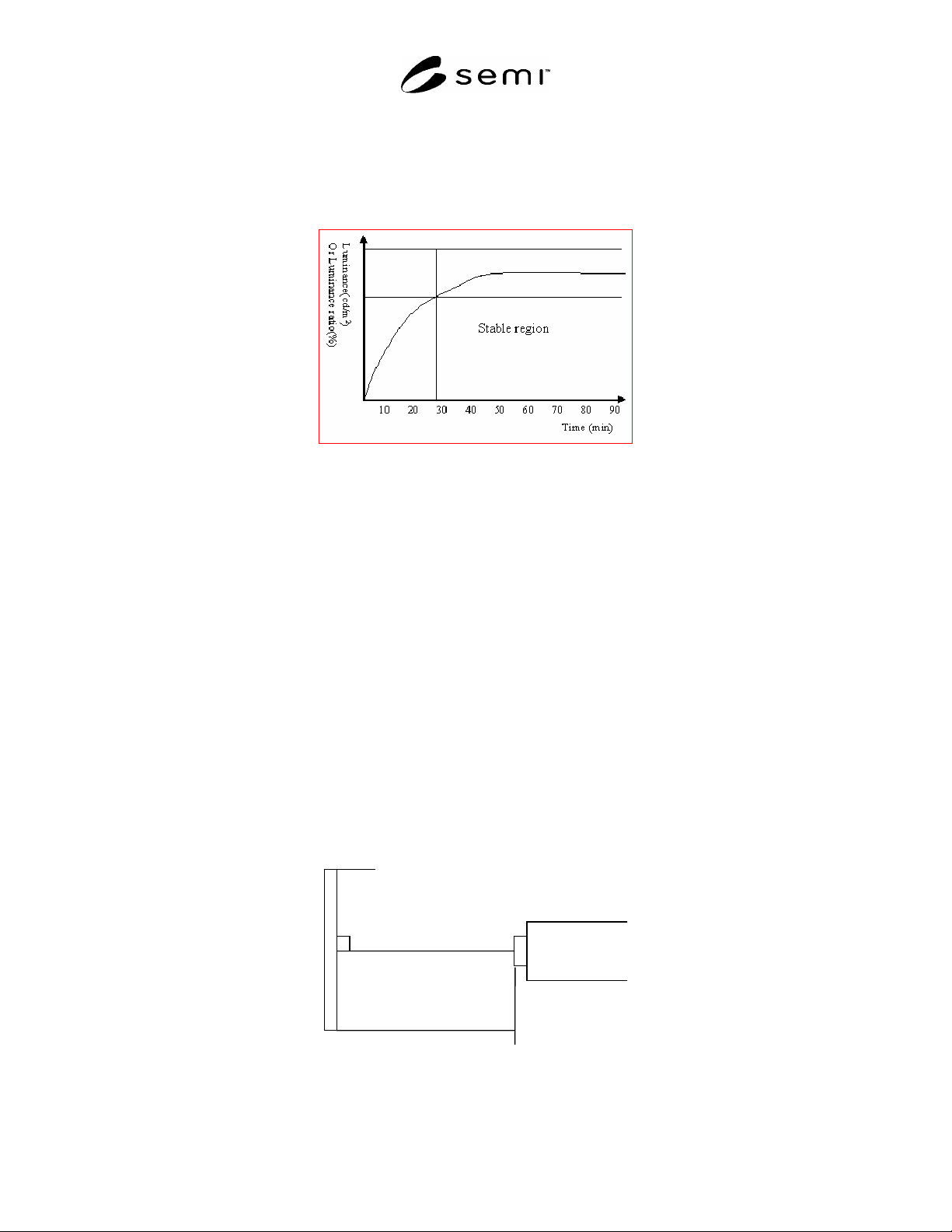
7.2.1.1 Warm-up time is the period from power-on to saturation of the light intensity. The optical measurement
needs 15 to 30 minutes for more accurate measurement. In case of Mura, it has a little luminance difference between
the luminance of Mura and the luminance of background the area. Therefore it must be measured in a saturate state.
Figure 1
General Warm-Up Characteristics
7.2.2 Light Measurement Device (LMD)
7.2.2.1 When human eyes measure the FPD, it is detected in the total active area. So the measuring equipments
must have similar characteristics to the human eye detecting method. In this standard, we recommend the CCD
equipments to detect the Mura phenomena.
1) Dynamic Range — The dynamic range of the CCD equipment should be over 12 bits because the Semu value
must be controlled by 0.1 Semu.
2) Luminance Accuracy — The Accuracy of Luminance is very important to measure Mura, because the Mura
value is determined by low luminance difference. Therefore the accuracy of luminance should be 0.01 cd/m
2
at the 100cd/m
2
.
3) Measuring Points — The measuring points should be over 200(H) X 200(V) points. It is the same as the
number of the CCD sensors.
7.2.3 Test Pattern for Semu Measurement
7.2.3.1 The test pattern should be set by 50 cd/m
2
in the white pattern. The permissible error is 10 cd/m
2
.
7.2.4 Viewing Direction
7.2.4.1 The viewing direction angle should be set 90° ± 1°.
90° ± 1°
DUT
LMD
Measuring Distance
Figure 2
Viewing Direction for the Semu Measurement