semi合集-English.pdf - 第3842页
SEMI F20-0305 © SEMI 1995, 2005 6 As Sulfur increases from zero to the 0.030% maxi mum permitted: Solidification tem perature range increases. – Increased segregation in weld. – Rougher weld b ead surface. A1-2.1.3 The l…
SEMI F20-0305 © SEMI 1995, 2005 5
APPENDIX 1
THE EFFECTS OF SULFUR ON GTA WELDING OF 316L STAINLESS
STEEL
NOTICE: The material in this appendix is an official part of SEMI F20 and was approved by full letter ballot
procedures.
A1-2 Effects of Sulfur
A1-2.1 AISI Type 316L austenitic stainless steel is the preferred material for components of gas supply systems for
semiconductor fabrication. The composition of 316L specified in Table I of ASTM A 182/A 182M, ASTM A 240,
ASTM A 269, ASTM A 276, ASTM A 479/A 479M, or ASTM A 632, has a maximum of 0.030 percent Sulfur;
however several properties affecting the manufacture and applications of 316L can vary significantly over this range
of Sulfur content. Therefore a lower Sulfur maximum is specified in SEMI F20, as listed in ¶6.3.2 and Table 1 of
¶6.3.3.
A1-2.2 Sulfur has a very low solubility in austenitic stainless steels, thus in these alloys it exists as discrete
inclusions of Manganese Sulfide, with some solubility for Chromium as well as other trace elements. These
inclusions can initiate pits and other defects on electropolished surfaces, increasing in number with increasing Sulfur
content.
A1-2.3 The Manganese Sulfide inclusions improve the machinability of stainless steel; compositions intended for
machining have Sulfur compositions near the 0.030 percent maximum, whereas stainless steels with very low Sulfur
levels require lower feeds and speeds and will cause reduced tool life during machining.
A1-2.4 Sulfur also strongly affects welding of stainless steel; variation of Sulfur from very low contents to the
maximum permitted can increase weld bead penetration by approximately a factor of two for similar weld
parameters.
A1-2.5 The effects of Sulfur are summarized in Table A1-1.
A1-2 Welding Effects of Sulfur
A1-2.1 Two effects are observed on welding with variations in Sulfur level:
A1-2.1.1 As Sulfur is reduced the heat input required for full penetration increases.
A1-2.1.2 As Sulfur is reduced below approximately 0.005 percent there is a marked change in weld pool dynamics,
causing the weld pool to become wider and shallower
2
.
Table A1-1 – Effects of Sulfur on Austenitic Stainless Steels
As Sulfur increases from zero to the 0.030% maximum permitted:
Effects Results
Machinability improves.
– Lower machining costs for machined parts.
Inclusion density increases.
– More pits, stringers, other defects on surface.
– Decreased corrosion resistance, particularly on end grains.
Welding penetration increases.
– Weld settings must be reset when changing lots.
– Problems welding materials with dissimilar Sulfur contents.
2 K. Watanabe and K. Masuda, Effects of Residual and Micro-Alloying Elements on Welding of Stainless Steel; Part 1: Effects on weld pool
behavior by GTAW, IIW Doc. IX-1837-96, International Institute of Welding, 1996, 17 pp. (Literature review).
SEMI F20-0305 © SEMI 1995, 2005 6
As Sulfur increases from zero to the 0.030% maximum permitted:
Solidification temperature range increases.
– Increased segregation in weld.
– Rougher weld bead surface.
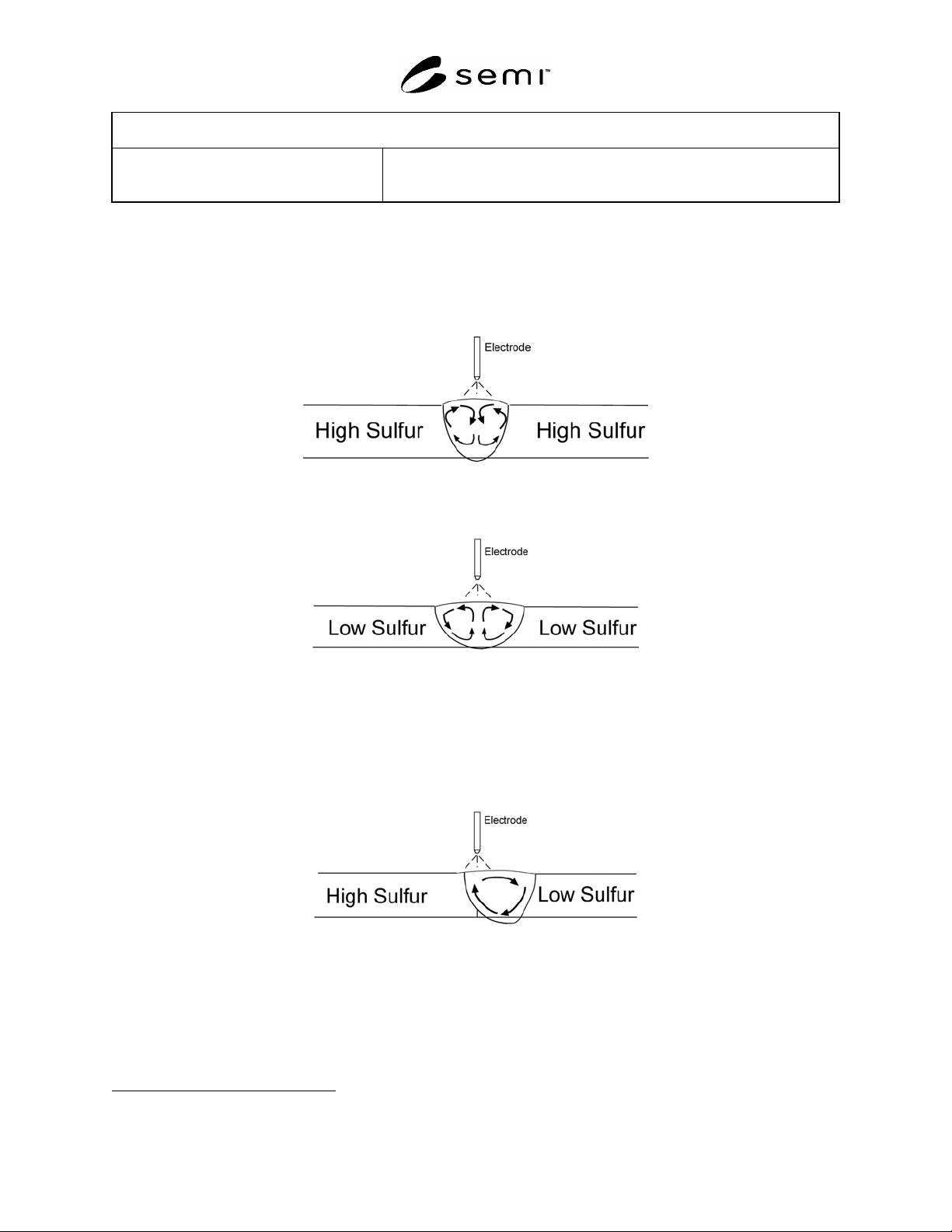
A1-2.1.3 The latter effect is due to a reversal of the convection currents in the weld pool at approximately 0.005
percent Sulfur. At Sulfur levels significantly above 0.005 percent the convective currents flow downward from the
arc, causing deep penetration as illustrated in Figure A1-1, whereas at Sulfur levels well below about 0.005 percent
the convective currents flow outward from the arc, causing a wider weld pool and shallower penetration as
illustrated in Figure A1-2
3
.
Figure A1-1
Convection Currents in the Weld Pool During Welding of Stainless Steel with >>0.005% Sulfur Levels
Figure A1-2
Convection Currents in the Weld Pool During Welding of Stainless Steel with <<0.005% Sulfur Levels
A1-2.1.4 Serious problems can occur when attempting to weld two pieces of stainless steel with substantially
different Sulfur contents. The weld pool can become asymmetric, favoring the low Sulfur side, and cause the root of
the weld to shift away from the joint, as illustrated in Figure A1-3.
Figure A1-3
The Weld Pool is Asymmetric When Welding Stainless Steel Pieces with Significantly Different Sulfur Levels
A1-2.1.5 In order to minimize this effect it is desirable to match Sulfur contents in components to be welded to
within ± 0.007 percentage points. Greater differences in Sulfur contents require very careful weld set-up to ensure
full penetration to the root of the joint.
3 Pollard, B., The Effects of Minor Elements on the Welding Characteristics of Stainless Steel, Welding Research Supplement, 202 (Sept 1988).

SEMI F20-0305 © SEMI 1995, 2005 7
A1-2.1.6 These effects lead to the following recommendations to ensure optimum weld quality when welding
stainless steel:
A1-2.1.6.3 Check compositions of pieces to be welded. Match Sulfur contents to within ± 0.007 percentage points.
A1-2.1.6.3 Welding of pieces with very low Sulfur (< 0.003 % approximately) may require additional attention to
the establishment of appropriate weld settings to achieve full, uniform penetration. It is recommended that product
with wall thickness > 0.100 inch approximately be restricted to > 0.003 % Sulfur.
A1-2.1.6.3 Establish weld settings for piece lots to be welded; recheck whenever changing lots.