semi合集-English.pdf - 第3481页
SEMI E134-0305 © SEMI 2004, 2005 34 11.1.8 ExceptionTrigger — Identifies an exception that can be gene rated by a specific source, and whose occurrence can t r igger the start ing or stopping of a trace . For stateful ex…
SEMI E134-0305 © SEMI 2004, 2005 33
11.1.5.5 TraceRequest Association Definition Table
Table 47 TraceRequest Association Definition
Association Role Name Definition Comments
parameterRequests A set of parameters whose values that the
consumer is requesting to be collected at
the interval specified in the TraceRequest.
Ordered list of structured data, of type
ParameterRequest, described in Section 11.1.9 . The
order of the ParameterRequests appearing in a
TraceRequest determines the order in which those
Parameter values will be reported in the corresponding
TraceReport (see Section 14.1.5 ).
startOn A list of zero or more events and/or
exceptions that can initiate the trace.
List of structured data of any type subclassed from
Trigger. See Section 11.1.5.6 for further explanation.
stopOn A list of zero or more events and/or
exceptions that can stop the trace.
List of structured data of any type subclassed from
Trigger. See Section 11.1.5.7 for further explanation.
11.1.5.6 startOn
11.1.5.6.1 If no triggers are provided, the trace initiates when the DCP is activated.
11.1.5.6.2 If one or more triggers are provided, the trace is started when any one of the start triggers is detected
after the activation of the DCP.
11.1.5.6.3 Subsequent occurrences of any of the start triggers after the trace has started are ignored, and do not
affect the execution of the trace.
11.1.5.6.4 The same start trigger may not appear more than once in the same TraceRequest (see Section 9.1.2.2.11).
11.1.5.7 stopOn
11.1.5.7.1 If no triggers are provided, the trace terminates when the total number of collection results is equal to
‘collectionCount’, or when the DCP is deactivated, whichever occurs first.
11.1.5.7.2 If one or more triggers are provided, the trace is stopped when any one of the stop triggers is detected, or
when the total number of collection results is equal to ‘collectionCount’, whichever occurs first. If the trace request
is buffered (groupSize > 1), any collected results stored at this time are sent in a single DataCollectionReport.
11.1.5.7.3 If a trigger provided by this association is identical to one specified in the ‘startOn’ association, trace
data collection shall start on the first occurrence of that trigger after activation of the plan, and stop on the next
occurrence of the same trigger (and so on, if cyclical).
11.1.5.7.4 The same stop trigger may not appear more than once in the same TraceRequest (see Section 9.1.2.2.11).
11.1.6 Trigger — An abstract class representing an occurrence that can trigger the starting or stopping of a trace.
This class has no attributes or associations.
11.1.7 EventTrigger — Identifies an event that can be generated by a specific source, and whose occurrence can
trigger the starting or stopping of a trace. See Section 9.1.2.2.11 for possible errors.
11.1.7.1 EventTrigger Attribute Definition Table
Table 48 EventTrigger Attribute Definition
Attribute Name Definition Form
sourceId The source of the event. Text, formatted according to the convention used to identify an event
source. See limitations, Section 3.1.1.
eventId The identifier for the event. Text, formatted according to the convention used to identify a specific
event. See limitations, Section 3.1.1.
SEMI E134-0305 © SEMI 2004, 2005 34
11.1.8 ExceptionTrigger — Identifies an exception that can be generated by a specific source, and whose
occurrence can trigger the starting or stopping of a trace. For stateful exceptions, the trigger can be activated by a
transition to any of the defined states for that exception. See Section 9.1.2.2.11 for possible errors.
11.1.8.1 ExceptionTrigger Attribute Definition Table
Table 49 ExceptionTrigger Attribute Definition
Attribute Name Definition Form
sourceId The source of the exception. Text, formatted according to the convention used to identify an exception
source. See limitations, Section 3.1.1.
exceptionId The identifier for the exception. Text, formatted according to the convention used to identify a specific
exception. See limitations, Section 3.1.1.
exceptionState For stateful exceptions, the
exception state which activates
the trigger.
Text, equal to a valid state for the exception. For exceptions
corresponding to E30 alarms, valid values are:
“urn:semi-org:E30:alarmSet”
“urn:semi-org:E30:alarmClear”
If no state is provided, the trigger shall activate when the equipment
detects an occurrence of the exception.
11.1.9 ParameterRequest — This class provides the source and name of a specific parameter that the equipment is
to report to the consumer as part of the DCP’s event or trace reports. Multiple trace reports or event reports across
multiple DCPs may refer to the same parameter.
11.1.9.1 ParameterRequest Attribute Definition Table
Table 50 ParameterRequest Attribute Definition
Attribute Name Definition Form
sourceId Unique identifier for the source
of the parameter.
Text, must be a valid parameter source, formatted according to the
convention used for identifying a source. See limitations, Section 3.1.1 .
parameterName Name of the parameter. Text, must be a valid parameter name for the specified source, formatted
according to the convention used for identifying a parameter. See
limitations, Section 3.1.1 .
SEMI E134-0305 © SEMI 2004, 2005 35
12 Data Collection Plan State Models
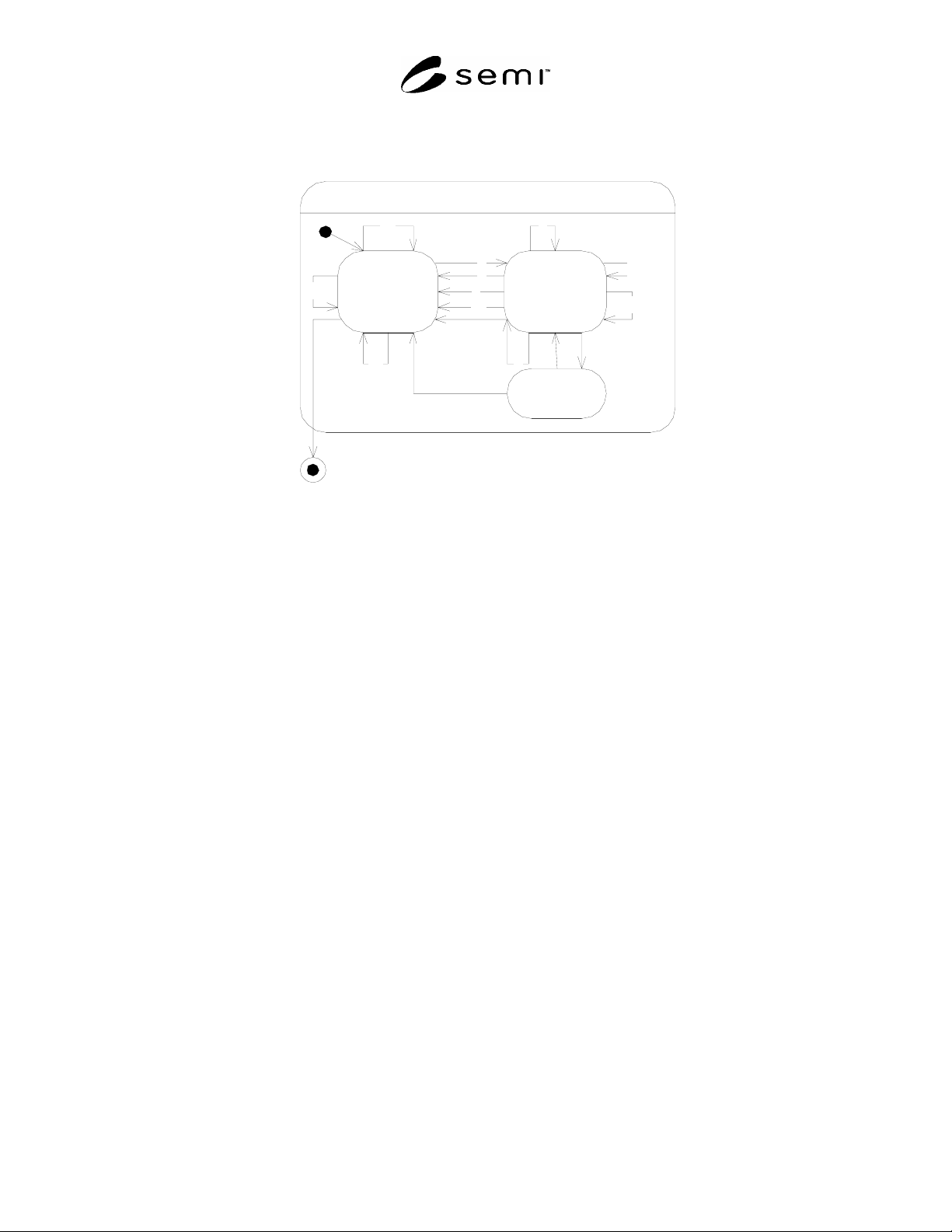
12.1 DataCollectionPlan State Model
DataCollectionPlan
ActiveInactive
2
8
4
7
H 1
H Deleted
17
6
10
12
13
Hibernating
1415
16
11
3
5
9
Figure 20
DataCollectionPlan State Model
12.1.1 The purpose of the DataCollectionPlan state model is to define the consumer’s view of the behavior of a
DCP, which includes the consumer’s interactions with the equipment necessary to define, activate, de-activate, and
delete DCPs. Each DCP on the equipment shall execute independently, as described in these state models. The
equipment supplier is not required to provide a direct, literal implementation of these state models. They are
documented here to provide a precise definition of the required behavior for DCPs on the equipment. The
transitions described in these state machines are not to be made available for event data collection.
12.1.1.1 Implementation mappings of this specification may identify additional conditions other than those defined
in this document under which DCP activity should be terminated (that is, cause a transition from the “Active” to the
“Inactive” state). All such conditions, and the details of required equipment behavior under those conditions, shall
be fully specified in any implementation mapping for which this is a consideration.
12.1.2 DataCollectionPlan — The superstate for all DCP states. The equipment has validated the DCP and stored it
in non-volatile memory. The DCP may now be activated and de-activated.
12.1.3 Inactive — The equipment is not sending or buffering any event, exception, or trace reports requested in the
DCP to any consumer. A transition to Active is required for the data defined in this DCP to be reported to a
consumer.
12.1.4 Active — The equipment is sending and/or buffering all event, exception, and trace reports requested in the
DCP to all consumers that have successfully activated the DCP. This state contains substates that are described in
Section.12.2 .
12.1.5 Hibernating — The equipment has paused the sending and buffering of all event, exception, and trace
reports requested in the DCP, because the equipment is entering a state in which it will not be possible to
communicate data to any consumers. The DCP has its ‘isPersistent’ attribute equal to ‘true’.
12.1.6 Deleted — The DCP is no longer stored in non-volatile memory, and can no longer be legally referenced by
any consumer.