semi合集-English.pdf - 第3665页
SEMI E142.1-0705 © SEMI 2005 2 4.5 Definitions 4.5.1 UML (Unified Modeling Language) — A notation fo r representin g object-ori ented desi gns and views creat ed by Booch, Rumbaugh, and Jacob son in or der to m erge thei…
SEMI E142.1-0705 © SEMI 2005 1
SEMI E142.1-0705
XML SCHEMA FOR SUBSTRATE MAPPING
This standard was technically approved by the global Information & Control Committee. This edition was
approved for publication by the global Audits and Reviews Subcommittee on April 7, 2005. It was available
at www.semi.org in June 2005 and on CD-ROM in July 2005.
1 Purpose
1.1 The purpose of this specification is to provide an XML schema that corresponds to the data model for
equipment defined by SEMI E142, Specification for Substrate Mapping. This schema is available to equipment
communication standards that want to use SEMI E142 -defined information in XML formatted equipment
communication.
2 Scope
2.1 The scope of this document is the representation of the SEMI E142 object model in an XML schema. It will not
add new domain information or concepts to the model. The only additions made are those needed to render a useful
XML schema.
NOTICE: This standard does not purport to address safety issues, if any, associated with its use. It is the
responsibility of the users of this standard to establish appropriate safety and health practices and determine the
applicability of regulatory or other limitations prior to use.
3 Referenced Standards and Documents
3.1 SEMI Standards
SEMI E142 — Specification for Substrate Mapping
SEMI E121 — Guide for Style and Usage of XML for Semiconductor Manufacturing Applications
3.2 OMG Standards
Unified Modeling Language (UML) Specification, Version 1.4, OMG Specification 01-09-67,
(
http://www.omg.org/technology/documents/modeling_spec_catalog.htm
).
3.3 W3C Standards
Extensible Markup Language (XML) 1.0 (Second Edition) — W3C, 6 October 2000
(http://www.w3.org/TR/2000/REC-xml-20001006/).
Namespaces in XML — W3C, 14 January 1999 (http://www.w3.org/TR/1999/REC-xml-names-19990114/).
XML Schema Part 0: Primer — W3C, 2 May 2001 (http://www/w3/org/TR/xmlschema-0/).
XML Schema Part 1: Structures — W3C, 2 May 2001 (http://www/w3/org/TR/xmlschema-1/).
XML Schema Part 2: Datatypes — W3C, 2 May 2001 (http://www/w3/org/TR/xmlschema-2/).
XML Path Language (Xpath) — W3C, 16 November 1999 (http://www/w3/org/TR/xpath/).
4 Terminology
4.1 Abbreviations and Acronyms
4.2 UML — Unified Modeling Language
4.3 W3C — World Wide Web Consortium
4.4 XML — eXtensible Markup Language
SEMI E142.1-0705 © SEMI 2005 2
4.5 Definitions
4.5.1 UML (Unified Modeling Language) — A notation for representing object-oriented designs and views created
by Booch, Rumbaugh, and Jacobson in order to merge their three popular notations plus aspects of other existing
notations into a single object-oriented notation intended to be usable by all.
4.5.2 XML (eXtensible Markup Language) — A markup language used for representing data rich with context and
content in documents and in communications. XML is an extension of SGML, a document-oriented markup
language. It was created by W3C for use on the Internet. XML can represent object-oriented structures.
5 Conventions
5.1 This section discusses the conventions used in this specification for translating UML to XML and for
documenting the XML. These conventions are heavily influenced by the SEMI E121 Guide for Style & Usage of
XML for Semiconductor Manufacturing Applications.
5.2 The reader is expected to have a working knowledge of the UML, XML, and Schema specifications (See ¶3.2
and ¶3.3). This document does not provide tutorial information on these subjects.
5.3 Translating UML to XML
5.3.1 This document follows the guidelines for XML as outlined in SEMI E121 “Guide For Style & Usage of XML
for Semiconductor Manufacturing Applications”.
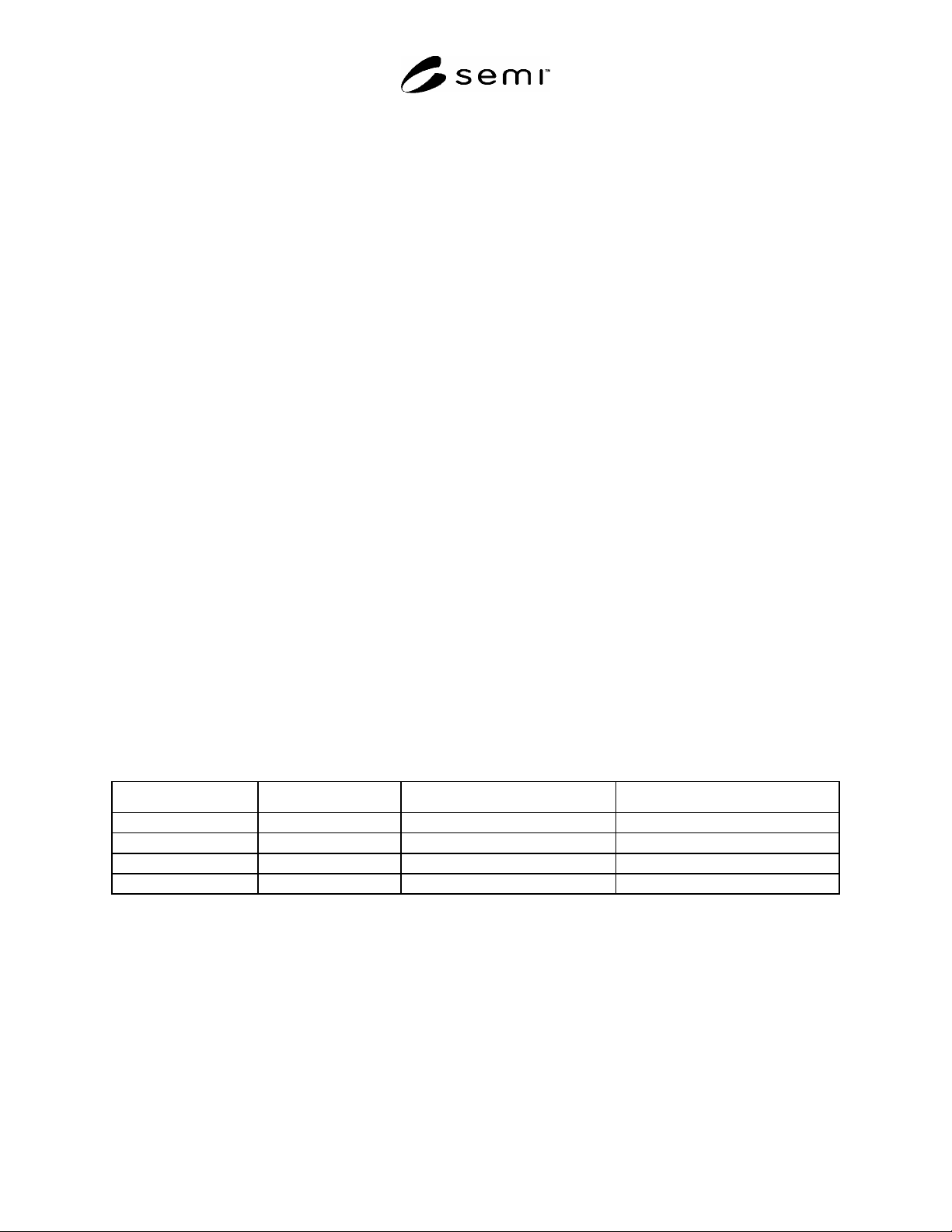
5.3.2 The translation of a UML class to XML is documented using a table format illustrated by Table 1.
5.4 Translation Table Column Header Description
5.4.1 Attribute or Role Name — If an attribute, the name of the attribute is placed here. If an association (including
aggregation or composition), the role name from the UML diagram is placed here. Compositions are often not
assigned role names. In that case “none” is placed here.
5.4.2 UML Name/Type — If an attribute, the data type of the UML attribute is placed here. If an association, the
type of association is placed here. The possible types are “Composition”, “Aggregation”, or the basic
“Association”. UML defines these three types of associations.
5.4.3 XML Element or Attribute — Lists the type of XML construct used to represent the UML attribute or
association.
5.4.4 XML Name/Type — Provides the name and data type of the resulting XML construct. The type may be a
built-in type (for example, xs:string), or a named type defined within the XML schema.
Table 1 Example Translation Table
Attribute or Role Name UML Name/Type XML Element or Attribute XML Name/Type
friend association element Friend: HumanReferenceArray
employees aggregation element Employees: HumanArray
family composition element Family: HumanArray
name string element Name: xs:string
6 XML Schema
6.1 The actual XML schema defined by this specification is contained in a separate document. The contents of the
schema document constitute the core part of this specification.
6.2 The target namespace for the schema is “urn:semi-org:xsd.E142-1.V0105.SubstrateMap”.
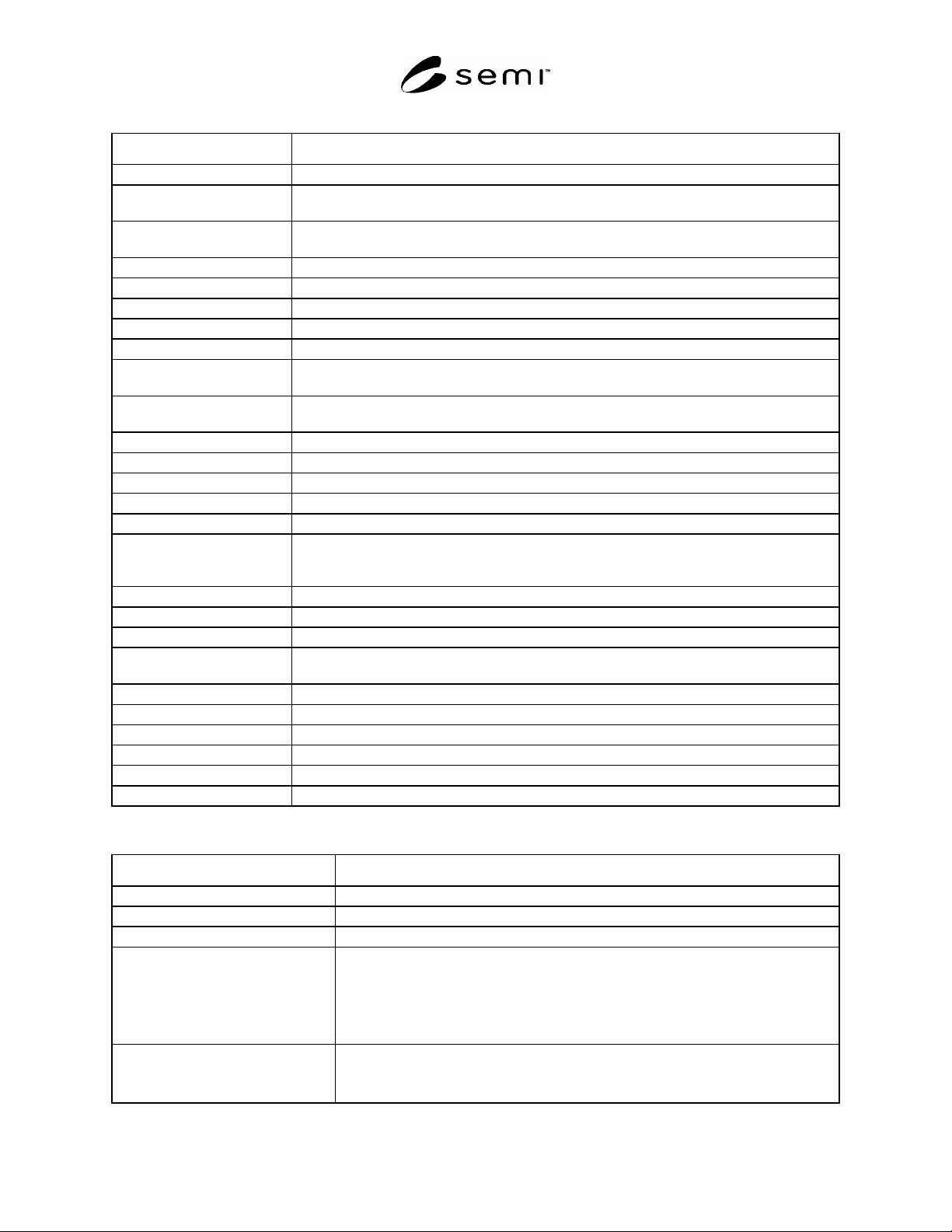
6.3 Table 2 describes the complex types defined in the schema and how they relate to one another.
6.4 Table 3 describes the simple types defined in the schema.
6.5 Table 4 shows how the element and attribute names in the schema map to the attributes defined in SEMI E142
Substrate Mapping.
SEMI E142.1-0705 © SEMI 2005 3
Table 2 Complex Elements and Types Defined in Schema
Element/Type Description
MapData Top level MapDataType element.
MapDataType Top level element that contains zero or one LayoutsType elements, zero or one SubstratesType
elements and zero or one SubstrateMapsType elements.
LayoutsType A collection of one or more LayoutType elements. The uniqueness of the LayoutId is enforced
by the xs:key LayoutKey defined in MapData.
LayoutType An element containing the attributes defined for the Layout object in SEMI E142.
LogicalCoordinatesType An element containing the attributes defined for the LogicalCoordinates object in SEMI E142.
PhysicalCoordinatesType An element containing the attributes defined for the PhysicalCoordinates object in SEMI E142.
ZDimensionsType An element containing the attributes defined for the ZDimensions object in SEMI E142.
ChildLayoutsType A collection one or more ChildLayoutType elements.
ChildLayoutType A element containing a reference (LayoutId) of the child layout. This relationship is enforced
by the xs:KeyRef ChildLayoutRef defined in MapData.
SubstratesType A collection of one or more SubstrateType elements. The uniqueness of the combined
SubstrateType and SubstrateId key is enforced by the xs:key SubstrateKey defined in MapData.
SubstrateType An element containing the attributes defined for the Substrate object in SEMI E142.
AliasIdsType A collection of one or more AliasIdType elements.
AliasIdType An element containing the attributes defined for the AliasId object in SEMI E142.
SubstrateMapsType A collection of one or more SubstrateMapType elements.
SubstrateMapType An element containing the attributes defined for the SubstrateMap object in SEMI E142.
Overlay An element containing the attributes defined for the Overlay object in SEMI E142. The
uniqueness of the combined MapName and MapVersion key is enforced by the xs:key
OverlayKey defined in SubstrateMapsType.
ReferenceDevicesType A collection of one or more ReferenceDeviceType elements.
ReferenceDeviceType An element containing the attributes defined for the ReferenceDevice object in SEMI E142.
BinCodeMapType An element containing the attributes defined for the BinCodeMap object in SEMI E142.
BinCodeType The content of this element corresponds to the Value attribute defined for the BinCode object in
SEMI E142. The remaining attributes are represented as XML attributes.
BinDefinitionsType A collection of one or more BinDefinitionType elements.
BinDefinitionType An element containing the attributes defined for the BinDefinition object in SEMI E142.
DeviceIdMapType An element containing the attributes defined for the DeviceIdMap object in SEMI E142.
DeviceIdType An element containing the attributes defined for the DeviceId object in SEMI E142.
TransferMapType An element containing the attributes defined for the TransferMap object in SEMI E142.
TransferType An element containing the attributes defined for the Transfer object in SEMI E142.
Table 3 Simple Types Defined in Schema
Type Description
MaterialIdType String of 1-32 characters
BinCodeContentType String of 1 or more characters
OrientationType Integer from 0 to 359
BinTypeEnum Enumeration:
Ascii
Decimal
Hexadecimal
Integer2
SubstrateSideEnum Enumeration:
TopSide
BottomSide