semi合集-English.pdf - 第7869页
SEMI T13-1104 © SEMI 2004 29 List 3 An Example of Substrate Layout Data in XML <? xml version ="1.0" encoding ="utf-8" ?> < SubstrateLayoutData xmlns ="urn:semi- org:xsd.Doc3754.V0312.Su…
SEMI T13-1104 © SEMI 2004 28
List 2 An Example of Device ID Data in XML
<?xml version="1.0" encoding="utf-8" ?>
<
DeviceIdData xmlns="urn:semi-org:xsd.Doc3754.V0312.DeviceIdData">
<SubstrateType>Strip</SubstrateType>
<SubstrateId>MyStrip</SubstrateId>
<LayoutId>Device</LayoutId>
<OriginLocation>LowerLeftTop</OriginLocation>
<RowColumnMajor>Column</RowColumnMajor>
<D><Id></Id></D>
<D><Id></Id></D>
<D><Id></Id></D>
<D><Id>Lot001-XXYY</Id></D>
<D><
Id>etc.</Id></D>
</
DeviceIdData>
NOTE 1:The <D> elements contain a tracking code marked on the package that is unique for the manufacturer and product.
NOTE 2: The <D> elements represent each device on the layout “Device” for strip “MyStrip”.
NOTE 3: The number of <D> entries must equal Rows * Columns defined in the “Device” layout.
NOTE 4: The one dimensional array of <D> elements represents the two dimensional array of locations defined in the “Devices” layout in
RowColumnMajor format with respect to the OriginLocation.
NOTE 5: The OriginLocation corresponds to the definition of the same name in SEMI G81.
R1-3 Substrate Layout Data Report
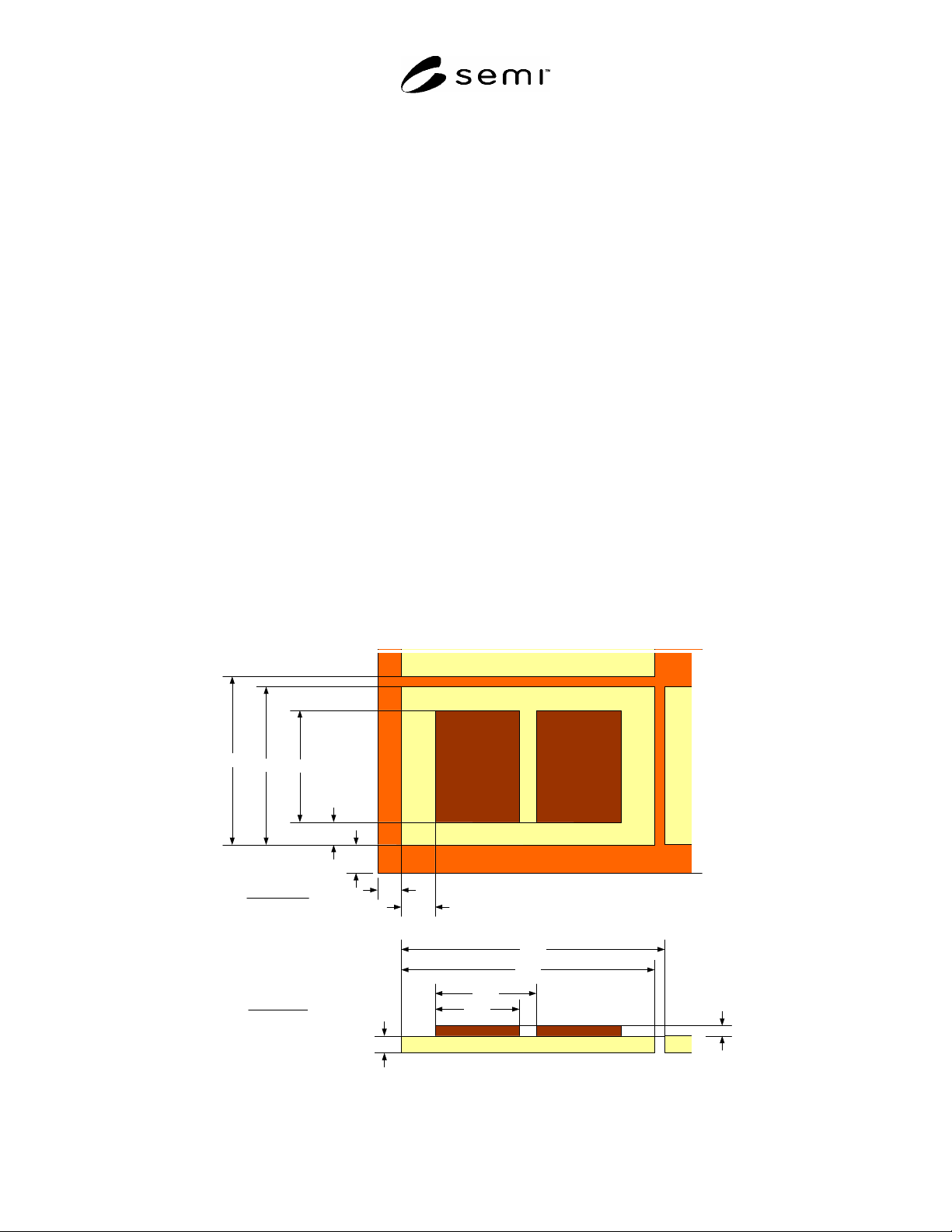
R1-3.1 Substrate Layout Example — The following figure shows the lower left corner of a strip that contains an
array of SRAM devices with 2 Flash devices mounted on each.
R1-3.2 Layout Representation Example — The following list shows the substrate layout data that represents the
strip shown in the figure.
SRAM
FlashFlash
30.00
75.00
78.00
33.00
46.67
49.67
5.00
3.00
SRAM Layout
Dimension (X=32, Y=8)
LowerLeft (X=7.00, Y=8.33)
StepSize (X=78.00, Y=49.67)
DeviceSize (X=75.00, Y=46.67)
Height = 5.00
ZOrder = 0
25.00
7.00
8.33
Flash Layout
Dimension (X=2, Y=1)
LowerLeft (X=10.00, Y=6.67)
StepSize (X=30.00, Y=0.00)
DeviceSize (X=25.00, Y=33.0)
Height = 3.00
ZOrder = 1
6.67
10.00
Figure R1-3

SEMI T13-1104 © SEMI 2004 29
List 3 An Example of Substrate Layout Data in XML
<?xml version="1.0" encoding="utf-8" ?>
<
SubstrateLayoutData xmlns="urn:semi-
org:xsd.Doc3754.V0312.SubstrateLayoutData">
<SubstrateType>Strip</SubstrateType>
<SubstrateId>MyStrip</SubstrateId>
<LayoutId>Device</LayoutId>
<Units>100micron</Units>
<Size><X>2510.00</X><Y>414.02</Y></Size>
<Layout>
<LayoutId>SRAM</LayoutId>
<Dimension><X>32</X><Y>8</Y></Dimension>
<LowerLeft><X>
7.00</X><Y>8.33</Y></LowerLeft>
<StepSize><X>78.00</X><Y>49.67</Y></StepSize>
<DeviceSize><X>75.00</X><Y>46.67</Y></DeviceSize>
<Z><Order>0</Order><Height>5.00</Height></Z>
<Layout>
<LayoutId>FLASH</LayoutId>
<Dimension><X>2</X><Y>1</Y></Dimension>
<LowerLeft><X
>10.00</X><Y>6.67</Y></LowerLeft>
<StepSize><X>30.00</X><Y>0.00</Y></StepSize>
<DeviceSize><X>25.00</X><Y>33.00</Y></DeviceSize>
<Z><Order>1</Order><Height>3.00</Height></Z>
</Layout>
</Layout>
</
SubstrateLayoutData>

SEMI T13-1104 © SEMI 2004 30
RELATED INFORMATION 2
AN EXAMPLE OF ENVELOP AND HEADERS FOR XML
COMMUNICATION
NOTICE: This related information is not an official part of SEMI T13 and was derived from the Japanese
Traceability Committee. This related information was approved for publication by full letter ballot on April 30,
2004.
R2-1 Message Encapsulation in Envelopes
R2-1.1 Message Envelope — Communicating messages for Die Trace Data in this document with eXtensible
Markup Language (XML) is one of effective choice. Such XML communication protocols as Simple Object Access
Protocol (SOAP) and XML-RPC (Remote Procedure Call) are very popular in this industry. In such protocols,
messages are structured and encapsulated in such lower level protocol as Hyper Text Transfer Protocol (HTTP). The
encapsulation is referred to as Envelope. Actual message header and body are filled in the envelop. This related
information introduces some example of the envelopes in the following sections.
R2-2 Placing Message Name in Header with Message Parameters in Body
R2-2.1 Regular SOAP or XML-RPC Messaging — If message has no possibility to have binary value as its
parameter, regular XML messaging is often used. It is typical to have message name in header and parameters in
body as shown in the following list.
R2-2.1.1 SEMI E128 Style Data Report — The following list shows an example of regular XML messaging
envelope in accordance with SEMI E128 “Specification for XML Message Structure” for the service ‘takeDTD’ of
Die Tracer. Service name is enclosed in element ‘Action’ of SOAP Header and message parameters are enclosed in
element ‘data’ of SOAP Body. SOAP Fault may be appended in the SOAP Body if SOAP communication error
happens.