semi合集-English.pdf - 第7186页
SEMI S24-0705 © SEMI 2005 6 9.1.2.4 Example of Organiz ation Chart of the SSCC EHS Manager Facility Administ rator(s) Independe nt Contractors Equipment Suppliers and their contractors Facility Suppliers and their cont r…

SEMI S24-0705 © SEMI 2005 5
9 Safety Supervisors’ Communication Council (SSCC)
9.1 Organization of the SSCC
9.1.1 The SSCC consists of representatives of the user and all the suppliers and the contractors. The SSCC meeting
should be held by the user every workday to present the work schedule and work layout plan, review work
procedures, identify what are unacceptable risks, and discuss how to reduce the risks to acceptable level.
9.1.2 The organization of the SSCC should be as described below. In addition to the user representative, one
representative of each facility or equipment supplier and contractor should participate in the council.
SSCC members
9.1.2.1 User Side
EHS Manager
Facility Administrator(s)
Equipment Administrator(s)
9.1.2.2 Supplier Side
Each Facility Supplier and its contractors
Each Equipment Supplier and its contractors
Each group of independent contractors
9.1.2.3 Responsibilities of SSCC members
9.1.2.3.1 An EHS Manager, who is the user’s representative on all kinds of EHS matters, should hold and chair the
council meeting and control the council tasks.
NOTE 4: An EHS Manager should assign his/ her representative for his/ her absence due to an unavoidable circumstance.
9.1.2.3.2 An EHS Manager of the user should provide the user’s safety requirements to suppliers and contractors,
review work procedures of suppliers and contractors, provide guidance if required, and coordinate safety control.
9.1.2.3.3 Each supplier and contractor should make its workers understand the user's safety requirements, report its
own work plan in the cases specified in the ¶9.4, grasp any work plan of other suppliers or contractors that would
affect to its own work, and let its own workers know it. Each supplier and contractor should participate in the safety
patrol and take a corrective action if the patrol points out any unsafe state or safety violation by its own worker or
work area.
SEMI S24-0705 © SEMI 2005 6
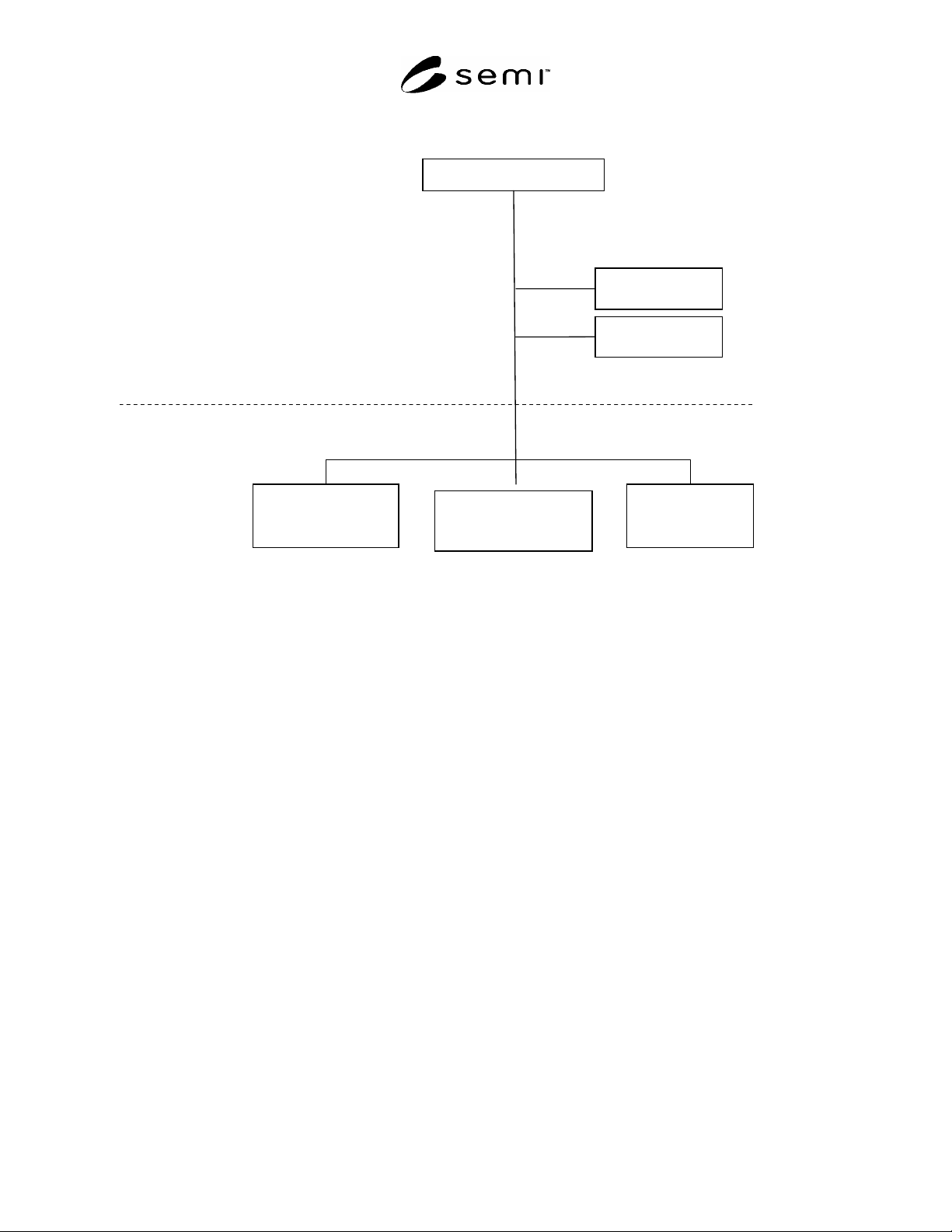
9.1.2.4 Example of Organization Chart of the SSCC
EHS Manager
Facility
Administrator(s)
Independent
Contractors
Equipment
Suppliers
and their contractors
Facility
Suppliers
and their contractors
Equipment
Administrator(s)
User Side
Supplier Side
Table 1
Example of Organization Chart of the SSCC
9.2 Role of the SSCC
9.2.1 Review and discuss all the safety issues (including concerns escalated by employees) about perceived or
obvious unsafe conditions, even though not listed below.
9.2.2 Review the safety of installation/overhaul/startup work based on the work procedure and work schedule.
9.2.2.1 Identify each hazardous task and review the appropriate work procedures.
9.2.2.2 Share the incident/accident information and recurrence preventive actions.
9.2.2.3 Follow the user safety rules. Verify all workers are trained
to perform tasks assigned to them.
9.2.2.4 Specify communication channel on hazardous work among affected suppliers and contractors.
9.2.2.5 Share the update of work status.
9.2.2.6 Discuss how to eliminate or mitigate each difficulty reported by safety patrol team.
9.2.2.7 Conduct safety patrol, report the results, such as unsafe action or violation, and take corrective action.
NOTE 5: The SSCC should discuss how to avoid intellectual property issues that might be generated when observing adjacent
work areas at a safety patrol.
9.2.2.8 Inform the affected employees how to respond including evacuation route and method in an emergency.
9.3 Specific activities of the SSCC
9.3.1 Establish a communication route from the user to the supplier/contractor workers so that results of the SSCC
meeting or the safety patrol can be conveyed to everyone smoothly each time. The workers should communicate
with each other and coordinate their work by informing each other of their work progress under the leadership of the
user.

SEMI S24-0705 © SEMI 2005 7
9.3.2 Have everyone know and follow the instruction of the incident/accident prevention measures after confirming
the work procedures based on the work schedule and the work procedures of the adjacent work area.
9.3.3 Cooperate with the user in their safety training so that the user safety rules will be known to everyone and
fully carried out.
9.3.4 Have each SSCC member report his/her respective work schedules and contents at respective work sites to the
council.
9.3.5 When conflict occurs among the schedules, adjust each work schedule among the user and affected
suppliers/contractors, and identify hazardous areas and restricted areas in multi-employer work areas. Notify each
company's workers of the adjustments.
9.3.6 Conduct safety patrol in the workplace and, if any unsafe condition, place or behavior is found, give proper
advice or instruction to the relevant worker on the spot and report it to the council.
9.3.7 Instruct everyone of the evacuation procedures.
9.3.8 Identify common warning signs.
9.3.9 Share all kinds of safety topics of the previous day.
9.4 Specific things to be reported to the SSCC
9.4.1 Floor opening or closing
9.4.2 Work performed on elevated surface
9.4.3 Using a scaffold, stepladder or ladder
9.4.4 Upper floor work or lower floor work
9.4.5 Starting gas or liquid chemical supply in a pipe
9.4.6 Turning on the facility electrical supply to the equipment
9.4.7 There is a possibility of affecting to an adjacent work area.
9.4.8 Having witnessed or caused an incident/accident
9.5 Inauguration of the SSCC
9.5.1 When two or more suppliers/contractors are conducting or planning installation, startup, or servicing of
equipment in the user fab simultaneously, the user should inaugurate Safety Supervisors’ Communication Council.
9.5.2 The user should confirm:
a supplier/contractor name,
number of workers,
a work supervisor’s name and how to contact him/her,
equipment name,
each tool name for the work,
qualification required for the work,
work contents, and
a training record of each worker.
9.5.2.1 After confirming above, the user should start the council activities, and each council members should carry
out their roles. (Refer to ¶9.2.)