semi合集-English.pdf - 第6932页
SEMI S8-0705 © SEMI 1995, 2005 29 R1-3 Maximum Recommended Grip Forces R1-3.1 The grip forces in Table R1-4 are based upon percentages of maxim u m one-t ime grip forces. The se values differ from maximum hand grip f orc…
SEMI S8-0705 © SEMI 1995, 2005 28
Body Part
Awkward Posture
#1
(angle in degrees from neutral)
Comments Image
Seated Postures
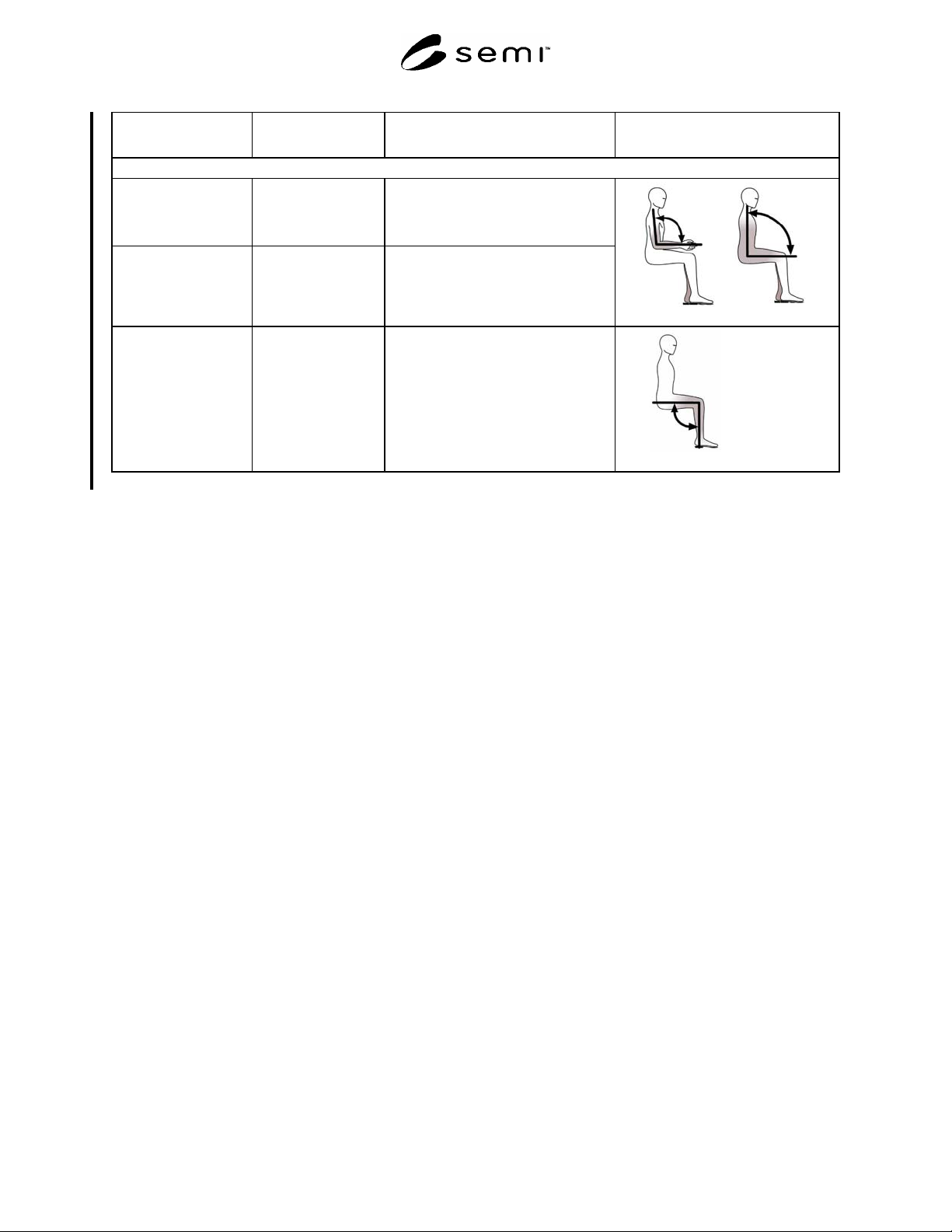
17. Elbow flexion < 90, OR > 120 A 90 elbow angle is defined as the
theoretical “neutral” position.
18. Back trunk-thigh
angle
< 90 Increasing the trunk-thigh angle
reduces pressure on the lower back.
17 18
19. Knee angle < 90 Increasing the angle at the knees
reduces stress at the knees.
19
#1
Joint angles adapted from Humanscale 7/8/9, The MIT Press, Massachusetts Institute of Technology, Cambridge, MA, 1981.
SEMI S8-0705 © SEMI 1995, 2005 29
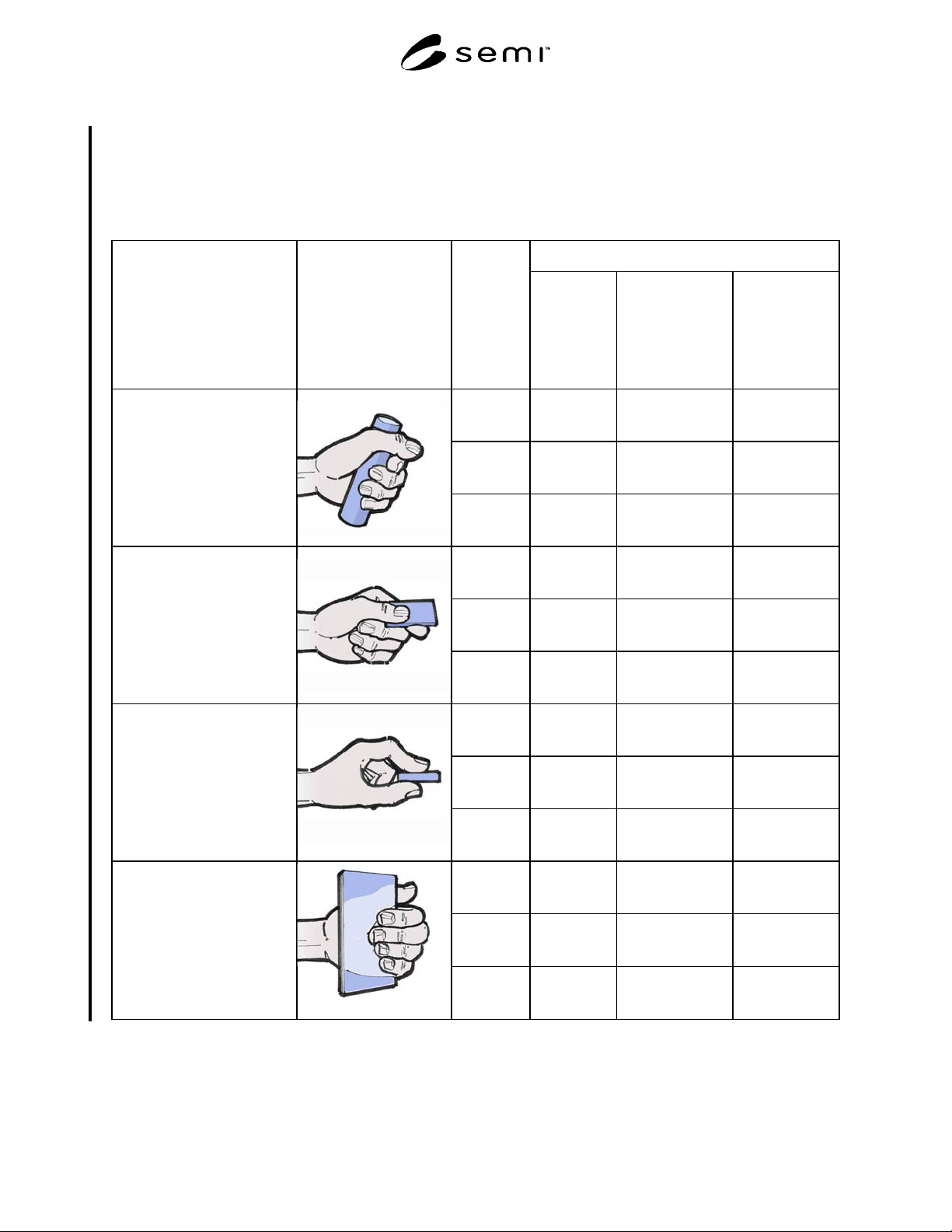
R1-3 Maximum Recommended Grip Forces
R1-3.1 The grip forces in Table R1-4 are based upon percentages of maximum one-time grip forces. These values
differ from maximum hand grip force values in Appendix 1: Supplier Ergonomic Success Criteria ¶6.7.1.1 through
¶6.9.2, which are maximum values for lift or pull forces based upon comfort and contact pressure against the hand.
Table R1-4 Maximum Recommended Grip Forces
Maximum Force
Grip Type Image Glove Use
Infrequent
Tasks
Repetition is
less than once
every 5 minutes
Occasional
Tasks
Tasks with a
repetition rate
between that of an
infrequent and a
f
requent tas
k
Static or
Frequent Tasks
Duration greater
than 4 seconds or
repeated more than
once every 30
seconds
Grip
without
gloves
137 N
(30.9 lbf.)
82 N
(18.5 lbf.)
41 N
(9.4 lbf.)
Grip with
cleanroom
gloves
116 N
(26.3 lbf.)
70 N
(15.7 lbf.)
35 N
(8.0 lbf.)
Power Grip:
The fingers of the hand wrap
around the object, and the
thumb overlaps the index
finger (e.g., gripping a
hammer).
Grip with
chemical
gloves
111 N
(25.0 lbf.)
66 N
(15.0 lbf.)
33 N
(7.6 lbf.)
Grip
without
gloves
35 N
(7.9 lbf.)
21.8 N
(4.9 lbf.)
10.7 N
(2.4 lbf.)
Grip with
cleanroom
gloves
30 N
(6.7 lbf.)
19 N
(4.2 lbf.)
9 N
(2.0 lbf.)
Lateral Pinch:
Object is held between the
thumb and the side of the index
finger (often referred to as key
grip).
Grip with
chemical
gloves
28 N
(6.4 lbf.)
18 N
(4.0 lbf.)
9 N
(1.9 lbf.)
Grip
without
gloves
24.5 N
(5.5 lbf.)
14.7 N
(3.3 lbf.)
7.6 N
(1.7 lbf.)
Grip with
cleanroom
gloves
21 N
(4.7 lbf.)
13 N
(2.8 lbf.)
7 N
(1.4 lbf.)
Tip Pinch:
Object held between the tips of
the thumb and index finger.
Grip with
chemical
gloves
20 N
(4.5 lbf.)
12 N
(2.7 lbf.)
6 N
(1.4 lbf.)
Grip
without
gloves
36 N
(8.2 lbf.)
21.6 N
(4.85 lbf.)
11.1 N
(2.5 lbf.)
Grip with
cleanroom
gloves
31 N
(7.0 lbf.)
18 N
(4.1 lbf.)
9 N
(2.1 lbf.)
Palmar Pinch:
Fingers pressed against the
palm of the hand, with the
object held between the fingers
and the palm. Thumb is not
used (e.g., picking up a sheet of
plywood).
Grip with
chemical
gloves
29 N
(6.6 lbf.)
18 N
(3.9 lbf.)
9 N
(2.0 lbf.)
SEMI S8-0705 © SEMI 1995, 2005 30
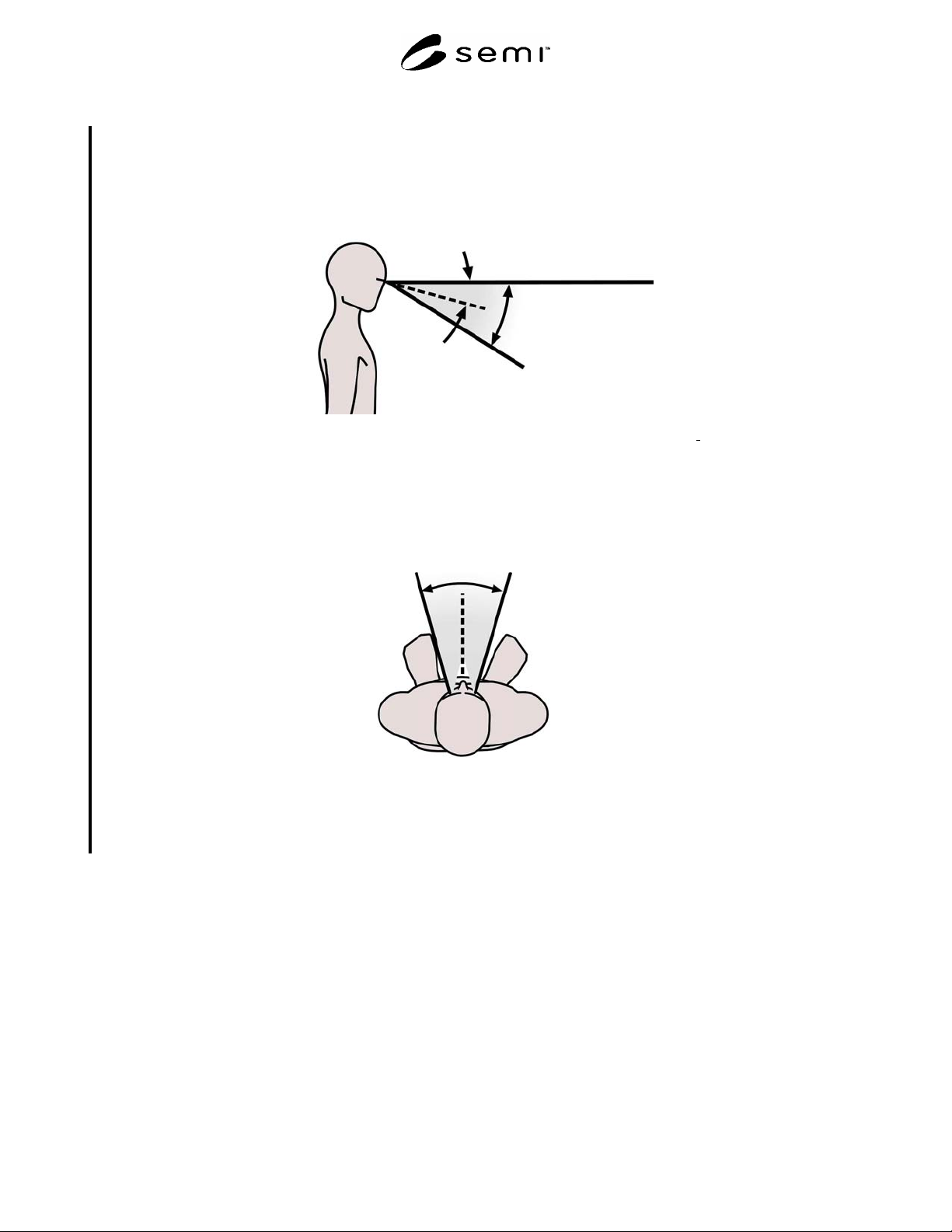
R1-4 Viewing Zones
R1-4.1 The Figures R1-3 and R1-4 depict the primary viewing areas for visual displays. This area is conical.
30
0
Primary
viewing
area
Eye at rest
15
0
Horizontal
line of sight
NOTE: This figure is based on data from: Pheasant, Stephen., Bodyspace: Anthropometry Ergonomics
and Design, Taylor and
Francis, 1996.
Figure R1-3
Side View of Primary Viewing Area for Visual Displays
Primary viewing area
30
0
NOTE: This figure is based on data from: Eastman Kodak Company, Ergonomic Design for People at Work (2
nd
Ed.), John
Wiley & Sons Inc., 2004.
Figure R1-4
Top View of Primary Viewing Area for Visual Displays