semi合集-English.pdf - 第7081页
SEMI S18-1102 © SEMI 2002 19 RELATED INFORMATION 1 SILANE SAFETY CONTROL SYSTEMS NOTICE: This Related Information is not an official balloted part of SE MI S 18. It is i nc l uded t o assist the user of the document in u…
SEMI S18-1102 © SEMI 2002 18
© 2001 Factory Mutual Insurance Company. Reprinted with permission from FM Global Property Loss Prevention Data Sheet 7-7
‘Semiconductor Fabrication Facilities’
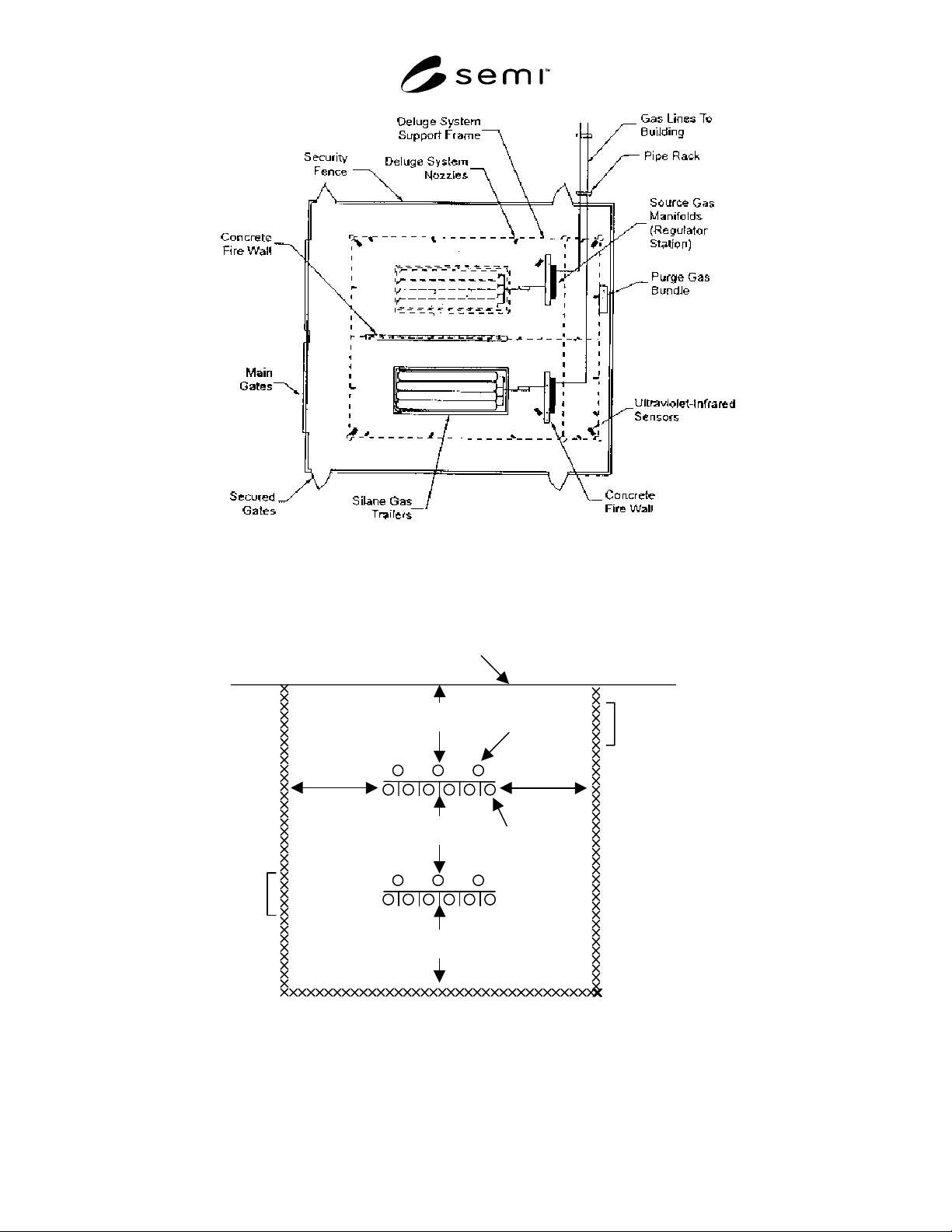
Figure 1
Bulk Silane Storage/Dispensing Facility
Fabrication building /Support building
Exit
Exit
Open chain-link fence
2.7m (9ft)
2.7m (9ft)
2.7m (9ft)
2.7m
(9ft)
2.7m
(9ft)
Purge
cylinders
Gas
cylinders
2.7 m
2.7 m (9 f t
)
2.7 m
2.7 m
(
9 f t
)
2.7 m
(
9 f t
)
(9 f t )
(9 f t )
© 2001 Factory Mutual Insurance Company. Reprinted with permission from FM Global Property Loss Prevention Data Sheet 7-7
‘Semiconductor Fabrication Facilities’
Figure 2
Exterior Dispensing Areas for Cylinder Rack System

SEMI S18-1102 © SEMI 2002 19
RELATED INFORMATION 1
SILANE SAFETY CONTROL SYSTEMS
NOTICE: This Related Information is not an official balloted part of SEMI S18. It is included to assist the user of
the document in understanding effective control systems. Publication is authorized by vote of the responsible
committee.
R1-1 Silane Safety Control Systems
R1-1.1 These systems should be fail-safe and fault-tolerant in order to perform effectively.
R1-1.2 In order for Silane Safety Control Systems to continually monitor the status of the gas delivery system that
they control, they should be connected to devices that provide real-time information on the parameters of the system
being monitored.
R1-1.3 Devices such as pressure transducers, and cycle counters should operate in conjunction with the software
that ensures the parameters (pressure, counts, etc.) are within the safe operating limits for the silane family gas
controlled.
R1.3.1 Software (firmware) that monitors the data from such devices should have the following features:
a) Protected from access by unauthorized personnel,
b) Require version testing before the version can be installed in active controller systems,
c) Have tolerance to accidental keystroke errors (such as asking if you really want to make a change), and
d) Require review and approval by a supervisory entity before it can be placed on line.
R1-1.4 In locations where ignitable mixtures of air and flammable gas can form in normal operation or as the
result of a single, credible failure, the control devices should not be capable of igniting the mixture.
R1-1.4.1 This criterion applies to ALL types of controls, including fire protection, leak detection, and process
safety monitoring.
SEMI S18-1102 © SEMI 2002 20
RELATED INFORMATION 2
EXAMPLES OF CALCULATIONS FOR MAXIMUM POTENTIALS FOR
SILANE FAMILY GASES
NOTICE: This Related Information is not an official balloted part of SEMI S18. It is included to assist the
user of the document in understanding effective control systems. Publication is authorized by vote of the responsible
committee.
R2-1 Release Potentials
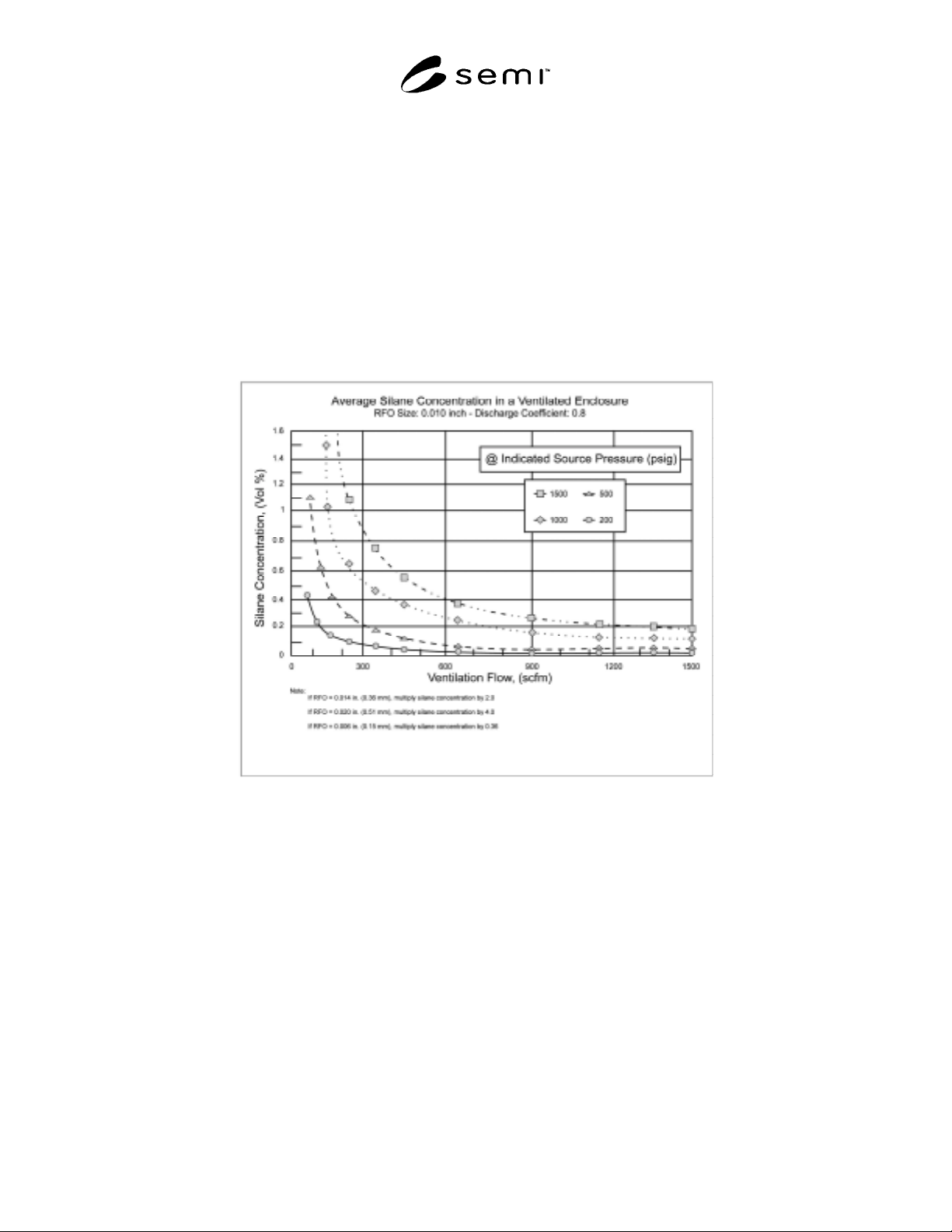
R2-1.1 In gas cabinets, size the ventilation system to limit the maximum concentration of silane inside the cabinet
to 0.4 percent by volume. Base the maximum concentration of silane inside the gas cabinet on the continuous release
of SiH
4
at a standard volumetric flow rate given by the size of the RFO in the discharge line and the maximum SiH
4
gas cylinder storage pressure (see Table R2-1). For a 0.4 percent concentration, the required ventilation airflow rate
can be estimated from Figure R2-1.
© 2001 Factory Mutual Insurance Company. Reprinted with permission from FM Global Property Loss Prevention Data Sheet 7-7
‘Semiconductor Fabrication Facilities’
Figure R2-1
Average Silane Concentration in a Ventilated Enclosure