semi合集-English.pdf - 第1895页
SEMI E54.1-1000 © SEMI 1996, 2000 1 SEMI E54.1-1000 STANDARD FOR SENSOR/ACTUATOR NETWORK COMMON DEVI CE MODEL This st andard w as technica lly approve d by the Global Inform ation & Contr ol Comm ittee and is the dir…
SEMI E54-0705 © SEMI 1997, 2005 10
RELATED INFORMATION 2
INDEX FOR SENSOR/ACTUATOR STANDARDS
NOTICE: This related information is not an official part of SEMI E54 and is not intended to modify or supercede the official
standard. After approval of this document, publication of this Related Information was authorized by the committee chairs solely
to aid in identifying the relationships between the current Sensor Bus standards and documents in process. Determination of the
suitability of the material is solely the responsibility of the user.
R2-1 Scope
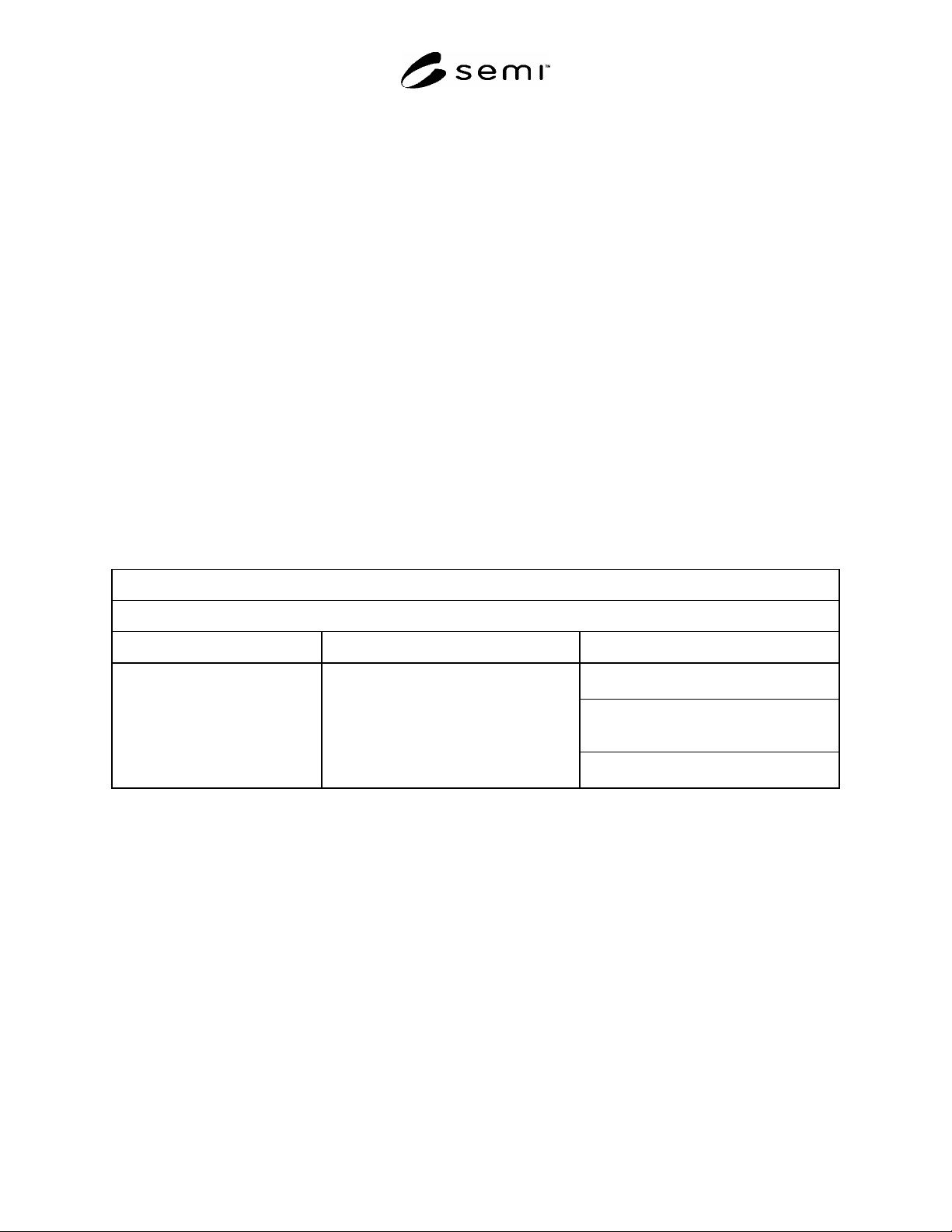
R2-1.1 The table below is based on Figure 1 in SEMI E54.1, and is intended to show the relationships between
standards that are currently published, as well as describe documents in process in SEMI Standards that, if approved,
will be added to SEMI E54.
R2-1.2 There are five categories:
Main Document
Templates
Specific Device Model
Common Device Model
Network Communication Standards
R2-1.3 Standard titles with a designation number are published documents, and descriptors without designation
numbers are documents in process.
Table R2-1 Sensor/Actuator Network (SAN) Standards
SEMI E54, Sensor/Actuator Network (SAN) Standard
Templates (How to Write Network Communications Standards (NCS) and Specific Device Models (SDM))
Specific Device Models Common Device Models Network Communications Standards
SEMI E54.4, Standard for SAN
Communications for DeviceNet
SEMI E54.5, Standard for SAN
Communications for the Smart Distributed
System (SDS)
Mass Flow Controller SDM
SEMI E54.1, Standard for Sensor/Actuator
Network Common Device Model
SEMI E54.6, Standard for SAN
Communications for LONWorks
NOTICE: SEMI makes no warranties or representations as to the suitability of the standard set forth herein for any
particular application. The determination of the suitability of the standard is solely the responsibility of the user.
Users are cautioned to refer to manufacturer’s instructions, product labels, product data sheets, and other relevant
literature respecting any materials mentioned herein. These standards are subject to change without notice.
The user’s attention is called to the possibility that compliance with this standard may require use of copyrighted
material or of an invention covered by patent rights. By publication of this standard, SEMI takes no position
respecting the validity of any patent rights or copyrights asserted in connection with any item mentioned in this
standard. Users of this standard are expressly advised that determination of any such patent rights or copyrights, and
the risk of infringement of such rights, are entirely their own responsibility.
Copyright by SEMI® (Semiconductor Equipment and Materials
International), 3081 Zanker Road, San Jose, CA 95134. Reproduction of
the contents in whole or in part is forbidden without express written
consent of SEMI.

SEMI E54.1-1000 © SEMI 1996, 20001
SEMI E54.1-1000
STANDARD FOR SENSOR/ACTUATOR NETWORK COMMON DEVICE
MODEL
This standard was technically approved by the Global Information & Control Committee and is the direct
responsibility of the North American Information & Control Committee. Current edition approved by the
North American Regional Standards Committee on July 14, 2000. Initially available at www.semi.org
August 2000; to be published October 2000. Originally published in 1996; previously published February
1999.
NOTE: This document was previously designated SEMI E54.
Because this document is part of a suite of documents, its
designation has been reassigned for ease of reference.
1 Purpose
This standard defines a model comprised of device
objects which are common to all devices on a semicon-
ductor equipment sensor/actuator communications
network.
2 Scope
2.1 This document describes common device structure
and behavior (i.e., the minimum data structure and
behavior all devices must support to operate on the
network). These devices may range from simple sensors
and actuators through hosts, masters, or controllers.
2.2 The model specified in this do cument is used in
conjunction with a sensor/actuator network specific
device model which describes the data structure and
behavior characteristic of the specific device. Together,
these two models are sufficient to completely describe a
device as it appears from the network interface.
2.3 This standard, together with a sensor/actuator
network interoperability guideline, a sensor/actuator
network communication specification, and one or more
specific device model specifications, form a complete
interoperability specification. The sensor/actuator
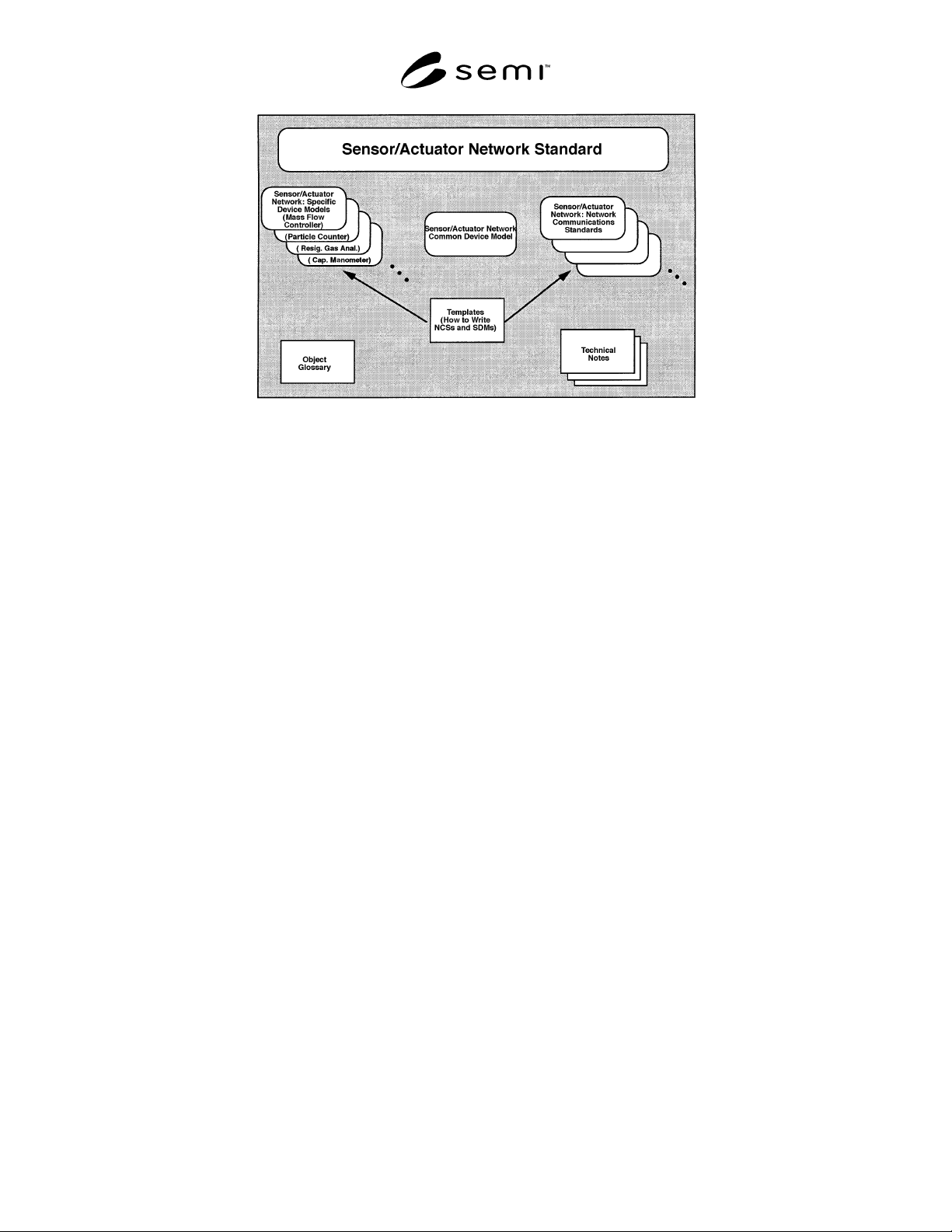
network document architecture is shown in Figure 1.
2.4 To comply with this standard, a device must
implement and support instances of the objects, object
attributes, object services, and object behaviors ident-
fied in this document, unless explicitly stated otherwise.
3 Limitations
3.1 This standard is a companion to a suite of sensor/
actuator network communication network specifica-
tions. Therefore, using portions of this standard that re-
late to network communications necessarily requires an
understanding of the associated network specification.
3.2 As this document is a standard for a common
device model, it does not contain any information (e.g.,
object, attribute, services, or behavioral descriptions)
that relates to a specific device or device type.
3.3 While the standards depicted in Figure 1 are
sufficient to completely describe a device as it appears
from the network, they do not fully describe behavior of
the device which is not visible from the network. Some
of the behavior detail within standard objects is inten-
tionally left to the manufacturer to define. This allows
flexibility for product differentiation and creates room
for technology evolution. Manufacturer-specific objects
may be defined by the manufacturer as appropriate, but
are by definition outside the scope of this standard.
3.4 This standard is compatible, but not compliant,
with SEMI E39. This means that although this standard
does not require compliance with SEMI E39, it is
extensible such that implementations may be developed
that are fully compliant with both standards. Note that
the concepts and terminology of this standard are
compatible with those of SEMI E39. However, SEMI
E39 has specific requirements that are intended for
higher level applications and thus are not applied to the
Common Device Model.
4 Referenced Documents
4.1 SEMI Documents
SEMI E30 — Generic Model for Communications and
Control of SEMI Equipment (GEM)
SEMI E39 — Object Services Standard: Concepts,
Behavior, and Services
4.2 Other Documents
ISO 7498
1
— Basic Reference Model for Open
Systems Interconnection
David Harel, “Statecharts: A Visual Formalism for
Complex Systems,” Science of Computer Programming
8, 1987
James Rumbaugh, Michael Blaha, William Premerlani,
Frederic Eddy, William Lorensen, Object-Oriented
Modeling and Design, Englewood Cliffs, New Jersey:
Prentice-Hall, 1991
1 International Organization for Standardization, 1 rue de Varembe,
Case postale 56, CH-1211, Geneva 20, Switzerland. Available in the
US from American National Standards Institute, 11 West 42nd Street,
13th Floor, New York, NY10036.
SEMI E54.1-1000 © SEMI 1996, 2000 2
Figure 1
Sensor/Actuator Network-Related Documents
5 Terminology
Terminology may be reproduced here which is defined
in other SEMI documents.
5.1 Device Component Terminology
5.1.1 attribute — Externally visible information
concerning an object.
5.1.2 behavior — A specification of how an object
acts. Actions result from different events the object
detects, such as receiving service request, detecting
internal faults, or elapsing timers.
5.1.3 class — A specific type or classification of
objects.
5.1.4 device — A tangible thing consisting of: (1) at
least one sensor and/or actuator and/or controller, (2) a
communications controller which supports a single
point of access to a network as specified in this docu-
ment, and (3) interconnection and management hard-
ware and software that provides for the consolidation of
(1) and (2) into a system that has the capability to
comply with the specification detailed in this document.
Examples of devices are given in Figure 2.
5.1.5 device model — An abstractio n of a device for
the purpose of understanding it before building it or
using it.
5.1.6 embedded object — An embedded object is sim-
ilar in functionality or purpose to the object in which it
is embedded, or supports the functionality of the object
in which it is embedded. The embedding construct is
utilized solely for purposes of documentation structure
and understanding. As such, it does not imply any
direct relationship, inheritance, similarity in structure,
or connectivity in addressing scheme between the em-
bedded object and the object in which it is embedded.
5.1.7 instance — A specific and real occurrence of an
object.
5.1.8 manufacturer — In the context of this document,
this refers to the manufacturer of the device.
5.1.9 object — An entity with a specific set of data
and behaviors. Objects may be physical or conceptual.
An object may be described in terms of its attributes,
services it provides, and behavior it exhibits.
5.1.10 service — A function offered or supported by
an object. A service consists of a sequence of service
primitives, each described by a list of parameters. A
service excludes definition of message structure and
protocol.
5.1.11 state diagram — A means of representing state
transitions, where the boxes represent states and the
arrows represent transitions between states.
5.2 Data Type Terminology — Unless otherwise
noted, data type terminology defined in SEMI E39 will
be used in this document. The following terminology
will also be used:
5.2.1 Boolean (BOOL) — A binary bit representing 0
and 1 corresponding to FALSE and TRUE or
DISABLE and ENABLE respectively.
5.2.2 byte — A string of eight adjacent bits,
interpreted as a unit and often representing a character.
5.2.3 character — A text symbol, letter, digit, or mark
used to represent, control, or organize information that
is one byte in length.
5.2.4 character string — A text string.