semi合集-English.pdf - 第1744页
SEMI E42-0704 © SEMI 1995, 2004 13 2.2 Major Objects in RMS — Recipe Management is concern ed with the major areas of functionality illu strated in Figure 2.1: re cipes 3 , recipe namespaces providing persist ent recipe …
SEMI E42-0704 © SEMI 1995, 2004 12
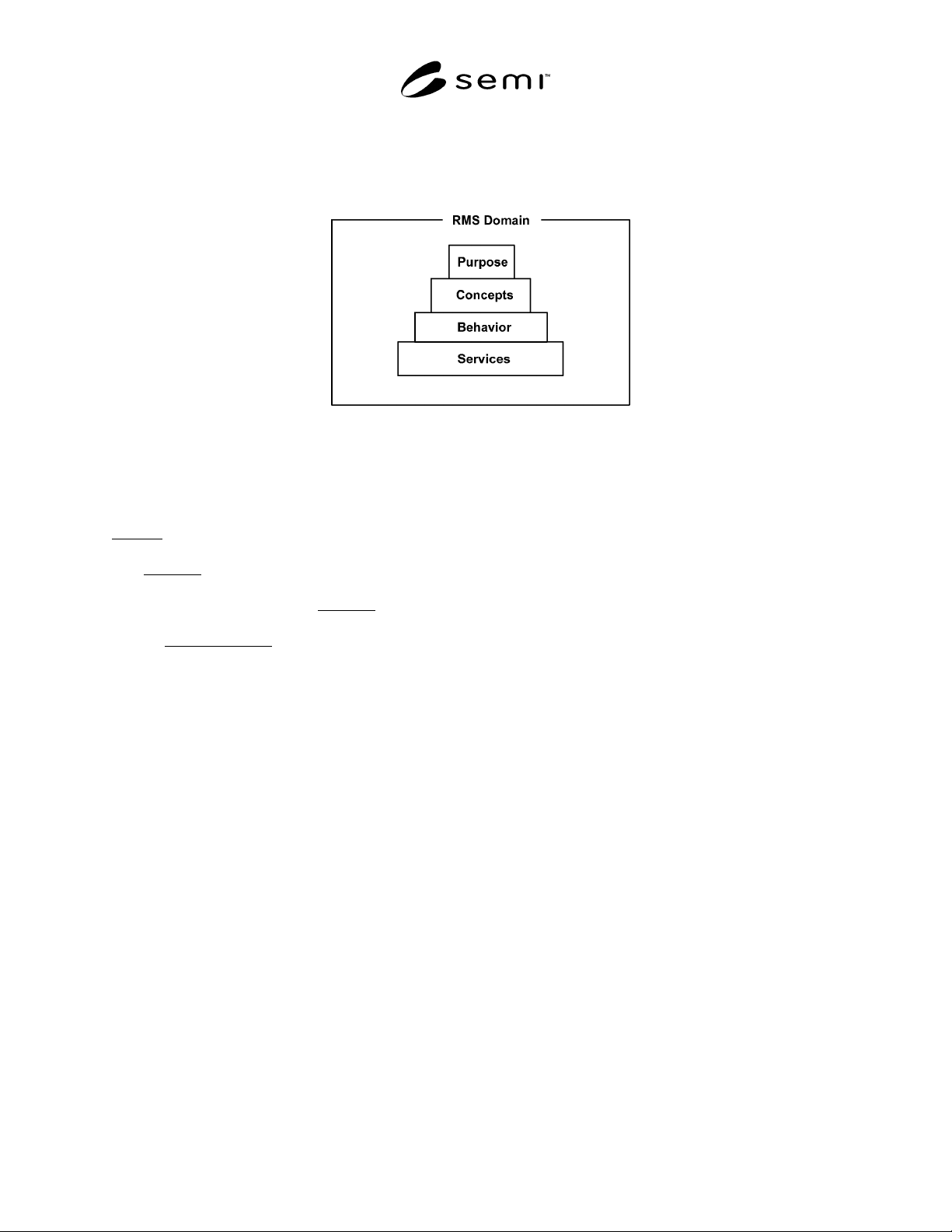
1.7 Document Structure — Figure 1.1 depicts the domain of the Recipe Management Standard as consisting of
Purpose, Concepts, Behavior, and Message Services. This also reflects an underlying structure of the document.
Figure 1.1
Recipe Management Domain
Purpose
provides the motivation for Recipe
Management capabilities and is addressed in Section
1.6. Concepts
provide a detailed introduction to the
standardized objects of RMS, their attributes, and their
relationships with other objects. Behavior
describes the
operations that are performed by, or on, these objects.
Finally, message services
define the messages and their
parameters independently of the protocol in which they
are implemented. Both concepts and behavior represent
an "inside view" of an RMS application, while services
provide an interface from an external view.
• Section 1: the formal introduction to RMS.
• Section 2: an overview of the major objects of RMS
and their relationships, to provide a general
context for the technical detail that follows.
• Sections 3-6: concepts for recipes, recipe
namespace, distributed recipe namespace, and
recipe executor.
• Section 7: the concept of the agent and of service
resources, to provide a more complete context for
RMS implementations.
• Sections 8-11: behavior (operations) for recipe
management, namespace management, distributed
recipe namespace management, and the recipe
executor.
• Sections 12-14: definitions of message services for
the recipe namespace, distributed recipe
namespace, and recipe executor service resources.
• Section 15: RMS compliance.
• Section 16: a glossary of terms, provided as a
convenient reference.
• Related Information: provides background
information on the requirements behind RMS and
examples of applications.
1.8 Applicable Documents
ISO/TR 8509:1987, Information Processing Systems,
Open Systems Interconnection — Service Conventions.
2 Overview of RMS
This section provides an introduction to, and overview
of, the major objects of RMS.
2.1 Recipe Management Models — To provide a
clearer understanding of the major entities or areas of
functionality specified by RMS, they are portrayed as
objects in RMS models, using OMT notation.
Relationship lines in the object-based models do not
represent a direct communication link between objects,
but rather the knowledge and association that one object
has with respect to another.
The models do not indicate the relative location of two
objects.
SEMI E42-0704 © SEMI 1995, 2004 13
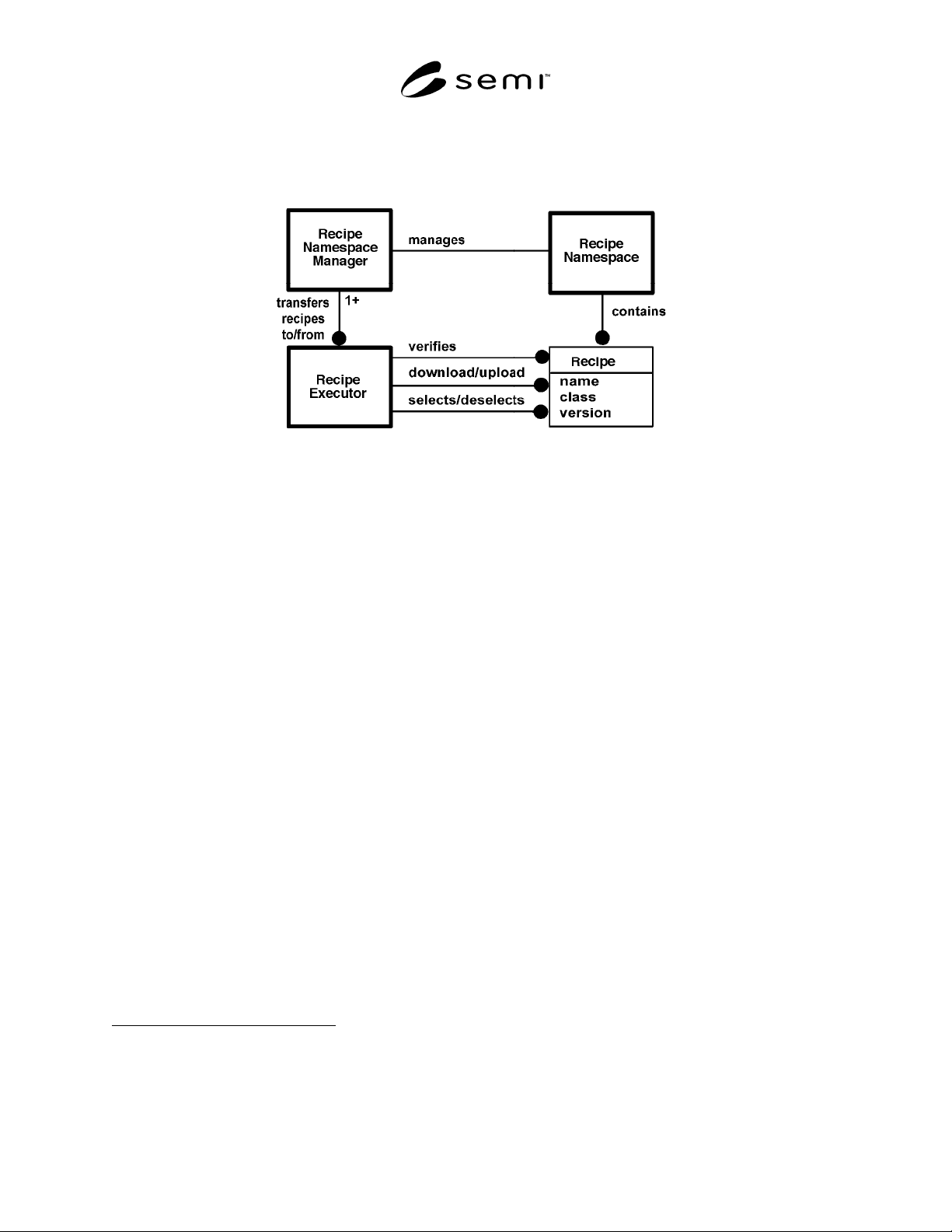
2.2 Major Objects in RMS — Recipe Management is concerned with the major areas of functionality illustrated in
Figure 2.1: recipes
3
, recipe namespaces providing persistent recipe storage, recipe namespace managers that
provide management of the namespace and access to its recipes, and the recipe executor that executes recipes.
Figure 2.1
Major Objects of RMS
3 The recipe object in Figure 2.1 is not itself a standardized object. However, two recipe subtypes defined in Section 3 are standardized objects.
2.2.1 Recipes — Recipes provide a flexible,
manipulatable, and re-usable form for users to select
sequencing and settings to effect a particular result.
Equipment uses recipes in a variety of ways to control
the processing environment, sometimes using several
types of recipes together. Recipes may also be used for
maintenance activities, such as calibration or cleaning.
Recipes can be modified and copied from one
environment to another. Their inherent flexibility as a
form also becomes an endless source of problems
unless they can be managed. Misprocessing,
unintentionally running the wrong recipe for a given
product, is prohibitively expensive for factories.
RMS defines a recipe as an object with attributes —
information about the recipe — as well as content. It is
the attributes of the recipe that allow true management
of recipes, throughout their lifecycles, to occur.
2.2.2 Recipe Namespace — A recipe namespace in
RMS is analogous to a smart file directory. The
namespace provides long-term recipe storage
capability.
Basic operations are part of the namespace
specification. For example, recipes can be copied from
one namespace to another, copied within a namespace,
renamed, created, updated, and deleted. They can be
downloaded to, and uploaded from, an application
called a recipe executor. Several recipes can be linked
together to form a set.
The namespace also can serve as a recipe pool that can
be shared by a group of equipment of a common type.
The distributed recipe namespace is a namespace able
to utilize and manage recipe storage provided by such
an equipment group.
2.2.3 Recipe Namespace Manager — The recipe
namespace itself is passive, a container for recipes. The
recipe namespace manager (manager) provides the
dynamic element that manages the namespace. The
manager represents the interface for the namespace to
the external world and the internal decision authority
within the namespace.
SEMI E42-0704 © SEMI 1995, 2004 14
2.2.4 Recipe Executor — The recipe executor (executor) is the component of an agent that understands the
contents of a recipe and is able to verify their syntactical correctness and to validate that it can be executed under
the current configuration. It executes a recipe by reading its contents and applying them appropriately in order to
achieve a desired result.
The recipe executor also may provide additional limited storage capability, but it is restricted from modifying
existing recipes, except under special conditions, to prevent unexpected and/or unwanted change.
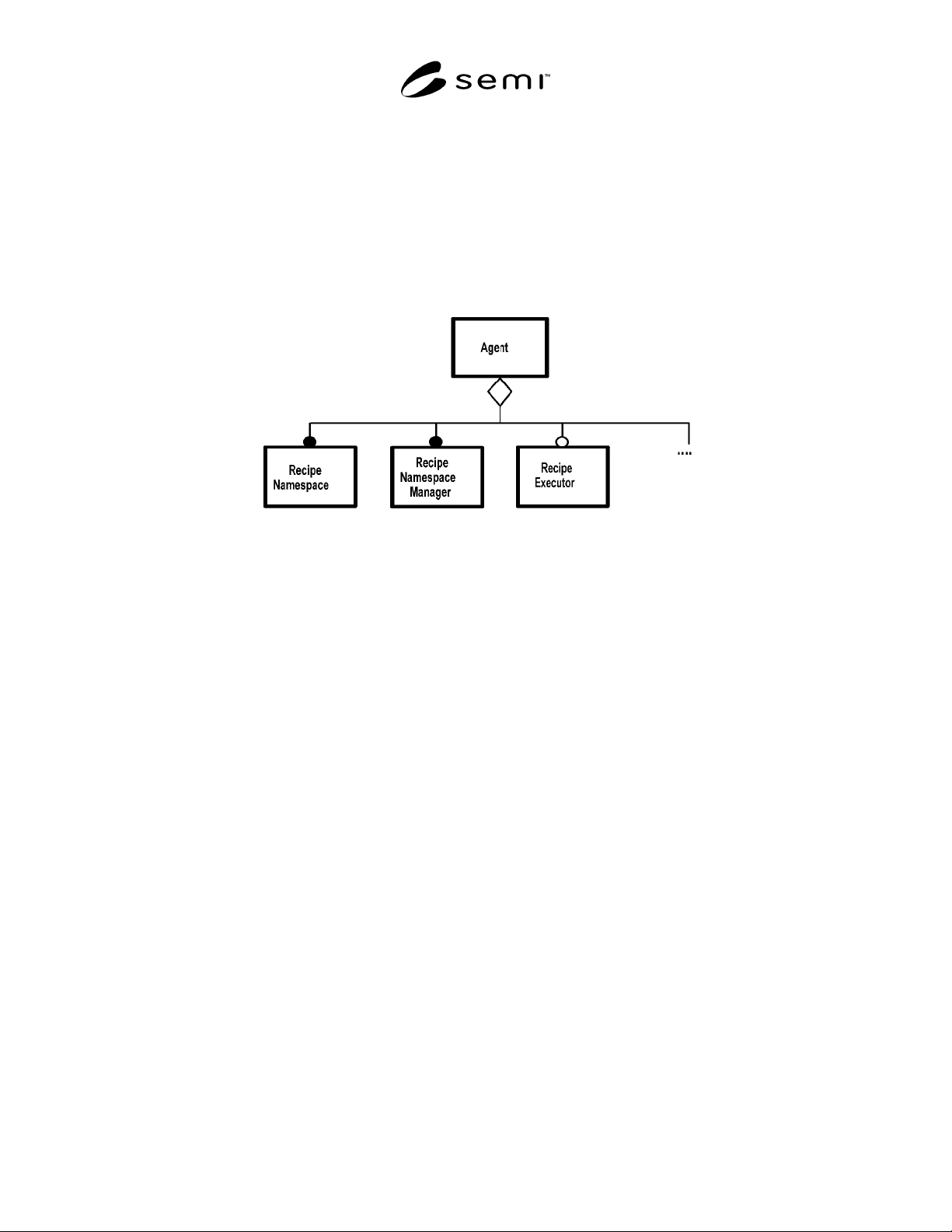
2.3 Agent — As used in RMS, an agent is a system, or subsystem, in a factory, that has a physical aspect. It consists
of one or more applications that provide and/or use service resources, such as a recipe namespace manager and/or a
recipe executor, as illustrated in Figure 2.2.
Figure 2.2
An Example of an Agent and Component Applications
Agent is a generalization that covers traditional equipment, supervisory or aggregate systems such as stations, cells,
and clusters, and intelligent subsystems within equipment, such as process modules within a cluster. Other types of
agents may also be implemented, such as those dedicated to recipe namespace management.
An agent that provides a recipe executor is called an executing agent. Equipment is an executing agent with
associated hardware to which the recipe applies and which it uses to do work.
2.4 Implementations — RMS can be implemented on different platforms within a factory. A host controller may
only provide recipe namespace management, while a diskless cluster module may provide only recipe execution.
Traditional equipment capable of operating in stand-alone mode is required to provide a recipe namespace that is
available on powerup as well as a recipe executor component. Additional examples of implementations of RMS are
provided in Related Information 1.
RMS defines the services provided through an external interface. Communications between or within applications
that are internal to an agent are not covered by RMS, so long as the attributes and operations comply with RMS
requirements.
3 Recipes
This section describes the concepts concerning recipes.
3.1 Motivations — Definitions of recipe structure, attributes, and operations address the following issues:
• maintenance of recipe attributes for management and traceability,
• provision of a standard method for transferring attributes separately, as well as with the recipe body,
• reduction or elimination of the need for dedicated recipe editors,
• support for applications requiring multiple recipe types, such as formats or language syntaxes,
• run-to-run control,