semi合集-English.pdf - 第6927页
SEMI S8-0705 © SEMI 1995, 2005 24 RELATED INFORMATION 1 ANTHROPOMETRIC RESOURCE DATA NOTICE : This related i nformati on is not an official part of SEMI S8 and is not intended to m odify or supersede the official guideli…
SEMI S8-0705 © SEMI 1995, 2005 23
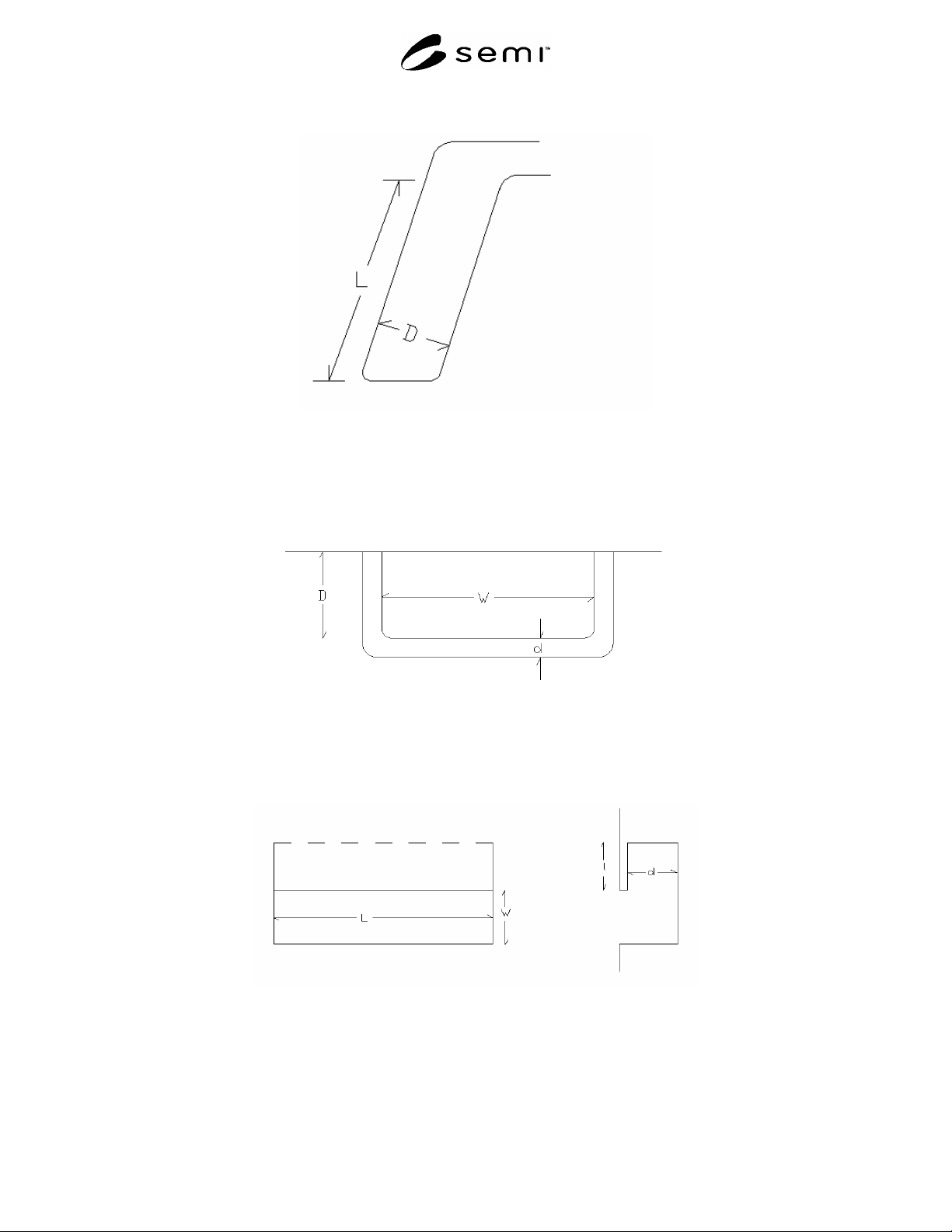
A3-1.1.4 Pistol Grip Handle
Figure A3-4
Pistol Grip Handle
D - Handle diameter
L - Handle length
A3-1.1.5 Enclosed Handle
Figure A3-5
Enclosed Handle
D - Handle depth
W - Handle width
d - Handle diameter
A3-1.1.6 Hook Grasp Handle, or Finger Pull Handle
Figure A3-6
Hook Grasp Handle, or Finger Pull Handle
W - Handle opening width
L - Handle opening length
l - Handle lip length
d - Handle depth
SEMI S8-0705 © SEMI 1995, 2005 24
RELATED INFORMATION 1
ANTHROPOMETRIC RESOURCE DATA
NOTICE: This related information is not an official part of SEMI S8 and is not intended to modify or supersede the
official guidelines. It was derived from the work of the originating task force. Publication was authorized by full
ballot procedures. Determination of the suitability of the material is solely the user’s responsibility.
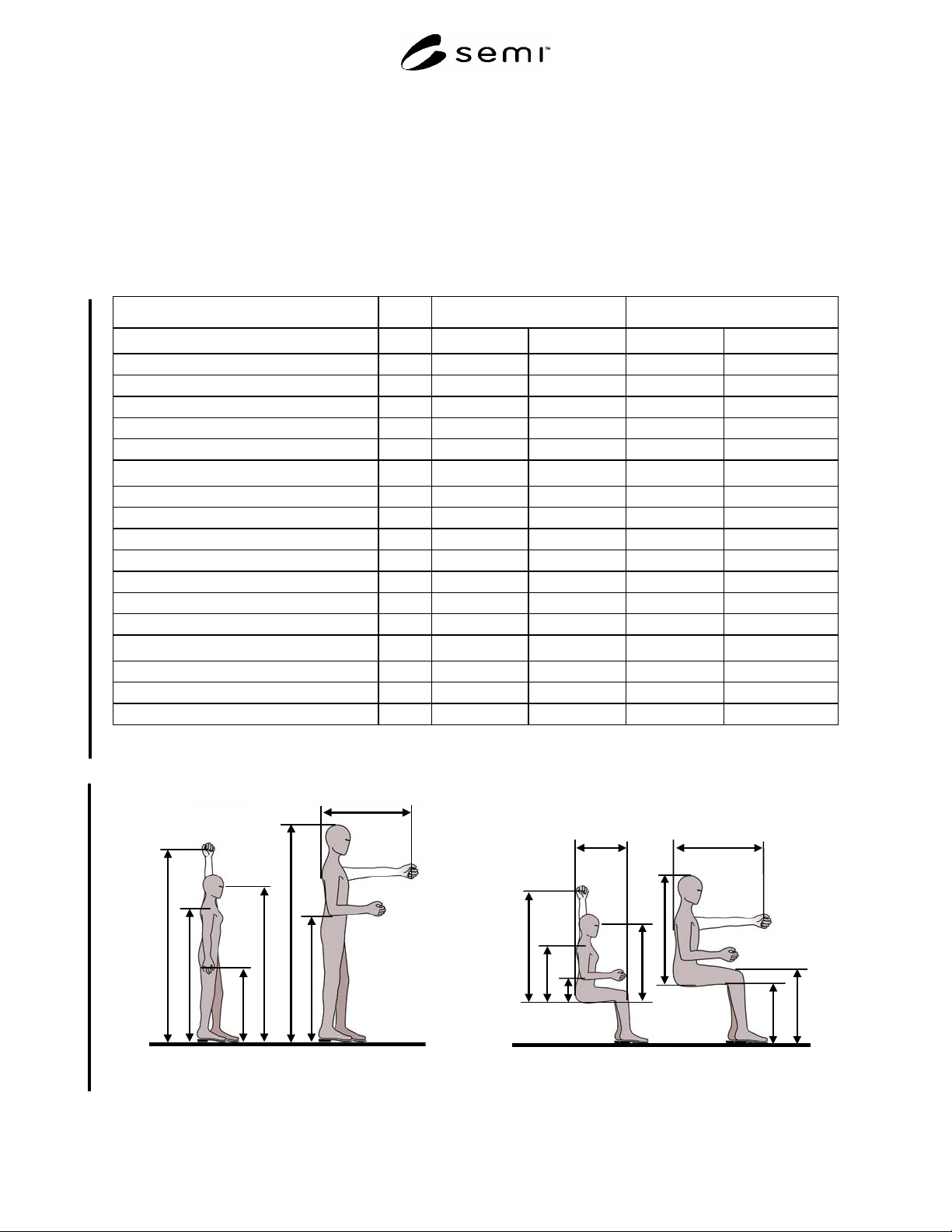
R1-1 Selected 5th Percentile Female and 95th Percentile Male Standing and Seated Dimensions
Table R1-1 Selected Body Dimensions for Females and Males (see Figures R1-1 and R1-2)
Criteria Label 5th Percentile Female (Asian) 95th Percentile Male (U.S.)
Standing Dimensions
#1
mm inch mm inch
Stature
#2
(A) 1471 57.9 1895 74.6
Eye Height
#2
(B) 1356 53.4 1763 69.4
Shoulder height
#2
(C) 1206 47.5 1572 61.9
Elbow height
#2
(D) 894 35.2 1214 47.8
Knuckle height
#2
(E) 676 26.6 831 32.7
Seated Dimensions
#1
mm inch mm inch
Seated height (F) 780 30.7 973 38.3
Eye height (G) 660 26.0 843 33.2
Shoulder height (H) 510 20.1 645 25.4
Elbow height (I) 165 6.5 287 11.3
Buttock-knee length (J) 470 18.5 650 25.6
Popliteal height
#2
(K) 350 13.8 521 20.5
Knee height
#2
(L) 434 17.1 632 24.9
Reach Distances
#1
mm inch mm inch
Standing vertical grip reach
#2
(M) 1712 67.4 2134 84.0
Sitting vertical grip reach (N) 855 33.7 1356 53.4
Forward grip reach (O) 580 22.8 787 31.0
#1
Dimensions based on Pheasant (1988), MIL-STD-1472D (1994), and SAE J833 (1989).
#2
An allowance of 25mm (1 inch) has been made for shoes on all vertical dimensions where the feet touch the floor.
M
C
D
B
E
O
A
Figure R1-1
Standing Dimensions
N
H
I
G
K
O
F
L
J
Figure R1-2
Seated Dimensions
SEMI S8-0705 © SEMI 1995, 2005 25
R1-2 Neutral and Awkward Postures
R1-2.1 An important concept in the field of ergonomics is the “neutral posture”. A neutral posture is the body
position that minimizes stresses on the joints and is the posture where a person has the greatest strength potential.
The neutral posture for each joint is near the middle of its range of motion. Generally, the body in its neutral
position is standing erect with the eyes looking forward, and the arms hanging by the sides, as defined by ¶5.2.25.
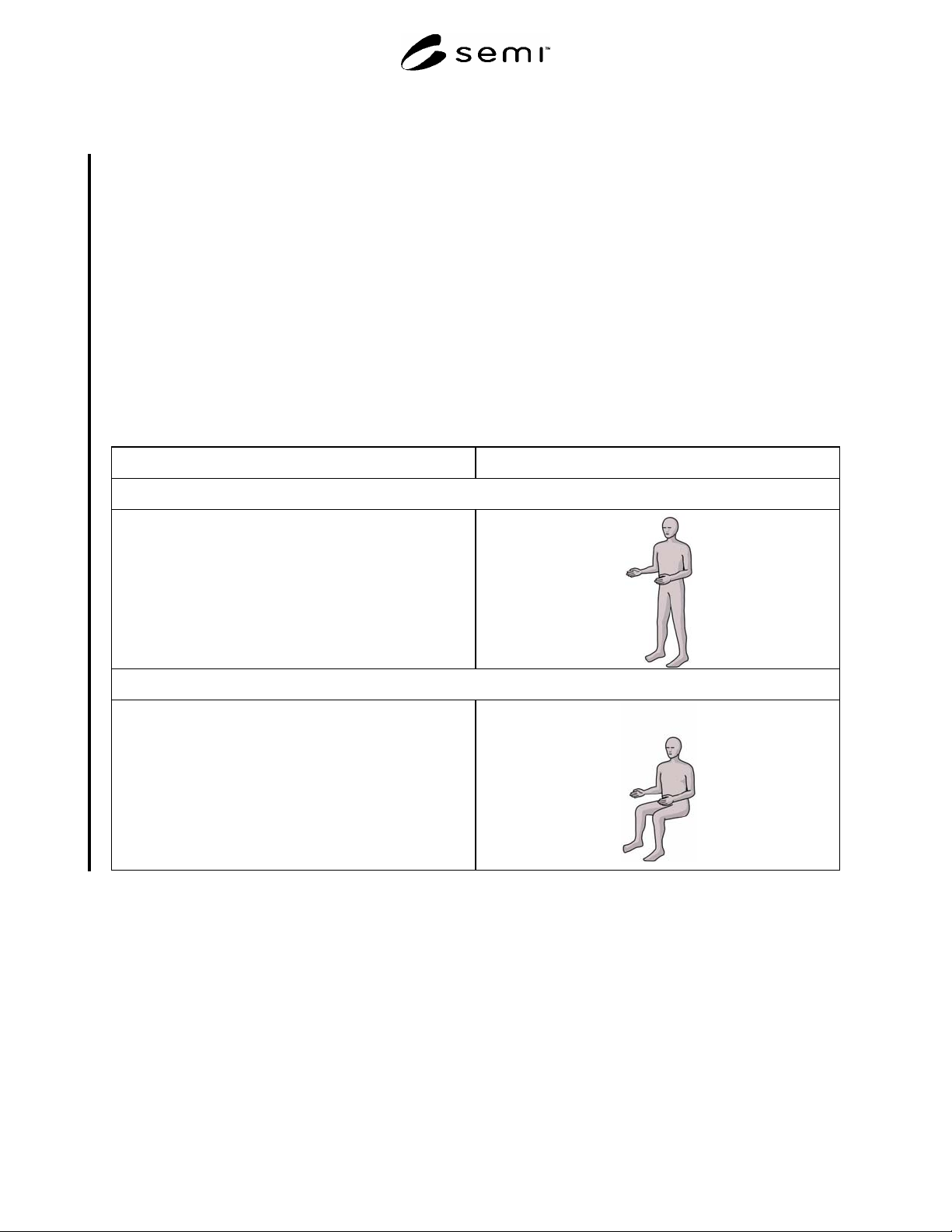
R1-2.2 Neutral postures are shown for standing and seated tasks in Table R1-2. The joint angles of these neutral
postures are used as the origin when measuring angular deviations of body part(s) to determine if a posture is
awkward.
R1-2.3 When the body is in a non-neutral posture, potential strength and efficiency decrease. Table R1-3 depicts
selected awkward postures. Angular deviations of the body part(s) from a neutral posture are shown for the
appropriate joint(s).
R1-2.4 It is not always practicable to design equipment and tasks so that personnel remain in neutral postures. The
intent of these tables is to show the neutral postures for reference and the awkward postures that, according to the
normative portions of this document (e.g., ¶6.1.1 and ¶A2-1.2) should be avoided.
Table R1-2 Neutral Postures for Standing and Seated Tasks
Posture Image
Standing Task
Arms loosely at the sides with the shoulders relaxed
Forearms parallel with the floor
Hands in the “handshake” position
Back has a natural “S” curve
Knees slightly bent
Feet are shoulder-width apart, pointing slightly outward
Head looking forward and slightly downward
Seated Task
Arms loosely at the sides with the shoulders relaxed
Forearms parallel with floor
Hands in the “handshake” position
Back has a natural “S” curve
Knee angle greater than 95 degrees
Feet are shoulder-width apart, pointing slightly outward
Head looking forward and slightly downward