semi合集-English.pdf - 第4228页
SEMI F74-1103 © SEMI 2002, 2003 15 NOTICE: SEMI makes no warranties or represen tations as to the suitability o f the standards set forth herein for any particular application. The determination of the suitability of the…
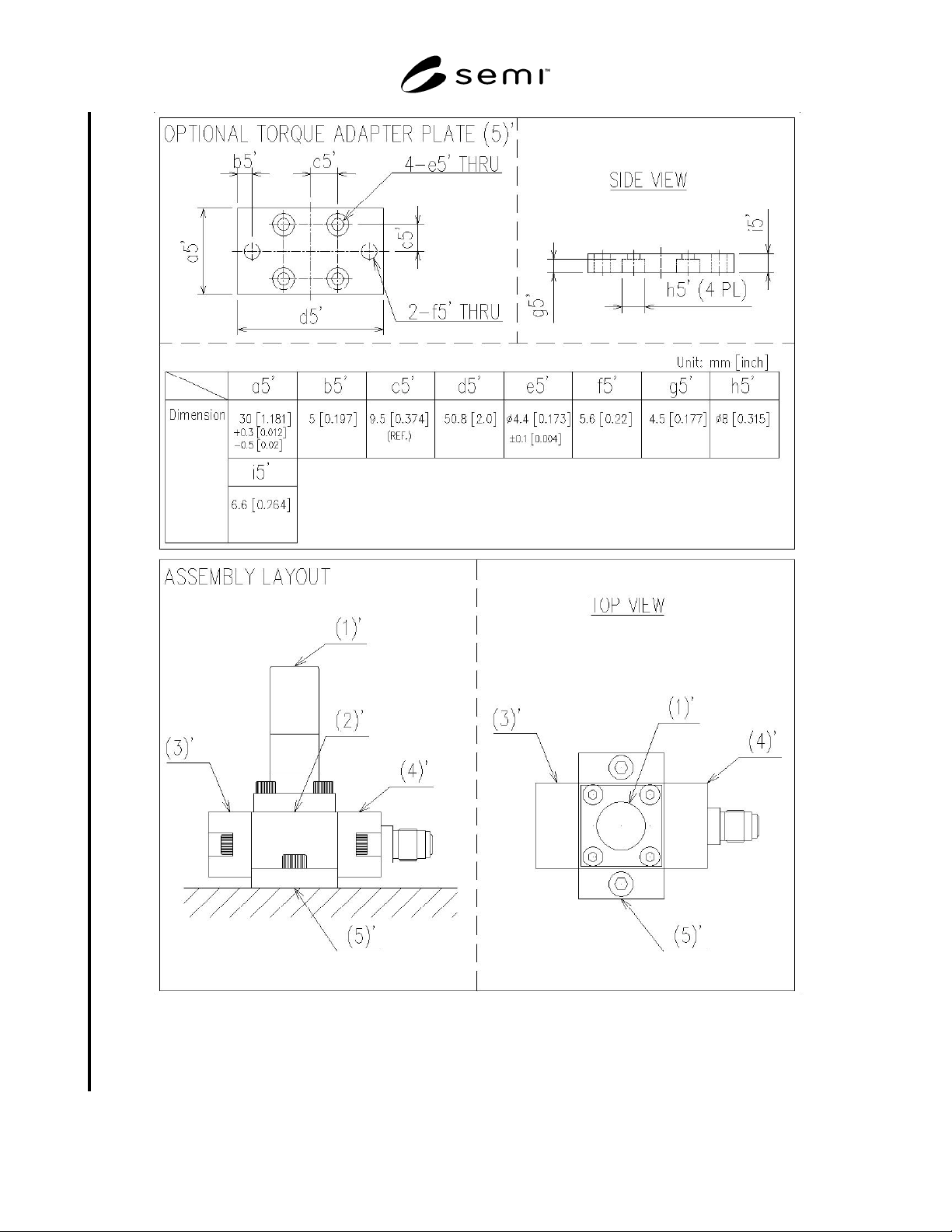
SEMI F74-1103 © SEMI 2002, 2003 14
NOTE 1: Leak test port(s) and porting are dependent on seal system/substrate design configuration.
NOTE 2: Material of Construction: 316SS.
NOTE 3: Drawing scale is not specified.
Figure R1-3c
1.125” Surface-Mount Performance Testing Fixture

SEMI F74-1103 © SEMI 2002, 2003 15
NOTICE: SEMI makes no warranties or representations as to the suitability of the standards set forth herein for any
particular application. The determination of the suitability of the standard is solely the responsibility of the user.
Users are cautioned to refer to manufacture' s instructions, product labels, product data sheets, and other relevant
literature, respecting any materials or equipment mentioned herein. These standards are subject to change without
notice.
By publications of this standard, Semiconductor Equipment and Materials International (SEMI) takes no position
respecting the validity of any patent rights or copyrights asserted in connection with any items mentioned in this
standard. Users of this standard are expressly advised that determination of any such patent rights or copyrights, and
the risk of infringement of such rights are entirely their own responsibility.
Copyright by SEMI® (Semiconductor Equipment and Materials
International), 3081 Zanker Road, San Jose, CA 95134. Reproduction o
f
the contents in whole or in part is forbidden without express written
consent of SEMI.

SEMI F75-1102 © SEMI 2002 1
SEMI F75-1102
GUIDE FOR QUALITY MONITORING OF ULTRAPURE WATER USED IN
SEMICONDUCTOR MANUFACTURING
This guide was technically approved by the Global Facilities Committee and is the direct responsibility of the
North American Facilities Committee. Current edition approved by the North American Regional Standards
Committee on August 29, 2002. Initially available at www.semi.org September 2002; to be published
November 2002.
1 Purpose
1.1 These guides provide recommendations for facility
engineers and other manufacturing and quality
professionals who may be responsible for establishing
programs to monitor and control the quality of their
ultrapure water (UPW) systems through to point-of-use
(POU). These guides may be used to help determine the
parameters that should be monitored for UPW that is
produced, distributed and used throughout the
manufacturing facility, and the frequency and location
of testing.
NOTE 1: These suggested guides are published as technical
information and are intended for informational purposes only.
2 Scope
2.1 UPW is used extensively in the production of
semiconductor devices for all wet processing steps.
Ultrapure water systems need to be tested and
monitored to ensure that the UPW being produced
matches the specifications established by the
manufacturing process. The purity of the UPW may
affect device yield unless a wide range of parameters is
closely controlled at the point of distribution (POD).
Semiconductor devices are currently being designed
with smaller linewidths (< 0.13–0.18 µm) and are more
susceptible to low level impurities.
2.2 UPW systems are monitored for continuous
performance for desired and achievable levels of
quality. Action limits are generally set to determine
when system performance data warrants that corrective
action is needed. Table 1 Parameters and Range of
Performance in SEMI F63 may be a useful reference
for establishing quality levels.
2.3 In more critical processes, the quality of the UPW
also needs to be monitored at the POU where the UPW
is in contact with the wafer. The quality of the UPW
should not be expected to be identical to the quality of
the UPW being produced at final filter (FF), which is
not subject to conditions within the tool or distribution
system.
2.4 These guides logically follow the series of SEMI
guides developed for UPW, which include a standard
defining the performance of a UPW system, and a
standard defining the quality of UPW (see reference
section). The Schematic of a Typical Ultrapure Water
System in Figure 1 of SEMI F61 may be a useful
reference for determining sampling points.
2.5 Guides are provided concerning the frequency and
location of sampling for those parameters that are not
available from on-line analyzers. Frequency of
sampling should be based on the specifications set by
manufacturing for the quality of the POD UPW, the
number and locations of on-line analyzers, the stability
of the incoming feed water to the system, and the
historical performance of the UPW system over time.
2.6 These guides may also be used to establish process
control criteria for the incoming feedwater,
performance of UPW system components and POU
rinse baths.
2.7 This standard does not purport to address safety
issues, if any, associated with its use. It is the
responsibility of the users of this standard to establish
appropriate safety health practices and determine the
applicability or regulatory limitations prior to use.
3 Limitations
3.1 These guides have been developed with
consideration of various other sources deemed to be
relevant for this purpose. However this guide was not
intended to be identical to or consistent with any other
industry document or standard.
3.2 Monitoring and testing of recycled or reclaimed
water systems are not specifically addressed in these
guides. Additional test parameters, such as
quantification and identification of organic species in
reclaim water, should be added to monitoring programs
for reclaim and reuse waters.
3.3 Measuring the purity of UPW can prove
challenging. Many on-line instruments (sodium
analyzers, TOC analyzers, silica analyzers, optical
particle counters, non-volatile residue analyzers)
provide very low limits of detection but may not be
capable of being calibrated in the range of detection or
may have very poor accuracy at low levels. On-line
analyzers should primarily be used for trend analysis.
Many tests can still be performed more accurately and
reproducibly in a laboratory environment but taking