semi合集-English.pdf - 第3131页
SEMI E125-0305 © SEMI 2003, 2005 39 R1-3 Use Case Descriptions R1-3.1 Retrieve State Machine Descriptions — This use case provides a way for an application to request a description of all of the state machines su pported…
SEMI E125-0305 © SEMI 2003, 2005 38
RELATED INFORMATION 1
TYPICAL USE CASES
NOTICE: This related information is not an official part of SEMI E125 and was derived from the work of the
originating committee. This related information was approved for publication by full letter ballot procedures.
R1-1 Example Use Cases
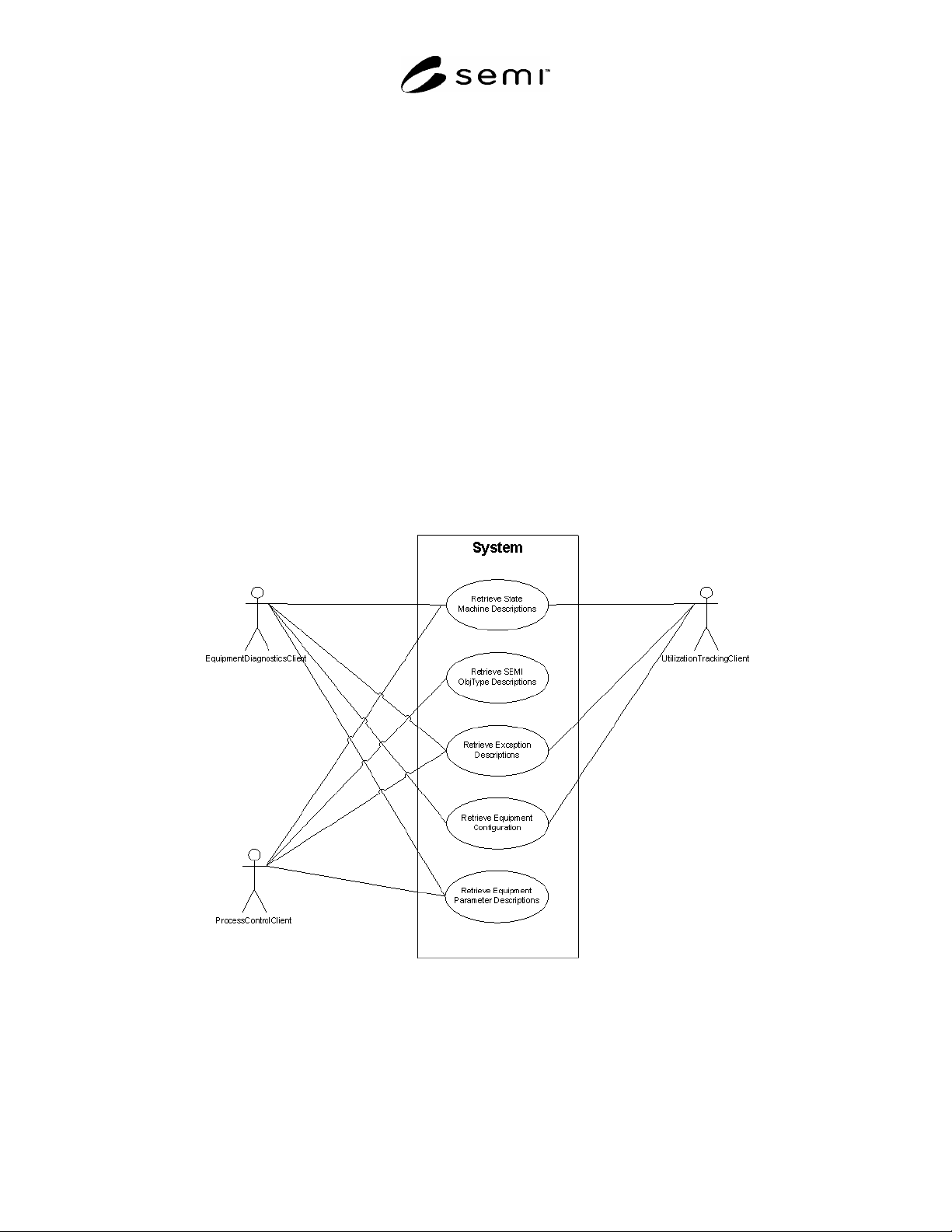
R1-1.1 Figure R1-1 shows an example of some typical use cases that this specification supports. The actors shown
represent some of the possible applications that could make use of the information provided by this specification,
and are only examples. In an actual factory, other applications/actors not shown here may make use of equipment
metadata. The system boundary in this diagram represents all entities that comprise or represent a single equipment
installation.
R1-2 Example Actors
R1-2.1 EquipmentDiagnosticsClient — This actor represents an application that helps factory or supplier personnel
troubleshoot mechanical, electrical, chemical, or other problems identified with the equipment.
R1-2.2 UtilizationTrackingClient — This actor represents an application that collects performance information
from the equipment to calculate relevant utilization metrics.
R1-2.3 ProcessControlClient — This actor represents an application that orchestrates material processing,
measurement, or testing performed by the equipment.
Figure R1-1
Typical Equipment Metadata Use Cases
SEMI E125-0305 © SEMI 2003, 2005 39
R1-3 Use Case Descriptions
R1-3.1 Retrieve State Machine Descriptions — This use case provides a way for an application to request a
description of all of the state machines supported by the equipment, and to determine which state machines are
implemented by which components of the equipment. This supports automated usage, so that applications that are
looking for standardized or well-known equipment-specific state models can discover their existence on a specific
tool, as well as the supplier-specific event id’s used to communicate standardized state transitions. It also supports
any manual application in which a human user would like to understand equipment-specific behavior that has not
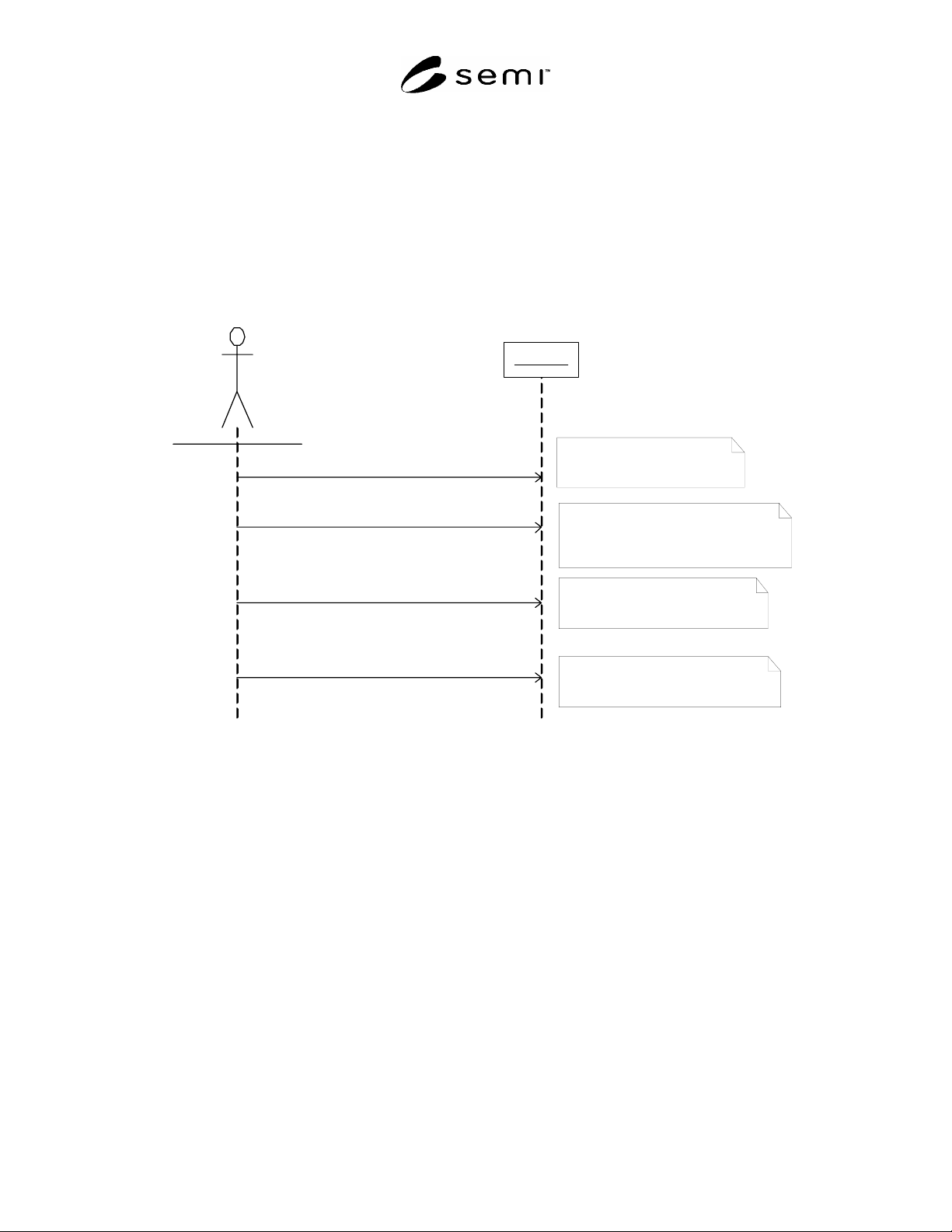
been standardized. Figure R1-2 shows one example of how this use case can be realized using messages from the
interface defined in this specification (see Section 9).
: U t iliz at ion Track ing Client
Equipment
Get all stat e machine definitions
in use by equipment
GetEquipment NodeDescriptions ()
Get all equipment nodes, det ermine
whic h nodes implement the st ate
machines of interest, and the parameters
that can be reported with each event.
Get all t yp e def in itions in use
by t he equipment, look for the
type definitions u sed by paramet ers.
GetStateMachines()
Ge tT ype s()
GetUnits()
Get all units in use
by t he equipment, look for the
unit s referred t o by t he type definitions.
Figure R1-2
Use Case Realization for “Retrieve State Machine Descriptions”
SEMI E125-0305 © SEMI 2003, 2005 40
R1-3.2 Retrieve SEMIObjType Descriptions — This use case provides a way for an application to request a
description of all of the SEMI standard OSS ObjTypes supported by the equipment. This supports automated usage,
so that applications that are written to work with OSS ObjTypes can discover which ObjTypes are in use on a
specific equipment installation, and can learn the event id’s that the supplier uses for standardized state transitions.
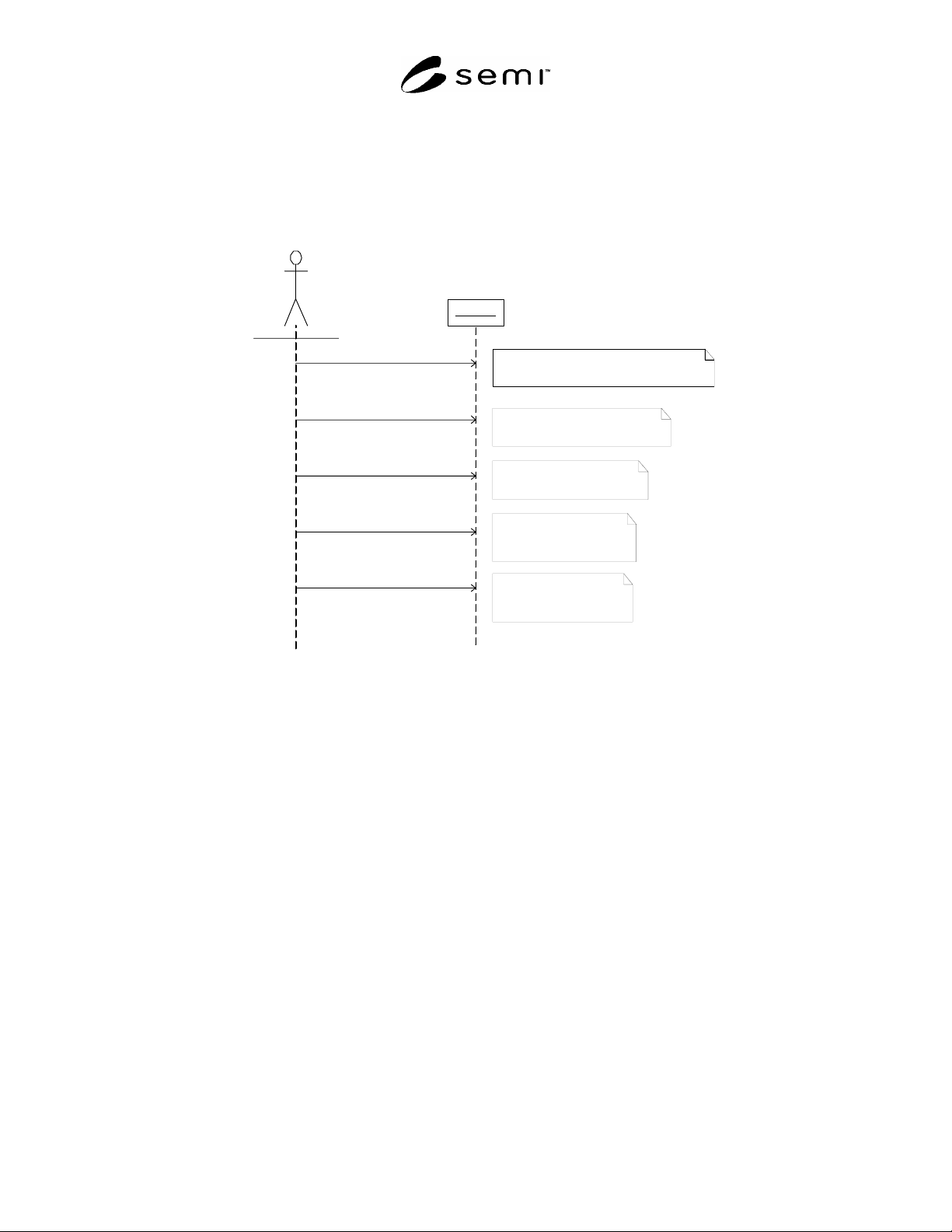
Figure R1-3 shows one example of how this use case can be realized using messages from the interface defined in
this specification (see Section 9).
: Proc essC on trolClient
Equ ipme nt
GetStateMachines()
GetSEMIObjTypes()
GetEquipmentNodeDescriptions()
GetTypes()
GetUnits()
Get all state mac hine def initions in u se by equipment,
look for state machines specific to the ObjTypes of
interest, and determine the supplier-specific event id's
Get all ObjTypes in u se by t he equipment,
look for the ObjTypes of interest, and their
associate d at tribut es.
Get all eq uipm ent node s, d et ermine
which nodes provide the ObjTypes
of interest
Get all type d ef init ions in us e
by the equipme nt , l ook for the
ty pe definitions us ed by ObjType
attribut es.
Get all unit s in use
by the equipme nt , l ook for the
units ref erred to by the ObjType
attribut es
Figure R1-3
Use Case Realization for “Retrieve ObjType Descriptions”