semi合集-English.pdf - 第1680页
SEMI E39-0703 © SEMI 1995, 2003 22 service user serv ice provider ObjectAction.r e q ObjectAction.rsp Obje ctAct ionCom plet ion- Notification.nfy Obje ctAct ionCom plet ion- Notification.r sp Figure 12 ObjectAction Requ…

SEMI E39-0703 © SEMI 1995, 2003 21
service user service provider
ObjectAction.req
ObjectAction.rsp
Figure 11
ObjectAction Request and Response
12.11.3 It is recommended that OperationID be always set to a unique non-zero value. However, if a value of zero
is used, then the host should not send additional request until informed of the results of the outstanding request.
Otherwise it may be ambiguous to which request an ObjectActionCompletion notification pertains. The definition of
the target object type must include specification of the specific actions that it supports, together with the arguments
that are required and the arguments that are optional for each action.
Table 18 ObjectAction Service
Parameter Req/Ind Rsp/Conf Description
OperationID M M(=) Operation identifier. Used
where the service user may
send multiple requests to link
subsequent events to the
original requests. May be
zero otherwise.
ObjSpec C - The object specifier of the
target object or owner of the
target object.
ObjectAction M - Specific action requested.
(list of)
ObjectActionParameter
Request
C - A list of name/value pair
arguments providing
additional information about
the request.
(list of)
ObjectActionParameter
Result
- C A list of name/value pair
arguments providing
additional information about
the reply.
ObjectActionStatus - M Information concerning the
result of the requested action.
ObjectLinkID - M Set to non-zero if and only if
additional completion reports
will be sent.
12.12 ObjectActionCompletion Notification — This notification is sent to the requestor of an earlier action when the
completion of that action occurred after the response to the request was sent.
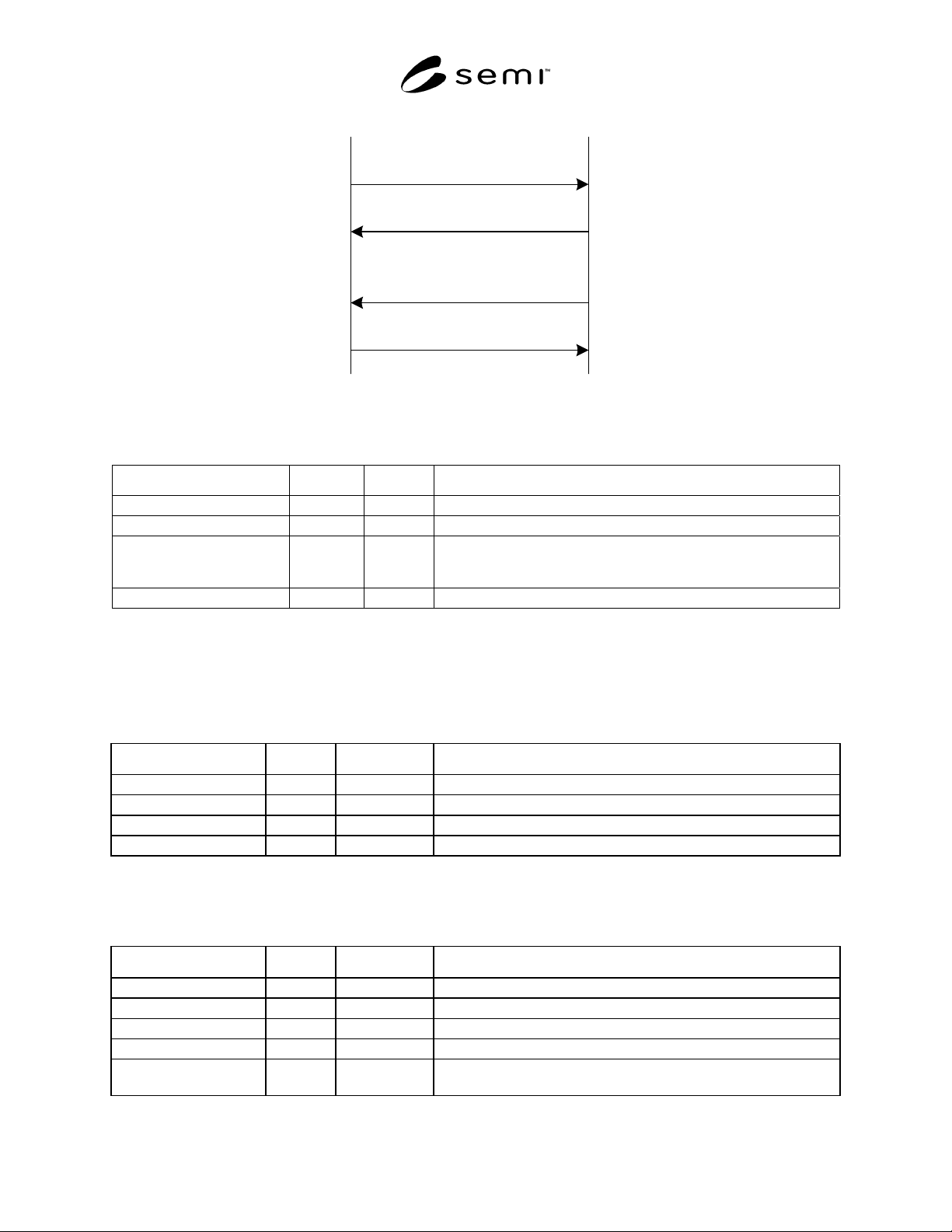
12.12.1 Figure 12 illustrates the scenario where the notification message is sent. The value of
ObjectActionAcknowledgement should be set to “Action will be performed and notification sent later”.
SEMI E39-0703 © SEMI 1995, 2003 22
service user service provider
ObjectAction.req
ObjectAction.rsp
ObjectActionCompletion-
Notification.nfy
ObjectActionCompletion-
Notification.rsp
Figure 12
ObjectAction Request, Response, and Notification
Table 19 ObjectActionCompletion Notification
Parameter Req/Ind Rsp/Conf Description
OperationID M - Operation identifier. Set to the same value as in the original request.
OperationActionStatus M - Information concerning the result of the service completion.
(list of)
ObjectActionParameter
Result
C - A list of name/value pair arguments providing additional
information about the reply.
ObjectActionReportStatus - M Indicates whether the report has been received with no errors.
12.13 GetServiceNames — A service user may ask an object owner for a list of the services supported by its owned
objects.
12.13.1 The definition of the target object type must include specification of the specific actions that it supports,
together with the arguments that are required and the arguments that are optional for each action.
Table 20 GetServiceNames Service
Parameter Req/Ind Rsp/Conf Description
ObjSpec C - The object specifier of the owner object.
(list of) ObjType M M A list of object type values
ObjStatus - M Information concerning the result of the requested action.
(list of) ObjServiceList - M List of structures of the form ObjType, (list of) service names.
12.14 GetServiceParameters — This message may be sent to an object to determine the service parameters that are
used by that object for a set of different services that it supports.
Table 21 GetServiceParameters
Parameter Req/Ind Rsp/Conf Description
ObjSpec C - The object specifier of the owner object.
ObjType M - The type of object referenced.
(list of) ServiceName M - A list of service names.
ObjStatus - M Information concerning the result of the requested action.
(list of)
ServiceParameterDef
- C List of structures that contain a service name with a list of parameter
names.

SEMI E39-0703 © SEMI 1995, 2003 23
13 Applications
13.1 This section provides examples of applications of
object services.
13.2 Get All of an Object’s Attributes — In the most
straight-forward case, GetAttr is used to get all of the
current attribute values of a single target object known
to the provider of the GetAttr service. The object
specifier is omitted, and the object type is set to the type
of the target object. To get all of the object’s attributes,
both the attribute filter and the names of requested
attributes are also omitted.
13.3 Determine All Objects of a Specific Type and with
Specific Characteristics — To determine subordinate
objects with specific characteristics, such as of type
“Module” with an identifier ObjID starting with
“ABC”, set object type to “Module”. In the attribute
filter, set the attribute name to “ObjID”, set the attribute
value to “ABC*”, and set the qualifying relationship to
“is equal to” (or omit it).
13.4 Determine Specific Attributes of a Specific Object
Instance — To determine the current value of certain
attributes of a specific object, set the object type
appropriately. Either set the list of ObjID to a list
containing the one identifier of the target instance, or
alternatively, in the attribute filter, set the attribute
name to “ObjID”, set the attribute value to the
identifier, and set the qualifying relationship to “is
equal to” (or omit it).
13.5 Determine Types of Subordinate Objects — To
determine all object types that are owned by another
object, the GetType service is used with the single
parameter of the object specifier of the owner. The
service provider returns an error of “Unknown object
type” if it has no types of owned objects.
13.6 Determine Names of Attributes of Subordinate
Objects — To determine the names of the attributes of
specific objects owned by the service provider, the
GetAttrName service is used with two parameters: the
object specifier of the owner and a list of the types of
the target objects. The service provided returns an error
of “Unknown object type” if it has no types of owned
objects.
14 Requirements for Compliance
14.1 Object Services are common to all service
resources that define public objects with operations for
getting (reading) and setting (writing) attribute values
and for getting object types and attribute names for
objects. Object services provide common definitions
for public objects and object services that may be
incorporated into these service resources, thereby
avoiding unnecessary duplication.
14.2 Fundamental Requirements — All objects
compliant to any part of OSS shall be subtypes of the
top object. That is, they shall inherit (provide) the
ObjType and ObjID attributes as described in Section
8.2.
14.2.1 They shall provide documentation of their
public attributes in the form of an Object Attribute
Definition table as described in Section 5.2.
14.2.2 They shall also provide the services GetAttr and
SetAttr as defined in Section 11.5. Support for an
owner’s object specifier and filter are not required for
fundamental compliance with OSS. If the service user
provides parameters for scope or filter in its request,
they may be ignored by the service provider. However,
they shall not cause errors in the response due to their
presence.
14.3 Additional Capabilities
14.3.1 Filters — Support for attribute filters in GetAttr
and SetAttr requests is an optional capability.
14.3.2 Owner Objects — All owner objects
(aggregates, containers, and supervisors) shall support
both scope and filters for the GetAttr and SetAttr
services, as defined in Sections 9.3, 11.2, and 11.3.
14.3.2.1 In addition, they shall provide the service
GetType as defined in Section 11.6, with support for
wild characters in the specification of object types.
14.3.3 Multiple Inheritance Hierarchy Inheriting
objects shall identify inherited objects with an
inheritance expression in the object specifier.