semi合集-English.pdf - 第1571页
SEMI E36.1-0704 © SEMI 2004 8 RELATED INFORMATION 1 IDENTITY AND METADATA EXAMPLE NOTICE : Thi s related information i s not an of ficial part of SEMI E36.1 a nd was derived from the work of the North Am erican Informati…

SEMI E36.1-0704 © SEMI 2004 7
• Item Security
• Item Lookup
• Distributed Metadata
• Efficient Distribution
6.3 Externalizing Information Many XML initiatives focus on rigorously defining rich structure for Elements.
The current approach has been the opposite, to externalize as much structure as possible.
6.3.1 This approach is to promote flexibility and simplicity. The objective was to provide a small set of powerful
modeling primitives from which richer models may be built. Providing a mechanism for distributing related
information among different locations allows systems to capitalize on this property for economic efficiency. The
metadata model allows content to be stored in some sort of native XML format, while associated metadata is
maintained in a relational database system. This creates more options for users.
6.4 Utilizing RDF as the Basis for Metadata Level 2 type and metadata is based on the existing XML standard
for metadata called the Resource Description Framework (RDF). RDF provides a very simple, but very powerful
model of information that is easy to understand and process. RDF allows flexible extension of the metadata standard
without having to modify existing schema definitions. This will allow users to incorporate future key learnings into
the standard.
6.5 Tag and Attribute Selection A large number of tags and attributes were considered for possible inclusion in
the standard. In making decisions about which of the many possibilities to choose as the basis of this work, several
factors were considered. First representative users of the information were interviewed to identify concepts and
relationships that they considered to be important and valuable. Tags resulting from this work were given high
priority relative to tags that derived from other sources. Next, semantic or conceptual tags were favored over tags
derived from structural or physical properties of the service documents. Finally, tags determined to have broad
utility were chosen in favor of tags considered useful in only a limited context.
6.5.1 Once a reasonable set of tags were selected for inclusion, a set of attributes was produced for those tags. The
basic approach was to determine an attribute set that was necessary and sufficient for making the information
captured by the tags economical to produce and beneficial to end users.
NOTICE: SEMI makes no warranties or representations as to the suitability of the standards set forth herein for any
particular application. The determination of the suitability of the standard is solely the responsibility of the user.
Users are cautioned to refer to manufacturer' s instructions, product labels, product data sheets, and other relevant
literature, respecting any materials or equipment mentioned herein. These standards are subject to change without
notice.
By publication of this standard, Semiconductor Equipment and Materials International (SEMI) takes no position
respecting the validity of any patent rights or copyrights asserted in connection with any items mentioned in this
standard. Users of this standard are expressly advised that determination of any such patent rights or copyrights, and
the risk of infringement of such rights are entirely their own responsibility.

SEMI E36.1-0704 © SEMI 2004 8
RELATED INFORMATION 1
IDENTITY AND METADATA EXAMPLE
NOTICE: This related information is not an official part of SEMI E36.1 and was derived from the work of the
North American Information & Control committee. This related information was approved for publication by full
letter ballot on March 14, 2004.
R1-1 Identity and Metadata Example
R1-1.1 This section illustrates the use of the identity and metadata defined in the standard. The material shown
below was produced using a tool called the “RDF Validation Service” available on the web at
http://www.w3.org/RDF/Validator/. Given a candidate XML/RDF document, the tool will first validate the
document for compliance with the RDF specification. Next, the document is parsed and represented in three
alternative forms: the original XML version, a tabular version, and a graphical version.
R1-1.2 The graph shows that the sample RDF document contains five elements, as shown by the five ellipses on the
left side of the graphic. These items are the subjects of the RDF model. These are the items we are associating
metadata. Each subject has a URI embedded within; this URI points to the content that the subject refers to. This
binds metadata to a subject in a completely different context than that in which the subject’s content is developed.
R1-1.3 Emanating from the subjects are arrows. Each of these arrows defines a relationship between the subject and
another information item. The nature of the relationship is indicated as a label on the arc and corresponds to one of
the relationships defined in the E36 RDF model.
R1-1.4 These arrows terminate on graphics representing the object of the relationship. In cases where the
terminating graphic is a box, the object of the relationship is a literal value such as a number, date, or phrase. When
the terminating graphic is an oval, this is an indication that the object of the relationship is another resource. A URI
is embedded within the oval to identify which resource is being referred to.
R1-1.5 Original RDF/XML document
1: <?xml version='1.0' encoding='UTF-8'?>
2: <rdf:RDF
3: xmlns:rdf = 'http://www.w3.org/1999/02/22-rdf-syntax-ns#'
4: xmlns:rdfs = 'http://www.w3.org/2000/01/rdf-schema#'
5: xmlns:dc = 'http://purl.org/dc/elements/1.1/'
6: xmlns:e36base = 'http://www.semi.org/schemas/e36Base#'
7: >
8:
9: <e36base:Component rdf:about='D7C2E128-A1F2-4FAC-962F-00BA4E6150E5'>
10: <e36base:releaseDate>4/29/2003</e36base:releaseDate>
11: <dc:title>Cables</dc:title>
12: <dc:publisher>Some Publisher</dc:publisher>
13: <e36base:oemPartNumber>01-1010110</e36base:oemPartNumber>
14: <e36base:partName>Pump control</e36base:partName>
15: <e36base:oemName>Some OEM</e36base:oemName>
16: </e36base:Component>
17:
18: <e36base:Component rdf:about='C89722A8-2B03-4DDF-8ABD-68F01FCD2ADE'>
19: <e36base:releaseDate>4/29/2003</e36base:releaseDate>
20: <dc:title>Cables</dc:title>
21: <dc:publisher>Some Other Publisher</dc:publisher>
22: <e36base:oemPartNumber>02-1101001-01</e36base:oemPartNumber>
23: <e36base:partName>Power Cable</e36base:partName>
24: <e36base:oemName>Some Other OEM</e36base:oemName>
25: </e36base:Component>
26:
27: <e36base:Procedure rdf:about='CA46B949-B999-40B3-8554-2513DADEEBF7'>
28: <e36base:releaseDate>4/29/2003</e36base:releaseDate>
29: <dc:title>How To Use This Manual</dc:title>
30: <dc:publisher>A Publisher</dc:publisher>
31: <e36base:procedureType>OperationProcedure</e36base:procedureType>
32: </e36base:Procedure>
33:
34: <e36base:Recipe rdf:about='F9A6EB40-2DE4-4AF5-82C9-6C26E97BD197'>
35: <e36base:releaseDate>4/29/2003</e36base:releaseDate>
SEMI E36.1-0704 © SEMI 2004 9
36: <dc:title>Some Operation</dc:title>
37: <e36base:recipeType>ProcessRecipe</e36base:recipeType>
38: </e36base:Recipe>
39:
40: <e36base:SafetyItem rdf:about='0566910F-2C23-443F-B498-03B984735675'>
41: <e36base:releaseDate>4/29/2003</e36base:releaseDate>
42: <dc:title>Hazardous Material Detection</dc:title>
43: </e36base:SafetyItem>
44:
45: </rdf:RDF>
46:
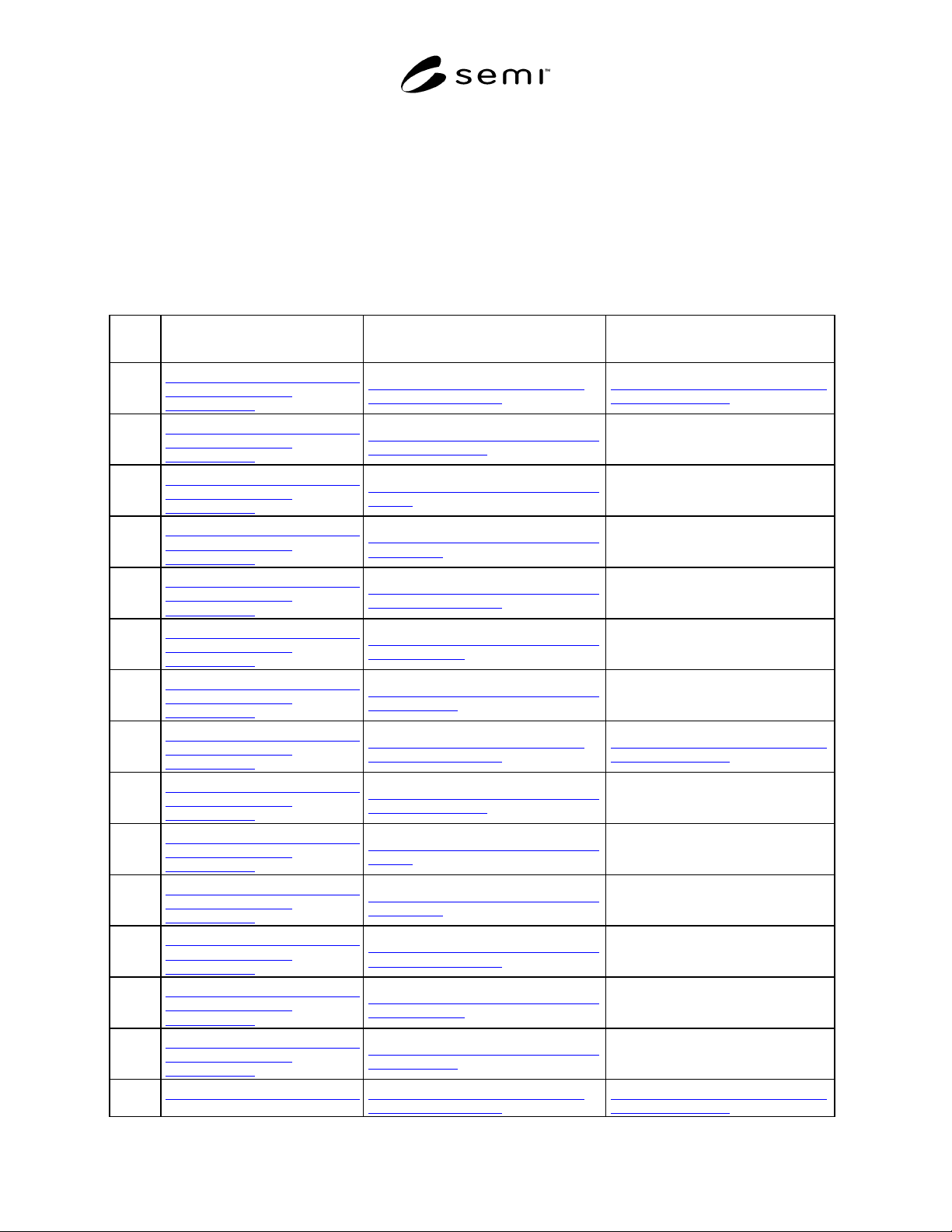
Table R1-1 Triples of the Data Model
Number Subject Predicate Object
1
http://unknown.org/D7C2E12
8-A1F2-4FAC-962F-
00BA4E6150E5
http://www.w3.org/1999/02/22-
rdf-syntax-ns#type
http://www.semi.org/schemas/e
36Base#Component
2
http://unknown.org/D7C2E12
8-A1F2-4FAC-962F-
00BA4E6150E5
http://www.semi.org/schemas/e36
Base#releaseDate
" 4/29/2003"
3
http://unknown.org/D7C2E12
8-A1F2-4FAC-962F-
00BA4E6150E5
http://purl.org/dc/elements/1.1
/title
" Cables"
4
http://unknown.org/D7C2E12
8-A1F2-4FAC-962F-
00BA4E6150E5
http://purl.org/dc/elements/1.1
/publisher
" Some Publisher"
5
http://unknown.org/D7C2E12
8-A1F2-4FAC-962F-
00BA4E6150E5
http://www.semi.org/schemas/e36
Base#oemPartNumber
" 01-1010110"
6
http://unknown.org/D7C2E12
8-A1F2-4FAC-962F-
00BA4E6150E5
http://www.semi.org/schemas/e36
Base#partName
" Pump control"
7
http://unknown.org/D7C2E12
8-A1F2-4FAC-962F-
00BA4E6150E5
http://www.semi.org/schemas/e36
Base#oemName
" Some OEM"
8
http://unknown.org/C89722A
8-2B03-4DDF-8ABD-
68F01FCD2ADE
http://www.w3.org/1999/02/22-
rdf-syntax-ns#type
http://www.semi.org/schemas/e
36Base#Component
9
http://unknown.org/C89722A
8-2B03-4DDF-8ABD-
68F01FCD2ADE
http://www.semi.org/schemas/e36
Base#releaseDate
" 4/29/2003"
10
http://unknown.org/C89722A
8-2B03-4DDF-8ABD-
68F01FCD2ADE
http://purl.org/dc/elements/1.1
/title
" Cables"
11
http://unknown.org/C89722A
8-2B03-4DDF-8ABD-
68F01FCD2ADE
http://purl.org/dc/elements/1.1
/publisher
" Some Other Publisher"
12
http://unknown.org/C89722A
8-2B03-4DDF-8ABD-
68F01FCD2ADE
http://www.semi.org/schemas/e36
Base#oemPartNumber
" 02-1101001-01"
13
http://unknown.org/C89722A
8-2B03-4DDF-8ABD-
68F01FCD2ADE
http://www.semi.org/schemas/e36
Base#partName
" Power Cable"
14
http://unknown.org/C89722A
8-2B03-4DDF-8ABD-
68F01FCD2ADE
http://www.semi.org/schemas/e36
Base#oemName
" Some Other OEM"
15
http://unknown.org/CA46B94
9
-
B999
-
40B3
-
8554
-
http://www.w3.org/1999/02/22-
rdf-syntax-ns#type
http://www.semi.org/schemas/e
36Base#Procedure