semi合集-English.pdf - 第3116页
SEMI E125-0305 © SEMI 2003, 2005 24 0. . * ty p eI nf or ma t io n 1 {X OR } mi nE le me n t s ma xEl e me n t s el em ent D es c ri pt io n Arra y T y p e 1 ty p eI nf or ma t io n 1 P ara me t e rT y p e D e f i n i ti…
SEMI E125-0305 © SEMI 2003, 2005 23
10.5.2.10 Because the mapping from an available unit to the Configuration Parameter setting that selects it is
described by the UnitConfig class, it is not required to use the “affectedParameters” attribute (see Section
10.4.11.5.1) to refer to the Parameters whose units are changed by the Configuration Parameter when describing its
classification.
10.5.2.11 If a ParameterTypeDefinition includes numeric types with configurable units, then all Parameters that are
declared to be of that type shall support the configurable units described in the ParameterTypeDefinition.
10.5.2.12 UnitConfig — This class describes a configurable unit setting available for a numeric ParameterType.
UnitConfig provides a mapping between the available unit, the non-transient configuration Parameter used to change
the selected unit, and the enumeration value of that configuration Parameter that results in the selection of the unit.
This class has no attributes.
10.5.2.13 UnitConfig Association Definition Table
Table 35 UnitConfig Association Definition
Association Role Name Definition Comments
unit An available unit supported by this type. One and only one element of type Unit.
configParameter The unit configuration Parameter whose value
selects the unit.
One and only one element of type Parameter.
The Parameter must have a string-based
enumeration ParameterTypeDefinition.
setting The enumeration value which, when set on the
corresponding configParameter, results in the
available unit being selected.
One and only one element of type
EnumeratedString.
10.5.2.14 StringType — Represents a string type.
10.5.2.15 StringType Attribute Definition Table
Table 36 StringType Attribute Definition
Attribute Name Definition Required Form
language Identifies the language used to represent the string. Y Text, must be equal to an IETF RFC
1766 language tag, using ISO 3166 to
name countries and subdivisions, and
ISO 639 to name languages.
maxCharacters The maximum number of characters that this string
can contain.
N Integer 0. If 0, there is no restriction
on the number of characters.
10.5.2.16 BooleanType — Represents a Boolean type.
10.5.2.17 BinaryType — Represents a binary type.
10.5.3 Composite Type Description
10.5.3.1 Describing Arrays
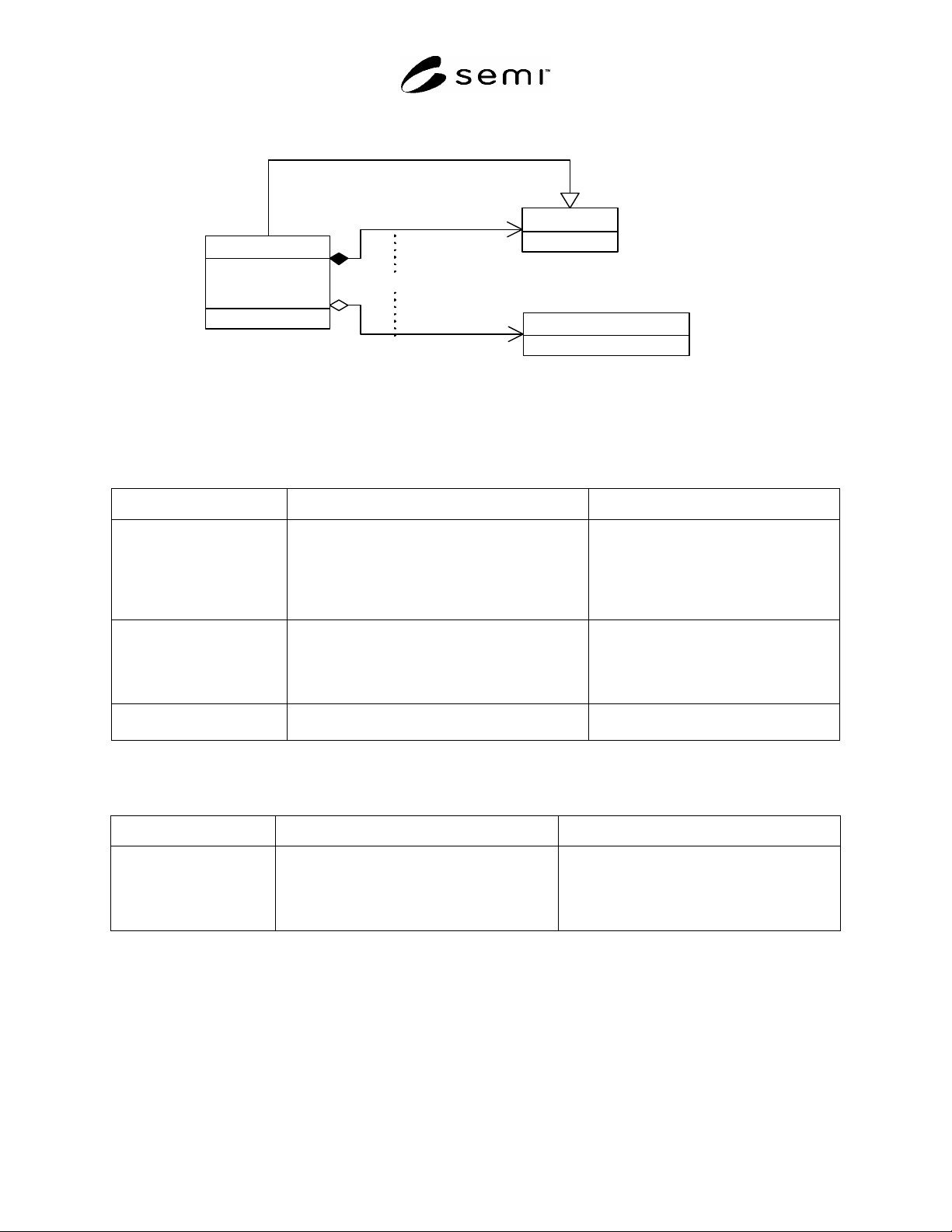
10.5.3.1.1 Arrays are container types that can hold one or more values that are of the same type. Figure 14 shows
how to describe the type of the elements in a given array. An array can refer to only one of the primitive or
composite types, and can declare that it has a maximum number of elements. For example, an array description that
has a maxElements value of 0 and refers to the RealType primitive type represents an array of real numbers (for
example, float or double) that has no limitation on the number of values it can contain.
10.5.3.1.2 Each element of an array must represent the same physical concept. For example, an array of real
numbers must not be used to represent a repeating sequence of a measured value in odd-numbered elements and the
uncertainty for the measurement in even-numbered elements. In such cases, an array of StructureType elements is
the correct representation, where the different concepts appear as different fields in the structure (for example, a
measurement field and an uncertainty field). A human-readable description of the meaning of the array elements is
required.
SEMI E125-0305 © SEMI 2003, 2005 24
0..*
typeInformation
1
{XOR}
minElements
maxElements
elementDesc ription
ArrayType
1
typeInformation
1
ParameterTypeDefinition
ParameterType
Figure 14
Describing Arrays
10.5.3.1.3 ArrayType Attribute Definition Table
Table 37 ArrayType Attribute Definition
Attribute Name Definition Form
minElements The minimum number of elements that can be held
in the array.
Positive integer, with 0 representing no
restriction on the minimum number of
elements. If this attribute and
maxElements are both non-zero, the value
of this attribute must be less than
maxElements.
maxElements The maximum number of elements that can be held
in the array.
Positive integer, with 0 representing an
unlimited number of elements. If this
attribute and minElements are both non-
zero, the value of this attribute must be
greater than minElements.
elementDescription A human-readable description of the purpose of the
elements in the array.
Text.
10.5.3.1.4 ArrayType Association Definition Table
Table 38 ArrayType Association Definition
Association Role Name Definition Comments
typeInformation Describes the data type of each element
contained in the array.
Structured data, must be one and only one of the
following: any type derived from
ParameterType, or a ParameterTypeDefinition
(can be a recursive reference from within the
same ParameterTypeDefinition).
10.5.3.2 Describing Structures
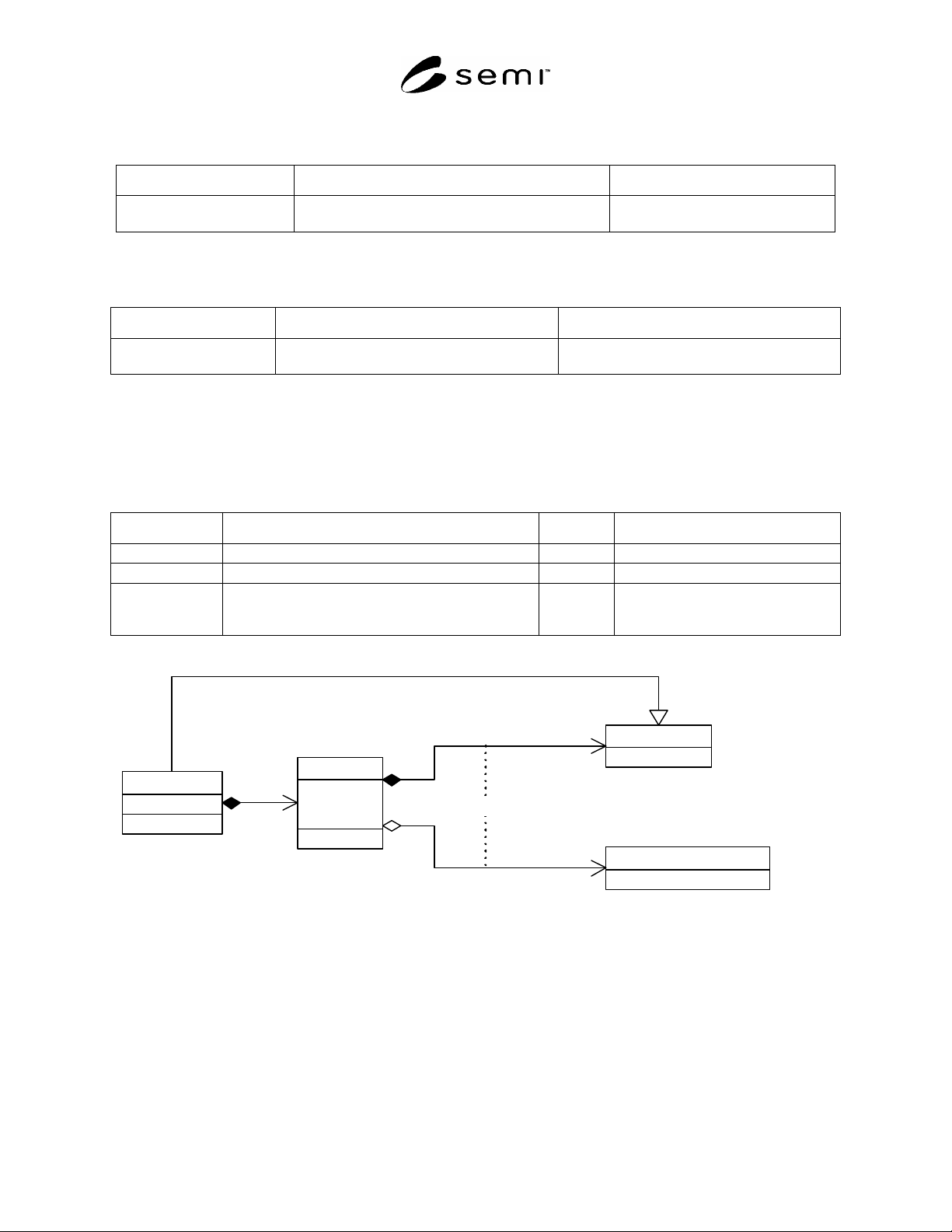
10.5.3.2.1 Structures are composite types that can hold one or more fields that are of differing primitive or
composite types. Figure 15 shows how a structure is described as a collection of one or more typed field’s.
SEMI E125-0305 © SEMI 2003, 2005 25
10.5.3.2.2 StructureType Attribute Definition Table
Table 39 StructureType Attribute Definition
Attribute Name Definition Form
description A human-readable description of the meaning or
purpose of the structure.
Text.
10.5.3.2.3 StructureType Association Definition Table
Table 40 StructureType Association Definition
Association Role Name Definition Comments
fields The fields that comprise this data structure. Ordered list of one or more structured data
elements of type Field.
10.5.3.2.4 Field — Represents a named field that has one and only one type, primitive or composite. This class is
used for describing fields within structures. See Section 10.5.1.2 for a description of the ParameterTypeDefinition
class.
10.5.3.2.4.1 Field Attribute Definition Table
Table 41 Field Attribute Definition
Attribute Name Definition Required Form
name The name of the field. Y Text.
description A description of the meaning or purpose of the field. Y Text.
canBeNull Whether or not the field’s value may be omitted. Boolean. True if the field’s value is
not always provided for all values of
the structure.
name
description
canBeNull
Field
des cription
StructureT ype
fields
11..*
ParameterType
1
typeInformation
1
ParameterTypeDefinition
0..*
typeInformation
1
{XOR}
Figure 15
Describing a Structure