semi合集-English.pdf - 第1890页
SEMI E54-0705 © SEMI 1997, 2005 6 Therefore, each NCS is also a specification that grow s over time. As new devi ce models are developed and approved, a m apping of the model t o a netwo rk technology is adde d to a NCS.…
SEMI E54-0705 © SEMI 1997, 2005 5
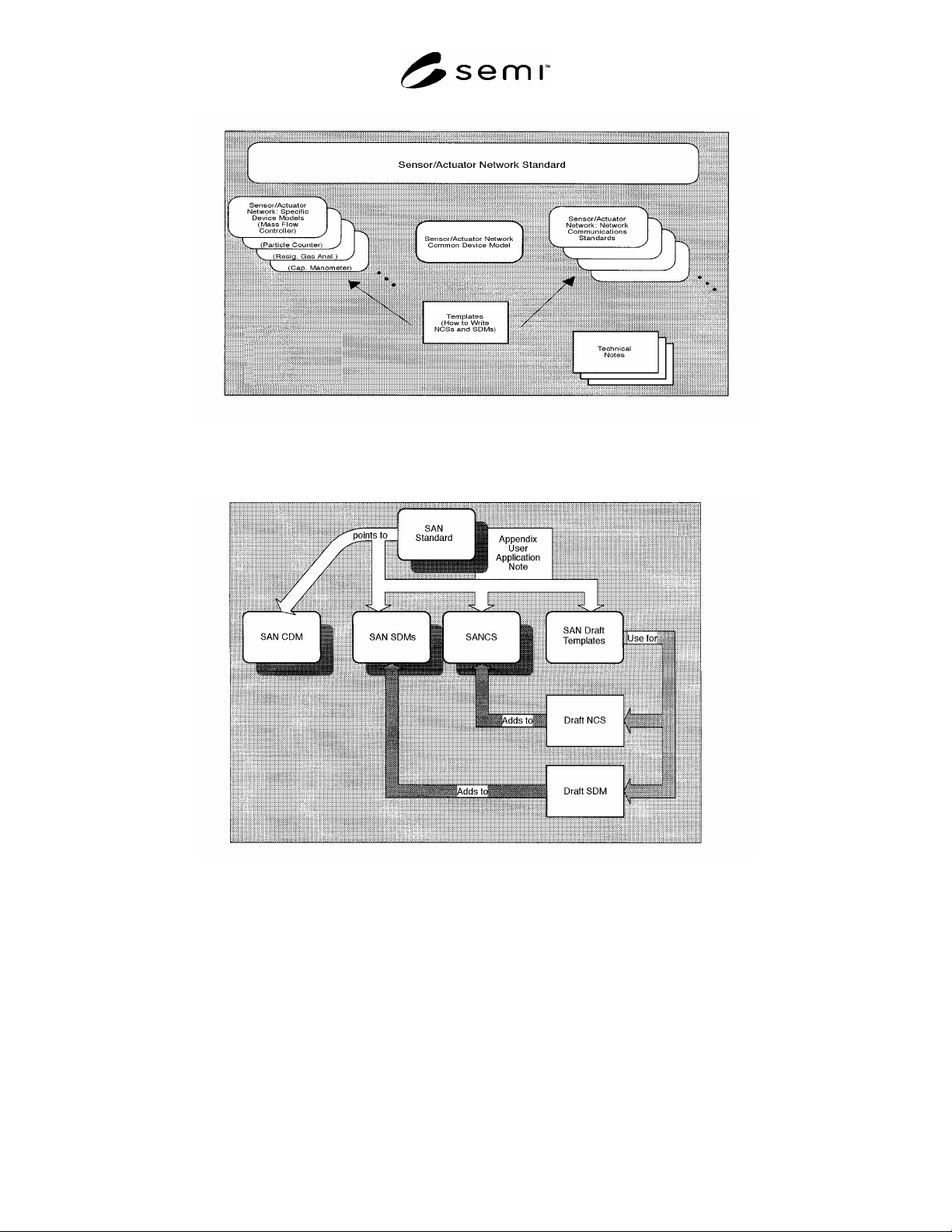
Figure 2
Organization of SAN Specification
Figure 3
SAN Standard Relationships
7.1.1 The CDM specification is the first ancillary document of the SAN suite.
7.1.2 A second ancillary specification to the SAN standard provides templates that are guides to adding specific
device models and network communication mappings to the SAN standard.
7.1.3 Specifications for specific device models for all types of devices are included as additional ancillary
specifications of the SEMI SAN standard. Specific device models are added in the order they are developed and
passed SEMI’s ballot procedure.
7.1.4 Each network technology’s user layer specification is included as an ancillary standard (see Figure 3). These
Network Communication Standards (NCS) provide the mapping for each of the approved specific device models.

SEMI E54-0705 © SEMI 1997, 2005 6
Therefore, each NCS is also a specification that grows over time. As new device models are developed and
approved, a mapping of the model to a network technology is added to a NCS.
7.1.5 Auxiliary Information — Auxiliary information may be included with the standard in the form of appendices
or technical notes. Generally, this information is not balloted, but is included as provided by the SEMI Standards
Program regulations. Auxiliary information shall always be noted as such when it accompanies a specification or
ballot.
7.2 Interoperability
7.2.1 At the Applications Level — The SDMs are used to derive the definitions for attributes, services, and behavior
that are unique to each device type. A model may discuss relationships internal to a device to provide additional
meaning to the services and attributes that can be manipulated over the network. Applications written to these
models can operate a device independent of the network on which they communicate. The models shall assure that
devices of different types can operate cooperatively at the applications level.
7.2.2 Below the User Layer — The various SANCS specifications describe the method by which a device
communicates over a specific network such that it can meet the requirements of its type. All devices described
within an NCS shall operate cooperatively on that specific network technology below the user layer.
7.2.3 The SEMI SAN standard does not address methods for internet-working below the applications layer, as
described herein. An application entity may connect to more than one network. This could be typical of the
application entities on the equipment controller. While the SAN standard allows that application entities could exist
at any network node, it requires no mechanism for a message that begins on one network to be routed to another
network.
7.3 SEMI SAN Compliance — To fully describe the characteristics of a network capable device, its compliance
shall be specified by reference to the SAN ancillary standards. Thus, a device indicates both its type and network
technology for its SDM and a NCS.
7.3.1 For a device to be compliant to the SAN standard, it shall implement all of the required attributes, behavior,
and services as described in the SAN CDM.
7.3.2 Type or Applications Model Specification — The SDM of a device (which is its type, e.g., MFC or
thermocouple) shall be denoted by SEMI E54.y, where “y” indicates the SDM ancillary standard.
7.3.3 Network Communication Specification Communication (protocol) compliance specification of a device is
denoted by SEMI E54.x, where “x” is the network communications ancillary specification.
NOTICE: SEMI makes no warranties or representations as to the suitability of the standard set forth herein for any
particular application. The determination of the suitability of the standard is solely the responsibility of the user.
Users are cautioned to refer to manufacturer’s instructions, product labels, product data sheets, and other relevant
literature respecting any materials mentioned herein. These standards are subject to change without notice.
The user’s attention is called to the possibility that compliance with this standard may require use of copyrighted
material or of an invention covered by patent rights. By publication of this standard, SEMI takes no position
respecting the validity of any patent rights or copyrights asserted in connection with any item mentioned in this
standard. Users of this standard are expressly advised that determination of any such patent rights or copyrights, and
the risk of infringement of such rights, are entirely their own responsibility.
SEMI E54-0705 © SEMI 1997, 2005 7
RELATED INFORMATION 1
APPLICATION NOTES
NOTICE: The material contained in these Application Notes is not an official part of SEMI E54 and is not intended to modify or
supersede the official standard. Rather, these notes are auxiliary information included as reference material for implementers of
the standard. The standard should be referred to in all cases. SEMI makes no warranties or representations as to the suitability of
the material set forth herein for any particular application. The determination of the suitability of this material for any particular
purpose is solely the responsibility of the user.
R1-1 Implementing a SAN Standard-Compliant Device
R1-1.1 This Related Information section describes how the SAN standard is used by a device supplier who wishes
to offer SEMI SAN-compliant devices to the market.
R1-1.2 While the SAN standard may appear overwhelming on first viewing, it is actually built from independent
components. It is not necessary to understand or ‘know’ the entire standard. It can be dealt with in small pieces. For
device suppliers, only the pieces that deal with their particular device type need to be considered. The specifications
to implement a specific device are typically less than thirty pages of text. The standard is structured such that it is
extensible while providing the ability to specify a device by reference to the standard.
R1-1.3 Synopsis of Device Operation — All devices on a SAN have a similar operational profile. That profile is
specified in SEMI E54.1 (Standard for Sensor/Actuator Network Common Device Model) and in the Common
Device Model support section of each NCS.
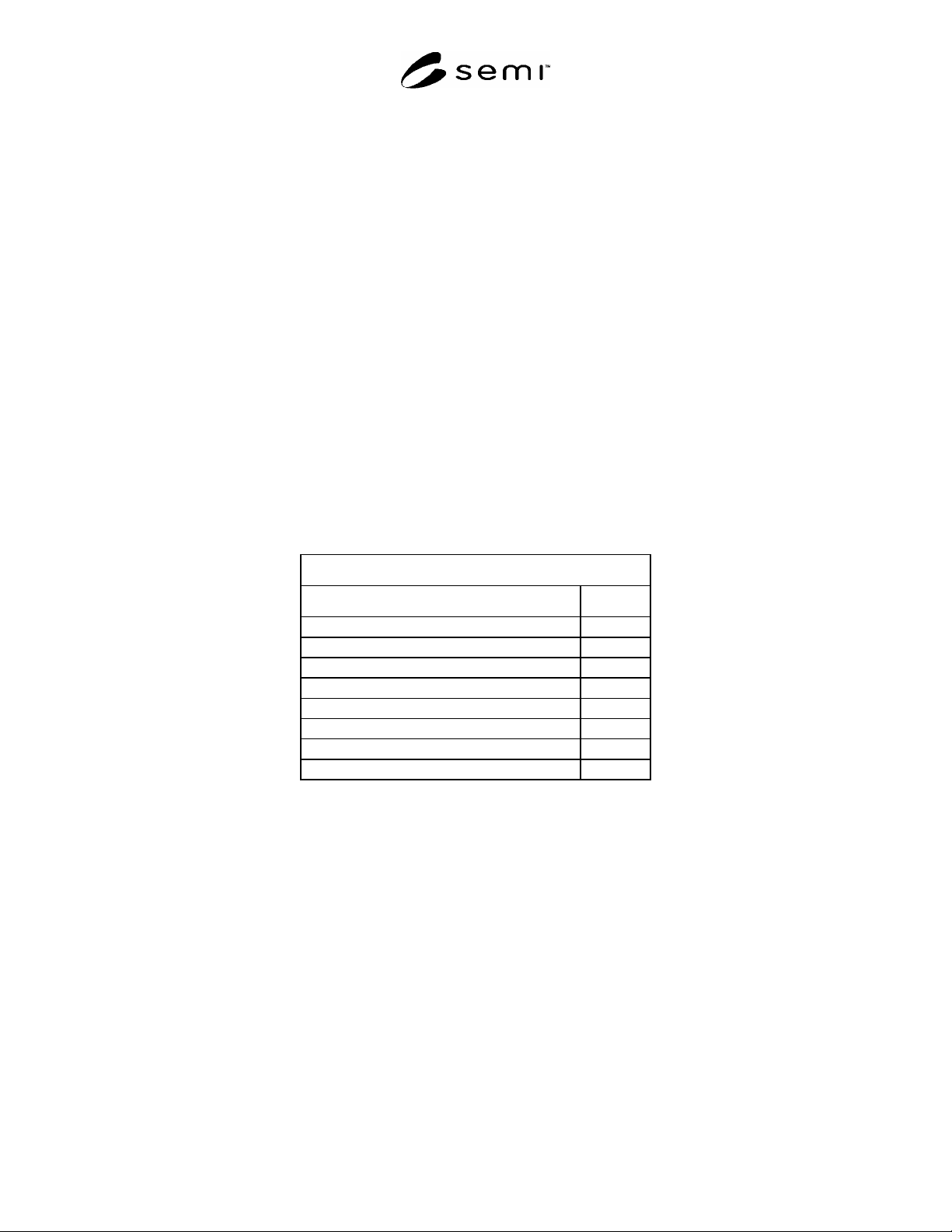
R1-1.3.1 Table R1-1 explains where to find specifications for various device operations.
Table R1-1
Operation Spec.
Power applied CDM
Enable SAC CDM
Enable DM CDM
Enable Communications NCS
Establish Communication NCS
Send Events CDM
Receive messages/answer CDM
Send messages/accept CDM
R1-1.4 Device Type — Each type of device is specified in the SDM specifications. One SDM is devoted to each
device type. An SDM is always a specialization of the CDM. The SDM provides services, behavior, and attributes
that are in addition to those specified in the CDM. For example, the SDM of a manometer might specify attributes
for current pressure and alarm bands. It might have services needed for performing calibration.
R1-1.5 Network Technology — How a network technology is used by the SAN standard is specified in an NCS.
The NCS for a technology provides a mapping of the CDM and SDM of a device type to a specific network
protocol.
R1-1.5.1 It is only necessary for a device to support an NCS and the section for its type within that NCS. The NCS
provides all that is needed to ensure that a device can communicate and interoperate across a given network
technology. The point is that from the other side of the wire, the network-independent interface is not visible. That
interface is implied by the behavior of the network interface.
R1-1.6 Network Independence — Device suppliers have the option of supplying an interface at the protocol-
independent applications layer, as indicated in Figure 1. While this requires more implementation work for the
device supplier, it speeds the integration of sensors and actuators for the OEM.