semi合集-English.pdf - 第4417页
SEMI F97-0305 © SEMI 2005 27 Subsystem/Component: Pumps Discrete Data Set Data Possible (yes/no) Tag Data Type Update Cycle Time Meaning Pump 1 (on/off) No CUB_UPW_ PUMP1_STAT US Unsigned8 5 s 0: Off 1: On Pump 2 (on/off…
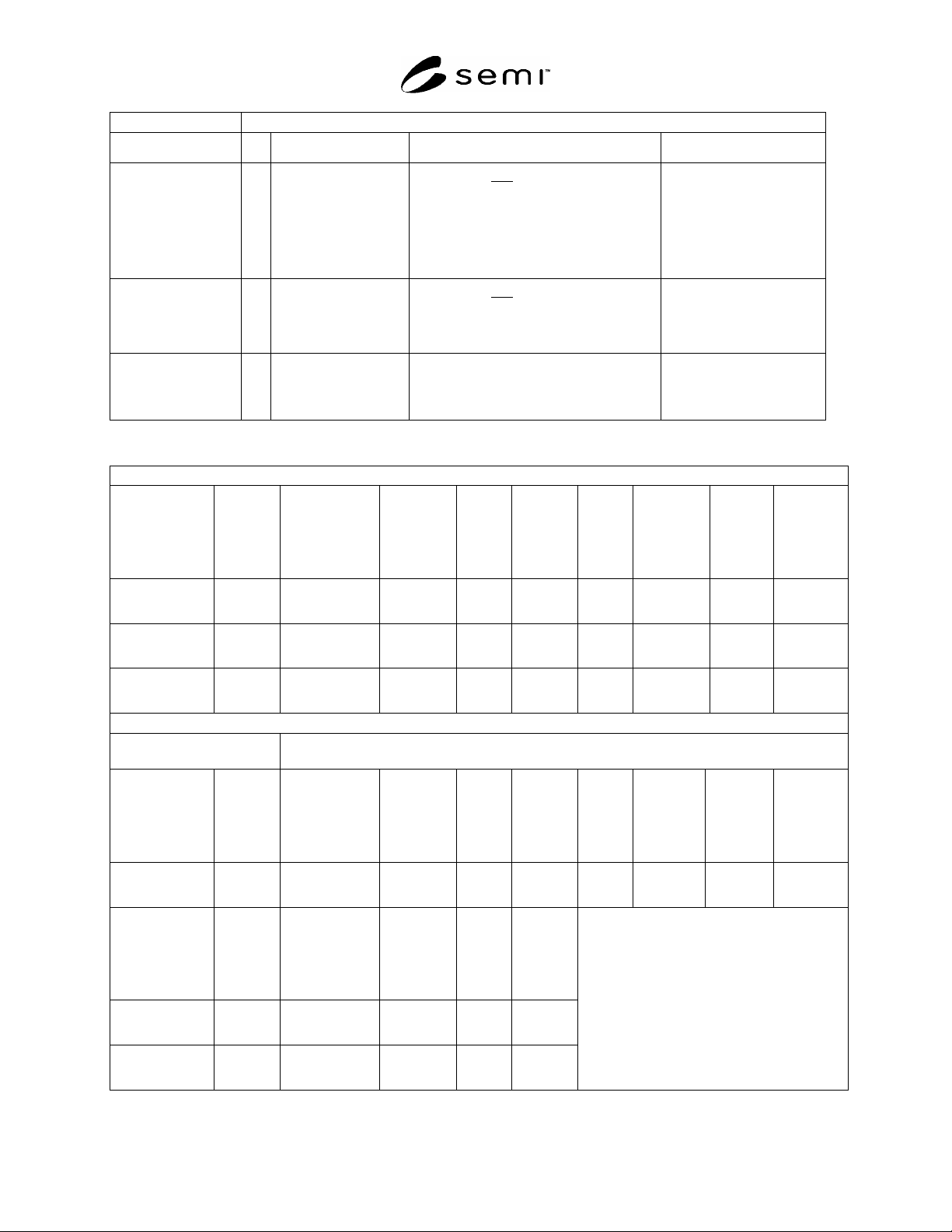
SEMI F97-0305 © SEMI 2005 26
Tag: CUB_UPW_STATUS
Field Bit Meaning Issue Comment/Value
Simulation-Mode 9 0 : No_Simulation
1 : Simulation
Supported? Yes / No
Initial state when started?
⌧No_Simulation
Simulatiom
Means to switch between states?
Manual switch at control
panel of FPU
Lock-Mode 10 0: Not_Locked
1: Locked
Supported? Yes / No
Critical failures which cause FPU to leave
locked state?
see functional design
specification xxxx
Others
(Describe)
Data Information
FPU System Output Data
Analog Data Set Data
Possible
(yes/no)
Tag Data Type Update
Cycle
Time
Value
Range
Value
Step
Polarity Alarm
Levels
Warning
Levels
Temperature
(°C)
Yes CUB_UPW_
TIC_401
Real 32 2 s 20–100 0.1 Unipolar Low: 22
High: 40
Low: 25
High: 30
Resistivity
(MegaOhm-cm)
No CUB_UPW_
RES_402
Real 32 2 s 10–100 0.1 Unipolar Low: 16 Low: 17
Operation time
(hours)
No CUB_UPW_
TIME_403
Real 32 6 min 0–100,000 0.1 Unipolar
FPU Subcontrol Level Data
Subsystem/Component: Reverse Osmosis
Analog Data Set Data
Possible
(yes/no)
Tag Data Type Update
Cycle
Time
Value
Range
Value
Step
Polarity Alarm
Levels
Warning
Levels
Capacity (%) No CUB_UPW_
ROS_CAP
Integer 16 5 s 0–100 1 Unipolar High: 95 High: 90
Discrete Data Set Data
Possible
(yes/no)
Tag Data Type Update
Cycle
Time
Meaning
Cartridge RO-1
(on/off)
No CUB_UPW_
RO1_STATUS
Unsigned8 2 s 0: Off
1: On
Cartridge RO-2
(on/off)
No CUB_UPW_
RO2_STATUS
Unsigned8 2 s 0: Off
1: On

SEMI F97-0305 © SEMI 2005 27
Subsystem/Component: Pumps
Discrete Data Set Data
Possible
(yes/no)
Tag Data Type Update
Cycle
Time
Meaning
Pump 1
(on/off)
No CUB_UPW_
PUMP1_STAT
US
Unsigned8 5 s 0: Off
1: On
Pump 2
(on/off)
No CUB_UPW_
PUMP2_STAT
US
Unsigned8 5 s 0: Off
1: On
NOTICE: SEMI makes no warranties or representations as to the suitability of the standards set forth herein for any
particular application. The determination of the suitability of the standard is solely the responsibility of the user.
Users are cautioned to refer to manufacturer's instructions, product labels, product data sheets, and other relevant
literature, respecting any materials or equipment mentioned herein. These standards are subject to change without
notice.
By publication of this standard, Semiconductor Equipment and Materials International (SEMI) takes no position
respecting the validity of any patent rights or copyrights asserted in connection with any items mentioned in this
standard. Users of this standard are expressly advised that determination of any such patent rights or copyrights, and
the risk of infringement of such rights are entirely their own responsibility.
Copyright by SEMI® (Semiconductor Equipment and Materials
International), 3081 Zanker Road, San Jose, CA 95134. Reproduction
of the contents in whole or in part is forbidden without express written
consent of SEMI.

SEMI F98-0305 © SEMI 2005 1
SEMI F98-0305
GUIDE FOR TREATMENT OF REUSE WATER IN SEMICONDUCTOR
PROCESSING
This guide was technically approved by the Global Facilities Committee and is the direct responsibility of the
North American Facilities Committee. Current edition approved by the North American Regional Standards
Committee on December 10, 2004. Initially available at www.semi.org February 2005; to be published
March 2005.
1 Purpose
1.1 This guide establishes definitional requirements for industrial water systems that reuse water in a semiconductor
manufacturing facility. It is intended to establish a common basis for developing detailed specifications in
subsequent documents concerning design, performance, optimization, and monitoring of such systems.
1.2 This document may be used by users and suppliers as a basis for developing site-specific specifications and
performance criteria.
2 Scope
2.1 This guide applies to water systems designed for reuse of water including reclaim and recycle, used in
semiconductor manufacturing facilities, supplying water to a variety of uses. Such uses include directing waters to
the front end of a UPW system, to cooling systems, scrubbers, thermal processes, and to irrigation systems,
depending on the quality of the water.
2.2 This guide can be used to understand the design elements and functionality of water systems that support reuse
of water. Although such systems can be retrofitted into existing manufacturing factories, there is a broader range of
opportunities available in new facilities that can be designed with water saving applications in mind.
NOTICE: This standard does not purport to address safety issues, if any, associated with its use. It is the
responsibility of the users of this standard to establish appropriate safety and health practices and determine the
applicability of regulatory or other limitations prior to use.
3 Limitations
3.1 This guide does not define the actual specifications generally negotiated between the user and the manufacturer
of the reclaim or recycle system.
3.2 This guide does not address the methodology for optimizing the reuse of spent rinse waters.
3.3 This guide does not address the frequency or scope of ongoing maintenance for reuse water systems including
change-out of resin beds and replacement of filters.
3.4 This guide does not describe the broad range of possible reuse opportunities and the associated water quality
required for each.
3.5 This guide does not intend to cover any of the important safety considerations that relate to the proper
installation, operation, or maintenance of a reuse water system.
4 Referenced Standards
4.1 SEMI Standards
SEMI E49 — Guide for High Purity and Ultrahigh Purity Piping Performance, Subassemblies, and Final Assemblies
SEMI F63 — Guide for Ultrapure Water System Used in Semiconductor Processing
SEMI S2 — Environmental, Health, and Safety Guideline for Semiconductor Manufacturing Equipment